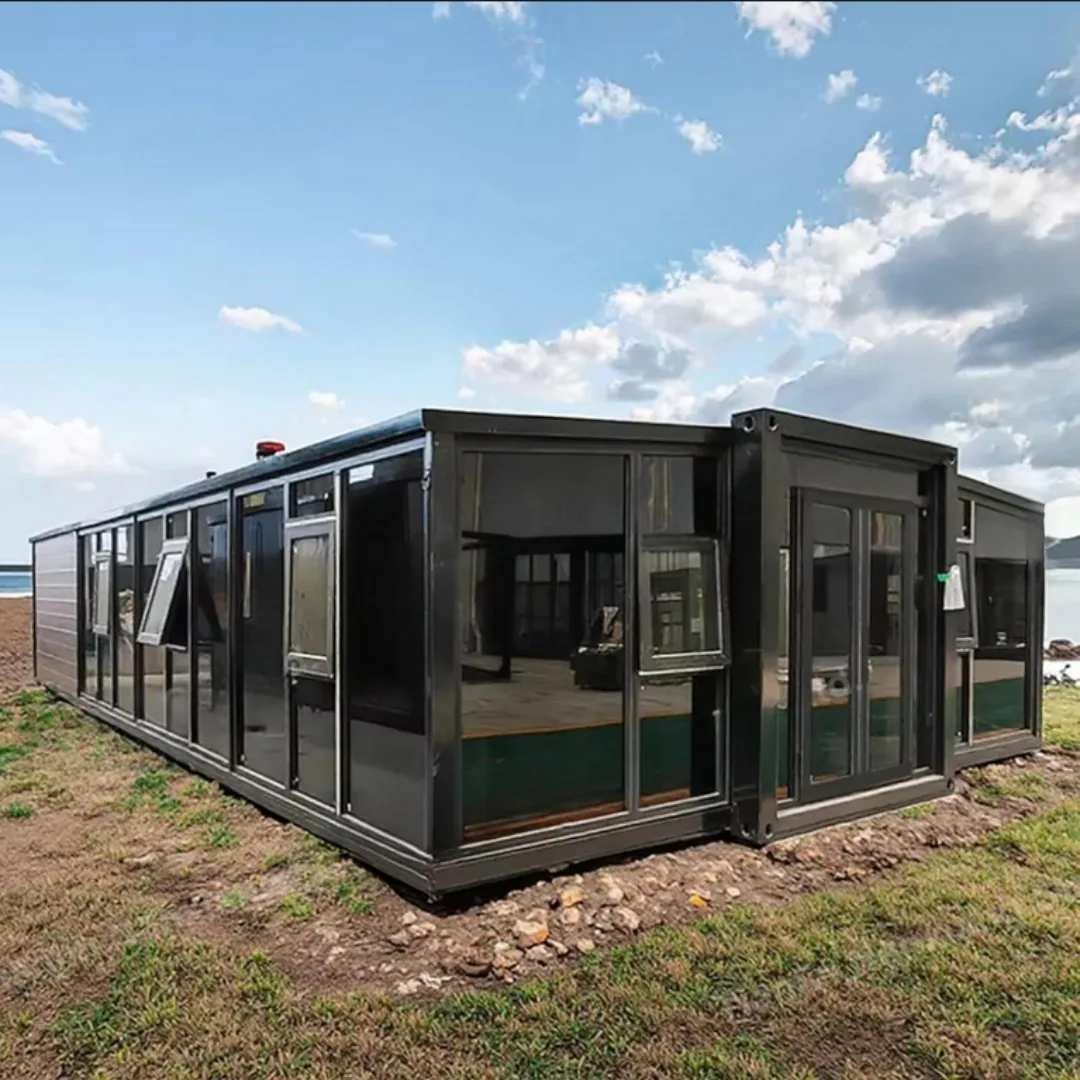
HG Prefab foldable expandable container homes — built to last, delivered worldwide.
A car detailing studio is one of the few businesses where a folding container house is not a compromise but an advantage. The work is weather-dependent, the customers come to you, the site is often rented, and the whole operation has to be movable if the lease ends. A conventional building answers none of those problems well: it takes months to build, it cannot be moved, and it ties up capital in a structure you may have to walk away from. A folding unit arrives as a finished, insulated, wired steel envelope that is weathertight the day it lands, and it can be closed, trucked and reopened on the next site. What it does need is a fit-out thought through properly, because detailing is unusually demanding on four things at once: water on the floor, water out of the floor, light without shadow, and enough power to run it all. This guide walks through each one in the order you will need to decide it.
Why a Container Suits Detailing Better Than Most Trades
Mobile versus fixed: the decision that sets everything else
Decide this first, because it changes your specification. A fixed studio sits on a prepared base, connects to mains water and three-phase power, and drains to a legal discharge point. It is cheaper to run and easier to permit. A mobile studio carries its own water and power: a buffer tank and pressure pump, a generator or a battery and inverter set, and a waste tank you empty at an authorised facility instead of a drain you are licensed to use. Mobile units win where you are serving office parks, apartment blocks or event sites and where the local authority will not let you discharge at all. Fixed units win where you have a long lease and a drain you can legally use. Most operators we supply work to a hybrid specification: the water recovery and power circuits are built for fixed connection, but the tank and generator connections are pre-plumbed so the unit can be made mobile later without cutting the floor.
The envelope you are fitting out
A folding container house arrives with a galvanised steel frame, insulated sandwich wall and roof panels, a floor deck, doors, windows, internal linings and pre-installed electrical wiring. For a detailing studio that means the expensive and slow parts of the fit-out are already done: the building is warm, lit, wired and sealed before your first customer arrives. Your fit-out is then the wet and electrical package specific to detailing: floor finish and falls, drainage and interception, hot water, pressure washing, task lighting, extraction, and the ceramic coating room. None of those need the structure modified, which is what keeps the conversion fast and reversible. Because the unit is engineered as a single box designed to be craned and shipped, the floor will take point loads from vehicle jacks and lift arms far better than a domestic slab of the same thickness, provided you spread them as you would on any floor.
The table below sets out the realistic layout options by unit size, with the kind of work each one supports. Read it as a business decision rather than a floor plan: the number of bays determines your daily throughput, and throughput determines whether the unit pays for itself in one season or three.
Detailing Studio Layout Options by Unit Size
| Layout option | Best unit size | Bays and capacity | What it is suited to | Watch-outs |
|---|---|---|---|---|
| Single car bay, solo operator | 20FT folding unit, opens to about 3.6 m usable width | 1 vehicle at a time; 2–4 cars per day | Mobile valeting, solo detailing, maintenance washes, interior work on cars | Full-size pickups and vans will not fit with the doors open; no separate coating room |
| Single bay with a ceramic coating room | 30FT folding unit | 1 vehicle in the bay plus 1 curing in the coating room | Serious single-operator studios selling coatings and paint correction | Fit the partition and the door before the floor finish goes down |
| Twin wash bays | 40FT folding unit | 2 vehicles simultaneously; 6–8 cars per day with two staff | Employing a second detailer, fleet contracts, high-throughput sites | Needs a bigger power supply and duplicated hose points and drains |
| Bay plus coating room plus waiting area | 40FT folding unit | 1 in the bay, 1 curing, plus a small customer reception | Retail-facing studios where customers wait, and upselling in person | Reception must be sealed from the wet bay or it will smell of chemicals |
| Bay with wash and inspection zones | 30FT or 40FT folding unit | 1 vehicle, with a separate dry zone for inspection and correction | Paint correction specialists and high-end detailing | Cross-lighting and ambient lighting must be on separate circuits |
| Mobile self-contained unit | 20FT folding unit with tanks | 1 vehicle at a time at changing sites | Office parks, apartment blocks, events, sites with no drain available | Water and waste weight changes transport planning; empty waste at authorised facilities |
| Pickup and van bay | 30FT or 40FT folding unit, high-cube if available | 1 large vehicle at a time | Markets dominated by pickups, vans and light commercial fleets | Confirm internal clear height before ordering if you need a lift or gantry |
| Wash bay plus separate dry valeting bay | 40FT folding unit | 1 wet, 1 dry, continuous throughput | Volume operations separating exterior wash from interior valeting | Two drain runs and two lighting zones; keep the humidity out of the dry bay |
Bay Sizing: How Much Room a Car Actually Needs
The working envelope around a vehicle
Detailers routinely underestimate this, and the mistake is expensive because it cannot be fixed later. A car is not a rectangle you park; it is a rectangle you walk around, with doors open, a pressure washer lance in your hands and a drying towel in the other. Work from the vehicle outwards, not from the container inwards. A mid-size saloon is roughly 4.7 m long and 1.85 m wide, and with both doors fully open its working width is close to 3.6 m. An SUV or pickup adds width and height; a full-size pickup with mirrors is around 2.1 m wide and opens to about 4.1 m. Then add your own working clearance: 0.7 to 0.9 m each side is the minimum at which a person can wash, rinse and dry without constantly stepping around the vehicle, and 1.0 m is comfortable. That puts a single usable bay at about 3.6 m wide by 6.5 m long for cars and 4.2 m by 7.0 m for pickups and large SUVs. Height matters too: 2.4 m clear is adequate for cars, but if you are detailing vans, or fitting a scissor lift or a gantry, you need 3.0 m or more and you should confirm it before ordering.
What each unit size gives you
A 20FT folding unit opens to a single bay and is the natural starting point for a solo operator or a mobile valeting business: one vehicle at a time, wash, decontaminate, polish and interior, with the coating work done in the same bay on a quiet day. A 30FT unit will take a single generous bay with a separate ceramic coating room at the end, which is the configuration most serious single-operator studios should aim for, because it lets you take in a second car while the first is curing. A 40FT unit supports two working bays, or one bay plus a coating room plus a customer waiting area, and is the right choice if you intend to employ a second detailer. If your market is pickups and vans, buy the larger unit and run one bay rather than the smaller one and turn work away; the cost difference is far smaller than the revenue difference.
Floor Drainage, Falls and Oil Interceptors
Build the fall into the floor, not the finish
Water management is the whole game. If water pools, you get slip risk, water tracking into the customer area, humidity that fights your coating work, and eventually a damp problem in the floor build-up. The fix is a designed fall. Specify a 1 to 2 percent slope towards a collection point, which for a 6.5 m bay means 65 to 130 mm of drop across the width or length. Falls steeper than 2 percent are uncomfortable to stand on for eight hours and make vehicle jacking awkward, so 1.5 percent is a good target. Collect into a linear trench drain or channel drain running across the bay threshold and the wash line rather than a single point gully in the middle: a channel catches water along its whole length, is easier to keep clear of grit, and lets you position the bay wherever you like. Use a grate rated for vehicle traffic, in stainless or galvanised steel, and make it removable with a lifting key so it can be cleaned properly rather than poked at.
Oil interception: what you are required to do
Wash water from vehicles carries oil, fuel residues, brake dust, surfactants and road film. In most jurisdictions you may not discharge that to a storm drain or to ground under any circumstances, and in many you may not discharge it to the sanitary sewer without treatment and a trade effluent consent that names your flow and your contaminants. The standard answer is a two-stage treatment train: a silt or grit trap that captures the heavy solids, then a Class I oil separator, sometimes called an oil-water separator or oil interceptor, sized to your flow rate, and often a coalescing stage. The separator needs emptying on a schedule by a licensed waste carrier, which is a real operating cost, and it needs a high-level alarm or at minimum a dip check, because a separator that has filled with oil stops working and quietly becomes a pollution incident. If you are working at a site with no drain at all, use a closed-loop system: collect to a holding tank, empty at an authorised facility, and keep the waste transfer notes. Many operators also fit a recycling skid so that rinse water is filtered and reused, which cuts both water cost and tank emptying.
- Fall of 1–2% towards the collection point; 1.5% is the practical target for both drainage and comfort.
- Linear trench or channel drain with a removable, vehicle-rated grate, plus a sediment basket you can lift out and empty.
- Grit trap first, then an oil separator sized to your peak flow, not your average flow.
- Either a trade effluent consent for sanitary discharge, or a holding tank and an authorised waste carrier — never a discharge to a storm drain or to ground.
- Slippery-wet rated flooring: a chemical-resistant epoxy or polyurethane screed rated for wet slip resistance, coved up the walls at the perimeter so water cannot reach the floor build-up.
- Hot and cold hose points on both sides of the bay, so you are never dragging a pressurised hose across a wet floor behind a customer's car.
Lighting: Colour Accuracy and No Shadow
CRI and lux: the two numbers that decide the result
Detailing is a visual inspection task, and lighting is the tool that makes it possible. Two numbers matter, and most cheap LED panels fail on the first. Colour rendering index, or CRI, describes how faithfully a light source reveals colour compared with a reference source; at CRI 80, which is common in industrial lighting, a red car is a muddy brown and swirl marks hide in plain sight. Specify CRI 95 or above for the working area, and R9 above 80 if the manufacturer publishes it, because R9 describes deep red rendering and is the first thing to collapse on a poor LED. The second number is illuminance in lux. For general bay lighting, 500 to 800 lux at working height is a reasonable target; for paint correction and coating application, 1,000 to 1,500 lux over the panel you are working on, which usually means supplementary lighting rather than raising the whole bay to that level. Colour temperature matters for the finish you produce: 5,000 to 6,500 K daylight is the detailing standard, so a car that looks perfect under your lights still looks perfect in sunlight. Mixing colour temperatures in one bay is the most common lighting mistake, and it will make your correction work inconsistent.
Placing the light so it does not lie to you
A single row of downlights directly overhead is the worst possible arrangement, because it puts the strongest shadow directly under the vehicle and on the vertical panels you are inspecting. Shadow free does not mean brighter; it means light arriving from several directions so that defects reveal themselves. Three elements do the work. Ambient light from high-output LED panels or linear fixtures at 5,000 to 6,500 K, mounted along the length of the bay rather than over its centreline, gives even general illumination. Cross-lighting from wall-mounted, tilted fixtures at 1.2 to 1.6 m height rakes across the panels and is what shows holograms and buffer trails. Handheld or rail-mounted inspection lamps at CRI 95 or above let you examine a single panel closely before you commit to correcting it. In a folding container house you also have a genuine advantage: the internal liner is light-coloured and the ceiling is low enough that a modest number of fixtures gives you a high, even illuminance, bouncing light off the ceiling and walls instead of losing it.
- CRI 95+ at 5,000–6,500 K for every fixture in the working area, with R9 above 80 where it is published.
- 500–800 lux ambient at working height, rising to 1,000–1,500 lux over the panel being corrected.
- Fixtures mounted along the bay length, not over the centreline, plus wall-mounted cross-lighting at 1.2–1.6 m for raking inspection.
- Wet-rated, impact-resistant fittings with an appropriate ingress protection rating for a permanently wet environment.
- A separate switchable circuit for inspection lighting, so you are not paying for full output during a simple wash.
Water Heating, Pressure Washers and Supply
Hot water: where detailing separates from car washing
Hot water is not a luxury in detailing, it is a process input. Warm water and steam lift traffic film and road grime at lower chemical concentration, which means less product, less residue and less risk to trim. It is also what makes interior work possible in winter, and what makes engine bays and wheel arches clean without scrubbing. A continuous-flow gas or electric water heater sized to your washer flow is the usual answer: for a single bay, a unit delivering 12 to 18 litres per minute at a 40 to 60 °C rise covers washing and pre-wash; if you want steam, add a dedicated steam generator rather than pushing the heater to its limit. Temperature regulation matters as much as capacity, because water above about 60 °C at the nozzle can damage trim, soften some protective films and is a scald risk to the operator. Specify a thermostatic mixing valve so the delivered temperature is controlled independently of the heater setting, and lag all hot pipework so you are not waiting for hot water at 8am.
Pressure washers and the mopping-up details
For detailing, the useful specification is not maximum pressure but pressure and flow together. A machine delivering around 110 to 140 bar at 10 to 15 litres per minute is right for safe washing and snow-foam application; above that you risk stripping wax, lifting trim and forcing water past seals. Fit a foam lance, a variable nozzle and a hose reel, and plumb a filtered rinse line for the final rinse if you are offering a spotless dry finish. Behind the washer sits the unglamorous equipment that keeps the studio usable: a compressor with a regulated line for drying and interior blowing out, a wet and dry vacuum with a proper extraction hose, an air blower or drying fan, and hose reels on both sides of the bay. Most importantly, separate the electrical zones: in a wet area, use equipment with an appropriate ingress rating, weatherproof sockets at a safe height, residual current protection on every circuit and a clearly accessible isolator at the entrance.
Power Load, Circuits and Backup
Adding up what you actually draw
Power is where detailing studios most often run out of capacity, because the loads are intermittent but coincide. A pressure washer with a 2.5 to 3 kW motor, a compressor at 2 to 3 kW, a hot water heater or steam generator at 6 to 12 kW, drying fans and a wet vacuum, plus lighting and a small office load. Add them and a single bay is comfortably in the 12 to 18 kW range when everything is running, which on a 230 V supply at 40 A is beyond what a domestic-style connection will give you. Two things follow. First, size the incoming supply properly: if you have three-phase available, take it and distribute your large loads across the phases; if you have single phase, arrange the control panel so the washer and the heater are interlocked or at least sequenced, and consider storing heat in a buffered hot water cylinder charged before the working day. Second, separate your circuits by function so a tripped breaker does not black out the whole bay with a wet car inside: lighting, sockets, water heating, extraction and the coating room each on their own protected way.
- Dedicated circuits for lighting, general sockets, water heating, extraction and the coating room, each separately protected.
- Residual current protection on every wet-area circuit, plus a clearly marked main isolator at the entrance.
- Three-phase supply where available, with the large loads balanced across phases; otherwise sequence or interlock the washer and heater.
- Generator or battery-inverter backup for mobile operation, sized to the simultaneous load rather than the nameplate total.
- Supply sized for growth: if a second bay or a lift is a realistic next step, put the cable and the spare ways in now, when the walls are easy to open.
Ventilation for Chemicals and Fumes
Why a sealed studio is a health problem
A folding container house is well sealed, which is excellent for heat retention and terrible for air quality if you are spraying chemicals inside it. Detailing products carry volatile organic compounds from solvents, degreasers and ceramic coating carriers, and the exposure is occupational rather than occasional: you are in that air for eight hours a day. Provide mechanical extraction sized to the volume of the unit, with the intake low and the extract high on the opposite side so the air sweeps across the working area rather than short-circuiting between two nearby grilles. Aim for the air change rate your local workplace exposure rules require, and where there is any doubt fit more capacity with a speed controller so you can turn it down when you are only washing. Add local extraction at the coating bench and at any parts-washing or solvent work, because capturing a vapour at the point it is released is many times more effective than diluting it in the whole space. Where you use an air-fed or filtered respirator for coating, that is a personal control and does not replace ventilation — you need both. Keep the safety data sheets for every product on site, and store flammable liquids in a proper cabinet, not under the bench.
The Ceramic Coating Room
If you are selling ceramic coatings, the coating room is what makes them saleable rather than a gamble. A coating cures by reaction with moisture in the air, and it cures badly in a wet, dusty, cold, badly lit environment: you get high spots, hazing and a comeback that costs you a full re-correction. So the coating room is a separate, sealed space with its own four controls. Temperature held between roughly 18 and 25 °C, which the insulated sandwich panels give you easily with a small heater. Humidity controlled to the range your coating manufacturer specifies, normally 40 to 60 percent, with a dehumidifier in humid climates and monitoring when the wash bay next door is running. Air cleanliness, which means no cross-draught from the wet bay, filtered intake air and a floor you keep dry. Lighting that matches the rest of the studio at CRI 95, with good raking light so high spots are visible while the coating is still workable. A single car capacity of about 5.5 by 3.5 m is enough, which is exactly the space a 30FT unit gives you after the wash bay, and it is the strongest reason to choose 30FT over 20FT.
Detailing Through Winter
Winter is where a folding container studio earns its keep, because a brick-built wash bay of the same cost is usually unheated and miserable. Four items make winter operation possible. The insulated sandwich panels with thermal break detailing keep the heat in and, just as importantly, keep the internal surfaces warm enough that condensation does not form on the steel frame and drip onto a car you have just dried. Heating sized to the volume and the door-opening losses, with warm air curtains or strip curtains at the door if you are in a cold climate. Hot water is essential, so size the heater for the winter inlet temperature, not the summer one, and lag every pipe that is exposed to freezing air. And drainage freeze protection: trench drains and traps outside the heated envelope need trace heating or antifreeze-compatible design, and any external pipe run needs lagging and a fall so it drains. It also helps to plan the cycle: wash and dry in the bay, then move the car into the coating room to warm through and finish, so the wet work and the dry work never share the same air.
Permits, Zoning and Compliance
Detailing sits awkwardly in planning systems because it is part light industrial, part vehicle maintenance and part retail, and you should find out which one your authority thinks it is before you sign a lease. Work through four questions in writing. First, use class: is a vehicle cleaning and valeting operation permitted on this site at all, and does it need a change of use. Second, trade effluent: will the water authority grant a consent to discharge to the sewer, and on what limits, or will you be required to tank and remove. Third, building approval: a folding container house may be treated as a building, as a temporary structure, or as movable equipment depending on the locality, and each classification has a different paperwork path; see container home permits for the general pattern. Fourth, business registration, signage permission and insurance, including cover for customers' vehicles in your care, which most general policies exclude. Where you are operating at a customer's home or workplace, check separately whether commercial vehicle cleaning is allowed there at all.
Costs, Throughput and Payback
What the studio costs and what it earns
The honest way to judge this investment is to price the whole studio and divide it by the number of cars you can put through it. The building is the predictable part. An HG Prefab folding container house costs 20FT $7,200–$9,800, 30FT $10,500–$14,500 and 40FT $12,500–$16,500 ex-works, and that price includes the folding galvanised steel frame, insulated sandwich wall and roof panels, the floor, doors, windows, internal linings and pre-installed electrical wiring. To that you add four local line items: freight and import clearance, the prepared base, the crane or forklift, and the final water and power connections. The fit-out is then yours to scope: drainage and the oil separator, flooring, lighting, hot water and pressure washing, extraction and the coating room. Do the arithmetic with your own prices, because they vary enormously by market, but the shape of the answer is stable. A single-operator studio handling two to three cars a day at a realistic net margin per car recovers the building cost far faster than a conventional unit of equivalent quality, chiefly because you are trading for six months before the first car arrives.
| Unit size | Factory price (ex-works) | Included in the factory price | Budgeted locally |
|---|---|---|---|
| 20FT | $7,200–$9,800 | Folding galvanised steel frame, insulated sandwich wall and roof panels, floor, doors, windows, internal linings, pre-installed electrical wiring | Freight and clearance, level base, crane or forklift, service connections, permits, detailing fit-out |
| 30FT | $10,500–$14,500 | As above, on the larger 30FT platform | As above |
| 40FT | $12,500–$16,500 | As above, largest single-unit footprint | As above |
Compare the 20FT, 30FT and 40FT folding models against a conventional build on total cost to first paying customer, not on materials. And if your second use case is a workshop or a garage, our container workshop and garage guide covers the same ground from the mechanical side.
Delivery, Placement and Assembly
Placement is a plant operation and should be planned as one, not treated as a delivery detail. Yes — a crane or forklift is required to offload the folded unit from the truck. Once it is set in position, four workers can unfold and assemble the main structure in about 2 hours. For a detailing studio there is one extra instruction worth giving the crew: set the unit with the fall in mind. The base must be level and load-bearing, but the floor build-up that creates your drain falls has to be designed around the finished position, so confirm the drain outlet point and the direction of slope before the base is poured, and keep the outlet clear of the anchor points and the hinge line. Book the crane and the crew before the truck is dispatched, confirm the machine has the reach for the lift radius and that the ground will carry the outriggers, and you will be weathertight and fitting out the same day it arrives.
Planning a container car detailing studio?
HG Prefab, manufactured by Henan Huangang Machinery Equipment Co., Ltd., builds 20FT, 30FT and 40FT folding expandable container houses with galvanised steel frames, insulated sandwich panels, thermal break detailing and factory-fitted electrical wiring — the right starting point for a wash bay, a ceramic coating room and a reception in one delivered unit. Factory prices are 20FT $7,200–$9,800, 30FT $10,500–$14,500 and 40FT $12,500–$16,500 ex-works. Tell us your bay layout, your water and power availability and your discharge situation, and we will size the unit and the fit-out with you. Email hgmechequip@gmail.com or WhatsApp +86 191 0388 7380. Full model range on the products page.
Get a Quote Browse modelsDo I need a crane or forklift to unload a container detailing studio?
Yes — a crane or forklift is required to offload the folded unit from the truck. Once it is set in position, four workers can unfold and assemble the main structure in about 2 hours. Budget the machine as its own line item, confirm the lift radius and that the ground will carry the outriggers, and have the base finished and certified level before the truck is dispatched. For a detailing studio, confirm the drain outlet position and the direction of the floor falls before the base is poured, so the drainage is designed around the finished position rather than retrofitted.
Which size should I buy, and what does it cost?
It follows the work you intend to take. A 20FT folding unit gives one car bay and suits a solo mobile operator. A 30FT gives one generous bay plus a separate ceramic coating room, and is the best choice for a single-operator studio selling coatings. A 40FT gives two working bays, or one bay plus a coating room plus reception, and suits anyone employing a second detailer. If your market is pickups and vans, buy the larger unit and run one bay rather than the smaller one and turn work away. Prices are 20FT $7,200–$9,800, 30FT $10,500–$14,500 and 40FT $12,500–$16,500 ex-works, including the folding galvanised steel frame, insulated sandwich wall and roof panels, floor, doors, windows, internal linings and pre-installed electrical wiring. Freight and clearance, the level base, the crane or forklift, service connections, permits and the detailing fit-out are budgeted locally.
Can I discharge the wash water to the sewer, or do I need an oil interceptor?
You need treatment either way, and in most places you need permission as well. Vehicle wash water carries oil, fuel residue, brake dust and surfactants, and discharging it to a storm drain or to ground is prohibited virtually everywhere. Discharging to the sanitary sewer normally requires a trade effluent consent that limits your flow and your contaminants, and the consent will usually be conditional on treatment: a grit trap to capture solids followed by a correctly sized oil separator, with a scheduled emptying by a licensed waste carrier. If you have no drain, or no consent, use a closed-loop system with a holding tank and remove the waste to an authorised facility, keeping the transfer notes. Sizing the separator to your peak flow, not your average, is the most common specification error.
How much lighting and power does a detailing bay actually need?
For lighting, specify CRI 95 or above at 5,000–6,500 K, with 500–800 lux ambient at working height and 1,000–1,500 lux over the panel being corrected. Mount fixtures along the length of the bay rather than over its centreline, and add wall-mounted cross-lighting at 1.2–1.6 m for raking inspection, because a single overhead row puts the deepest shadow exactly where you are working. For power, a single bay can draw 12–18 kW when the washer, compressor, hot water heater or steam generator, drying fans and extraction are all running, which is more than a domestic-style supply will give. Take a three-phase supply where it is available and balance the large loads across phases; otherwise sequence or interlock the washer and the heater. Put lighting, sockets, water heating, extraction and the coating room on separate protected circuits with residual current protection in all wet areas.
Can I operate a container detailing studio through winter?
Yes, and it is one of the strongest arguments for a folding unit, because the insulated sandwich panels and thermal break detailing keep the building warm and keep internal surfaces warm enough that condensation does not drip onto a car you have just dried. Four things make winter work: heating sized to the volume and to door-opening losses, with warm air or strip curtains at the door in cold climates; a hot water system sized for the winter inlet temperature rather than the summer one, with all exposed pipework lagged; freeze protection on external drains, traps and pipe runs, with a fall so they drain down; and a working cycle that moves the car from the wet bay into the coating room to warm through and finish. If you are frost-splitting and using a dehumidifier in the coating room, check that its condensate drain is protected too.