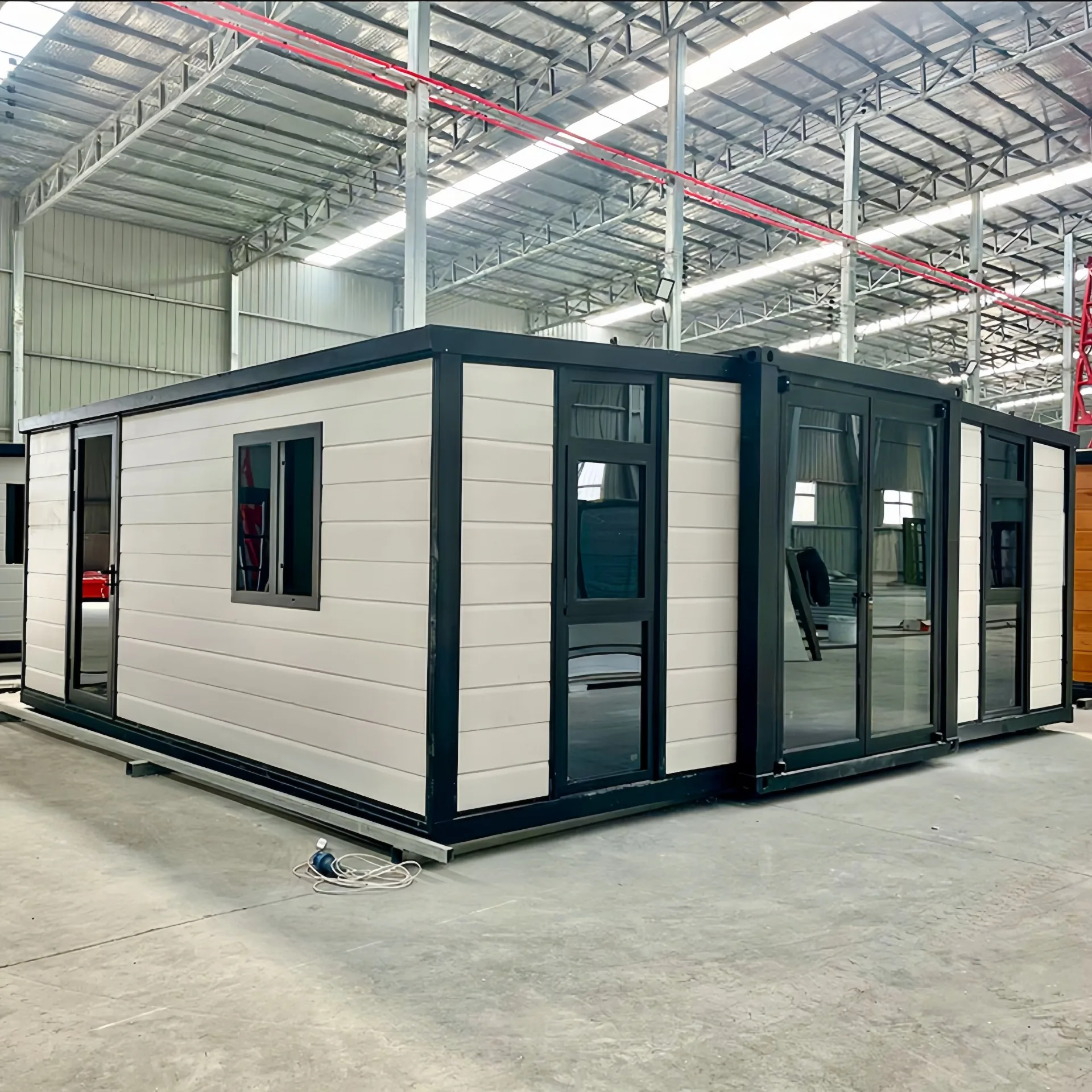
HG Prefab foldable expandable container homes — built to last, delivered worldwide.
India is one of the most rewarding and most paperwork-heavy markets you can import a building into. The demand side is strong and obvious: infrastructure and highway projects that need site offices within weeks, manufacturing clusters that need worker housing near the gate, and resort operators who want rooms that can be placed without a two-year construction programme. The supply side is where projects slip. A folding container house is classified as a building rather than a machine, it attracts a customs duty plus IGST structure that many first-time importers read wrongly, and it lands in a country whose ports, road network and weather each add their own schedule risk. This guide is written for the buyer who has a site and a budget and needs to know what happens between the factory gate and the day the unit opens on its plinth.
Henan Huangang Machinery Equipment Co., Ltd. ships folding expandable container houses to India as standard containerised cargo. What follows is the full sequence — classification, standards, duty, port selection, the road leg, monsoon timing, use cases and site placement — with the numbers that decide whether your project lands on schedule.
What You Are Actually Importing
Classification: a building, not a piece of machinery
The first decision in any Indian import is the tariff line, because the HS code determines the duty rate, the applicable IGST rate and the list of documents the assessing officer will ask for. A completed, habitable prefabricated unit is normally presented under the prefabricated building heading, the family that covers structures assembled from panels and modules, with sub-lines distinguishing wood-frame from other materials. A folding galvanised steel unit with insulated sandwich panels, floor, doors, windows and pre-installed wiring belongs on the steel-and-other-materials side of that heading, not on the timber side, and not under a machinery or parts heading.
This distinction matters more than it sounds. If the consignment is presented as components, the assessing officer may treat it as a collection of separately rated goods — steel articles, panels, doors, cable — each with its own rate and its own standard obligations. That is usually worse for the importer. The correct approach is to present the built unit as a single finished structure, supported by a specification sheet, a packing list that describes the contents as belonging to that structure, and photographs of the unit folded for transport. Have your Customs House Agent confirm the classification in writing before the vessel sails, not after the bill of entry is filed.
Why the folding design changes the freight economics
The folding format exists to solve a freight problem. A rigid volumetric module occupies the same shipping volume whether it is empty or full, so on a long voyage you pay to move air. A folding unit collapses to a compact transport envelope, which means it travels as standard containerised freight at standard rates rather than as out-of-gauge breakbulk or flat-rack cargo. For an Indian importer that difference compounds: fewer special-equipment surcharges, fewer ports that can handle it, less chance of a roll-over when the vessel is tight on space, and a much simpler road leg, because the folded unit is far more likely to fit within standard motor vehicle dimension rules on the final haul to site.
The practical consequence is that you can buy Indian delivery the way you would buy any other import: a freight quotation, a transit time, a port, and a truck. That is the whole point of the product. The table below summarises how the main import variables stack up.
Folding Container Home Import to India: Main Variables at a Glance
| Import variable | What applies in India | What it means for your project |
|---|---|---|
| Classification | Presented as a finished prefabricated structure under the HS 9406 heading, on the non-timber side | Determines the duty rate and the IGST band; confirm with your CHA before the vessel sails |
| Standards | BIS Quality Control Orders and CRS registration reach many steel and electrical products; scope for a finished unit must be confirmed | Clarify in writing before production, or you risk a clearance hold charged by the day |
| Duty stack | Basic Customs Duty, then Social Welfare Surcharge, then IGST on the cumulative value | IGST multiplies the whole stack, so budget the landed cost per unit, not a single rate |
| GST treatment | IGST at import; input tax credit generally available to a GST-registered importing business | Import in the name of a registered entity and keep the bill of entry to support the claim |
| Port choice | Nhava Sheva for the west and north, Chennai for the south, Mundra for Gujarat and Rajasthan | Choose by total landcost to site, including inland haulage, not by the ocean freight rate |
| Dwell time | Short container free time; demurrage at the terminal and detention by the line | File the bill of entry early, have the truck arranged before clearance, and negotiate free time in the contract |
| Monsoon window | June to September: reduced port productivity, flooding and landslip closures on inland corridors | Aim to clear before June, or add a transit buffer and a covered storage or offload point |
| Road leg | Folded envelope travels as standard containerised freight; state over-dimensional rules still need checking | Survey the route and the last fifty metres, and prepare the site track before dispatch |
| Placement | Crane or forklift required to offload; four workers unfold the structure in about 2 hours | Book the machine and the crew with the truck, on a base that is level and cured |
| Factory prices | 20FT $7,200–$9,800; 30FT $10,500–$14,500; 40FT $12,500–$16,500 ex-works | Add freight, duty, IGST, inland haulage, the base and the crane to reach your landed figure |
BIS Standards and the Paper Trail
BIS quality control orders and the CRS registration question
The Bureau of Indian Standards administers a compulsory registration and certification system that reaches a long and frequently updated list of products through Quality Control Orders issued under the BIS Act. The list includes many steel products and a wide range of electrical and electronic goods. Whether a specific obligation bites on your consignment depends on two things: whether the goods fall under an active Quality Control Order, and whether a finished imported structure is inside or outside the scope of that order.
Be precise about this, because it is where importers lose weeks. Structural steel used in construction is covered by standards for general purpose structural steel, and electrical accessories and cables sold in India are commonly subject to separate registration or licence requirements. But a complete imported building is not automatically the same thing as the separate products it was made from, and scope is determined by the wording of the order and by how the consignment is presented. The responsible sequence is: send your CHA the exact specification, the HS line and the country of origin; ask them to confirm in writing which Quality Control Orders apply, if any; and if a covered electrical component is being imported as part of the unit, decide with them whether it should be supplied separately with the required registration rather than fitted at the factory. Do this before production, not after shipment, because a clearance hold at Nhava Sheva is charged by the day.
Documents to assemble before the vessel sails
- IEC and GST registration. An Import Export Code from the Directorate General of Foreign Trade and an active GST registration are prerequisites; the IEC is also used to claim input tax credit on IGST.
- Commercial invoice and packing list. Matched to the HS line, stating ex-works value, freight and insurance separately so the assessable value is calculated correctly.
- Bill of lading and arrival notice. Confirm the consignee name matches your IEC record, because a mismatch at the terminal is a common and avoidable delay.
- Certificate of origin. Required to claim any preferential tariff treatment that applies, and requested routinely in any case.
- Insurance and specification sheet. The technical dossier is what your CHA uses to defend the classification and to answer any standards query.
- CHA authorisation and e-filing. Your agent files the bill of entry on the ICEGATE portal and uploads supporting documents through e-Sanchit.
Customs Duty, IGST and the Real Landed Cost
How the duty stack is built
Indian import duty is a stack, not a single rate, and understanding the order of the stack is what lets you forecast the landed cost. The base is Basic Customs Duty, applied to the assessable value. A Social Welfare Surcharge is then levied as a percentage of the customs duty amount. IGST is then charged on the value of the goods plus all the preceding duties and transport, which is why it behaves like a multiplier on the whole stack rather than a separate flat charge. Where an exemption or concession applies, it is applied to a specific layer, not to the total, so the order matters.
The two things that change your number most are the BCD rate on the specific HS line, which is set in the annual Finance Act tariff schedule and does move from year to year, and the GST rate band the goods sit in. Because both can change, do not budget from a blog post — ours or anyone else's. Ask your CHA to pull the current tariff line and the applicable notification, and get the answer as an all-in landed figure per unit. If you are importing several units, ask for it per unit at each size, because the duty is ad valorem and the three sizes land differently.
GST input tax credit: the offset most first-time importers miss
If the importing entity is GST-registered and the unit is used in the course of business, the IGST paid at import is generally available as input tax credit and can be set against output GST. This is the single largest reason commercial buyers in India should import in the name of a registered business entity rather than an individual, and it materially changes the comparison against locally sourced alternatives. Confirm the credit position with your tax adviser before you order, and keep the bill of entry, because it is the document that supports the claim. If the unit is imported by an individual for personal use, or by an entity without the right registration, the IGST becomes a genuine cost rather than a pass-through, and your budget must treat it that way.
Choosing a Port: Nhava Sheva, Chennai and Mundra
Nhava Sheva, Chennai and Mundra compared
Nhava Sheva, the Jawaharlal Nehru Port, handles the largest container volumes in the country and is the default gateway for western and northern India. It has the deepest carrier coverage from China and the densest network of container freight stations and inland container depots behind it. The trade-off is congestion; when the yard is tight, free time disappears and demurrage starts. Chennai is the natural entry for Tamil Nadu, Karnataka, Kerala and Andhra Pradesh, and it is worth the premium in road distance saved if your site is in the south. Mundra, on the Gujarat coast, is well placed for Gujarat, Rajasthan and northern hinterland deliveries and is frequently the cheapest total-landcost option for projects in that quadrant, because the savings on inland haulage offset any difference in ocean freight.
Choose the port by the destination, not by the freight rate. Add up ocean freight, terminal handling, the inland haulage distance to site, and the realistic dwell time you will pay for, and the answer often changes. For a site near Pune or Nashik, Nhava Sheva wins on inland distance. For a resort in Kerala or a site near Bengaluru, Chennai usually does. For a industrial project in Gujarat or Rajasthan, Mundra frequently wins even at a higher ocean rate. Ask your forwarder for the through-rate to the door, not the port-to-port rate, because only the through-rate lets you compare.
Container free time, demurrage and detention
Demurrage is charged by the terminal for a container sitting in the yard, detention by the shipping line for the box being held outside it, and both begin the moment free time expires. Free time on imports in India is typically short relative to the time a customs query can take. The defences are unglamorous and effective: have the bill of entry filed early, have the CHA's documents uploaded in advance of arrival, arrange the truck before clearance rather than after it, and if there is any chance of delay, request an extension of free time from the line when the booking is made rather than negotiating after the deadline. For a project importing several units, negotiate free time for the whole consignment in the contract, not one container at a time.
Monsoon Season Delivery: The June to September Window
The southwest monsoon runs roughly from June to September, and it should be on your project schedule as a named risk, not a footnote. Its effects are cumulative and they land on the least flexible part of your programme. Port productivity drops during heavy rain and cyclonic warnings; yard surfaces degrade and crane moves slow; inland highways in the Konkan, the Western Ghats corridors and parts of the northeast are subject to flooding and landslip closures that add days with no notice. Cleared containers also sit in yards in standing water during periods of intense rainfall, and a folded unit waiting for a truck in those conditions is a unit you should expect to inspect carefully on arrival.
The right response is to plan around the window rather than through it. If the unit is wanted for a site office or a labour camp at the start of a work season, order so that it clears before the monsoon, ideally landing in February to April. If you must receive during the season, build a buffer of at least a week into the inland transit, arrange covered storage or a covered offload point, and inspect the packaging, the folded envelope and the panel faces for water ingress and salt staining before you sign the delivery receipt and before the transporter leaves. Photograph the unit on the truck as well as on the ground; a claim without photographs taken before unloading is much harder to pursue.
There is also an upside worth planning for. A folding unit arrives weathertight from the factory, so if it lands during a wet spell, the building inside stays dry while the site around it is a swamp. That is the practical argument for receiving before the monsoon and holding it closed: you can place the unit on its plinth in a single dry morning and have a usable, watertight interior while the rest of the site waits for the ground to dry.
Road Transport and the Final Leg
Standard freight, but not an ordinary delivery
Because the unit folds, the final leg is normally a standard trailer movement rather than an over-dimensional convoy. That is a large advantage and it should not be spent carelessly. Three checks still apply. First, confirm with the transporter, in advance, whether the folded envelope on your specific model requires a state over-dimensional or special-permit movement on the route you intend; state rules and enforcement vary and a permit obtained on the day costs more than one obtained in advance. Second, survey the route: village-level road widths, culvert and bridge load ratings, low-hanging cable and signage, and the turning circle at the site entrance. Third, and most commonly overlooked, the last fifty metres. The road to a project site in India is frequently a compacted laterite track that will not carry a loaded trailer after rain, and the fix is to lay a stone base or a geo-textile and aggregate track before the truck is dispatched.
- Book the machine with the truck. A crane or forklift has to be on site when the trailer arrives; a trailer waiting is demurrage and idle crew time charged to you.
- Finish the base before dispatch. A reinforced slab, strip footings under the perimeter and hinge line, or pad piers — level and cured, not level and green.
- Survey the last fifty metres. Compacted laterite tracks fail under loaded trailers after rain; a stone or aggregate base solves it cheaply and in advance.
- Check ground bearing at the lift point. Outriggers on soft or recently filled ground need mats or a prepared hardstanding.
- Confirm access for the crew. Four workers for about 2 hours, with hand tools, a ladder and the electrical connection ready.
- Plan the return of the trailer. Trailer detention is charged by the day if the truck cannot leave after the lift.
Use Cases: Where Folding Units Earn Their Cost in India
Site offices on infrastructure and industrial projects
The strongest and most common use in India is the project site office, and the economics are straightforward. A highway, metro, power or industrial project needs office and supervision space at the start of the works, needs it to be secure and air-conditionable, and needs it gone at the end. A folding unit delivers an enclosed, wired, lockable and insulated workspace within days of arrival, and because it refolds, it can be moved along the alignment as the work front advances or relocated to the next project. For a contractor carrying several sites, the same unit serves four projects in ten years instead of being written off at one. That reusability is what turns a purchase into a depreciating asset on the books rather than a cost line.
Worker housing near the gate
Labour accommodation is volume-sensitive and schedule-driven, and it is where the folding format shows its second advantage: transport density. Because units fold, more usable floor area fits into a given shipping volume, which lowers the freight and duty component per worker housed. On a project that must house a crew before the monsoon or before a peak construction season, the ability to have the accommodation placed and closed within days of clearance is worth more than the marginal saving on an alternative. Specify for the climate as well: rock wool core panels for fire and acoustic performance, an insulating internal liner, cross-ventilation and ceiling fans for the pre-monsoon heat, and a roof build-up and rainwater disposal designed for intense rainfall rather than for European drizzle.
Resorts, farm stays and eco-tourism
The third use case grows fastest and is the most site-specific. Resorts, homestays and eco-tourism operators use folding units as guest rooms where a permanent structure is either not permitted or not wanted, and the format suits it: a finished, insulated, glazed room that can be placed lightly on pad piers with minimal excavation, removed without leaving a slab, and relocated within the property. For a coastal resort, specify the coating system and the stainless or hot-dip galvanised fixings appropriate to a saline atmosphere, and treat the roof and the anchoring as cyclone-region items. Plan the services too: the plumbing and the electrical connection to the unit are local work, and the electrical connection must be made by a licensed electrician to Indian wiring practice and the relevant supply voltage and frequency. See the model range on the products page for the sizes that suit a guest-room layout.
Offloading and Assembly on Site
Placement is a plant operation
Treatment of the last hour determines whether the whole import goes smoothly, so plan it as a lift rather than as a delivery. The sequence that works is: base finished, cured and certified level; crane or forklift booked for the same window as the trailer and confirmed for the lift radius; route surveyed and the last fifty metres prepared; ground bearing at the outrigger positions checked; crew of four booked with hand tools and a ladder; and the electrical connection arranged with a licensed electrician for the same day. Then the unit is set in position and closed, and the interior is usable immediately.
Yes — a crane or forklift is required to offload the folded unit from the truck. Once it is set in position, four workers can unfold and assemble the main structure in about 2 hours. That is the whole reason a folding unit can be handed over in a single working day while a conventional site build of the same floor area is still waiting for its roof. More on lift planning in our guide to container home crane offloading.
Pre-Order Checklist for Indian Buyers
- Confirm the HS classification in writing with your Customs House Agent before production, and ask for an all-in landed cost per unit from them.
- Confirm which BIS obligations apply to the finished unit and to any covered electrical component, and decide whether those components are better sourced locally.
- Register or verify your IEC and GST registration, and confirm that IGST input tax credit will be available to the importing entity.
- Choose the port by total landcost to site across Nhava Sheva, Chennai and Mundra, and negotiate container free time for the whole consignment.
- Schedule around the monsoon where possible, targeting clearance before June, and add a transit buffer if you must receive during the season.
- Survey the road leg, including the last fifty metres, and prepare it before the truck is dispatched.
- Book the crane or forklift and the four-person crew for the same window as the trailer, with the base finished and cured.
- Specify for the climate: panel core, insulation build-up, cross-ventilation, roof and rainwater design, and a coating system fit for coastal or industrial atmospheres.
Importing to India? Get the landed cost before you commit.
HG Prefab, manufactured by Henan Huangang Machinery Equipment Co., Ltd., supplies 20FT, 30FT and 40FT folding expandable container houses to India as standard containerised freight. Factory prices are 20FT $7,200–$9,800, 30FT $10,500–$14,500 and 40FT $12,500–$16,500 ex-works, including the folding galvanised steel frame, insulated sandwich panels, floor, doors, windows, internal linings and pre-installed electrical wiring. Tell us your port, your nearest city and your site access and we will quote a through-rate with a stated validity period, plus a specification sheet your CHA can work from. Email hgmechequip@gmail.com or WhatsApp +86 191 0388 7380. Full model range on the products page.
Get a Quote Browse modelsDo I need a crane or forklift to unload a folding container house in India?
Yes — a crane or forklift is required to offload the folded unit from the truck. Once it is set in position, four workers can unfold and assemble the main structure in about 2 hours. Book the machine for the same window as the trailer, confirm the lift radius and that the ground will carry the outriggers, and have the base finished and cured before dispatch. In most Indian cities a mobile crane or a heavy-capacity forklift is straightforward to hire; on remote project sites, arrange it several days ahead and hold it, because the nearest available machine may be a district away.
What do folding container houses cost for delivery to India?
HG Prefab factory prices are 20FT $7,200–$9,800, 30FT $10,500–$14,500 and 40FT $12,500–$16,500 ex-works, and each includes the folding galvanised steel frame, insulated sandwich wall and roof panels, floor, doors, windows, internal linings and pre-installed electrical wiring. On top of that, budget ocean freight to Nhava Sheva, Chennai or Mundra, basic customs duty with the surcharges, IGST, terminal and CHA charges, inland haulage to site, the prepared base, and the crane for the lift. Because IGST is charged on the cumulative value, ask your CHA for an all-in landed figure per unit rather than estimating with a single percentage.
Is BIS certification required to import a folding container house into India?
It depends on the scope of the Quality Control Orders that are in force and on how the consignment is presented, and this is worth resolving before production rather than at the port. Many steel products and many electrical goods carry BIS obligations in India, but a complete imported building is not automatically covered in the same way as its separate components. Send your CHA the specification, the HS line and the origin, and ask them to confirm in writing which orders apply. Where a covered electrical component would otherwise be fitted at the factory, it is often simpler to source it locally in India with the required registration and have it installed on site by a licensed electrician.
Which Indian port should I import into, and how long does clearance take?
Choose the port by total landcost to your site, not by the ocean freight rate. Nhava Sheva is the default for western and northern India and has the widest carrier coverage; Chennai suits Tamil Nadu, Karnataka, Kerala and Andhra Pradesh; Mundra is frequently cheapest overall for Gujarat, Rajasthan and northern hinterland projects once inland haulage is counted. Clearance time depends mainly on whether your documents were filed in advance and whether a standards or valuation query is raised, so a clean file with a prepared CHA can clear in a few days, while a query during a congested period can run to weeks. Add a buffer, and negotiate container free time in the contract so demurrage does not start on day four.
How should I plan delivery during the Indian monsoon?
Plan around the June to September window where you can, and treat it as a programme risk where you cannot. Monsoon effects are cumulative: port productivity drops, inland corridors in the Ghats and the northeast suffer flooding and landslip closures, and containers sit in yards in standing water. If you must receive during the season, add at least a week of buffer to inland transit, arrange a covered offload point, and inspect the packaging and panel faces for water ingress and salt staining before the transporter leaves, with photographs taken on the truck. The consolation is that a folding unit arrives weathertight from the factory, so once it is placed it gives you a dry interior while the site around it drains.