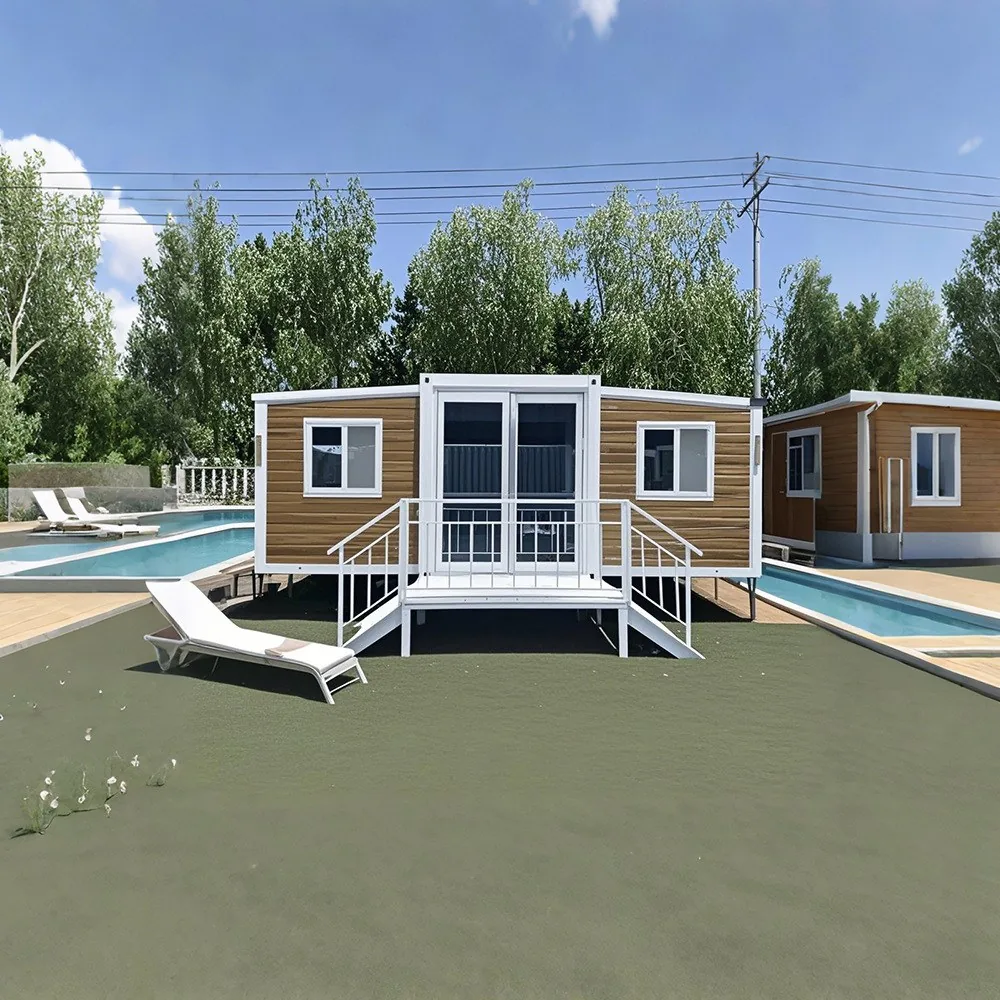
HG Prefab foldable expandable container homes — built to last, delivered worldwide.
Mexico is one of the most active markets we ship to, and the pattern is always the same: a beach plot near Puerto Vallarta, a hillside lot above Zihuatanejo, a rental cluster outside Mazatlán, a surf camp on the Oaxaca coast. The appeal of a folding container home in those places is obvious — it arrives as one sealed, compact steel package, opens into a finished house in a single day, and costs far less than building on a remote lot with no reliable contractor within two hours. What trips buyers up is not the house. It is the paperwork, the taxes and the last 200 kilometres of road.
This guide covers the four things that decide whether a Mexican import goes smoothly: how the unit should be classified and declared, which NOM (Norma Oficial Mexicana) technical standards actually touch a folding container home, what the clearing sequence costs and looks like at a Pacific port, and how to plan inland transport and site delivery on the Pacific coast. It is written for buyers working through an agente aduanal (customs broker) and is general guidance — every NOM number, duty rate and permit should be confirmed against the current official list before you pay for anything. Start with our container home shipping guide for folded dimensions, trade terms and freight basics, then come back here for everything Mexico-specific.
What Arrives: Folded Envelope, Expanded Footprint and Unit Price
The single most useful thing about a folding unit for import planning is how much smaller it travels than it lives. A 40FT unit that opens to roughly 5.9 m × 12.2 m and about 76 m² of floor area ships as a package about 2.15 m wide and 12.0 m long — inside standard road widths, inside a standard container envelope, and handled at port like ordinary break-bulk or flat-rack cargo. Once the unit is en route, the folded shipping weight is documented on the packing list and confirmed by the factory dispatch team; that number drives your crane or telehandler booking at the destination.
| Model | Folded transport footprint | Expanded size | Floor area | Factory price (FOB China) | Mexican use case |
|---|---|---|---|---|---|
| 20FT folding expandable unit | 2.15 m × 5.9 m | 5.9 m × 6.1 m | ~36 m² | $7,200–$9,800 | Couple's beach casita, surf-shack rental, caretaker unit |
| 30FT folding expandable unit | 2.50 m × 7.0 m | 7.0 m × 8.0 m | ~56 m² | $10,500–$14,500 | Two-bedroom family holiday home, small villa rental |
| 40FT folding expandable unit | 2.15 m × 12.0 m | 5.9 m × 12.2 m | ~76 m² | $12,500–$16,500 | Three-bedroom rental, glamping-resort unit, beachfront main house |
You can browse every configuration — /products listing all 20FT, 30FT and 40FT folding models — before deciding the size that will actually travel well on your access road. Prices above are ex-works factory prices for the folding unit and its standard interior finish; freight, insurance, customs duty, IVA, broker fees and inland transport are all additional, and together they usually add 35 to 60 per cent to the factory price depending on destination and exchange-rate timing.
HS Classification: Where a Prefab Home Sits in the Mexican Tariff
Prefabricated buildings are classified under HS heading 9406 in almost every customs territory, and Mexico follows that convention. Your broker determines the Mexican statistical subheading — the eight- or ten-digit line actually printed on the pedimento — and that line drives the duty rate and any non-tariff requirements attached to the import.
Get the subheading confirmed in writing before the unit loads. It costs nothing to confirm and it removes the risk of arriving at the port with a classification dispute, which is exactly where demurrage and storage charges start accumulating.
Who is allowed to import
To clear a commercial shipment in your own name you generally need a Mexican tax identity (RFC), registration in the Padrón de Importadores maintained by the tax authority SAT, an active e.firma (electronic signature), and — in practice — an agente aduanal holding a customs licence to file the pedimento on your behalf. Some HS lines additionally require sector registration; your broker will tell you if yours does. Buyers without Mexican tax residency either import through a Mexican company or use a seller arrangement / importación temporal route for temporary-project use. For payment mechanics, see our letter of credit guide.
NOM Standards: What Mexico Actually Regulates
A NOM (Norma Oficial Mexicana) is a mandatory technical regulation issued under Mexico's quality-infrastructure law and administered through the Dirección General de Normas; an NMX (Norma Mexicana) is voluntary. In simple terms, NOMs cover safety, health, information and environmental requirements, and compliance is normally evidenced by a certificate issued by an accredited certification body — ANCE is the usual name in electrical work, NYCE in electronics and allied fields.
Here is the practical map for a folding container home. Treat it as a scoped checklist to hand your broker, not as legal advice.
| Area | Instrument commonly cited | What it governs in practice | How compliance is handled for a folding unit |
|---|---|---|---|
| Electrical installations (utilisation) | NOM-001-SEDE | Design and installation rules for the building's wiring, protection devices and grounding | Order the unit pre-wired for Mexican service — 127 V / 60 Hz single-phase and 220 V where needed — with the correct protection layout, then have a licensed Mexican electrician sign off the final hook-up |
| Drinking-water quality | NOM-127-SSA1 | Water intended for human consumption, including the treatment applied before potable use | Relevant to your water supply design: cistern, filtration or UV treatment. A folding unit can be delivered plumbed for any incoming supply you specify |
| Sanitary plumbing installations | NOM-244-SSA1 | Hydraulic and sanitary installations inside buildings | Specify waste routing, traps and venting to Mexican practice at the factory; many buyers also have their local plumber review the drawing before production |
| Electrical products safety | NOM-003-SCFI | Safety specification and test methods for electrical products placed on the market | Applies mainly to plug-in appliances shipped inside the unit. The simplest route is to order the house appliance-free and buy locally certified Mexican appliances |
| Structural design and seismic resistance | No single federal NOM; local Reglamento de Construcción plus voluntary NMX steel and welding standards apply | Wind loads, seismic design and materials accepted by the municipality issuing your building permit | Supply the factory's structural drawings, steel grade certificates and load ratings to your Director Responsable de Obra when applying for the municipal permit |
| Site safety during installation | STPS workplace-safety NOMs | Safe working practices for crews, equipment and heights | Briefing, exclusion zones and a certified machine operator — see our crane and forklift offloading guide |
Two observations make this table less intimidating than it looks. First, the structure itself is generally handled at municipal level rather than by a federal NOM, so what really matters is having drawings and material certificates a Mexican engineer will sign. Second, the items most likely to attract product-level NOM requirements are the things you can simply buy locally: air-conditioning units, refrigerators, water heaters and other plug-in equipment.
Specifying the unit for Mexican service
The most valuable customisation for a Mexican order is done before production, not after arrival. Order the wiring loom and distribution board configured for 127 V / 60 Hz with the corresponding protection devices, specify the glazing and insulation build-up appropriate for your climate — “Pacific-cool humid winter / hot humid summer” is a different specification from Sonoran desert heat — and choose an air-conditioning strategy up front so the factory can pre-run the condensate drain and the electrical circuit for it. See our customization options for what can be specified and built in at the factory.
Customs Clearance: Documents, Taxes and Realistic Timelines
The clearance itself is a broker's job, but you control whether it takes two days or two weeks. The sequence below is what a normal importation of a folding unit looks like.
Documents you must have ready
- Commercial invoice with buyer details matching your RFC registration, unit description, unit price and Incoterm.
- Packing list stating dimensions, folded shipping weight and contents — the same number your crane contractor needs.
- Bill of lading corrected and released to your broker before the vessel berths.
- Certificate of origin and any certificates requested by your broker for the declared goods.
- Insurance certificate covering the ocean leg; optional but strongly recommended.
- Pedimento de importación filed by your agente aduanal, supported by the customs valuation documentation.
Taxes and fees to budget
- IGI (Impuesto General de Importación) — the general import duty at the rate applicable to your confirmed subheading. Budget a provisional line and ask your broker for the exact current figure.
- IVA — value-added tax at the standard 16 per cent rate, generally applied to the customs value including duty, transport and handling.
- DTA (Derecho de Trámite Aduanero) — the customs processing fee, commonly levied at 8 al millar (0.8 per cent) of the customs value; your broker confirms the applicable basis.
- Broker, port handling, storage and deposit — variable by port; get these quoted before the vessel sails, because every extra day in the terminal is a charge.
- Anti-dumping and other trade measures — Mexico maintains anti-dumping measures affecting certain steel inputs and product categories. Confirm with your broker whether any measure touches your declaration before you price the project.
Ask your broker for a landed-cost estimate in MXN before dispatch. A useful rule of thumb for budgeting before you have real figures is ocean freight of roughly $1,800–$3,600 for a single unit on Asia–Mexico Pacific services, plus taxes and local charges calculated on the customs value, plus $800–$2,800 for inland haulage and crane day depending on distance and route difficulty. Real quotes always beat rules of thumb — but they stop surprises.
Choosing a Pacific Gateway
Mexico has several Pacific container ports, and the right one is usually obvious once you look at road distance rather than port fees.
| Port | State | Best for destinations | Notes for folding-unit imports |
|---|---|---|---|
| Manzanillo | Colima | Puerto Vallarta, Barra de Navidad, Manzanillo, Guadalajara, Colima coast | Mexico's busiest Pacific container port and the default choice; most sailings from China, best onward truck availability, roughly half a day's haul to Puerto Vallarta depending on route |
| Lázaro Cárdenas | Michoacán | Ixtapa–Zihuatanejo, Acapulco, Michoacán and Guerrero coast, inland Michoacán | Second major Pacific option with good road links south; often stronger than Manzanillo for Guerrero destinations |
| Topolobampo | Sinaloa | Los Mochis, northern Sinaloa; ferry onward to La Paz, Baja California Sur | Smaller gateway; useful when your plot is in Sinaloa or when combining road plus ferry into BCS |
| Mazatlán & Guaymas | Sinaloa, Sonora | Sinaloa coast, Sonora coast, Puerto Peñasco, Hermosillo | Regional calls rather than deep-sea mainlines; viable for some lots but check the current service roster before routing |
| Ensenada / California ports | Baja California | Baja peninsula, Los Cabos via the peninsula road | Used when the buyer prefers a US west-coast discharge and cross-border haulage; compare total customs and transport cost before choosing |
Ask your forwarder to quote the same unit through Manzanillo and through Lázaro Cárdenas. The difference in inland haulage for a Guerrero-bound shipment often exceeds the difference in ocean freight, and it is the part buyers forget to compare.
Inland Transport and Pacific Coast Last-Mile Delivery
The last stretch — port gate to pad — is where Mexican projects most often lose days. Plan it in three parts.
Freight paperwork on Mexican roads
Domestic goods movement requires the electronic invoice (CFDI) with its Complemento Carta Porte for cargo transport, issued by whoever carries the load. Use carriers who issue this properly; a truck without a valid carta porte can be stopped and fined on the highway, which becomes your problem. If the transported combination exceeds standard weight or dimension limits, a special permit from the transport authority (SICT, formerly SCT) is required for the movement, and escort vehicles are sometimes mandated. Your haulage contractor handles this — but book it early, because permits are issued per movement.
Route survey
Survey the route from the port to the plot with the same care you would in any other country, plus a few Mexico-specific items: federal highway tolls and libramientos (bypasses) around towns, bridge and culvert ratings, army and police checkpoints that add time, seasonal slides on coastal mountain roads, unpaved terracería stretches that become impassable after heavy rain, and the rainy season itself — May to October along most of the Pacific coast. Schedule the offload window outside peak storm weeks when you can.
The pad and the lift
A folded several-tonne unit cannot be manoeuvred into place by hand. Build the pad inside the machine's rated reach from where the truck can legally stand, on compacted load-bearing ground, with overhead clearance checked. Then schedule machine and truck in the same window: roughly 30 to 60 minutes to offload and set, then about 2 hours for four workers to unfold and assemble the main structure. Our folding container home site prep checklist covers the pad, access and services in the order they need to be done, and the crane and forklift offloading guide covers lifting lugs, forklift pockets, reach and exclusion zones.
Permits at Destination: Municipality, Coastal Zone and Utilities
Customs clearance makes the house yours; local permits make it legal to occupy.
- Land-use and building permits. Apply at the municipality with structural drawings, foundation design for your soil, and a local Director Responsable de Obra signing the package. Whether a tiny or compact unit qualifies as major works varies by municipality — ask first.
- Coastal-zone concession. If the plot touches the federal maritime-terrestrial zone (ZOFEMAT), the occupation needs its own concession or permit, separate from owning the land behind it. This is the single most common source of surprise delay on Pacific-beach projects.
- Water and environmental authorisations. Wells and surface-water abstraction are regulated nationally by CONAGUA; discharge and ecological impact can involve federal environmental authority depending on location and scale.
- Utilities. Confirm whether grid power (CFE) is available at the plot or whether you are designing off-grid with solar and storage — see our solar power setup guide and off-grid water guide.
- Insurance. Many coastal insurers ask for the wind rating and the structural documents; order the structural package as part of the unit, not after.
Timeline Summary
- Weeks 1–2. Confirm model and price band (20FT $7,200–$9,800; 30FT $10,500–$14,500; 40FT $12,500–$16,500), lock specifications for 127 V / 60 Hz service, confirm folded shipping weight.
- Weeks 2–4. Broker confirms HS subheading and current IGI rate; forwarder quotes Manzanillo versus Lázaro Cárdenas; initiate any permits.
- Weeks 4–8. Production, typically 15–30 days, with factory QC and container loading or flat-rack securing.
- Weeks 7–11. Ocean transit from Shanghai, Ningbo, Qingdao or Shenzhen to the Pacific gateway — commonly around 18–30 days depending on service.
- Terminal. Clearance, usually 2–5 working days once documents are complete; avoid anything that extends storage time.
- Inland. Haulage, usually 1–5 days by destination, then machine offload and unfolding on the same visit.
Planning a Mexican import?
HG Prefab, manufactured by Henan Huangang Machinery Equipment Co., Ltd., supplies 20FT, 30FT and 40FT folding expandable container houses to Mexican buyers with factory documentation for customs and structural review: folded dimensions, shipping weights, steel specifications, electrical drawings configurable to 127 V / 60 Hz, and lifting-point layouts for your crane booking. Send your nearest Pacific port and plot location for a landed-cost estimate. Email hgmechequip@gmail.com or WhatsApp +86 191 0388 7380. Full model range on the products page.
Get a Quote Browse modelsFrequently Asked Questions
Do I need a crane to install a folding container home in Mexico?
Yes — a crane or forklift is required to offload the folded unit from the truck. Once it is set in position, four workers can unfold and assemble the main structure in about 2 hours. On Pacific coast sites, book the machine for the same window as the truck through your local rental company, confirm the folded shipping weight from the packing list before booking, and plan the pad so the unit lands inside the machine's rated reach.
Which HS code is used for a folding container house imported into Mexico?
Prefabricated buildings are normally declared under HS heading 9406, and your agente aduanal confirms the Mexican statistical subheading and the current duty (IGI) rate before the pedimento is filed. Duty and any applicable charges depend on the exact classification, so get the subheading confirmed in writing rather than assuming a rate from another country.
Do NOM standards apply to a folding container home imported into Mexico?
NOM standards are mandatory Mexican technical regulations, and the ones that matter most for a folding container home are usually NOM-001-SEDE for electrical installations, NOM-127-SSA1 for water intended for human use, NOM-244-SSA1 for sanitary plumbing installations, and NOM-003-SCFI for the electrical safety of plug-in products. Structural design follows local building regulations rather than a single NOM. Verify the current list with your customs broker, because NOMs are updated and repealed.
How much duty and tax will I pay importing into Mexico?
Budget for the customs duty (IGI) at the rate applicable to your confirmed HS subheading, IVA at the standard 16 per cent rate applied to the customs value plus duty and transport costs, and the customs processing fee (DTA), commonly levied at 8 al millar of the customs value. Add customs broker fees, port handling and storage, and inland transport. Your agent issues the pedimento showing each line, so ask for a landed-cost estimate before the unit ships, not after it berths.
How long does it take to ship a folding container home from China to Mexico's Pacific coast?
Production is typically 15 to 30 days depending on customisation, ocean transit from Chinese ports such as Shanghai, Ningbo, Qingdao and Shenzhen to Manzanillo or Lázaro Cárdenas is usually around 18 to 30 days depending on the service and routing, customs clearance normally takes 2 to 5 working days once documents are complete, and inland transport to Puerto Vallarta, Zihuatanejo, Los Cabos or Mazatlán adds a further 1 to 5 days.