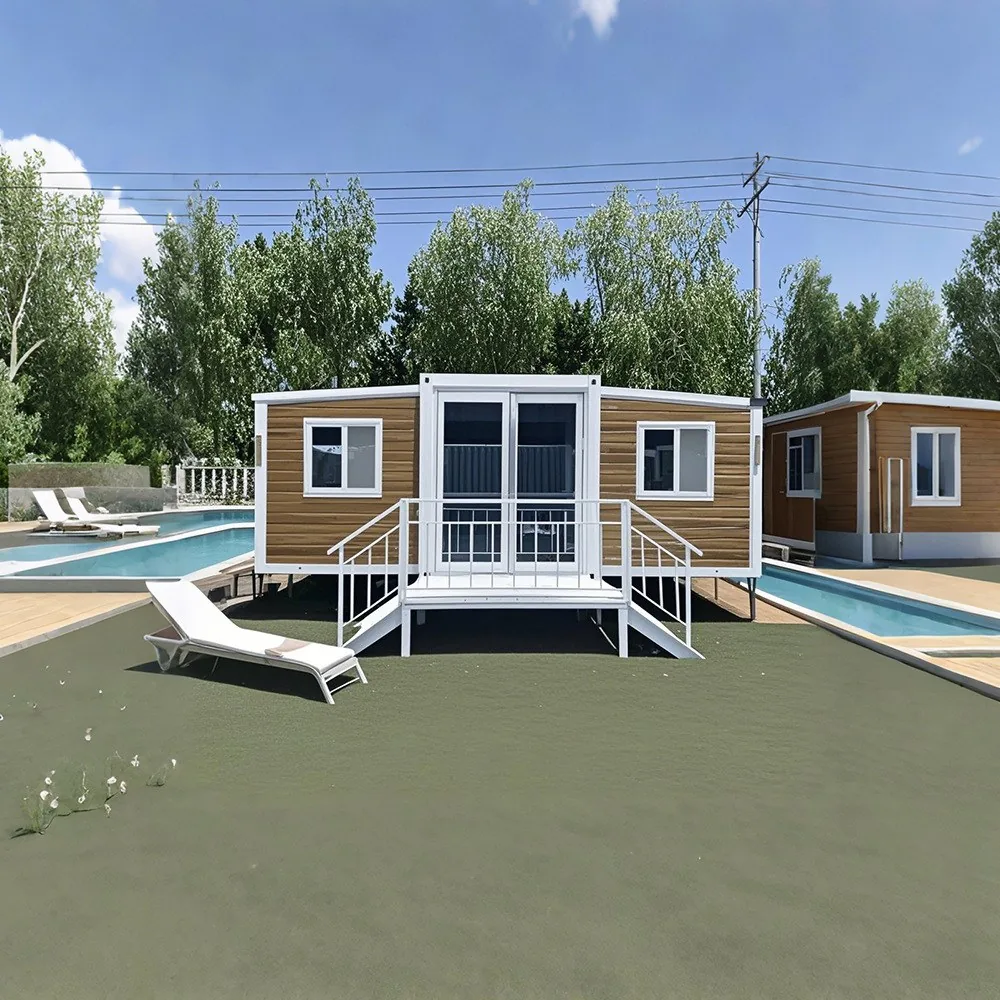
HG Prefab foldable expandable container homes — built to last, delivered worldwide.
South Africa is one of the most active destinations we ship to, and the pattern is always the same: a game-farm lodge in Limpopo, a contractor camp outside Musina, a coastal rental in KwaZulu-Natal, a staff house on a flower farm near the Cape, a residential extension in a Johannesburg suburb where conventional building is slow. The appeal of a folding container home in those places is obvious — it arrives as one sealed, compact steel package, opens into a finished house in a single day, and avoids the multi-month wait for a conventional contractor to be available. What trips buyers up is not the house. It is the SANS standards checklist, the SARS customs duty and VAT line, and the routing decision between Durban and Cape Town.
This guide covers the four things that decide whether a South African import goes smoothly: how the unit should be classified and declared, which SANS (South African National Standard) technical references actually touch a folding container home, what the clearing sequence with SARS (South African Revenue Service) looks like at a South African port, and how to plan inland transport and site delivery on roads that range from excellent national highways to short gravel farm tracks. It is written for buyers working through a registered clearing and forwarding agent, and is general guidance — every duty rate, permit and Standard should be confirmed against the current official list before you pay for anything. Start with our container home shipping guide for folded dimensions, trade terms and freight basics, then come back here for everything South Africa-specific.
What Arrives: Folded Envelope, Expanded Footprint and Unit Price
The single most useful thing about a folding unit for import planning is how much smaller it travels than it lives. A 40FT unit that opens to roughly 5.9 m × 12.2 m and about 76 m² of floor area ships as a package about 2.15 m wide and 12.0 m long — inside standard road widths, inside a standard container envelope, and handled at port like ordinary break-bulk or flat-rack cargo. Once the unit is en route, the folded shipping weight is documented on the packing list and confirmed by the factory dispatch team; that number drives your crane or telehandler booking at the destination.
| Model | Folded transport footprint | Expanded size | Floor area | Factory price (FOB China) | South African use case |
|---|---|---|---|---|---|
| 20FT folding expandable unit | 2.15 m × 5.9 m | 5.9 m × 6.1 m | ~36 m² | $7,200–$9,800 | Couple's coastal cottage, farm gate staff unit, security office, game-lodge guest chalet |
| 30FT folding expandable unit | 2.50 m × 7.0 m | 7.0 m × 8.0 m | ~56 m² | $10,500–$14,500 | Two-bedroom family home, small backpacker rental unit, contractor camp house |
| 40FT folding expandable unit | 2.15 m × 12.0 m | 5.9 m × 12.2 m | ~76 m² | $12,500–$16,500 | Three-bedroom rural family home, lodge main house, multi-room staff accommodation |
You can browse every configuration — /products listing all 20FT, 30FT and 40FT folding models — before deciding the size that will actually travel well on your access road. Prices above are ex-works factory prices for the folding unit and its standard interior finish; freight, insurance, SARS customs duty, VAT, broker fees and inland transport are all additional, and together they typically add 35 to 60 per cent to the factory price depending on port choice, exchange-rate timing and inland distance.
HS Classification: Where a Prefab Home Sits in the South African Tariff
Prefabricated buildings are classified under HS heading 9406 in almost every customs territory, and South Africa follows that convention in its Customs and Excise Tariff. Your registered clearing agent determines the South African tariff subheading — the eight-digit line actually printed on the SARS bill of entry — and that line drives the customs duty rate and any non-tariff requirements attached to the import.
Get the subheading confirmed in writing before the unit loads. It costs nothing to confirm and it removes the risk of arriving at the port with a classification dispute, which is exactly where demurrage, storage and handling charges start accumulating.
Who is allowed to import
To clear a commercial shipment in your own name in South Africa you need an importer of record with a valid SARS tax-compliance status, a registered clearing and forwarding agent holding a customs licence to file the bill of entry on your behalf, and — in practice — a South African bank account from which VAT and duties are paid via SARS eFiling. Some HS lines additionally require a permit or certificate before release; your clearing agent will tell you if yours does. Buyers without South African tax residency typically import through a local company, an appointed importer of record, or use a temporary-importation route for short-term project use. For payment mechanics, see our letter of credit guide.
SANS Standards: What South Africa Actually Regulates
SANS (South African National Standards) are technical documents published by the South African Bureau of Standards (SABS), and many of them are referenced by the National Building Regulations (NBR), which are issued under the National Building Regulations and Building Standards Act and administered at municipal level. Some SANS are also called up by the Occupational Health and Safety Act for workplaces, and by certain SARS codes for product safety. An NBR citation is binding; a free-standing SANS reference is usually voluntary but routinely treated as the proof of compliance by insurers, engineers and banks.
Here is the practical map for a folding container home. Treat it as a scoped checklist to hand your engineer and clearing agent, not as legal advice.
| Area | Instrument commonly cited | What it governs in practice | How compliance is handled for a folding unit |
|---|---|---|---|
| Electrical installations (utilisation) | SANS 10142-1 (wiring of premises) | Design and installation rules for the building's wiring, protection devices and earthing | Order the unit pre-wired for South African supply — 230 V / 50 Hz single-phase and 400 V three-phase where needed — with the correct breaker and earth-leakage layout, then have a registered electrician (wireman's licence) issue a Certificate of Compliance (CoC) on final hook-up |
| Drinking-water and hot-water supply | SANS 10252 (water supply and hot-water delivery) | Design, installation and commissioning of water and hot-water systems in buildings | Relevant to your incoming water design: cold-water storage, pressure control, hot-water generation. A folding unit can be delivered plumbed for any incoming supply you specify |
| Drainage and sanitary plumbing | SANS 10254 (drainage installations) and SANS 10252-3 (water installations for fire protection) | Soil, waste and vent design inside the building | Specify waste routing, traps, venting and gully detail to South African practice at the factory; many buyers also have their local plumber review the drawing before production |
| Electrical products safety | SANS / IEC product safety standards referenced in the SABS product database | Safety specification for electrical products placed on the market | Applies mainly to plug-in appliances shipped inside the unit. The simplest route is to order the house appliance-free and buy locally certified appliances carrying the SABS mark or the LOA (Letter of Authority) |
| Structural design and wind loads | SANS 10160 (basis of structural design and actions) and SANS 10400 series called up at municipal level | Wind loads, snow loads (rare but relevant in some Highveld and Drakensberg sites), seismic considerations and materials accepted by the municipality issuing your building permit | Supply the factory's structural drawings, steel grade certificates and load ratings to your appointed engineer when applying for the municipal building permit, with wind-region calculations for your specific site |
| Site safety during installation | Occupational Health and Safety Act construction regulations | Safe working practices for crews, equipment and heights | Briefing, exclusion zones and a certified lifting-machine operator — see our crane and forklift offloading guide |
Two observations make this table less intimidating than it looks. First, the structure itself is checked at municipal level through the NBR / SANS 10400 system rather than by a single national product certificate, so what really matters is having drawings and material certificates a South African engineer will sign and a municipality will accept. Second, the items most likely to attract product-level SABS requirements are the things you can simply buy locally: air-conditioning units, refrigerators, water heaters and other plug-in equipment.
Specifying the unit for South African service
The most valuable customisation for a South African order is done before production, not after arrival. Order the wiring loom and distribution board configured for 230 V / 50 Hz with the corresponding protection devices and earth-leakage, specify the glazing and insulation build-up appropriate for your climate — “Highveld dry winter / warm summer” is a very different specification from the humid KwaZulu-Natal coast or the hot dry Northern Cape — and choose a hot-water and air-conditioning strategy up front so the factory can pre-run the plumbing and the electrical circuit for it. See our customization options for what can be specified and built in at the factory.
Customs Clearance: Documents, Taxes and Realistic Timelines
The clearance itself is your clearing and forwarding agent's job, but you control whether it takes a few days or a few weeks. The sequence below is what a normal importation of a folding unit into South Africa looks like.
Documents you must have ready
- Commercial invoice with buyer details matching your importer of record information, unit description, unit price and Incoterm.
- Packing list stating dimensions, folded shipping weight and contents — the same number your lifting-machine contractor needs.
- Bill of lading corrected and released to your clearing agent before the vessel berths.
- Certificate of origin and any certificates requested by your clearing agent for the declared goods (relevant if a free-trade-agreement preference is being claimed).
- Insurance certificate covering the ocean leg; optional but strongly recommended.
- Bill of entry / SAD 500 filed by your clearing agent with SARS, supported by the customs-valuation documentation.
Taxes and fees to budget
- Customs duty at the rate applicable to your confirmed tariff subheading. Budget a provisional line and ask your clearing agent for the exact current figure on the date of entry.
- VAT at 15% — applied to the customs value plus duty plus certain levies, and payable to SARS via eFiling before release of the cargo. A SARS-registered importer generally recovers this VAT as input tax on the next return period.
- Customs broker fee — your clearing and forwarding agent charges per shipment; get a written quote before the vessel sails.
- Terminal handling, storage and wharfage — variable by port; get these quoted before the vessel sails, because every extra day in the terminal is a charge.
- Anti-dumping, safeguard or other trade-remedy duty — South Africa maintains trade-remedy measures on certain steel and finished-good categories under ITAC (International Trade Administration Commission). Confirm with your clearing agent whether any measure touches your declaration before you price the project.
Ask your clearing agent for a landed-cost estimate in ZAR before dispatch. A useful rule of thumb for budgeting before you have real figures is ocean freight of roughly $2,800–$5,200 for a single unit on Asia–South Africa services, plus taxes and local charges calculated on the customs value, plus roughly R18,000–R65,000 for inland haulage and a crane day depending on distance and route difficulty. Real quotes always beat rules of thumb — but they stop surprises.
Choosing a Gateway: Durban vs Cape Town
South Africa has several deep-water container ports, and the right one is usually obvious once you look at road distance rather than port fees. Durban handles the majority of the country's container traffic and is the default choice for Gauteng-bound and inland shipments; Cape Town is the natural choice for Western Cape deliveries and re-export into the SADC neighbourhood; Port Elizabeth (now Gqeberha) handles the Eastern Cape and southern Free State.
| Port | Province | Best for destinations | Notes for folding-unit imports |
|---|---|---|---|
| Durban | KwaZulu-Natal | Johannesburg, Pretoria, Bloemfontein, the Highveld, KwaZulu-Natal itself, Gauteng | South Africa's busiest container port and the default gateway; weekly deep-sea sailings from China, the strongest trucker pool, around half a day's haul to Johannesburg depending on route and traffic |
| Cape Town | Western Cape | Cape Town itself, the Winelands, the Garden Route, Western Cape farms, Namibia | Default choice for Western Cape destinations; weekly sailings from China, good onward road, and the natural exit if part of the cargo is destined for Windhoek or Walvis Bay |
| Port Elizabeth (Gqeberha) | Eastern Cape | Gqeberha itself, East London, the Karoo, southern Free State, eastern Cape coastal towns | Strong for Eastern Cape deliveries; smaller container pool than Durban so confirm the current service roster before routing |
| Richards Bay | KwaZulu-Natal | Northern KwaZulu-Natal, Mpumalanga, northern Mozambique via road | Bulk terminal rather than deep-sea container specialist; used mainly when northern KZN is the destination, with containers often trucked inland from Durban instead |
Ask your forwarder to quote the same unit through Durban and through Cape Town when the destination is Gauteng. The difference in inland haulage for a Cape-bound shipment routed via Durban can exceed the difference in ocean freight, and it is the part buyers forget to compare.
Inland Transport and Last-Mile Delivery
The last stretch — port gate to pad — is where South African projects most often lose days. Plan it in three parts.
Freight paperwork on South African roads
Domestic goods movement in South Africa is normally handled by a registered road-haulage carrier with a valid Cross-Border Road Transport Agency (C-BRTA) cross-border permit for international cargo, and a SARS customs release note for each movement out of the port precinct. Use carriers who are licensed and release the cargo via the proper SARS process; a truck operating outside the rules will be flagged at a weighbridge and fined, which becomes your problem. If the transported combination exceeds the National Department of Transport's abnormal-load thresholds on weight or dimension, an abnormal-load permit from the relevant provincial authority is required for the movement, and escort vehicles are mandatory in many cases. Your haulage contractor handles this — but book it early, because abnormal-load permits are issued per movement and lead times vary by province.
Route survey
Survey the route from the port to the plot with the same care you would in any other country, plus a few South Africa-specific items: toll roads on the N3 between Durban and Johannesburg, weighbridches on the N1 south of Bloemfontein and on the N4 through Mpumalanga, load-shedding-related traffic light outages around Gauteng, gravel plaaspaaie (farm tracks) that become impassable after a heavy Highveld thunderstorm, and seasonal commercial-vehicle restrictions over long weekends and the December holiday window. Schedule the offload window well clear of peak traffic weeks when you can.
The pad and the lift
A folded several-tonne unit cannot be manoeuvred into place by hand. Build the pad inside the machine's rated reach from where the truck can legally stand, on compacted load-bearing ground, with overhead clearance checked. Then schedule machine and truck in the same window: roughly 30 to 60 minutes to offload and set, then about 2 hours for four workers to unfold and assemble the main structure. Our folding container home site prep checklist covers the pad, access and services in the order they need to be done, and the crane and forklift offloading guide covers lifting lugs, forklift pockets, reach and exclusion zones.
Permits at Destination: Municipality, Water Use and Utilities
Customs clearance makes the house yours; local permits make it legal to occupy.
- Land-use and building plans approval. Submit at the local municipality with structural drawings, foundation design for your soil, and a registered professional engineer or architect signing the package. Whether a small folding unit qualifies as a Category 1 or Category 2 building varies by municipality — ask first.
- Water-use authorisation. If you sink a borehole for water, the Department of Water and Sanitation requires a registration or licensed-use authorisation in terms of the National Water Act. A rainwater-only supply still requires a roof and tank design that meets local regulations.
- Coastal and environmental authorisations. If the plot touches a sensitive area, a National Environmental Management Act (NEMA) basic assessment or more detailed environmental authorisation may be required. Coastal-edge works on the Wild Coast or in the Garden Route are particularly sensitive.
- Utilities. Confirm whether Eskom grid power is available at the plot or whether you are designing off-grid with solar and storage — see our solar power setup guide and off-grid water guide.
- Insurance. Many South African insurers ask for the wind rating and the structural documents, and agricultural and coastal policies may apply specific geographic loadings; order the structural package as part of the unit, not after.
Climate Considerations: Heat, UV, Coastal Air and Highveld Frost
South Africa covers almost every climate you would design a house for, which is the main reason a folding unit should be specified against your actual plot rather than ordered off the shelf. The Highveld around Johannesburg and Pretoria has dry winters with regular night frost and cool windy afternoons, summer hailstorms, and intense UV exposure at 1,500 m altitude. The KwaZulu-Natal coast is humid subtropical with hot wet summers and mild winters, plus salt-laden coastal air. The Western Cape has a Mediterranean climate with winter rainfall, summer drought and strong south-easters. The Northern Cape and parts of the North West are hot and arid with extreme day-night temperature swings.
Order against the climate you are building in. For high-altitude and Highveld plots, ask for enhanced roof and wall insulation, anti-condensation build-up behind cladding, and UV-resistant external paint. For coastal plots, prioritise hot-dip galvanised steel framing, marine-grade fixings, and additional corrosion allowance on window and door joinery. For arid zones, prioritise light-coloured external finishes, oversized gutters and downpipes for the rare heavy downpour, and roof-pitch options that shed dust. None of this is difficult to specify at the factory, and the cost difference of a few hundred dollars protects a unit that is expected to last decades.
Timeline Summary
- Weeks 1–2. Confirm model and price band (20FT $7,200–$9,800; 30FT $10,500–$14,500; 40FT $12,500–$16,500), lock specifications for 230 V / 50 Hz service, confirm folded shipping weight.
- Weeks 2–4. Clearing agent confirms HS subheading and current SARS duty rate; forwarder quotes Durban versus Cape Town; initiate any municipal building plans.
- Weeks 4–8. Production, typically 15–30 days, with factory QC and container loading or flat-rack securing.
- Weeks 7–12. Ocean transit from Shanghai, Ningbo, Qingdao or Shenzhen to Durban or Cape Town — commonly around 22–35 days depending on service.
- Terminal. SARS clearance, usually 2–7 working days once documents are complete and VAT has been paid; avoid anything that extends storage time.
- Inland. Haulage, usually 1–6 days by destination, then machine offload and unfolding on the same visit.
Planning a South African import?
HG Prefab, manufactured by Henan Huangang Machinery Equipment Co., Ltd., supplies 20FT, 30FT and 40FT folding expandable container houses to South African buyers with factory documentation for SARS and engineer review: folded dimensions, shipping weights, steel specifications, electrical drawings configurable to 230 V / 50 Hz, and lifting-point layouts for your crane booking. Send your nearest port (Durban or Cape Town) and plot location for a landed-cost estimate. Email hgmechequip@gmail.com or WhatsApp +86 191 0388 7380. Full model range on the products page.
Get a Quote Browse modelsFrequently Asked Questions
Do I need a crane to install a folding container home in South Africa?
Yes — a crane or forklift is required to offload the folded unit from the truck. Once it is set in position, four workers can unfold and assemble the main structure in about 2 hours. On KwaZulu-Natal and Western Cape sites, book the machine for the same window as the truck through a local rental company, confirm the folded shipping weight from the packing list before booking, and plan the pad so the unit lands inside the machine's rated reach.
Which HS code is used for a folding container house imported into South Africa?
Prefabricated buildings are normally declared under HS heading 9406, and your clearing agent confirms the South African tariff subheading (the eight-digit line on the SARS customs declaration) and the current duty rate before the bill of entry is filed. Duty and any applicable charges depend on the exact classification, so get the subheading confirmed in writing rather than assuming a rate from another country.
Do SANS standards apply to a folding container home imported into South Africa?
SANS (South African National Standards) are referenced by the National Building Regulations (SANS 10400 series), and the ones most relevant to a folding container home are usually SANS 10142 for electrical installations, SANS 10252 for water supply and hot water delivery, SANS 10254 for drainage and sanitary plumbing, and SANS 10160 for structural design including wind loads. Always verify the current standards list with a registered engineer or your local municipality, because SANS editions are revised from time to time.
How much duty and tax will I pay importing into South Africa?
Budget for the customs duty at the rate applicable to your confirmed HS subheading, VAT at the standard 15 per cent rate applied to the customs value plus duty, and any applicable anti-dumping or safeguard duty. Add customs broker fees, terminal handling and storage, and inland transport. Your clearing agent issues the SARS customs declaration showing each line item, so ask for a landed-cost estimate in ZAR before the unit ships, not after it berths.
How long does it take to ship a folding container home from China to Durban or Cape Town?
Production is typically 15 to 30 days depending on customisation, ocean transit from Chinese ports such as Shanghai, Ningbo, Qingdao and Shenzhen to Durban is usually around 22 to 35 days, customs clearance normally takes 2 to 7 working days once the complete document set is in order, and inland transport to Johannesburg, Pretoria, Cape Town, Bloemfontein or Gqeberha adds a further 1 to 6 days depending on distance from the discharge port.