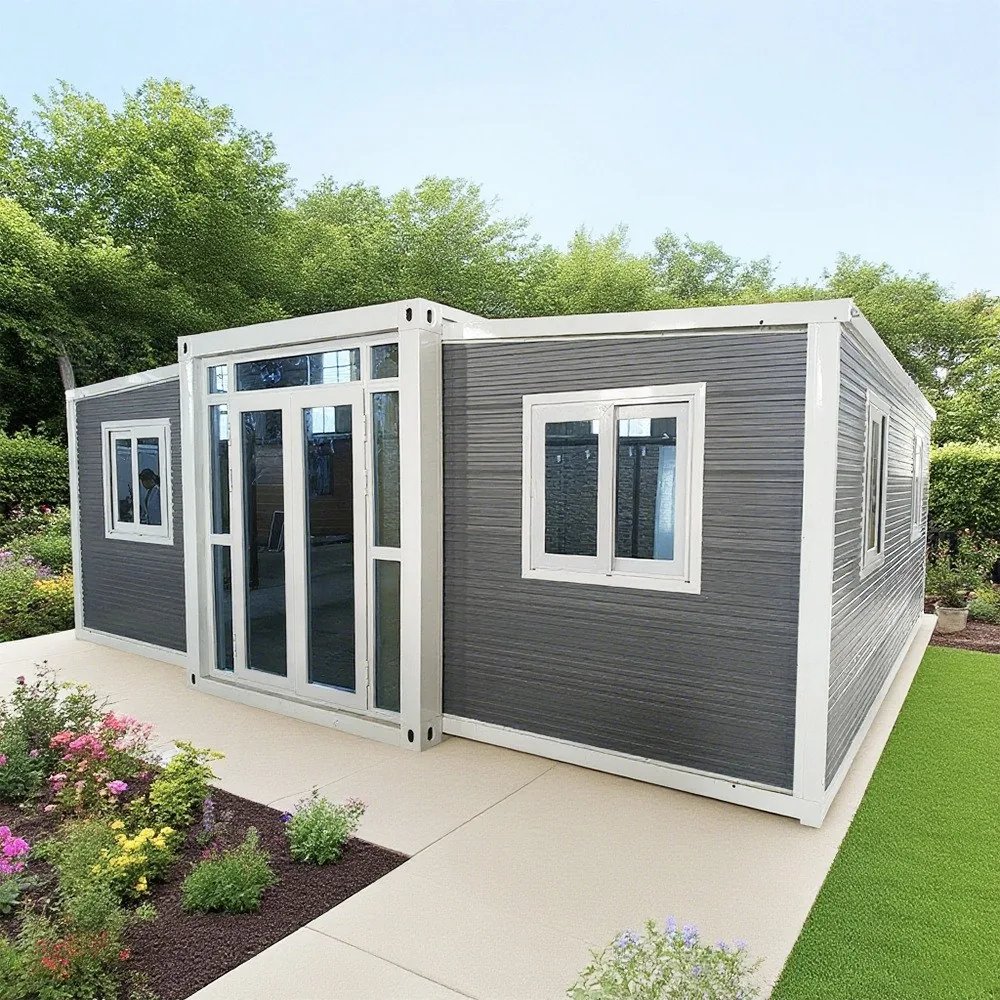
HG Prefab foldable expandable container homes — built to last, delivered worldwide.
Recycling schemes live or die on convenience. When the drop-off point is dark, badly signed, closed during the hours people are actually free, or overflowing because the bins were sized for an optimistic collection round, participation collapses and the material that does arrive is contaminated. Traditional fixed recycling buildings solve this well but take months to build, need a permanent land commitment and cannot follow population growth. Purpose-modified shipping containers solve it faster but arrive as a single-use conversion with no interior fit-out.
A folding expandable container house sits between the two. It ships as a compact folded package on a flatbed truck, opens into a finished, insulated, wired and lockable steel building in a single working day, and can be relocated to follow demand. That combination makes it a strong fit for municipal collection points, campus and industrial parks, estate-wide schemes, remote community programs and temporary event recycling where the site will not be permanent. This guide walks through the decisions that determine whether the facility works on day one: what role it plays, how to size it, how to arrange the traffic, how many streams it can honestly hold, what services it needs, and how to keep contaminated and hazardous material out. Pair it with our folding container house site prep checklist, because access surfacing and drainage decide most of the problems operators report later.
Why a Folding Container House Fits Recycling Work
A recycling point asks a lot of a small building, and the folding unit answers several of those demands simultaneously:
- Shortest possible lead time. Rather than a design-and-build cycle, the unit is manufactured, finished and tested at the factory, then shipped and opened. Interior finishes, doors, windows and electrics arrive already installed, so the client's work is fit-out rather than construction.
- Relocatable asset. A collection point that turns out to be in the wrong place can move. For leased land, pilot schemes and seasonal programs that matters more than almost anything else.
- Hard-wearing envelope. Steel wall panels and a steel roof with a durable factory finish tolerate wheelie bins, pallet trucks, trolleys and daily hose-down in a way that plasterboard and timber studwork do not.
- Security by default. Lockable roller or personnel doors, steel skins and optional shutters over the drop-off apertures allow the site to be closed cleanly outside staffed hours, which is the single most effective control against illegal dumping.
- Expandable capacity. Demand rarely arrives evenly. Additional units can be added later to create separate streams, a staff room or a second bay, and the whole cluster can be re-arranged as volumes change.
Defining the Role: Collection Point, Sorting Hub or Both
Be precise about the job before choosing a size. Most facilities are one of three types, and each has a different layout and staffing model.
Staffed sorting hub
Sorters receive mixed material, hand-pick it on a bench and consolidate it into single-stream bunkers for onward transport. This needs the largest floor area, the best lighting, mechanical extraction and a welfare corner with hand-wash and a lockable store. It is also the configuration where throughput per square metre is lowest, because a worker needs clear space either side of the bench.
Unstaffed community drop-off
Residents drive up or walk up and place material directly into labelled apertures or open bunkers. There is no sorting inside, so quality depends entirely on signage and aperture design. This is the cheapest model to run and the most likely to suffer contamination, so apertures must be shaped around the accepted items and nothing else.
Satellite feeder point
A small unit collects a few high-volume streams in a neighbourhood and is emptied by a truck that tips into a larger transfer facility. There is rarely any sorting; the design priority is vehicular access and bin exchange rather than interior workspace.
Choosing Between 20FT, 30FT and 40FT
The practical question is not the length of the unit but how many streams, how many simultaneous users, and whether a vehicle needs to drive past rather than reverse out. Use this as a starting point and adjust for your own collection round.
| Unit | Typical usable floor area once opened | Realistic streams | Staff on shift | Best role | Factory price |
|---|---|---|---|---|---|
| 20FT folding unit | approx. 18-22 m² | 4-6 with 240 L bins | 1 | Satellite feeder point, small estate, campus node, seasonal event point | $7,200-$9,800 |
| 30FT folding unit | approx. 30-36 m² | 6-8 with 660-1100 L bins | 1-2 | Staffed community recycling center with sorting bench and office corner | $10,500-$14,500 |
| 40FT folding unit | approx. 42-54 m² | 8-12 with bunkers or 1100 L bins | 2-3 | District hub, drive-through bay with queue space, transfer point with baler | $12,500-$16,500 |
All prices are ex-works factory prices for the folding unit itself, before freight, taxes, import duties, local compliance and site works. In practice the building is a minority of a small facility's cost, but it is the part that determines whether everything else fits, so size it to bunkers and benches rather than to the price gap. The full model range is on our products page.
Laying Out the Drop-Off Traffic
Traffic behaviour does more for participation than any amount of signage, and it is far cheaper to get right at pad design stage than to fix later.
Drive-through and drive-past bays
The safest public layout is a one-way drive-through: vehicles enter from one end, stop beside the drop-off face, and exit ahead without reversing. Provide at least 6 m of apron width per standing bay and 3.5-4 m clear width on the approach, plus enough queuing length for the busiest half hour rather than the daily average. Reversing into a public drop-off face is where near-misses with pedestrians happen; avoid it wherever the site allows.
Walk-up community drop-off
Where residents arrive on foot, put the apertures at a comfortable working height of roughly 900-1100 mm with a small shelf or lip, keep them under a canopy so people are not standing in rain, and light the approach to around 50 lux. Two apertures at different heights — one around 800 mm for wheelchair users and children, one around 1100 mm for standing adults — cost almost nothing and noticeably widen who actually uses the facility.
The interior sorting line
Keep the internal flow strictly one-directional: material enters at the tipping face, moves to the sorting bench, then into single-stream storage, then out through the collection door on the opposite side. Never put the public drop-off face and the collection door on the same side; the truck collecting full bins then blocks the residents trying to drop off, which is the most common cause of queuing complaints.
Material Streams and Bunker Sizing
Size each compartment against collection frequency, not against available floor space. The rule of thumb is to hold 1.2 to 1.5 times the volume expected between collections, with one overflow position for holiday peaks.
| Stream | Best container | Typical hold before it smells or blocks | Notes for the fit-out |
|---|---|---|---|
| Paper and card | Open-top 1100 L bin or open-front bay | 1-2 weeks | Keep strictly dry; store away from the washdown zone; consider a small baler in the 40FT layout |
| Rigid plastics | Open bunker with restricted aperture | 1-2 weeks | Aperture shape should reject bags of mixed waste; rinse point adjacent if food contact plastic is accepted |
| Glass | Enclosed bay or lidded 240 L bins | 2-4 weeks | Noise and breakage control: line the bay and keep it away from public walkways; separate the colour fractions only if your haulier pays for them separately |
| Metals | 240 L or 660 L bin | 2-4 weeks | High value and high theft interest; store inside a lockable compartment |
| Organics and food waste | Lidded 240 L caddy bins | 3-7 days | Requires washdown, trapped drainage and extraction; keep on the coolest side of the unit |
| Textiles, e-waste and batteries | Lockable cage or lidded bin | Collection dependent | Lithium cells and button cells demand a dedicated non-combustible store away from combustible streams |
| Residual rejects | Lidded 240 L bin | Weekly | Always include one, clearly labelled; without it rejects end up in every other stream |
Note that a folding unit arrives with the interior ready to receive this fit-out, not with the fit-out installed. Bunkers, benches, cages and balers are normally local supply items specified to accepted haulier container sizes, so confirm those sizes with your collector before detailing the layout.
Power, Lighting, Water and Ventilation
Recycling is a wet, dusty, high-activity industrial use in a small volume, so the services specification should follow the operational load rather than domestic norms:
- Electrical supply. Size from your equipment list, not from habit. Lighting, extraction, hand-dryer, water heater and small tools are modest; a baler, compactor, glass crusher or electric pallet truck charger are not. Most small facilities specify a 32-63 A dedicated supply with clearly labelled circuits and waterproof-rated outlets in the washdown zone. See our container home electrical load guide for how to build the load list.
- Lighting. Aim for roughly 300-500 lux at the sorting bench so contaminants are actually visible, around 100-150 lux in storage, and about 50 lux on the external apron and approach. High-bay LED fittings with a sealed rating survive dust and washdown.
- Ventilation. Cross-ventilate always, and specify mechanical extraction of six to twelve air changes per hour over organics, food-adjacent plastics and any washdown area. Odour escaping the unit is what generates neighbour complaints.
- Water. A hose-down point with a backflow-protected tap, a hose reel and a wall-mounted eye-wash or first-aid station is the minimum for any staffed facility handling food waste.
- Floor. Specify a seamless, coved, chemically resistant floor finish with a sealed upstand at the wall. Absorbent joints and timber-based floors fail fast under daily washdown.
Drainage, Washdown and Contamination Control
Washdown water is not clean water. It carries grease, fines, glass dust and organic residue, and discharging it straight to a storm drain or the ground is a compliance problem in most jurisdictions. Provide a trapped gully with a silt bucket and a grease or silt interceptor, sized for daily hose-down, discharging to the foul sewer under whatever local consent applies. Where no sewer exists, collect in a sealed tank for licensed off-site disposal rather than installing a soakaway.
Slope the washdown bay floor at roughly 1:80 toward the gully, keep the grade spills out of the public walkway, and design the yard so that contaminated water never runs to the storm system. Contamination control itself is mostly behavioural: one large-plate diagram showing only accepted items, one clear reject bin, and staff presence during the busiest hours. The first week of operation sets the quality baseline for everything afterwards, so staff the opening week even if the site will later be unstaffed.
Fire Safety for Battery and Aerosol Streams
Lithium-ion batteries damaged in collection and pressurised aerosols are the two items that turn a small recycling unit into a serious incident. Damaged cells can enter thermal runaway hours after being crushed, and they re-ignite after apparent extinguishing. Standard practice is a dedicated non-combustible store for batteries and aerosols, kept apart from paper, card and textiles, ideally in a separate compartment or an external steel cage, with a clear exclusion of combustible storage above it.
Provide appropriate extinguishers rated for the stream types, clear egress that is never blocked by staged bins, a documented inspection routine, and signage telling residents not to place damaged cells in general streams. Our container home fire safety guide covers detection, compartmentation and extinguisher selection in more detail.
Site Prep, Access and Delivery Day
A public drop-off site is also a heavy-vehicle site, so the pad has to serve two loads: the collection truck and the facility itself. Specify a reinforced concrete slab or a properly engineered compacted platform able to take repeated truck axle loads, with the access route sized for the largest vehicle that will call — usually the hook-loader or front-loader collector, not the delivery truck.
Surfacing choice matters here. Gravel migrates, generates dust, and traps broken glass that later punctures tyres; asphalt ruts under stationary turning wheels; concrete is expensive but is the correct answer under a drive-through bay and a high-turnover drop-off face. Whichever you choose, provide positive drainage away from the building and away from neighbouring properties.
Delivery day follows a fixed sequence. Yes — a crane or forklift is required to offload the folded unit from the truck. Once it is set in position, four workers can unfold and assemble the main structure in about 2 hours. Allow roughly 30-60 minutes of machine time for the offload, then half a day to a full day for unfolding, services connection and fit-out. Lay the pad so it sits inside the reach envelope of the machine working from where the truck can legally stand, check overhead clearance along the whole lift path, and line up the machine booking for the same window as the truck. Our folding container home offloading guide sets out equipment options, rigging points and typical hire rates; the delivery timeline guide maps the same steps against production and transit.
What a Small Container Recycling Facility Costs
Costs divide into the building, the site and the fit-out. The building is well defined: 20FT $7,200–$9,800; 30FT $10,500–$14,500; 40FT $12,500–$16,500 ex-works for the folding unit. Typical additional project items are:
- Freight and import: highly variable by lane, port and container sharing; budget it alongside duties rather than as an afterthought.
- Lifting day: roughly $700-$2,500 depending on the machine and region.
- Pad, drainage and fencing: usually the largest custom line item, driven by your own ground conditions.
- Fit-out: bunkers or bins, a sorting bench, cages, signage, lighting upgrade, extraction, interceptor, camera coverage and baler if specified.
- Consents and utilities: local permits, electrical connection charges and any trade waste agreement.
For a municipal operator or estate manager, compare that against the cost of a traditional masonry building on the same site. The folding unit is usually a fraction of the capital cost, is delivered in weeks rather than seasons, and can be redeployed when the population it serves moves — which is the reason more of these schemes start with one unit and expand later.
Phasing: Start Small and Add Units
Start with the streams that have reliable markets and predictable volumes, usually paper and card, rigid plastics, glass and metals, then add organics, textiles and e-waste once the basic flows are working and the haulier schedule is stable. Put the second unit, when it comes, on the opposite side of the apron so that each has its own collection face, and keep space between them for the truck to swing. A phased scheme also gives you data: the first six months of weighbridge or lift-count records justify the second unit far more convincingly than any projection.
Planning a recycling collection point?
HG Prefab, manufactured by Henan Huangang Machinery Equipment Co., Ltd., builds 20FT, 30FT and 40FT folding expandable container houses suitable for community recycling drop-off, satellite collection points and staffed sorting hubs, with documented folded shipping weights, factory lifting lugs and forklift pockets, and layout support for bunker, bench and service planning. Send your site plan, stream list and expected volumes for a layout review. Email hgmechequip@gmail.com or WhatsApp +86 191 0388 7380. Full model range on the products page, or request a quotation.
Get a Quote Browse modelsFrequently Asked Questions
Is a crane required to install a folding container house recycling center?
Yes — a crane or forklift is required to offload the folded unit from the truck. Once it is set in position, four workers can unfold and assemble the main structure in about 2 hours. Budget half a day of machine hire, then allow the crew the rest of the day to unfold, fit the bunker fit-out and commission the electrical and washdown services before opening to the public.
Which size folding container house suits a community recycling drop-off?
A 20FT unit suits a single-operator satellite point with two to four streams and walk-up or car-boot drop-off. A 30FT unit is the most common choice for a staffed community recycling center with four to six streams, a sorting bench and a small office corner. A 40FT unit handles six to ten streams, two sorters at once and a drive-through bay with queue space. Factory prices are $7,200 to $9,800 for 20FT, $10,500 to $14,500 for 30FT and $12,500 to $16,500 for 40FT.
How many material streams can one unit realistically hold?
Plan on four to six streams in a 20FT unit, six to eight in a 30FT unit and eight to twelve in a 40FT unit, assuming 240 to 1100 litre wheeled bins or open-fronted bunkers. The real limit is collection frequency, not floor area: size each bunker to hold 1.2 to 1.5 times the volume you expect between pickups, and add a clearly signed overflow bay for holiday weeks.
What services does a container recycling center need on site?
A dedicated electrical supply of 32 to 63 amps for lighting, baler, compactor and hand tools, LED high-bay lighting of roughly 300 to 500 lux at the sorting bench, mechanical extraction of six to twelve air changes per hour over wet and food-adjacent streams, a hose-down water point with a trapped and silted drain discharging to sewer via an interceptor, and a lockable store for batteries and aerosols.
How do you stop illegal dumping and contamination at an unstaffed drop-off?
Control the opening, the sightlines and the closure. Use restricted clear-opening apertures sized to the accepted material, keep the apron lit to around 50 lux with a camera covering both the bays and the approach, close and lock outside staffed hours, post large plain-language signage showing only accepted items, and empty on a fixed published day so full never becomes a permanent state.