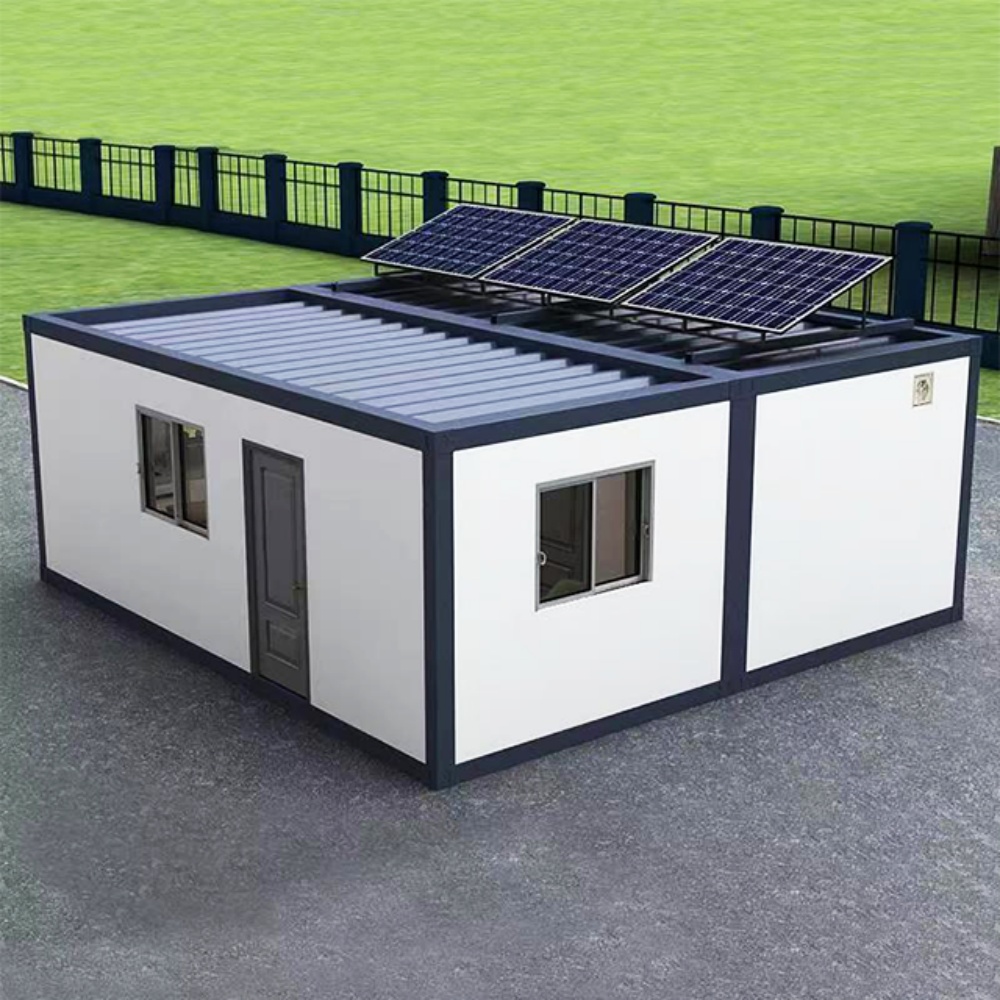
HG Prefab foldable expandable container homes — built to last, delivered worldwide.
A folding container home performs very well in desert regions, but only if it is specified for them. The steel box itself is not the problem — the problem is radiant gain through a thin metal skin, fine dust that finds every unsealed joint, and the fact that the cooling load peaks several hours after the sun does. Buyers in the Gulf, North Africa, the Sahel, Central Australia and the southwestern United States all face the same three engineering tasks: keep the heat out, keep the dust out, and generate enough power on site to run the cooling. This guide sets out the specification that does that, the cooling options and their real power and water budgets, and what a desert-ready 20FT, 30FT or 40FT unit costs to deploy.
The Desert Load Profile: Heat, Diurnal Swing and Radiant Gain
Desert heat is not simply "hot". It is a specific load profile, and understanding it changes every decision downstream.
- Roof surface temperature: at 45–50°C ambient with clear skies and no cloud cover, a bare dark steel roof reaches 70–80°C. That surface radiates into the ceiling cavity long after the air temperature falls, which is why poorly insulated containers feel hottest at 8 pm rather than at 2 pm.
- Diurnal swing: a 15–20°C drop between afternoon peak and pre-dawn low is normal. A heavy, well-insulated envelope can exploit this — you flush the structure with cool night air and then close it down before sunrise.
- Radiant component: direct gain through thin steel dominates over air infiltration. Reflecting radiation at the roof is worth more per dollar than adding another compressor.
- Low humidity by day, higher by night: relative humidity often sits under 25% at midday and rises above 40–50% before dawn. Any cooling strategy has to work across that whole range, not just the dry afternoon.
- Dust and sand: airborne fines load filters, abrade seals, settle on photovoltaic glass and work into the fold mechanisms of an expandable unit.
The practical consequence is that desert specification is an envelope problem first and a mechanical problem second. Get the insulation, the thermal break and the roof reflectance right and you may need half the cooling capacity you thought you did.
Insulation Spec: Thickness, Material and Thermal Breaks
Standard builds are not enough in this climate. Specify the following at order stage, because retrofitting insulation into a finished lining is slow and expensive:
| Element | Desert specification | Why it matters |
|---|---|---|
| Wall and roof panels | 75–100 mm rock wool or PIR sandwich panel | Cuts roof U-value enough to stop evening re-radiation into the room |
| Outer skin to frame | Continuous thermal break (nylon/PU isolator) | Steel studs bridging skin to lining bypass the insulation entirely |
| Panel joints | Taped and foamed on both faces | Open joints admit dust and create thermal bridges at every seam |
| Floor | 50–75 mm underfloor with sealed vapour barrier | Ground-reflected heat and dust ingress both come from below |
| Glazing | Double glazed, low-E, external shading | Single glazing in full sun is a heater, not a window |
Rock wool gives better acoustic performance and fire rating; PIR gives slightly better thermal value per millimetre and resists moisture uptake. In hot-dry climates both work, and the deciding factor is usually local fire code. What matters more than the choice between them is continuity: an unbroken steel path from the outer skin to the interior lining — a bracket, a purlin, a door frame — conducts heat straight past the insulation. Ask your sales engineer to confirm the thermal break detail at the fold line, because that is where a folding unit differs from a static container and where thermal bridging is easiest to get wrong. This is standard on our 40FT folding expandable container house and is available on the 20FT and 30FT as well.
Exterior Finish, Shading and Dust Sealing
Colour is a performance specification in the desert, not a styling choice. A white or light-grey roof can sit 20–25°C cooler than a dark green or dark grey one under the same sun.
- Light cladding: specify the lightest colour in the range for walls and roof. Solar reflectance (SR) above 0.60 on the roof should be the minimum target.
- Reflective roof coating: an elastomeric or acrylic reflective coating over the roof deck adds reflectance and protects the paint film from UV chalking. Reapply every 3–5 years.
- Shading verandas and overhangs: put a canopy or veranda on the sun-facing side. A 1.2–1.8 m overhang on the west and south elevations removes most of the afternoon wall load and creates usable shaded outdoor space.
- Second skin or rain screen: where budgets allow, a ventilated outer skin with a 40–60 mm air gap drops the surface temperature of the inner liner substantially.
- Window placement: minimise glazing on the west face. Cross-ventilation openings should be on opposite walls but shaded, and fitted with insect and dust mesh.
The second half of the exterior specification is keeping the desert out of the box.
Fine desert dust is the failure mode most buyers underestimate. It enters through door gaps, through the fold lines of an expandable unit, and through every unfiltered intake. Once inside, it abrades hinges and fan bearings, clogs condensate drains and coats electronics.
- Gasketed door leafs: compression gaskets on all external doors, with a threshold sweep. A door that racks out of square in the heat stops sealing — check adjustment annually.
- Compressible seals at fold lines: the folding joints are the weakest point of any expandable unit. Specify compressible bulb or foam seals with a dust lip, and inspect them at every service visit.
- Mesh on intakes: every fresh-air intake, dryer vent and combustion air opening gets a coarse mesh plus a fine filter stage.
- Positive-pressure ventilation: on dusty sites, run a filtered supply fan so the interior sits slightly above ambient pressure. Air then leaks outward through gaps instead of drawing dust inward.
- Filter cleaning cycle: set a written schedule — rinse pre-filters weekly in heavy season, replace fine filters monthly. Keep a spare set on site; a torn filter that stays in place is worse than none.
- Cable and pipe penetrations: every penetration gets a grommet and sealant. Unsealed conduit entries are the single most common dust path we see on inspected units.
Cooling Strategy Compared: Evaporative, Inverter AC and Hybrid
Three strategies cover almost every desert project. The right one depends on humidity, water availability and how much solar you can carry.
| Strategy | Best humidity range | Power draw | Water use | Maintenance | Best for |
|---|---|---|---|---|---|
| Evaporative / swamp cooler | Below 30–35% RH | 2–4 kW | 10–20 L/h | Pad change monthly, pump and bleed line, tank descaling | Dry inland desert, day cooling, large airflow |
| Inverter split AC | Any humidity | 2.5–5 kW per zone | None | Filter rinse, coil clean, condensate drain check | Humid evenings, coastal desert, bedrooms and offices |
| Hybrid (evaporative by day, AC at night) | 25–45% RH | 1.5–5 kW depending on mode | 5–12 L/h | Both schedules, plus changeover control | Sites with a real diurnal swing and metered power |
Evaporative cooling is the cheapest comfort per watt in genuinely dry air: a 2–4 kW unit moves enough air to drop the supply temperature by 8–15°C, and it doubles as continuous fresh-air ventilation, which you want anyway. Its limits are honest ones — output collapses once relative humidity rises above about 40%, so on coastal desert sites or during humid evenings it does very little, and it consumes 10–20 L/h of water that has to come from somewhere.
Inverter split units cost more to buy and roughly twice as much to run per hour of cooling, but they work regardless of humidity, they dehumidify, and they hold a setpoint overnight. For sleeping quarters, clinics, server rooms and offices, plan 2.5–5 kW of cooling per zone and size the electrical supply accordingly. A 30FT folding expandable container house laid out as two sleeping zones plus a living area typically needs two 3.5 kW inverter units plus one evaporative cooler for the daytime volume. The usual specification is a hybrid: evaporative cooling for the daytime occupied volume, and an inverter split in the bedrooms for the hours between dusk and midnight when humidity climbs.
Water strategy follows directly from that choice. An evaporative-led design needs larger storage than a compressor-led one — plan 1,000–2,000 L for a small household with evaporative cooling, plus a day tank sized so a pump failure does not immediately stop the cooling. Tanks must be opaque or shaded, sealed against dust, and fitted with dust caps on the fill point and a first-flush diverter if you are harvesting roof water. In remote sites, a shaded tank buried or placed under the veranda loses far less to evaporation than one standing in full sun.
Solar Sizing, Anchoring and Ground Conditions
Deserts are the best solar resource on earth and the worst for soiling. Both facts belong in the same calculation.
- Irradiance: 5.5–6.5 kWh/m²/day is typical for good desert sites, roughly 30–40% above temperate European figures. A 4–6 kWp array fits a 40FT roof and a 2–3 kWp array fits a 20FT.
- Soiling loss: dust on glass costs 15–25% of output if the array is never cleaned. Budget for a weekly rinse where water allows, or a monthly clean with soft brushes where it does not.
- Tilt: use a steeper tilt than the latitude-optimal angle for annual yield. Steeper glass sheds dust in wind and in the rare heavy rain, and it also favours winter production.
- Battery: 10–15 kWh covers overnight cooling for a single zone plus lighting and refrigeration. Lithium with active thermal management, or a ventilated, shaded battery enclosure — an unshaded battery box in 50°C air will derate and age fast.
- Inverter location: mount inverters in shade with airflow, never on the sun-facing wall. Derating starts around 40–45°C ambient.
Ground conditions are the other half of desert site work. Sand and loose alluvial soils have poor bearing capacity and almost no resistance to uplift, so the anchoring strategy has to be designed rather than assumed:
- Wider pads: spread the load with a reinforced concrete pad or a compacted gravel pad with edge restraint, sized generously rather than to the minimum.
- Deadman anchors: buried concrete blocks or screw anchors resist wind uplift far better than surface pins in loose sand.
- Concrete ballast: where excavation is impractical, cast ballast blocks at the corner castings and tie them to the frame.
- Scour and drift: raise the unit above the surrounding grade so sand does not bank against the walls and bridge the floor insulation.
Budget and Installation Sequence
Desert readiness adds cost, but the envelope items are cheap compared with the cooling capacity they remove. Typical 2026 budget:
- Container unit: 20FT $7,200–$9,800; 30FT $10,500–$14,500; 40FT $12,500–$16,500 depending on size and finish.
- Desert insulation upgrade (75–100 mm, thermal break, taped joints): $1,200–$3,500.
- Reflective roof coating and light-coloured cladding: $400–$1,200.
- Shading veranda or canopy on sun side: $1,500–$5,000.
- Dust sealing package and filtered positive-pressure ventilation: $800–$2,500.
- Cooling: evaporative cooler, inverter split units or hybrid: $1,500–$6,000.
- Solar array, battery and inverter: $4,000–$14,000 depending on capacity.
- Water storage, tanks and dust-capped fill points: $800–$3,000.
- Pad, anchors and site works: $2,000–$8,000.
Sequence the work so the ground is ready before the truck arrives. Survey and level the site, then build the pad and set the anchors or ballast points, because these are the tasks that slip on loose ground. Cast or compact, allow cure time, and mark the anchor positions against the unit footprint. Only then bring the unit in: Yes — a crane or forklift is required to offload the folded unit from the truck. Once it is set in position, four workers can unfold and assemble the main structure in about 2 hours. Fit the shading canopy and the roof coating as early as possible so the trades working inside are doing so in a shaded box, then complete the electrical, plumbing and cooling commissioning, and finish with the filter and seal inspection walk-around.
Need a folding container house?
HG Prefab manufactures 20FT/30FT/40FT folding expandable container houses, ships them flat-packed worldwide, and builds them to desert spec: 75–100 mm rock wool or PIR insulation with a full thermal break, light-coloured high-reflectance cladding, sealed fold lines and solar-ready roofs.
Browse modelsFrequently Asked Questions
How are folding container homes delivered and installed in remote desert areas?
Yes — a crane or forklift is required to offload the folded unit from the truck. Once it is set in position, four workers can unfold and assemble the main structure in about 2 hours. Plan the pad, the anchor points and the shading canopy before the truck arrives, because on an exposed desert site the structure is the fast part and the ground works are what take the time.
What insulation thickness does a desert container home need?
Specify 75–100 mm of rock wool or PIR in the sandwich panels, with a continuous thermal break between the outer steel skin and the internal frame. Below 75 mm the roof deck still radiates into the room after sunset, and any unbroken steel path from the outer skin to the interior lining will undo the insulation by conducting heat straight through the frame.
Do evaporative coolers work in desert container homes?
Yes, and in dry desert air they are the cheapest way to cool a small volume. Below roughly 30–35% relative humidity an evaporative cooler draws 2–4 kW while delivering an 8–15°C supply temperature drop, using 10–20 L/h of water. Once evening humidity rises above about 40%, its output collapses and an inverter split unit takes over.
How much solar does a desert container home need for air conditioning?
Desert irradiance is excellent at 5.5–6.5 kWh/m²/day, so a 4–6 kWp array on a 40FT roof plus a 10–15 kWh battery will run an inverter split unit through most of the day and into the evening. Budget for 15–25% soiling loss if the panels are not rinsed, and set a steeper tilt so wind and occasional rain shed dust between washes.