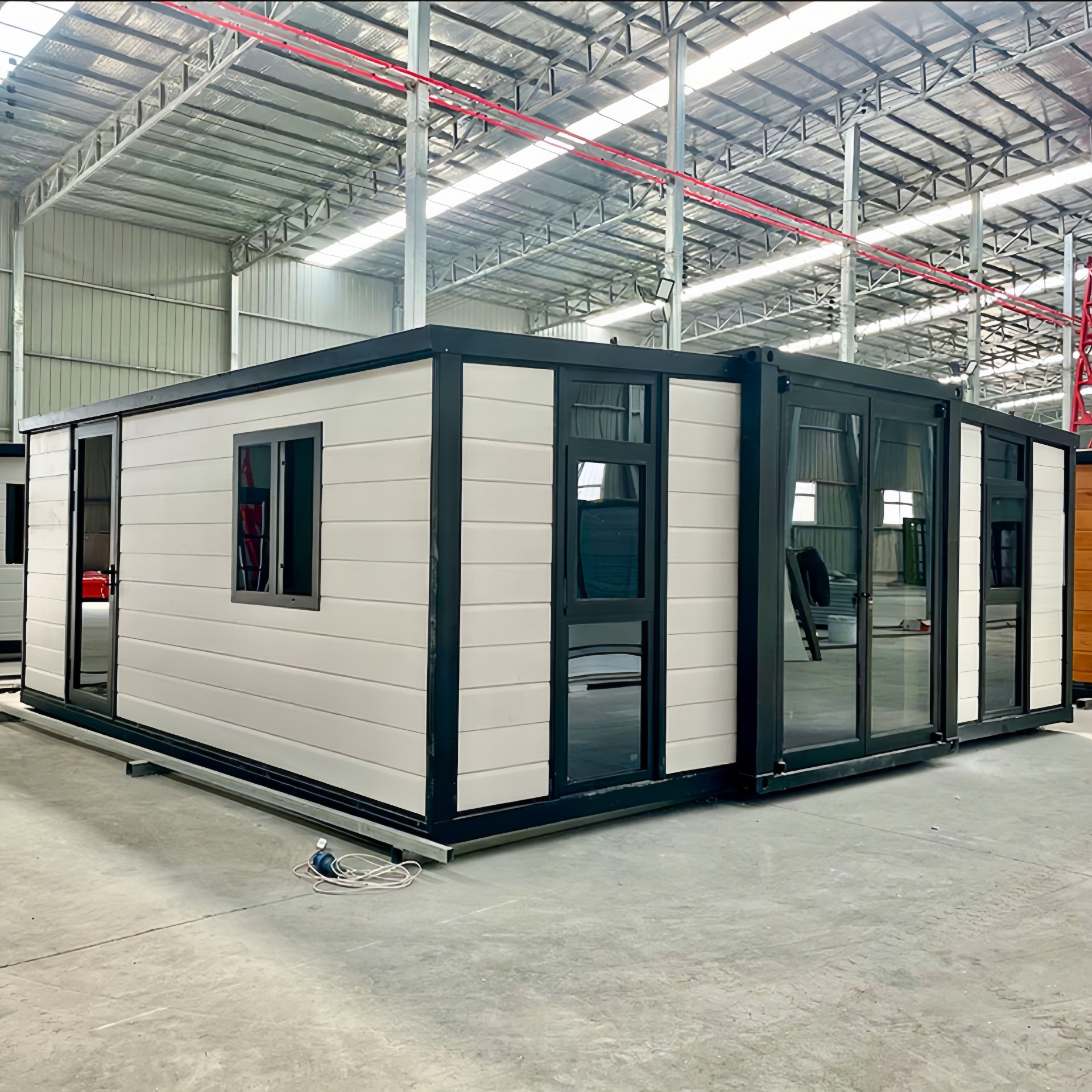
HG Prefab foldable expandable container homes — built to last, delivered worldwide.
Solar power is the natural energy partner for folding container houses. Whether you are setting up a remote cabin, an off-grid worksite office, or a self-sufficient tiny home, the steel roof of an expandable container house provides a ready mounting surface for photovoltaic panels. This guide walks through system sizing, component selection, mounting methods and cost analysis for 20FT, 30FT and 40FT folding container units.
Why Solar Pairs Perfectly with Container Houses
- Steel roof = ready racking surface — the corrugated steel roof of a folding container house provides a rigid, fire-proof mounting surface for solar panels. No additional structural reinforcement needed for typical residential arrays (3–6 kW).
- Predictable load profile — a single container dwelling has a known, stable energy consumption pattern (LED lighting, refrigerator, small AC, laptop/phone charging). This makes system sizing straightforward.
- Off-grid applicability — many container house use cases (remote sites, agricultural land, disaster relief) lack grid access. Solar + battery is often the only practical power source.
- Transportable system — panels can be removed, packed flat, and shipped with the folded container to the next site. Unlike a fixed rooftop array on a house, the entire power system relocates with the unit.
Energy Consumption: How Much Power Does a Container Home Use?
Sizing a solar system starts with understanding the load. A typical folding container house has these energy consumers:
| Appliance | Power draw (W) | Daily usage (hrs) | Daily energy (Wh) | Notes |
|---|---|---|---|---|
| LED lighting (6 fixtures) | 8 | 5 | 40 | Interior and exterior |
| Refrigerator (efficient) | 120 | 24 (cycling) | 800 | compressor runs ~40% duty cycle |
| Air conditioner (9000 BTU) | 800 | 6 | 4,800 | Summer cooling season |
| Water heater (electric) | 1,500 | 1.5 | 2,250 | Or use gas/solar thermal |
| Laptop + phone charging | 100 | 4 | 400 | Work-from-home baseline |
| Ventilation fan | 40 | 8 | 320 | Bathroom + kitchen exhaust |
| Water pump (pressure) | 200 | 0.5 | 100 | Well or storage tank pump |
| Miscellaneous (router, etc.) | 30 | 24 | 720 | Always-on baseline load |
| Total (summer) | — | — | ~9,430 Wh | ~9.4 kWh/day |
Winter loads shift: less AC but more heating. If using electric resistance heating, consumption jumps to 15–25 kWh/day. Most off-grid container homes use gas or diesel supplementary heating to keep solar systems manageable.
Sizing the Solar Array
Array size depends on daily energy need and local solar irradiance (peak sun hours). The formula:
Array kW = Daily Wh ÷ (Peak Sun Hours × System Efficiency)
System efficiency accounts for inverter losses, wiring losses, panel degradation and temperature derating — typically 0.75–0.80 for a well-designed system.
| Unit size | Daily need (kWh) | Array size (kW) | Panel count (450W) | Roof area needed (m²) |
|---|---|---|---|---|
| 20FT (minimal use) | 4–6 | 1.5–2.5 | 4–6 | 8–12 |
| 30FT (moderate use) | 6–9 | 2.5–3.5 | 6–8 | 12–16 |
| 40FT (full living) | 9–12 | 3.5–5.0 | 8–11 | 16–22 |
A 40FT folding container house has approximately 30 m² of roof area when expanded — enough for a 5 kW array with panels mounted at a 15–25° tilt. The 20FT has about 15 m², suitable for up to 2.5 kW. See our HVAC guide for strategies to reduce cooling load.
Battery Bank Sizing
Battery capacity determines how many days the container home can run without sun (autonomy). The formula:
Battery kWh = Daily kWh × Days of Autonomy ÷ Depth of Discharge
Lithium iron phosphate (LiFePO4) batteries are the standard choice — safe, 6,000+ cycle life, 80% usable depth of discharge. For a 40FT unit needing 3 days of autonomy:
- 10 kWh/day × 3 days ÷ 0.80 DoD = 37.5 kWh battery bank
- Typical configuration: 4 × 48V 200Ah server-rack batteries = ~38.4 kWh
- Estimated cost: $8,000–$12,000 for the battery bank alone
For 20FT units with lower consumption (4–6 kWh/day), a 2-day autonomy target requires 10–15 kWh of battery storage ($3,000–$5,000).
Inverter and Charge Controller Selection
The inverter must handle the peak simultaneous load. For a 40FT container home:
- Continuous load: ~2,000W (AC + fridge + lights + electronics)
- Surge load: ~4,000W (AC compressor startup, water pump startup)
- Recommended inverter: 5 kW pure sine wave, 48V DC input, with 10 kW surge capacity for 5 seconds
- Charge controller: MPPT type, sized to array kW ÷ battery voltage. A 5 kW array at 48V needs a 100A+ MPPT controller.
Hybrid inverters that combine solar charging, battery management and AC pass-through are the best choice for container homes — they simplify wiring and allow grid/generator backup. For detailed electrical guidance, see our plumbing and electrical guide.
Panel Mounting Methods on Container Roofs
Direct Bolt-On (Flat Mount)
Aluminum Z-brackets bolt directly to the corrugated steel roof using self-tapping screws with butyl sealant. Panels mount nearly flat (2–5° for drainage). Simple, cheap (~$2/panel in hardware), but loses 10–15% efficiency vs. tilted mounting. Best for low-latitude sites where sun angle is high.
Tilted Rack (Adjustable Angle)
Aluminum rails mount on roof-mounted brackets, allowing 15–35° panel tilt. Uses standard solar racking hardware. Adds ~$300–$600 in racking cost but gains 15–25% more energy annually. Best for mid-latitude sites with seasonal sun variation.
Ground-Mount Array
Panels mounted on a separate frame next to the container house, not on the roof. Allows optimal tilt angle, easy cleaning access, and avoids roof penetrations. Best for sites where the roof is needed for water collection or the container may be relocated. See our off-grid guide for ground-mount designs.
Cost Breakdown: Complete Solar System by Unit Size
| Component | 20FT system | 30FT system | 40FT system |
|---|---|---|---|
| Solar panels (450W each) | $900 (4 panels) | $1,350 (6 panels) | $2,250 (11 panels) |
| Battery bank (LiFePO4) | $3,500 (10 kWh) | $5,500 (20 kWh) | $10,000 (38 kWh) |
| Inverter (hybrid 3–5 kW) | $1,200 | $1,500 | $2,000 |
| MPPT charge controller | $300 | $400 | $500 |
| Racking + wiring + BOS | $500 | $700 | $1,000 |
| Installation (DIY vs pro) | $0–$1,500 | $0–$2,000 | $0–$2,500 |
| Total (DIY) | $6,400 | $9,450 | $15,750 |
| Total (professional install) | $7,900–$9,400 | $11,450–$13,450 | $18,250–$20,750 |
These systems pay back in 4–7 years compared to diesel generator power ($0.35–$0.50/kWh fuel + maintenance). After payback, power is effectively free for 10–15+ years (panel warranty: 25 years; battery life: 10–15 years).
Off-Grid vs Hybrid: Which to Choose?
If your container house site has grid access, a hybrid system (grid-tied with battery backup) offers the best of both worlds:
- Off-grid — no grid connection. Battery autonomy is critical (3–5 days recommended). A backup generator is essential. Best for remote sites, agricultural land, disaster relief. Higher upfront cost but zero ongoing fuel cost.
- Hybrid (grid-tied + battery) — solar feeds the house and charges batteries; grid covers deficits. Batteries provide backup during outages. Smaller battery bank sufficient (1-day autonomy). Best for sites with unreliable grid power. Lower cost, and excess production can be net-metered.
- Grid-tied (no battery) — solar feeds the house and exports excess to grid. No backup power. Lowest cost but no resilience. Not recommended for container homes in remote or storm-prone areas.
Maintenance and Monitoring
Solar systems on container homes require minimal maintenance:
- Panel cleaning — wipe panels with a soft brush and water every 2–3 months. Dust can reduce output by 15–30% in arid environments. See our maintenance guide.
- Battery monitoring — check battery cell balance and state of charge monthly via the BMS app. LiFePO4 requires no watering or equalization.
- Connection inspection — annual check of all MC4 connectors, fuses and terminal torque. Thermal imaging can spot loose connections before they fail.
- Inverter firmware — update inverter firmware annually for improved algorithms and bug fixes.
Need a folding container house?
HG Prefab manufactures 20FT, 30FT and 40FT folding expandable container houses for residential, commercial and industrial applications — shipped flat-packed worldwide.
Browse models