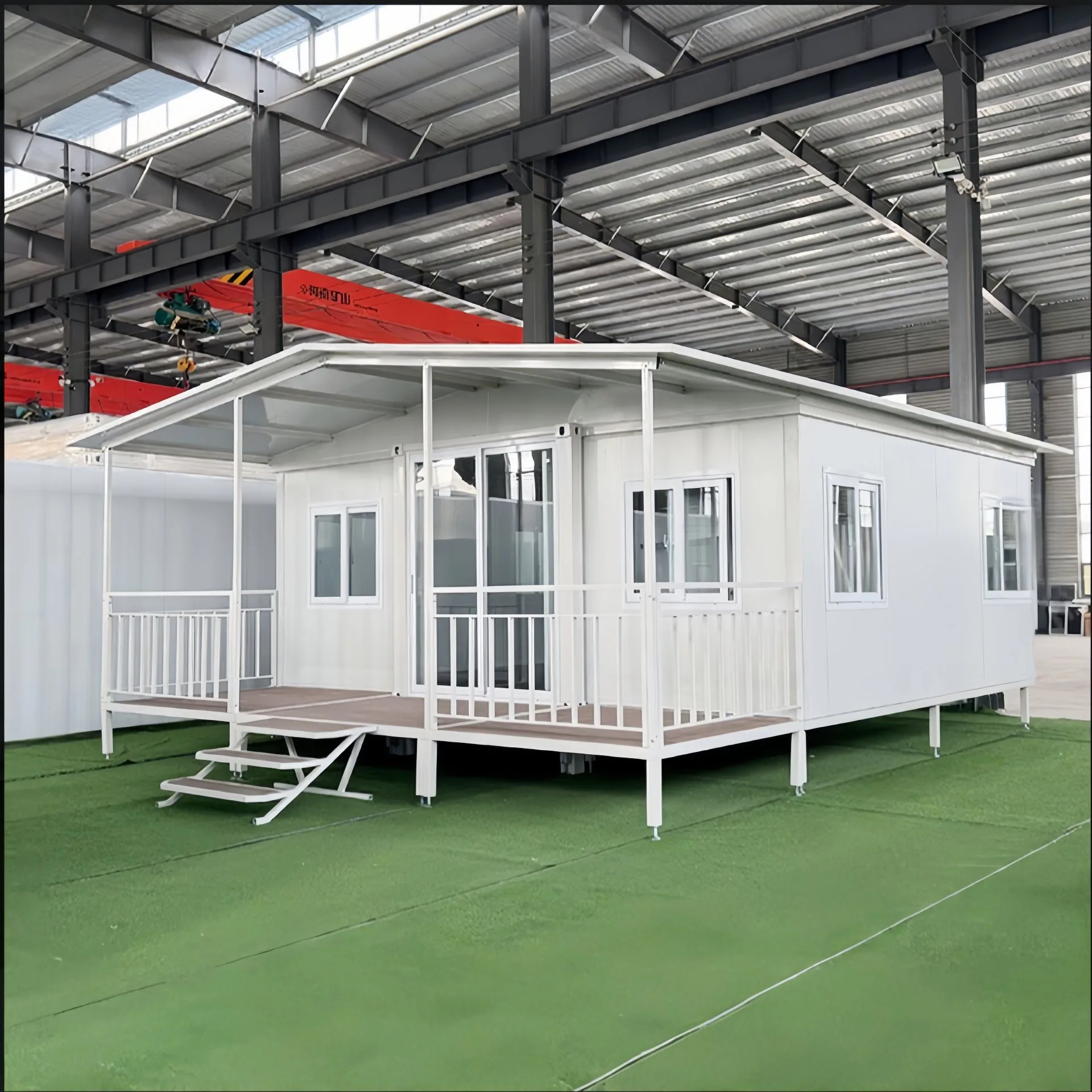
HG Prefab foldable expandable container homes — built to last, delivered worldwide.
A flower shop is one of the hardest small retail formats to fit into a building, and one of the easiest to fit into a folding expandable container house. The reason is simple: almost everything a florist does is a plumbing, drainage, temperature or sightline problem, and every one of those is solved at the factory rather than on site. A unit arrives with the electrics already in the walls, the wet area already roughed in, the window openings already cut where you asked for them, and a steel shell that does not care how many times a day you slop water across the floor.
This guide is written for florists, market-gardeners adding a retail arm, and event-flower studios who want a permanent shop without a permanent construction project. It covers the three sizes we actually sell and what each can hold, the cold-chain decision that determines your power bill, the wet-area details that keep a shop hygienic and legal, the display and customer-flow thinking that drives impulse sales, ventilation and humidity, flooring, delivery access and the permits you will be asked for. If you have already read our container home coffee shop guide, you will recognise the logic: the shell is the easy part, the services and the customer journey are what decide whether the shop works.
Why a Folding Unit Suits a Florist Better Than a Leased Shop Unit
Three structural advantages show up again and again in florist fit-outs. First, water. A florist floor gets wet dozens of times a day, and a steel-framed unit with a factory-fitted waterproof floor and a drained wet zone handles that far better than a carpeted rented room you are not allowed to alter. Second, cold. Retail leases penalise you for the ducting, condenser placement and extra circuits a walk-in cooler needs; in a folding unit the refrigeration penetrations, condensate drain and dedicated circuit are designed before the unit is built. Third, timing. A folding unit unfolds into a lockable, serviced shell in a single day, which means your fit-out budget goes into coolers, shelving and signage instead of six months of rent during a build.
The trade-off is footprint discipline. You are working with between roughly 36 and 76 square metres, so every square metre has to be assigned a job: cold storage, wet work, dry work, display, counter, circulation. That is a design constraint, not a problem — the best florist shops in the world are compact, and the discipline tends to improve the layout rather than harm it.
Layout by Size: 20FT, 30FT and 40FT
All three models use the same folding principle — the unit travels collapsed and opens into roughly double its transport width — so the difference between them is pure floor area and how you divide it. Factory prices are 20FT $7,200–$9,800, 30FT $10,500–$14,500 and 40FT $12,500–$16,500, ex-works, before freight, taxes and local fit-out.
20FT — around 36 m²: the bouquet bar
A 20FT unit opening to roughly 5.9 m × 6.1 m is a genuine single-room shop and it works best as a high-turnover bouquet bar in a high-footfall spot: a market entrance, a hospital or hotel forecourt, a garden-centre car park, a commuter plaza. Put the wet zone and walk-in cooler along the back wall in a single service band, run one continuous work counter across the middle, and leave the entire front glazed wall for display. In this size the customer stands outside or just inside the door and the florist works in full view — that transparency is the product. Choose a model with a wide glazed front such as our 20FT glass-front unit and you will not need to cut additional openings.
30FT — 7.0 × 8.0 m, about 56 m²: the sweet spot
The 30FT is the size most florists should buy. At roughly 7.0 m × 8.0 m it gives you about 56 m², which is enough to separate the three things that must be separated: a walk-in floral cooler of 6 to 8 m², a wet conditioning and bucket-sink zone, and a real customer area with room for two people to browse without touching elbows. The extra depth also lets you put the work bench parallel to the counter instead of behind it, so staff can prep and still serve. A configuration such as the 30FT woodgrain residence unit gives a warm interior finish that suits a florist without extra decorating spend.
40FT — around 76 m²: full-service studio
At roughly 5.9 m × 12.2 m, the 40FT supports a genuine two-zone business: a retail shop at the front and an event and wedding prep room at the back, each with its own cold storage. That separation matters more than it sounds, because wedding work involves hundreds of stems laid out across every flat surface for two days, and it should not collide with walk-in trade. The 40FT is also the size where a staff toilet and a proper staff hand-wash basin become realistic without eating the sales floor. See the 40FT glazed unit for a frontage that reads as retail rather than industrial.
Every model can be specified glazed or solid, single or double door, with the internal partitions and service runs placed where your layout needs them — start from the products page and work backwards from your cooler size.
Cold Chain: Walk-In Floral Cooler Versus Display Fridges
This is the single decision that shapes the whole fit-out, and the honest answer is that you need both, for different jobs.
A walk-in floral cooler is bulk storage. It holds hydrating buckets of cut stems, boxes of imported roses, wreaths and finished event work at roughly 2 to 4 °C with high relative humidity. It is the cheapest cubic metre of refrigerated space you can buy, it uses one condensing unit instead of five, and it keeps the entire back third of the shop at working temperature so conditioning happens in the cold rather than on the bench. Florists who skip the walk-in and try to run a shop from display fridges alone almost always run out of cold space in the second year.
Glass-door display fridges are merchandising, not storage. They sit in the customer area, they are lit, and they convert: a customer who can see a dozen ready-made bouquets at eye level buys one without asking a question, and that impulse purchase is the highest-margin sale in the shop. Specify single-door units for grab-and-go stems and a wider double-door unit for arrangements, and resist the urge to put them all in a row against the wall — an angled run creates a natural path through the shop.
Power load and circuits
Refrigeration dominates a florist's electrical demand, so size the supply around it rather than around the lighting. A small walk-in cooler with a self-contained condensing unit typically draws roughly 8 to 15 A on startup depending on climate and insulation; each display fridge adds roughly 3 to 6 A; and the balance of the shop — LED lighting, point-of-sale and card terminal, a small hot-water heater at the wash basin, extraction fans and a phone-charging point — adds another 10 to 20 A. Compressor startup is the peak that trips breakers, not steady running.
Ask for a dedicated circuit per refrigeration unit, a separate circuit for the wet area, and a whole-unit surge protector at the distribution board. Because our units are wired at the factory, these circuits can be pre-run in the wall with the outlets exactly where your equipment schedule puts them — no surface trunking after handover. See our container home electrical load guide for how we calculate a board, and the voltage and plug standards guide if you are importing to a 230 V / 50 Hz market.
One hard rule: the electrical hookup must be finished and tested before any cooler is switched on. A walk-in unit running on a long extension lead is a voltage-drop and fire problem, not a convenience. Our crane and forklift offloading guide covers how to sequence the lift, the set and the trades visit on the same day.
Wet Area: Bucket Sinks, Plumbing and Drainage
Conditioning flowers means buckets, and buckets mean water on the floor, stems in the drain and a sink that is deeper than a domestic one. The wet zone should be planned as a real room function even though it is only a corner: a deep stainless or composite bucket sink with a tall spout, a gooseneck tap that clears a 40 cm bucket, a hose reel or pull-out spray for rinsing stems and washing down, and a wall-mounted rack above the sink for drying buckets.
Drainage is where florist fit-outs go wrong. Specify a floor waste or a linear channel drain in the wet zone with a strainer that catches petals and leaves, and slope the floor to it — petals are the number one cause of blocked shop drains, and a removable strainer basket is worth more than any amount of drain cleaner. Give the sink its own trap and adequate venting, and keep the waste line short and direct. If your site has no mains sewer, our septic systems guide and greywater guide cover compliant options for a low-water commercial load.
Also plan a separate, clearly designated hand-wash basin for staff. Many shop-licensing inspections treat hand-washing and produce-washing as separate requirements even in a flower shop, and retrofitting a second basin after inspection is a painful way to learn that. Our plumbing and electrical rough-in guide shows what is normally positioned at the factory.
Display Windows, Shelving and Sightlines
Flowers sell through the eye, so glazing is not decoration — it is the shop window, the light source and the signage all at once. Three rules hold in almost every compact florist layout. Put the tallest, most colourful stock at the window line and the green, structural stock behind it, because colour is what stops a passer-by. Keep the window sill and the first metre of floor inside the glass free of buckets and crates, because clutter at the glass kills the view from the street. Light the display from above and slightly in front, at a high colour-rendering index, because warm-white lighting makes reds muddy and whites grey.
Shelving should be open, adjustable and shallow. Florist stock is mostly tall and narrow, so 25 to 35 cm deep shelves on a slotted upright system beat deep shelving every time; deep shelves create dead space at the back where stock is forgotten and wilts. Use a stepped display so the back rows are visible from the doorway, and keep a run of shelving at hip height near the counter for add-ons — vases, cards, ribbon and small gifts are the margin that pays the cooler's power bill. Tie the whole thing back to your retail boutique layout guide if you are also selling homeware.
Customer Flow and the Workspace Triangle
Apply the classic kitchen-triangle idea to the shop: the three points are the cooler, the wet bench and the counter. A florist walks between those three hundreds of times a day. Keep the total walking distance between them short, keep the path clear of the customer route, and never let the customer path cross the bucket-carrying path while a bucket is full of water.
The cleanest compact layout puts the service band — cooler, sink, bench — along one long wall, and the customer route along the opposite wall past the display fridges to the counter at the far end. That gives a single loop, one staff member can supervise it from the bench, and no one walks behind a customer carrying water. Keep the aisle at least 1.1 m wide where two people might pass and 0.9 m minimum elsewhere, and leave a clear 1.5 m turning circle at the counter for a wheelchair — see our accessibility design guide for the details inspectors look for.
Ventilation, Humidity and Ethylene
A sealed box full of wet flowers, foliage and open water is a humidity and mould problem waiting to happen. Two things control it. Mechanical extraction in the wet zone and above the bucket sink removes the water vapour at source; a humidity setpoint of roughly 50 to 60 per cent in the shop area and 85 to 90 per cent inside the cooler is the usual target, and a cheap hygrometer tells you whether the extraction is keeping up. Good airflow across the foliage also prevents botrytis, which is the grey mould that ruins stored stock — our mould prevention guide and ventilation guide both cover the detail.
Then there is ethylene. Ripening fruit and vegetables, and vehicle exhaust, release ethylene gas that ages cut flowers fast, so keep fruit and veg displays away from the flower storage, do not site the cooler's air intake near a parking area, and never store flowers in the same space as a generator. If your unit also holds a small grocery line, our cold storage guide explains why produce and flowers want separate air.
Flooring That Survives Water: Waterproof Luxury Vinyl
Choose waterproof rigid-core luxury vinyl plank (LVP or SPC) for a florist, and treat everything else as a compromise. It is fully waterproof rather than merely water-resistant, it is warm and slightly resilient underfoot for long conditioning shifts, it is quiet under bucket trolleys, and it is cheap enough to replace a damaged plank without a project. Laminate swells at the joints the first month; sheet vinyl is fine but harder to repair; timber needs a level of maintenance no flower shop has time for; and bare polished concrete is cold, hard and slippery when petals and water land on it.
Specify the details that make the difference: sealed or welded joints in the wet zone, a coved vinyl skirting turned up the wall where water is likely, a slip rating appropriate to a wet commercial floor, and a matted entrance that catches the first of the rain. Add a squeegee and a floor-drying routine at closing time — the cheapest safety measure in the shop. Our flooring options guide compares the full range available from the factory.
Delivery, Parking and the Offload Window
Flower shops live and die by two kinds of logistics: the supplier van with morning stock, and the customer who wants to pull up and run in for a bouquet. Plan for both before you choose the pad position. You need a level, compacted standing area within a short carry of the unit, room for a van to turn rather than reverse out onto a road, and a kerb-side or forecourt space close enough that a customer in a hurry still chooses you over the shop with parking.
The unit itself arrives folded. A crane or forklift is required to offload it from the truck, so survey gate width, overhead cables and ground bearing in advance, and build the pad inside the machine's rated reach from where the truck can legally stand. Once the unit is set, four workers unfold and assemble the main structure in about 2 hours, and the electrician should be on site the same day so the coolers have a tested supply. Work through our site prep checklist in the order it is written and the delivery day is boring, which is the goal.
Signage, Permits and Trading Rules
A folding container house reads as architecture, not as a shed — which helps with planning, but it does not exempt you from the rules that apply to any retail unit. Expect to deal with a change-of-use or commercial occupancy approval, a business licence or trading registration, and a separate signage permit for illuminated, projecting or roof-mounted signs. Submit the factory's structural drawings and electrical schedule with the application; inspectors accept documented systems far faster than verbal assurances. Our permits guide walks through the sequence.
Signage-wise, the strongest result for a compact unit is one clear fascia sign at the door side, a blade or projecting sign facing the approach direction, and one illuminated element — an illuminated fascia or a lit window display — because flower shops trade heavily in the early morning and the evening. Keep the sign off the glazing so the display stays visible. If you intend to sell gift hampers, chocolates or any packaged food alongside flowers, ask the licensing authority whether a food-handling registration is triggered before you open, because that can change the sink and surface requirements in the wet area.
Fit-Out Budget and Where the Money Goes
The table below allocates a typical florist fit-out across the three sizes. Costs are shown as a share of your fit-out budget rather than as fixed figures, because refrigeration pricing, labour rates and local compliance vary far more than the shell does — but the relative weighting is remarkably stable from project to project, and it is the weighting that catches people out.
| Fit-out item | Why it matters in a florist | 20FT (~36 m²) | 30FT (~56 m²) | 40FT (~76 m²) |
|---|---|---|---|---|
| Walk-in floral cooler | Bulk cold storage, hydrating buckets, wedding prep; one condensing unit instead of five | 28–34% (compact 4–5 m² unit, back wall) | 24–30% (6–8 m² unit, service band) | 20–26% (two units, retail and event zones separated) |
| Glass-door display fridges | Impulse sales at eye level; the highest-margin equipment in the shop | 14–18% (one single-door unit) | 13–17% (two units, angled run) | 12–16% (three units across two zones) |
| Wet area: bucket sink, tapware, drainage | Deep sink, gooseneck tap, floor waste with petal strainer, staff hand basin | 8–11% (single wet corner) | 8–10% (wet zone plus separate hand basin) | 9–12% (wet zone plus staff WC in 40FT layouts) |
| Electrical: dedicated circuits, board, surge protection | One circuit per refrigeration unit, separate wet-area circuit, whole-unit surge protection | 7–10% | 7–9% | 8–11% (more circuits, longer runs) |
| Flooring: waterproof LVP / SPC | Fully waterproof, sealed joints, coved skirting, wet-rated slip resistance | 6–9% | 7–10% | 8–11% |
| Display shelving, counters, work bench | Shallow adjustable shelving, stepped display, service counter | 9–12% | 9–12% | 8–11% |
| Lighting and ventilation | High-CRI display lighting over stock; extraction at the wet zone | 5–8% | 5–7% | 6–9% |
| Signage, permits, point-of-sale | Fascia, blade sign, one illuminated element; licence and signage permits | 8–12% | 6–9% | 5–8% (fixed cost spread over a bigger shop) |
The pattern to notice: cold storage and display refrigeration together take roughly 35 to 50 per cent of the fit-out budget in every size, and they are the two items that must be decided before the factory schedule is frozen, because both need a penetration, a condensate route and a dedicated circuit. Everything else can be bought locally and fitted later.
ROI Logic: Why the Shell Pays for Itself Twice
The commercial case for a folding unit flower shop rests on three numbers, and all three move in the same direction.
Rent you do not pay. A conventional shop lease means rent, deposit, and rent again during a six-to-twelve-week fit-out. A folding unit is delivered, unfolded and lockable in a day, so the fit-out window shrinks to days and your fixed occupancy cost is the finance on the unit rather than a market rent on someone else's square metres. On a site you own or lease long-term, that difference is usually the whole margin on a small florist.
Waste you avoid. Florist profitability is dominated by shrinkage — stock that wilts before it sells. A properly sized walk-in cooler at the right humidity extends vase life by days rather than hours, and days of vase life are the difference between selling a stem and composting it. Most florists find the cooler pays for itself in avoided waste inside two seasons, particularly around Valentine's Day, Mother's Day and the wedding peak, which is exactly when a small shop runs out of cold space.
Asset you keep. A leasehold fit-out is a sunk cost you leave behind; a folding unit is a structure you can move, resell or repurpose. It has a resale market, it can be relocated to a better pitch if the first one disappoints, and it can be converted to storage, studio or accommodation if the retail plan changes. That reversibility is the real risk-reduction for a first-time shop owner.
Sanity-check the plan before you order: walk your peak week. Mother's Day and Valentine's Day are the two weeks that define the year, and if your cooler, bench and counter cannot handle the peak-week volume, buy the next size up. A 30FT unit at $10,500–$14,500 with the right cold storage outperforms a 20FT unit at $7,200–$9,800 that cannot hold peak stock every single time. Budget in months, not years: most compact florist units reach break-even inside 12 to 24 months at steady footfall, and the payback is driven far more by pitch quality and cold-storage capacity than by the price of the shell.
Planning a container home flower shop?
HG Prefab, manufactured by Henan Huangang Machinery Equipment Co., Ltd., builds 20FT, 30FT and 40FT folding expandable container houses for retail use, with the cooler penetrations, wet-area plumbing, dedicated refrigeration circuits, drainage points and glazed frontages specified before production. Factory prices are 20FT $7,200–$9,800, 30FT $10,500–$14,500 and 40FT $12,500–$16,500. Send your layout sketch and equipment schedule for a specification review. Email hgmechequip@gmail.com or WhatsApp +86 191 0388 7380. Full range on the products page.
Get a Quote Browse modelsFrequently Asked Questions
Do I need a crane to set up a folding container house flower shop?
Yes — a crane or forklift is required to offload the folded unit from the truck. Once it is set in position, four workers can unfold and assemble the main structure in about 2 hours. For a flower shop, the electrical hookup has to be finished and tested before any cooler or display fridge is switched on, so book the electrician into the same window as the lift, and keep the shop on a temporary supply if the permanent meter is not energised yet. A walk-in floral cooler should never run off a long extension lead.
Should a container flower shop use a walk-in floral cooler or glass-door display fridges?
Use both, for different jobs. A walk-in floral cooler holds bulk stock, hydrating buckets and wedding work at 2 to 4 degrees Celsius with high humidity, and it is the cheapest cubic metre of cold storage you can buy. Single- or double-door glass display fridges belong in the customer area, because they sell: customers buy what they can see and reach without asking. A 20FT shop usually fits one walk-in and one display fridge; a 30FT shop fits a 6 to 8 square metre walk-in plus two display units; a 40FT shop can separate a wedding and event prep cooler from the retail display.
How much electricity does a folding container flower shop need?
Plan the supply around the cold chain first, because refrigeration dominates the load. A small walk-in floral cooler with a self-contained condensing unit typically draws 8 to 15 amps at startup depending on climate and insulation, each display fridge 3 to 6 amps, and the rest of the shop — lighting, point-of-sale, water pump, fans and a small hot-water heater for the wash area — adds another 10 to 20 amps. Ask your electrician for a dedicated circuit per refrigeration unit, a dedicated circuit for the wet area, and a whole-unit surge protector, and have the factory pre-run those circuits so nothing is surface-mounted after handover.
What is the best flooring for a folding container house flower shop?
Waterproof rigid-core luxury vinyl plank, known as LVP or SPC, is the default answer for a florist. It is 100 percent waterproof, comfortable to stand on for long conditioning shifts, quiet under trolleys, and it tolerates the constant splashing around bucket sinks that destroys laminate and swells timber. Specify a glued or click system with sealed joints, run a coved vinyl skirting up the wall where the wet zone is, choose a slip rating suitable for wet areas, and keep a drain or a squeegee routine at the door so petals and water do not turn the entrance into a hazard.
Do I need a permit to run a flower shop from a folding container house?
Yes in almost every jurisdiction. A retail unit needs a change-of-use or commercial occupancy approval, a business licence or trading registration, and usually a separate signage permit for illuminated or projecting signs. Because a folding unit arrives as a factory-built structure, most authorities treat it like any other shopfitting project once it is sited: submit the structural drawings and electrical schedule with the application, and check drainage and grease-free waste rules for the bucket sink. Where you also sell packaged food or gift hampers, ask whether a food-handling registration is triggered before you open.