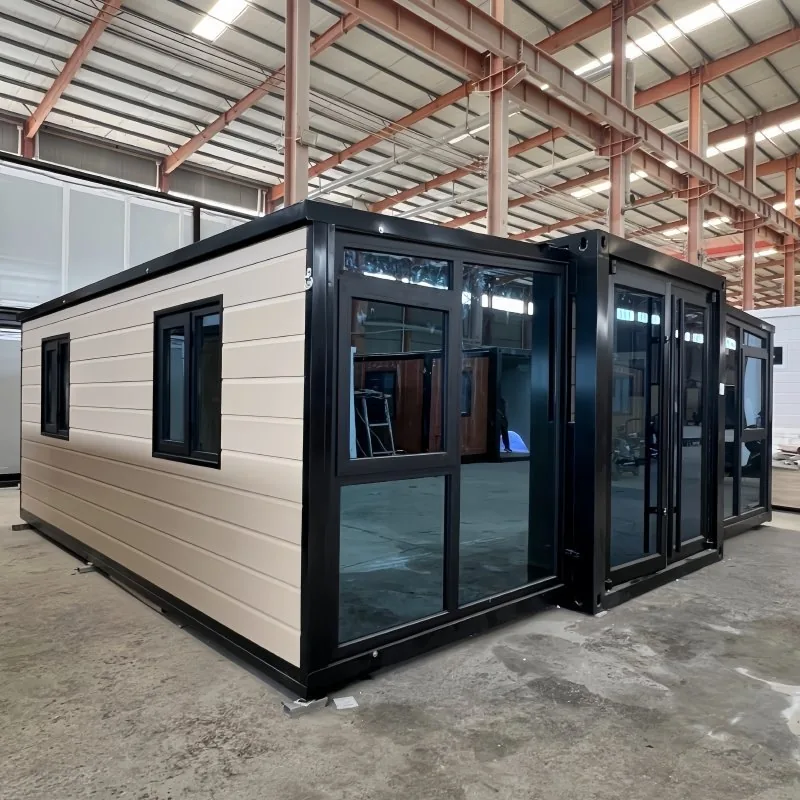
HG Prefab foldable expandable container homes — built to last, delivered worldwide.
Nigeria is the busiest West African market we ship folding container homes to, and the brief is remarkably consistent. A family plot in Lekki, Ajah, Ibeju-Lekki or Epe. A boys' quarters or a duplex replacement in Gwarinpa, Lugbe or Guzape in Abuja. A staff accommodation block inside an oil-services yard in Port Harcourt or Onne. A farmhouse outside Kaduna or Jos. A school, clinic or church extension in Enugu, Owerri or Ibadan. A small run of one-bedroom rentals on a cooperative estate in Ogun State. The reason buyers choose a folding unit instead of blockwork is the same in every case: conventional building in Nigeria is slow, cement and steel prices move with the naira, and the good contractors in Lagos and Abuja are booked out months ahead. A folding container home arrives as one sealed steel package, opens into a finished house in a single working day, and is priced in US dollars at the factory gate.
What decides whether a Nigerian import goes smoothly is never the house itself. It is the conformity paperwork, the tariff assessment, the pre-arrival documentation cycle, and the number of days your unit sits in a Lagos terminal waiting for a gate pass. This guide walks through all of it in the order it actually happens: what physically arrives and what it costs at the factory; the SONCAP programme run by the Standards Organisation of Nigeria and the two certificates it produces; HS 9406 classification, customs value and the duty question; Form M and the PAAR; the three Lagos gateways; demurrage and what congestion really costs; inland haulage to Abuja and Port Harcourt; how to specify the unit for Nigerian heat, humidity and termites; and how to pay for it without losing money to a scam. It is general guidance written for buyers working through a licensed Nigerian clearing agent. Every rate, fee and procedure should be confirmed against the current official schedule before you commit funds. Start with our container home shipping guide for folded dimensions, Incoterms and the document set, then come back here for everything Nigeria-specific.
What Arrives: Folded Envelope, Expanded Footprint and Factory Price
The most useful fact for import planning is how much smaller a folding unit travels than it lives. A 40FT unit that opens to roughly 5.9 m × 12.2 m and about 76 m² of floor area ships as a package about 2.15 m wide and 12.0 m long. That is inside standard road width, inside a standard container envelope, and handleable at Apapa or Lekki like ordinary break-bulk or flat-rack cargo. It is the reason a folded unit can travel 750 km up the A2 to Abuja on a low-bed trailer without an abnormal-load permit, while a volumetric modular box of the same floor area could not. Once the unit is built, the folded shipping weight is documented on the packing list and confirmed by the factory dispatch team. That one number drives three things: the freight quotation, the customs entry, and the crane class you book at the destination.
- 20FT folding expandable unit — folded about 2.15 m × 5.9 m, opens to 5.9 m × 6.1 m, roughly 36 m². Factory price $7,200–$9,800. The usual pick for a caretaker's house, a farm manager's unit, a site office or a single rental studio on a Lagos plot.
- 30FT folding expandable unit — folded about 2.50 m × 7.0 m, opens to 7.0 m × 8.0 m, roughly 56 m². Factory price $10,500–$14,500. The two-bedroom family layout most Nigerian buyers settle on; see the 30FT white folding unit for the standard configuration.
- 40FT folding expandable unit — folded about 2.15 m × 12.0 m, opens to 5.9 m × 12.2 m, roughly 76 m². Factory price $12,500–$16,500. Three bedrooms, a main house, a lodge building or a combined office-and-accommodation block on an industrial yard.
Those figures are ex-works factory prices for the folding unit with its standard interior finish. Freight, marine insurance, SONCAP fees, import duty, VAT, levies, terminal charges, the clearing agent's fee, inland haulage, the crane and the foundation are all additional and together they typically double the number. Confirm the configuration you want on the products page before fixing the size, because the decision that matters most in Nigeria is which unit will physically make it down your access road and onto your pad.
SONCAP: The Product Certificate and the SCER
Nigeria operates the SONCAP programme — the Standards Organisation of Nigeria Conformity Assessment Programme — for goods imported into the country. In plain terms, regulated products are assessed for conformity to Nigerian standards or their accepted international equivalents before they are shipped, and the importer presents the resulting certificate at the port. The programme produces two documents that matter to you: a Product Certificate (PC), which registers the product itself and is issued for a defined validity period, and the shipment-level SCER — the SONCAP certificate raised against a specific consignment and used at clearance. The PC comes first; the SCER is issued once the PC is in place and the shipment details are known.
There are different registration routes with different evidence requirements and different validity periods, and the route that applies to your shipment depends on how the product is declared and how often you import. Rather than assume, put the question to your agent in writing: does a folding expandable building under HS 9406 require SONCAP for this import, and if so, which route and which certificates? Where a required certificate is missing, consignments are held for destination inspection and the importer takes the penalty, the inspection cost and the delay. None of that is cheaper than doing the paperwork in China.
How the SONCAP sequence runs in practice
- Confirm scope before you order. Ask SON, an accredited inspection agent or your clearing agent whether your declaration falls inside the regulated scope. Get the answer in writing and file it with the rest of the import documents.
- Apply for the Product Certificate. The application carries the product description, technical file, photographs, test reports where available and the manufacturer's details. Where existing accredited test evidence is acceptable it is leveraged rather than repeated, which is why buying from a factory that holds its material certificates saves weeks.
- Product registration. Once the file is assessed and any testing is satisfied, the PC is issued. It belongs to the product and the manufacturer, not to one shipment, so a second unit ordered later moves faster.
- Raise the SCER for the consignment. With the PC in place, the shipment-level certificate is applied for against the pro-forma invoice and packing list, and a physical inspection is arranged at the factory before loading.
- Pre-load inspection in China. An inspector attends to verify the unit, its configuration, its markings and its conformity to the declared specification. This happens at the factory, not at the port.
- Certificate travels with the documents. The SCER is presented with the bill of lading, Form M and PAAR at clearance. Keep a scanned copy with your agent from the day it is issued.
What inspectors look at on a folding unit
Expect attention on four things: electrical safety and components, the build specification and materials, product marking and labelling, and the identity of the goods against the invoice description. The third and fourth are where imports most often stumble — a commercial invoice describing a generic "container" when a folding expandable prefabricated building is what is loaded, or a unit shipped with a configuration that differs from the registered technical file. Order the unit with the Nigerian electrical specification built in, keep the material certificates and test reports together as one document pack, and make sure the invoice description, the packing list and the physical unit all say the same thing.
HS 9406, Customs Value, Form M and PAAR
Classification and customs value
Prefabricated buildings are classified under HS heading 9406 in essentially every customs territory, and the Nigeria Customs Service follows the same convention through the ECOWAS Common External Tariff. Your clearing agent determines the national tariff line actually entered in the NCS system, and that line fixes the duty rate and any non-tariff conditions attached to your import. The second number that matters is customs value: Nigeria applies the WTO valuation rules and builds the value from the transaction value — the invoice price — with international freight and insurance added to reach a CIF-style base. Every percentage-based charge is calculated on that base, which is why an honest commercial invoice protects you and a creative one does not.
Form M: opened at a bank, before the goods ship
Form M is the mandatory import declaration form, and it is opened through an authorised dealer bank — a Nigerian bank licensed to handle import foreign exchange — before the goods are shipped. It carries the importer's details, the supplier, the goods description, the value, the HS code and the country of origin, and it is supported by the pro-forma invoice, the insurance certificate and the other import documents. Two consequences follow. First, you cannot start it late: a Form M opened after the vessel sails creates a mismatch that shows up at the PAAR stage. Second, the same bank is the channel through which the foreign exchange for the import is sourced, so your payment plan and your Form M are the same conversation. Our ordering and payment guide covers how that sequence is normally structured.
PAAR: the Pre-Arrival Assessment Report
The PAAR is issued by the Nigeria Customs Service before the goods arrive, and it is the document that tells you what you are going to pay. It is generated from the Form M, the pro-forma invoice and the risk assessment, and it states the HS classification, the duty rate, the VAT and the levies assessed on the consignment. A valid PAAR must be in place before the vessel berths. If the PAAR does not match the documents that arrive with the cargo, the entry is amended and re-assessed, and that amendment is measured in days at the terminal. Give your agent the final commercial invoice, the packing list and the bill of lading draft as early as possible so the PAAR is raised against real numbers rather than a pro-forma that changed.
Duty, VAT and the levies you should budget for
Four lines make up the tax stack. Import duty under the ECOWAS Common External Tariff on the confirmed 9406 line — commonly quoted as falling in a band of roughly 5% to 20% depending on the precise classification, and the only figure in this guide you must confirm with your agent before pricing the project. VAT at 7.5%, applied to the customs value plus duty and applicable levies; recoverable if you are a registered VAT taxpayer using the unit in a taxable business, and not recoverable for private residential use. Supervision and statutory levies, including the Comprehensive Import Supervision Scheme fee and other charges assessed as a percentage of the CIF value. And terminal, shipping-agency and NCS processing charges, which are tariffs rather than taxes and vary by terminal. Ask for a pro-forma duty computation in naira before the unit ships; seeing the payable figure early is the single cheapest insurance policy in this whole process.
The Lagos Ports: Apapa, Tin Can Island and Lekki Deep Sea Port
Almost every folding unit we ship to Nigeria discharges in Lagos, and Lagos has three working answers to the question of where. Knowing which one your carrier actually calls at is worth asking before you book, because it changes your trucking plan, your free time and your exposure to congestion.
- Apapa (Lagos Port Complex) — the oldest and largest, and the one most associated with the gridlock that has defined Nigerian port logistics for a decade. Deep-draft berths, full customs presence, and the heaviest truck traffic. Plan around the truck call-up and appointment system rather than assuming you can drive in on demand.
- Tin Can Island Port — across the harbour from Apapa, handling container and general cargo with its own terminals and bonded facilities. Often marginally quicker to gate than Apapa, but subject to the same road constraints once the truck is outside.
- Lekki Deep Sea Port — the newer deep-water port serving the Lagos Free Zone and Ibeju-Lekki corridor, with modern handling equipment and far less legacy congestion. If your sailing has a Lekki call and your plot is on the Lekki–Epe axis, this can be the cleanest door-to-site option in Nigeria; check container and break-bulk availability for your sailing window, because frequency is still building.
- Onne and Port Harcourt — worth asking about for Niger Delta deliveries. A direct discharge at Onne or the Port Harcourt wharf removes the entire Lagos-to-Port-Harcourt road leg, which is one of the longest and most unpredictable hauls in the country. Availability depends entirely on the carrier's service pattern.
Two questions to put to your forwarder at quotation stage. First, which terminal does this service actually discharge at, and is it a direct call or a transhipment? A transhipment that looks fine on paper can add ten days. Second, what are the free-time and demurrage terms at the Nigerian end, in writing? Some importers consider routing through Cotonou or Lomé for onward carriage into Nigeria; occasionally it works, but weigh the transit formalities and the risk profile before buying a shorter ocean leg with a longer land border.
Demurrage, Storage and What Congestion Actually Costs
Demurrage is the charge the shipping line makes for keeping its equipment beyond the free time, and storage is what the terminal charges for occupying space. Both are billed per unit per day, both start the moment free time expires, and both are the reason a well-planned Nigerian import can cost several hundred dollars less than a poorly planned one for the identical house. Get the daily figure in writing at booking, because the difference between a five-hundred-dollar clearance and a five-thousand-dollar clearance is usually five days.
What actually causes delay
- A PAAR raised against a pro-forma invoice that no longer matches the final commercial invoice.
- An HS code queried at entry, which triggers re-assessment and a physical examination.
- Form M amendments — a change of value, supplier or description after the form is opened.
- A SONCAP certificate that does not match the shipment description on the bill of lading.
- Missing or late original documents, especially the bill of lading release after a telex or bank delay.
- Public holidays, which close the banks as well as the ports, so a Form M cannot be amended either.
- Truck availability and the call-up system in Apapa, which decides when your low-bed can actually enter.
The countermeasure is boring and effective: appoint the clearing agent while the unit is still in production, send complete documents the day the vessel sails, and hold one person accountable for chasing the release. A good Lagos agent is not a line item to trim; he is the difference between three days and three weeks. Our customs broker and freight forwarder guide sets out what to ask before appointing one and how to read the quote they send back.
Inland Haulage, Offloading and Installation Day
Lagos to Abuja and the north
Abuja is roughly 750 km from Lagos, and the run is normally two to four days of road time after the gate pass is issued. The folded unit travels within standard road width, which is what makes the trip realistic at all, but three things still decide it: axle-load enforcement at the weighbridges, the condition of the last stretch to the plot, and the season. Book delivery outside the April-to-October rainy season wherever the site allows it, and walk the final approach in person before the truck is booked. If the last two hundred metres are laterite, plan for timber matting or a graded access before the low-bed arrives.
Port Harcourt, Warri and the Niger Delta
For Rivers, Bayelsa and Delta State deliveries, compare two plans honestly: discharge in Lagos and truck east, or discharge at Onne or Port Harcourt if the carrier calls there and move a short distance. The second plan usually wins on risk even when it loses on freight, because it removes a long haul on a corridor with checkpoints, road works and seasonal flooding. Where a site is genuinely off-road — a farm, a riverine plot, a pipeline corridor — a barge or a short water leg is sometimes the realistic option, and your agent will know the local operators.
Crane, forklift and the two-hour assembly window
Yes — a crane or forklift is required to offload the folded unit from the truck. Once it is set in position, four workers can unfold and assemble the main structure in about 2 hours. Mobile cranes of the class a folded unit needs are widely available for hire in Lagos, Abuja and Port Harcourt, but availability and price both move with the day, so book the machine for the same window as the truck rather than on the morning of delivery. Confirm the folded shipping weight from the packing list before you book the machine class, check that the pad sits inside the crane's rated reach, and make sure the ground will carry the outrigger loads — Nigerian laterite that has been rained on will not. Details and hiring tips are in our crane offloading guide.
Piers, drainage and levelling
A folding unit does not need a full slab. The standard approach is a set of concrete piers — pad footings cast on a compacted base, positioned to the unit's load points, with the unit set level on them so air moves underneath. On Nigerian plots piers beat slabs for three reasons: they cost less, they cure faster, and in a climate with a six-month rainy season they keep the steel frame clear of standing water. Take the pier design to a local structural engineer who knows your soil, give the site a positive fall so water drains away from the pad rather than under it, and size the pier depth to the ground rather than to a rule of thumb.
Specifying for Nigerian Heat, Humidity, Termites and Rain
Nigeria is not one climate. Coastal Lagos and Port Harcourt sit hot and humid for most of the year with salt in the air; Benin City and the south-east add heavier rainfall; Abuja has a wet season and a dry, dusty harmattan from roughly December to February; the north runs hotter, drier and dustier still. A unit specified for Kano wants a different build-up from one specified for Lekki, and the differences are cheap at the factory and expensive afterwards.
Corrosion and coating
Coastal and riverine sites are the demanding case. Specify a marine-grade coating system over a properly prepared, blast-cleaned substrate — a zinc-rich primer and a durable topcoat — and get the coating specification in writing on the order. Every cut, drill and weld made on site after coating is a corrosion site waiting to happen, so plan penetrations for services at the factory. Wash salt deposits off the exterior periodically on coastal sites and keep the underside clear and ventilated. Our rust and corrosion guide covers coating systems and repair in detail.
Ventilation, condensation and heat
Air conditioning running against a poorly insulated envelope is the most common source of condensation problems in tropical units, and condensation is what eventually shows up as staining, mould and swollen interior panels. Specify generous roof and wall insulation, a reflective or ventilated roof build-up where the model allows it, cross-ventilation through opposing openings, and powered extraction from kitchen and bathroom. Pre-wire the air-conditioning circuits at the factory so no one is chasing a cable through a finished wall later. Our tropical and humid climate guide goes through the detailing.
Termites and other pests
Nigeria has aggressive subterranean termite species, and they are the local hazard that most often surprises overseas buyers. The steel frame is not food for termites, but packaging timber, any decking, interior joinery and stored building materials are. Specify pre-treated timber for anything wooden, keep the ground around the pad clear of offcuts and formwork, never bridge the gap between soil and frame with untreated wood, apply a soil treatment around the pier line as your contractor recommends, and keep the under-floor gap dry and ventilated. Rodent-proof the service penetrations at the same time.
Stainless hardware and electrical specification
On coastal sites, insist on stainless steel — 304 as a minimum, 316 close to the sea — for hinges, locks, fasteners and door furniture. Zinc-plated fittings that look fine in a factory photograph will rust within a wet season in Lekki or Onne. On the electrical side, Nigeria runs 230 V, 50 Hz with the British-derived BS 1363 three-pin rectangular-pin socket and fused plug, and installations use RCD protection and proper earthing. Order the unit pre-wired to that arrangement with the distribution board, circuit layout and protective devices built in, and pre-run circuits for air conditioning, water heating, a borehole pump and a solar inverter. Given how unreliable grid supply is across most of the country, almost every Nigerian buyer we supply specifies at least a generator inlet and a solar-ready inverter position, plus surge protection for the whole installation.
Nigerian Landed Cost: Every Line Your Agent Will Charge
| Cost or compliance line | Basis of calculation | Indicative range (USD) | Notes for Nigerian imports |
|---|---|---|---|
| Factory price (FOB China) | Model and specification | 20FT $7,200–$9,800 · 30FT $10,500–$14,500 · 40FT $12,500–$16,500 | Invoiced by Henan Huangang Machinery Equipment Co., Ltd. (HG Prefab) |
| Ocean freight, China to Lagos | Per unit, by size, season and service | $2,400–$5,600 | Shanghai, Ningbo, Qingdao or Shenzhen to Apapa, Tin Can Island or Lekki |
| Marine insurance | Percentage of invoice value | $50–$140 | Optional but strongly recommended for the ocean leg |
| Import duty | ECOWAS Common External Tariff rate on the confirmed HS 9406 line, applied to customs value | Usually 5–20% depending on classification — confirm with your agent | The single largest variable; get the tariff line confirmed before you price the project |
| VAT | 7.5% of customs value plus duty and applicable levies | 7.5% | Recoverable for registered VAT taxpayers; not recoverable for private residential use |
| Supervision and statutory levies | Percentage of CIF value | Confirm current rates with your agent | Assessed in the PAAR; CISS and other charges each have their own basis |
| SONCAP Product Certificate and SCER | Per product registration, then per shipment | Varies by scope and route | Applied for in China, before the vessel sails |
| Form M and bank charges | Per Form M, through an authorised dealer bank | Confirm with your bank | Opened before shipment; the import FX is sourced through the same bank |
| Terminal handling, shipping agency and NCS processing | Port and agent tariffs | $400–$1,200 when clearance runs to plan | Every extra day is a charge — clear fast |
| Demurrage and storage | Per unit per day after free time expires | Ask for the daily figure in writing | The cost that escalates fastest in Lagos |
| Clearing agent fee | Per entry | $300–$900 | A good Lagos agent is the difference between three days and three weeks |
| Inland haulage, Lagos to destination | Distance, road condition and season | Within Lagos $400–$900 · Port Harcourt $1,200–$2,400 · Abuja $1,400–$2,800 | Low-bed trailer; the folded unit travels within standard road width |
| Crane or forklift day plus crew | Machine class and hours | $500–$1,400 | Required for offloading — book the machine for the same window as the truck |
| Concrete piers and site works | Local contractor and soil conditions | $1,500–$4,000 | Pier depth depends on the ground; give the pad a positive fall for drainage |
Read the table as a planning range, not a quotation. The pattern we see on Nigerian imports is consistent: a 40FT unit standing on piers in Abuja typically lands at around two to two and a half times the factory price, with the tax stack and the inland leg each contributing roughly a third of the uplift. Deliveries inside Lagos skip most of the inland leg; Port Harcourt and the north-east add the most.
Foreign Exchange, Payments and Avoiding Scams
Paying from Nigeria: the FX reality
Imports are paid for in foreign currency and your naira cost depends on the rate you actually get, on the day you get it. Foreign exchange for goods imports is sourced through the authorised dealer bank that opened your Form M, and the rate you are quoted, the documentation the bank requires and the time it takes to settle all vary. The practical advice is simple: budget the project in US dollars, convert at the rate your bank confirms in writing for the specific transaction, and build a contingency of ten per cent into the naira figure for rate movement between quotation and payment. Ask the bank which form and which documentation it needs before you send money, not after.
Scams and how to verify the factory
Nigerian buyers are targeted by fake suppliers more than most, and the losses are entirely avoidable. Work through this list before any money moves.
- The bank account must be in the legal name of the manufacturing company, matching the contract and the business licence. A request to pay a personal account, a trading company, a "logistics partner" or a third-party agent is the single clearest warning sign.
- Ask for the business licence and verify it. A legitimate factory will send its registration without hesitation and will not mind you checking it.
- Ask for a live video call on the production floor, and ask to see your unit specifically — the serial plate, the configuration, the packing list — not a stock marketing clip.
- Be sceptical of a price far below the market. A 40FT folding unit quoted at half the $12,500–$16,500 band is not a bargain; it is either an unfinished shell or a deposit that disappears.
- Use a trade term and a payment structure that gives you leverage — a documented contract, staged payment against production milestones, and a pre-shipment inspection before the balance is released.
- Confirm the email domain and the WhatsApp number against the company's published contact details before replying to any change of bank instruction. Our details are below and never change.
For genuine orders, the contract is with Henan Huangang Machinery Equipment Co., Ltd., brand HG Prefab, and payment is made to that company's account. Reach us at hgmechequip@gmail.com or on WhatsApp at +86 191 0388 7380. If an email claiming to be from us gives you different bank details, call the number above before you pay.
A working timeline, week by week
- Weeks 1–2. Confirm the model and price band (20FT $7,200–$9,800; 30FT $10,500–$14,500; 40FT $12,500–$16,500), lock the 230 V / 50 Hz Nigerian electrical specification and the coating system, appoint a Nigerian clearing agent and confirm the SONCAP scope in writing.
- Weeks 2–4. Open the Form M through your authorised dealer bank; the agent confirms the HS 9406 tariff line and the current duty rate; the SONCAP Product Certificate application and factory inspection are arranged in parallel with production.
- Weeks 4–8. Production, typically 15–30 days, with factory QC, the document pack and loading. The SCER is raised against the final shipping documents.
- Weeks 7–11. Ocean transit from Shanghai, Ningbo, Qingdao or Shenzhen to Lagos, commonly about 25–38 days depending on service and transhipment. The PAAR must be in place before the vessel berths.
- Terminal. Clearance, usually 4–10 working days once documents are complete; every additional day is demurrage or storage.
- Inland. Within Lagos 1–2 days; Lagos to Abuja 2–4 days; Lagos to Port Harcourt 2–4 days. Shorter if you discharge at Onne or Lekki.
- On site. Roughly 30–60 minutes to offload and set with a crane or forklift, about 2 hours for four workers to unfold and assemble the main structure, then 2–5 days for services, interior finishing and the electrical connection.
Planning a Nigerian import?
HG Prefab, manufactured by Henan Huangang Machinery Equipment Co., Ltd., supplies 20FT, 30FT and 40FT folding expandable container houses to Nigerian buyers at $7,200–$9,800, $10,500–$14,500 and $12,500–$16,500 ex works, with the documentation SONCAP, the Nigeria Customs Service and your clearing agent need: folded dimensions, shipping weights, steel and coating specifications, material certificates, electrical drawings configurable to 230 V / 50 Hz with BS 1363 sockets, and lifting-point layouts for your crane booking. Send your plot location, nearest main road and preferred Lagos terminal for a landed-cost estimate to Apapa, Tin Can Island, Lekki or Onne. Email hgmechequip@gmail.com or WhatsApp +86 191 0388 7380. Full model range on the products page.
Get a Quote Browse modelsDo I need a crane to install a folding container home in Nigeria?
Yes — a crane or forklift is required to offload the folded unit from the truck. Once it is set in position, four workers can unfold and assemble the main structure in about 2 hours. In Nigeria, mobile cranes of the class a folded unit needs are widely available for hire in Lagos, Abuja and Port Harcourt, but availability and price both move with the day, so book the machine for the same window as the truck rather than on the morning of delivery. Confirm the folded shipping weight from the packing list before you fix the machine class, check that the pad sits inside the crane's rated reach, and make sure the ground will carry the outrigger loads, because Nigerian laterite that has been rained on will not.
Is SONCAP certification required to import a folding container home into Nigeria?
Nigeria runs the Standards Organisation of Nigeria Conformity Assessment Programme (SONCAP) for imported goods, and it produces two documents that matter to you: a Product Certificate (PC) that registers the product, and the shipment-level SCER used at clearance. Whether a folding expandable building declared under HS 9406 falls inside the regulated scope, and which registration route applies, should be confirmed in writing with SON, an accredited inspection agent or your clearing agent before the unit loads. If certification is required, apply early, because the assessment and the factory inspection happen in China before the vessel sails. Consignments that arrive without a required certificate are held for destination inspection, and the importer takes the penalty, the inspection cost and the terminal delay.
What are Form M and PAAR, and when do I need them?
Form M is the mandatory import declaration form, opened through an authorised dealer bank in Nigeria before the goods are shipped. It records the importer, the supplier, the goods description, the value, the HS code and the origin, and it is the same channel through which the foreign exchange for the import is sourced — so your payment plan and your Form M are one conversation. The PAAR, or Pre-Arrival Assessment Report, is issued by the Nigeria Customs Service from the Form M, the invoice and the risk assessment, and it states the HS classification, duty rate, VAT and levies payable on your consignment. A valid PAAR must be in place before the vessel berths, and any mismatch between the PAAR and the documents that arrive with the cargo means re-assessment measured in days of demurrage.
How much duty and VAT will I pay on a prefabricated house imported into Nigeria?
Prefabricated buildings are declared under HS heading 9406, and your clearing agent confirms the national tariff line that fixes the rate. Budget for import duty under the ECOWAS Common External Tariff — commonly quoted as falling within a band of roughly 5% to 20% depending on the precise classification, and the one figure you must confirm with your agent rather than assume — plus VAT at the standard 7.5% rate applied to the customs value including duty and applicable levies, plus supervision and statutory charges assessed as a percentage of the CIF value, plus terminal, shipping-agency and NCS processing fees. Customs value is built from the invoice price with freight and insurance added, so an accurate commercial invoice protects you. Ask your agent for a pro-forma computation in naira before the unit ships.
How long does it take to ship a folding container home from China to Lagos and clear it?
Plan on production of roughly 15–30 days, ocean transit of about 25–38 days from Shanghai, Ningbo, Qingdao or Shenzhen to Lagos depending on service and transhipment, clearance of about 4–10 working days once documents are complete, then inland haulage: 1–2 days within Lagos, 2–4 days to Abuja and 2–4 days to Port Harcourt. Discharging at Lekki Deep Sea Port or at Onne shortens the land leg considerably if the carrier calls there. The variables that extend the timeline are almost never the sailing — they are a PAAR raised against a pro-forma that no longer matches, an HS code queried at entry, a Form M amendment, and a SONCAP certificate that does not match the bill of lading. Appoint the agent during production and send complete documents the day the vessel sails.