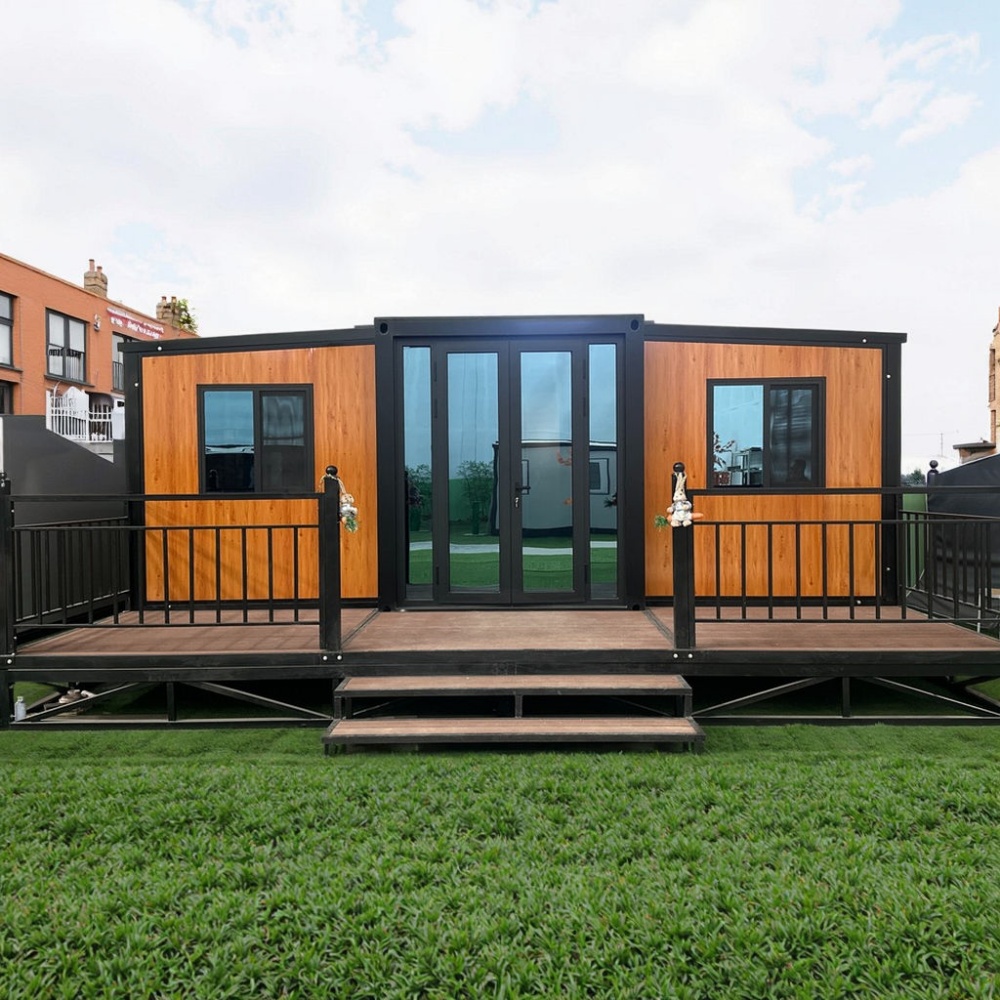
HG Prefab foldable expandable container homes — built to last, delivered worldwide.
An arcade is the rare home project where the machines dictate the building. Cabinets are heavy, they hum, they generate real heat, and each one wants a stable circuit that is not shared with anything else. A folding container unit handles those demands better than a converted garage: the steel shell is inherently dark and enclosed, the electrical rough-in is factory-installed, and the room can sit away from the house so a late-night session does not disturb anyone. HG Prefab builds 20FT, 30FT and 40FT foldable container houses that ship flat-packed and unfold on site. This guide covers cabinet layout, power, cooling, lighting, sound and budget for a container arcade.
Why a Container Unit Makes a Good Arcade Room
- Naturally dim and enclosed — arcades want low ambient light and a black ceiling. A windowless steel room delivers that with minimal treatment.
- Independent power and heat — the arcade can have its own sub-panel and its own cooling, so it does not load the house circuits or the household HVAC.
- Noise containment — the steel shell plus insulation and a solid door keeps cabinet hum, attract-mode jingles and shouting inside the room.
- Relocatable collection — collectors move. A container arcade travels with the machines rather than being abandoned in a garage.
The shell arrives folded. A crane or forklift is required to offload the folded unit from the truck. Once it is set in position, four workers can unfold and assemble the main structure in about 2 hours, so an empty room can be ready for cabinets the same afternoon.
How Many Cabinets Fit: 20FT, 30FT or 40FT
Cabinet planning is a simple arithmetic problem, but the constants matter. Allow 760 mm of width per upright cabinet, 1,100 mm for a sit-down driver or a two-player deluxe cabinet, and at least 1,200 mm of clear walking space in front of the control panels.
| Unit size | Floor area | Cabinets (uprights) | Layout |
|---|---|---|---|
| 20FT | ~14 m² | 3–4 | Single wall run plus one pinball machine |
| 30FT | ~21 m² | 5–7 | Two opposing walls with a central aisle |
| 40FT | ~28 m² | 8–10 plus a driver | Peripheral run with a free-standing island and a bar shelf |
Two rules keep the room playable. First, never place two cabinets back to back without a 1,200 mm aisle — two players cannot stand there at once otherwise. Second, leave the two cabinets nearest the door as the highest-traffic titles, because players drift toward the entrance.
Power: Circuits, Load and Safety
Arcade power planning is about inrush, not average draw. A cabinet that idles at 90 W can pull 400–600 W for a fraction of a second when the CRT or switching supply energises, and a dozen of those on one circuit will trip a breaker.
- Per-cabinet sizing — budget 200–400 W for a classic upright with a CRT monitor, 300–500 W for a modern LCD conversion with an amplifier and LED marquee, and 400–700 W for a driver, pinball or deluxe cabinet with solenoids and shakers.
- Cabinets per circuit — four cabinets per 20 A / 120 V circuit is a safe working limit, or five to six per 16 A / 230 V circuit. Never daisy-chain more than that on a single run.
- Dedicated circuits — give pinball machines and drivers their own circuit. Their solenoid coils and shaker motors create voltage dips that upset neighbouring boards.
- Total load — a 10-cabinet 40FT arcade with a driver, pinball and mini-split lands around 5–7 kW. At 120 V that is 40–60 A; at 230 V it is 22–30 A. A dedicated 63 A single-phase sub-panel covers most collector rooms with headroom.
- Protection — RCD/GFCI protection on the room's circuits, individual switched outlets or a rack-mounted power strip per group so you can isolate one cabinet without shutting the room down.
- Surge protection — original power supplies and vintage boards are sensitive. A whole-panel surge arrester plus a decent strip on each group is cheap insurance.
- Cable management — run a perimeter dado trunking or under-floor channel. Loose extension leads across a dark aisle floor are the main trip hazard in an arcade.
Our electrical load guide explains how to size the sub-panel, and the smart technology guide covers remote switching so the room can be powered down from the house.
Cooling and Ventilation
This is the part most home arcades get wrong. Ten cabinets with monitors, amplifiers and power supplies reject roughly 2–3 kW of heat into a room of about 28 m², and a sealed steel box holds that heat.
- Cooling capacity — allow 300 W of cooling per CRT cabinet and 200 W per modern LCD cabinet, plus 300–500 W for players. A 40FT with ten cabinets needs roughly 4–5 kW of cooling, comfortably more than a single 3.5 kW mini-split delivers.
- Two heads beat one — a 40FT arcade is best served by two 3.5 kW inverter heads, one at each end, so the room stays even rather than hot at the far wall.
- Air changes — 4–6 air changes per hour of fresh air keeps CO₂ and smell down in a closed room with a crowd. A heat-recovery ventilator moves the air without throwing away all the cooling.
- Exhaust at the ceiling — heat and dust rise. Extract high, supply low and away from seating.
- Dust — CRT and amplifier fans are dust magnets. A washable pre-filter on the return air, cleaned monthly, keeps cabinet interiors far cleaner.
Lighting and Sound
Arcade atmosphere is mostly a lighting decision. Get it right and even an empty container looks like a room built for the machines.
- Ambient level — keep general lighting low, around 50–100 lux, with a warm white or deep blue bias so the marquees and CRT glow dominate.
- Marquee and cabinet lighting — switch each bank of marquee lights separately from the general lighting so the room can be lit for maintenance without glare.
- Accent lighting — LED strip under a wall shelf, or a projected pattern on the ceiling, adds depth without raising ambient levels.
- Blackout — if the unit has a window, a blackout blind or shutter prevents daylight from washing out the screens at the worst time of day.
- Acoustic treatment — the steel shell reflects sound. A perforated acoustic panel on one long wall and a heavy or double-layer door cut the reverberation noticeably and keep the noise inside the unit rather than in the neighbour's garden.
Flooring, Cabinets and Comfort
- Floor structure — a loaded upright cabinet runs 90–150 kg, a pinball machine 130–180 kg and a deluxe driver up to 300 kg. Verify the point loads against the unit's floor rating, and spread heavy machines over a plywood or steel spreader plate.
- Floor finish — a dark, patterned LVT or vinyl hides scuffs and cable marks better than polished concrete and is far easier to clean.
- Cabinets and leveling — set cabinets on adjustable feet, level them after the unit has settled, and leave a 50 mm gap at the wall so the marquee light and back panel ventilate.
- Seating and shelf — a perimeter bar shelf at 1,050 mm with stools gives players somewhere to put a drink; a small counter for the coin-op change box or the scoreboard screen works well near the door.
- Accessibility and egress — keep a clear 900 mm path to the exit at all times and make sure the door opens outward. Crowded dark rooms are where people fall over.
Cost Breakdown and Planning
- Container unit — 20FT $7,200–$9,800; 30FT $10,500–$14,500; 40FT $12,500–$16,500 depending on finish and options.
- Electrical sub-panel, circuits and outlets — $2,000–$6,000 for a 10-cabinet room.
- Cooling and ventilation — $2,500–$7,000 for twin mini-splits and a heat-recovery ventilator.
- Acoustic panels, blackout and interior finishes — $2,000–$6,000.
- Flooring and furniture — $1,500–$4,000.
- Cabinets — the wildcard. Working classics run $800–$3,000 each, restored collector pieces far more.
A shell plus services package for a 40FT arcade typically lands between $25,000 and $45,000 before machines, and a 20FT starter room between $12,000 and $22,000.
Plan the services before the unit is ordered, because the electrical and cooling work is far cheaper as a factory or pre-delivery job than as a retrofit. Cure the pad fully, then book the lift. Yes — a crane or forklift is required to offload the folded unit from the truck. Once it is set in position, four workers can unfold and assemble the main structure in about 2 hours. Use that window to have the sub-panel, conduit and cooling pipework already prepared at the pad edge so the contractor can connect the day the shell is closed up. HG Prefab can pre-cut ducts and additional wall penetrations and upgrade the factory electrical package to suit a sub-panel feed, which avoids cutting into a finished interior later.
Need a folding container house?
HG Prefab manufactures 20FT, 30FT and 40FT folding expandable container houses with optional factory electrical upgrades, duct pre-cuts and insulation packages — ideal for game rooms, studios and workshops. Shipped flat-packed worldwide.
Browse modelsFrequently Asked Questions
How many arcade cabinets fit in a container home?
A 20FT unit fits three to four uprights plus a pinball machine, a 30FT fits five to seven across two opposing walls with a central aisle, and a 40FT fits eight to ten plus a driver. Allow 760 mm of width per upright, 1,100 mm for a driver or deluxe cabinet, and at least 1,200 mm of clear aisle in front of the control panels.
How much power does a container arcade game room need?
Budget 200–400 W per classic CRT upright, 300–500 W for an LCD conversion and 400–700 W for a driver or pinball machine. Keep to four cabinets per 20 A / 120 V circuit or five to six per 16 A / 230 V circuit, and give pinball and drivers their own circuit. A 10-cabinet 40FT arcade with cooling typically needs 5–7 kW, so a dedicated 63 A single-phase sub-panel is a sensible minimum.
How do I keep a container arcade room cool?
Allow about 300 W of cooling per CRT cabinet, 200 W per LCD cabinet and 300–500 W for players. A 40FT with ten cabinets needs roughly 4–5 kW, which is best served by two 3.5 kW inverter heads, one at each end. Add 4–6 air changes per hour of fresh air through a heat-recovery ventilator and extract high, where the heat collects.
How much does it cost to build a container arcade game room?
A 40FT shell with electrical sub-panel, twin mini-splits, ventilation, acoustic treatment and flooring typically lands between $25,000 and $45,000 before machines; a 20FT starter room between $12,000 and $22,000. The unit itself is $7,200–$9,800 for 20FT, $10,500–$14,500 for 30FT and $12,500–$16,500 for 40FT, and cabinets are the largest variable.
Do I need a crane to install a container arcade room?
Yes — a crane or forklift is required to offload the folded unit from the truck. Once it is set in position, four workers can unfold and assemble the main structure in about 2 hours. Cure the pad and pre-install the sub-panel feed, conduit and cooling pipework at the edge of the pad before delivery, so the room can be commissioned the same week.