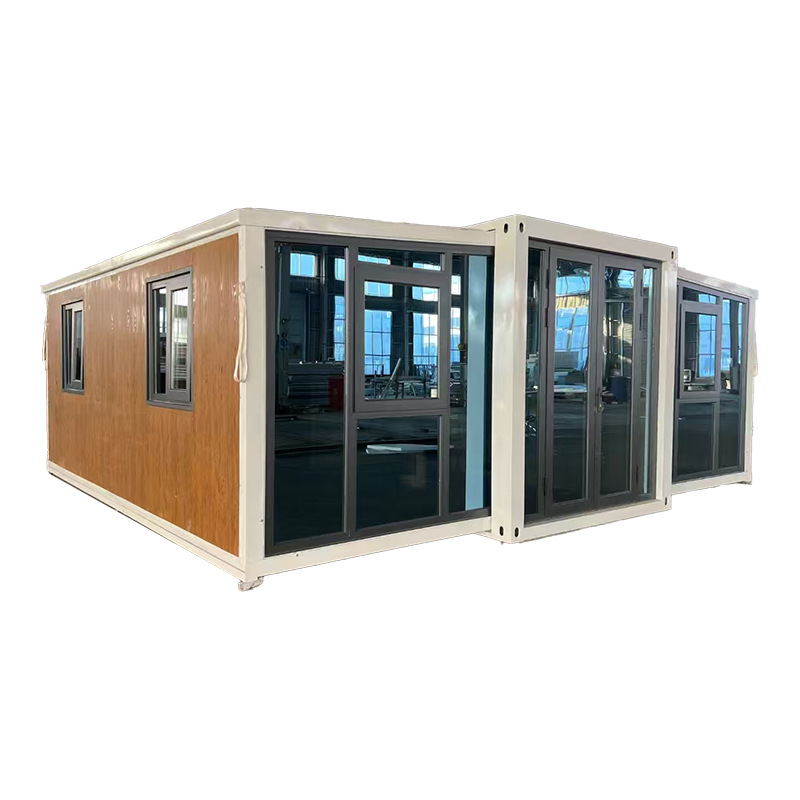
HG Prefab foldable expandable container homes — built to last, delivered worldwide.
Doors and windows are the obvious weak points of any home, and folding container homes are no exception. The good news is that a steel-framed container is naturally more secure than a timber-framed house, so most upgrades are simple, targeted and affordable. This guide covers steel doors, multi-point locks, roller shutters, security film, smart locks and camera placement for 20FT, 30FT and 40FT HG Prefab units.
Start With the Factory-Fitted Doors and Windows
HG Prefab units ship with steel-faced entry doors, double-glazed windows and multi-point locksets as standard. Those defaults are the baseline for any further upgrade:
- Entry door — insulated steel panel with a multi-point locking strip and a security escutcheon covering the cylinder.
- Windows — double-glazed units in aluminum frames, with key-locking handles and tilt-and-turn hardware.
- Door frame — welded steel sub-frame that anchors into the container corner posts.
For a full house-security overview beyond openings, see our container home security guide.
Upgrade the Entry Door
The entry door takes the most daily abuse and is the first target for an intruder. Three upgrades deliver most of the benefit:
- Replace the cylinder with an anti-snap euro cylinder — a £30–$50 cylinder stops the most common forced-entry technique.
- Add a multi-point lock — the standard 3-point lock engages at top, middle and bottom of the door. Upgrade to a 5-point lock (top, bottom, left hook, right hook, centre) for $80–$200 extra.
- Install a security strike plate — a stainless steel plate with 80 mm screws into the steel frame resists kick-ins far better than a wood-screw strike.
For 40FT units with a second entrance, repeat the same spec on every external door.
Secure the Sliding Glass Doors
Many 30FT and 40FT units have a large sliding glass door as the main entrance. Sliding doors are convenient but vulnerable without these additions:
- Anti-lift blocks — small plastic or metal blocks screwed into the top track stop the door being lifted off the rail.
- Charley bar or dowel — a 25 mm metal or hardwood dowel in the track blocks the door from sliding even if the lock is defeated.
- Multi-point sliding-door lock — a hook-lock engages at the head and sill for $80–$250 fitted.
- Security film — a 0.1 mm polyester film bonded to the inner glass holds shards together on impact.
Roller Shutters and Security Grilles
For high-risk sites — coastal rentals, isolated farms or commercial units — physical barriers add another layer:
- Aluminum roller shutters — manual or motorized shutters close over windows and doors. Expect $300–$700 per window for manual and $600–$1,200 for motorized.
- Steel security grilles — fixed or retractable grilles on the inside face of windows stop forced entry without darkening the room.
- Fold-away patio shutters — concertina-style shutters lock the largest openings and disappear when not in use.
Shutters also improve thermal performance — a useful side benefit for sun-exposed sites. See our insulation guide for thermal details.
Window Security Film, Sensors and Glass Choices
Glass is the second most common entry point after doors:
- Security film — a 0.1–0.3 mm clear film bonded to the inner pane delays forced entry by 30–90 seconds; usually $20–$40 per m² installed.
- Laminated glass — replace standard double-glazed units with laminated glass where break-in risk is highest; cost premium is 30–60%.
- Glass-break sensors — acoustic sensors detect the frequency of breaking glass and trigger alarms or sirens. Battery models cost $20–$60 each.
- Vibration contacts — a small sensor on the frame detects prying or impact; pairs well with roller shutters.
Smart Locks and Access Control
Smart locks add convenience and a full audit trail of who entered when:
- Bluetooth smart locks — open via phone, fingerprint or PIN; retrofittable to most euro-cylinder doors. Expect $80–$250 fitted.
- Wi-Fi smart locks — remote control and guest PIN sharing; need a stable Wi-Fi signal at the door.
- Keypad locks with mechanical backup — provide PIN entry plus a physical key override so a dead battery never locks you out.
- Integration with cameras — pair the smart lock with a doorbell camera so you can see and speak to visitors before unlocking.
Camera Placement and Lighting
Cameras and lighting double as deterrents and evidence sources:
- Front-door camera — mount at 1.6–1.8 m with a clear view of faces and packages; a doorbell camera with two-way audio is best.
- Side and rear cameras — cover the rest of the perimeter, especially near bedroom windows and the secondary entrance.
- Driveway or path camera — a 2.8–4 mm wide-angle lens with 1080p or higher resolution captures approaching visitors.
- Motion-activated lighting — 1,000–3,000 lumen LED floods at each external corner turn on when motion is detected.
For broader smart-home integration, see our smart home technology guide.
Security Budget by Unit Size
- 20FT unit: $400–$800 covers an anti-snap cylinder, security film on every window, two cameras and a smart lock.
- 30FT unit: $700–$1,400 adds roller shutters on the largest windows, glass-break sensors and a floodlight.
- 40FT unit: $1,200–$2,400 adds motorized shutters, four to six cameras, a multi-point sliding-door lock and full smart-lock access on every entrance.
Most of these upgrades are DIY-friendly, but motorized shutters and structural reinforcement are best left to a fitter.
Installation Timing and Sequencing
When you fit door and window security on a folding container home, timing matters as much as the hardware itself. Order your upgrades so they line up with delivery, structural work and the finishing schedule rather than layering everything on at the last minute.
- Factory-fit what you can — shutters, multi-point locks, security film and smart-lock pre-wiring are cheaper and cleaner to install before the unit ships. Specify these on the order so recesses, knockouts and cable runs are cut at the factory instead of being drilled on site.
- Plan the unit drop first — the delivery window determines when you can begin interior fitting. Yes — a crane or forklift is required to offload the folded unit from the truck. Once it is set in position, four workers can unfold and assemble the main structure in about 2 hours.
- Stage structural work before glazing — add anti-lift blocks, security strike plates and sliding-door hook locks while the steel frame is still exposed, then finish with laminated glass or security film on top.
- Retrofit smart locks after power and network — run the access-point cable and doorbell-camera wiring during rough-in, then mount the smart locks so their batteries and firmware start fresh rather than half-drained by weeks of bench testing.
- Sequence cameras and lighting last — mount front, side and rear cameras at 1.6–1.8 m and aim the 1,000–3,000 lumen motion floods only once landscaping and decks are complete so nothing blocks the field of view.
Most door and window upgrades take one to three days across a single unit. Allow one clear day between the structural pass and the finishing pass so any caulking, sealant or epoxy-based security film can cure before hardware is mounted on top of it.
After installation, budget a day each year to re-verify the whole system. Re-torque shutter brackets, check anti-snap cylinders for wear, confirm security-film edges are still bonded, and test every lock, camera and motion flood before the rental or winter season. Replace batteries in smart locks and glass-break sensors on that same schedule, and keep a spare euro cylinder plus the strike-plate screws in a labelled box. If you rent the unit out, photograph the finished hardware and add a clause to the tenancy agreement requiring tenants to report any door or window fault within 48 hours. A small annual audit costs under an hour and a few dollars in parts — and it is what separates hardware that lasts a decade from hardware that fails in its first season.
Need a folding container house?
HG Prefab manufactures 20FT, 30FT and 40FT folding expandable container houses with steel entry doors, double-glazed windows and security-ready sub-frames — with optional factory upgrades for shutters, multi-point locks and smart-lock pre-wiring. Worldwide delivery.
Browse modelsFrequently Asked Questions
Are folding container home doors easy to break into?
No. Standard HG Prefab units ship with insulated steel-faced doors, multi-point locks and welded steel sub-frames. A basic anti-snap cylinder and a security strike plate stop the most common forced-entry attempts, and the steel frame resists kick-ins far better than timber.
What is the best lock for a container home entry door?
A 5-point multi-point lock with an anti-snap euro cylinder and a stainless steel security strike plate fixed with 80 mm screws into the steel frame. For sliding doors, add anti-lift blocks, a dowel in the track and a hook-lock that engages at both the head and sill.
Do container home windows need security film?
Yes in most exposed sites. A 0.1–0.3 mm clear security film bonded to the inner pane holds shards together on impact and delays forced entry by 30–90 seconds. It costs $20–$40 per m² installed and does not change the look of the window.
Are roller shutters worth it on a container home?
On isolated, rental or coastal sites they are worth the investment. Manual aluminum shutters cost $300–$700 per window; motorized versions $600–$1,200. They also reduce solar heat gain, which helps with cooling.
Can smart locks be installed on container home doors?
Yes. Most euro-cylinder container doors accept a Bluetooth or Wi-Fi smart lock retrofit for $80–$250 fitted. Choose a model with a mechanical key override so a dead battery never locks you out.