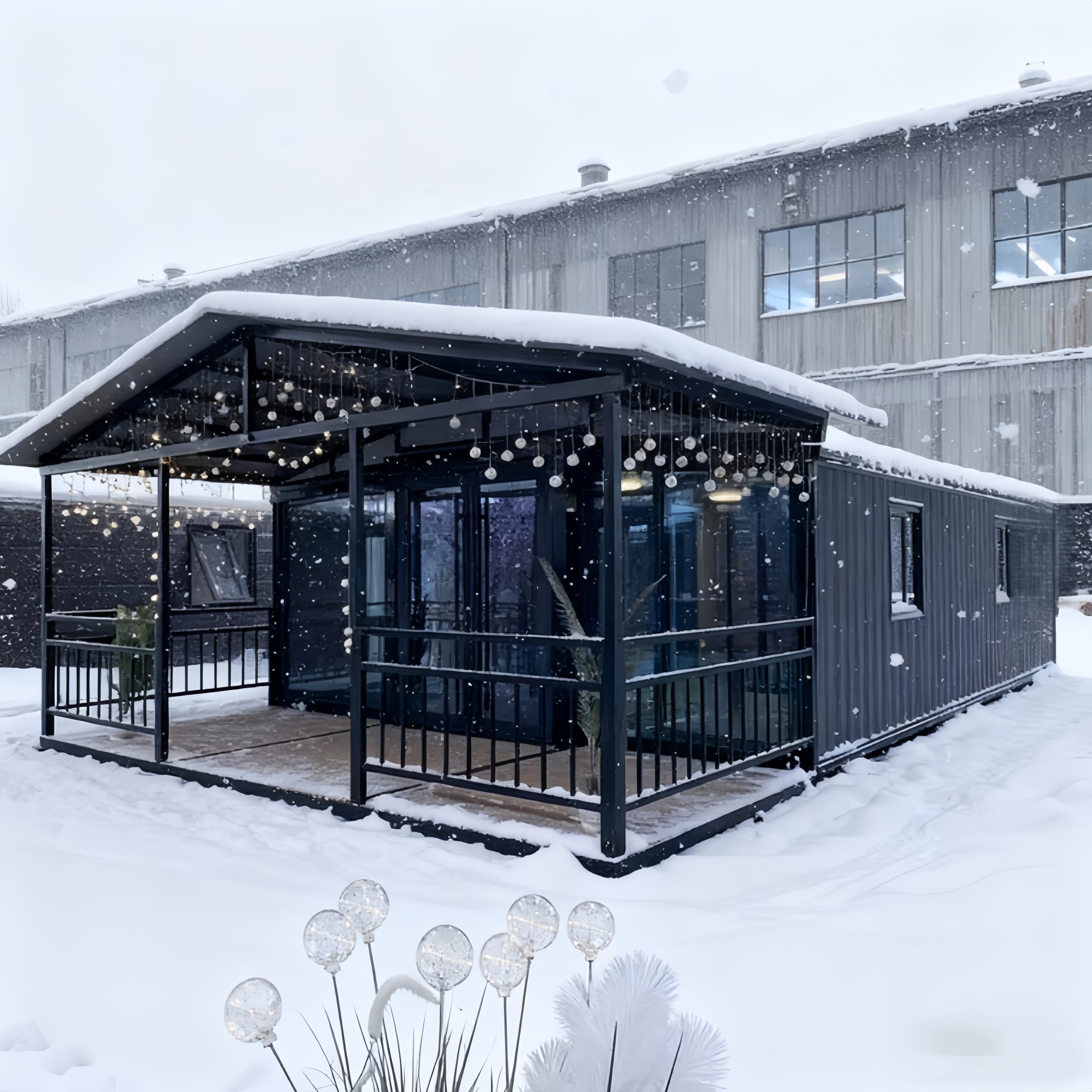
HG Prefab foldable expandable container homes — built to last, delivered worldwide.
A steel container home is strong, but steel is an excellent conductor — without proper insulation, a container becomes a furnace in summer and a fridge in winter. That is why insulation is the single most important quality difference between container homes. This guide explains how insulation works, what materials to look for, and why HG Prefab uses A1 fire-rated rock wool as standard.
Why steel homes need serious insulation
Steel conducts heat roughly 300 times faster than timber. On a 35°C day, an uninsulated container wall can reach 50–60°C on the inside surface. With the right insulation system, the same container stays within a few degrees of comfortable — and heating and cooling costs drop dramatically. Good insulation also stops condensation, the most common cause of mold in metal buildings.
A1 rock wool: the gold standard (HG Prefab standard)
Every HG Prefab container home uses A1 non-combustible rock wool (mineral wool) sandwiched between the steel panels. Rock wool is the same material used in high-rise fire protection.
- Fire safety: A1 is the highest European fire class — non-combustible, no toxic smoke. This matters enormously for insurance and permits.
- Thermal performance: Excellent insulation across all climates, with a long service life that does not degrade.
- Acoustics: Dense mineral fiber absorbs sound — a rock wool home is noticeably quieter.
- Moisture: Breathable and mold-resistant, reducing condensation risk.
PU foam vs EPS: the cheaper alternatives
Some manufacturers use polyurethane (PU) foam or expanded polystyrene (EPS) to save cost.
| Material | R-value (per 100 mm) | Fire class | Pros | Cons |
|---|---|---|---|---|
| Rock wool | ~3.0 – 3.4 | A1 (non-combustible) | Fireproof, acoustic, durable, breathable | Slightly higher cost |
| PU foam | ~5.0 – 5.5 | B (combustible) | Very high R-value, lightweight | Burns with toxic smoke; degrades with UV |
| EPS | ~3.7 – 4.0 | E (combustible) | Cheap | Poor fire performance, low strength |
For a home you will live in, sleep in and insure, the small price difference for rock wool pays for itself many times over in safety and comfort.
Understanding R-values and U-values
R-value measures resistance to heat flow — higher is better. U-value measures heat transfer — lower is better. A well-insulated container home in a temperate climate should achieve a wall U-value around 0.4 – 0.6 W/m²K, comparable to a modern timber-frame house. HG Prefab units are built to this standard with 75–100 mm rock wool core panels.
Condensation: the silent enemy
In cold or humid climates, warm indoor air meeting a cold steel surface creates condensation — which leads to rust and mold. Proper container construction handles this with:
- Vapor barriers on the warm side of the wall.
- Ventilation — trickle vents or an extractor fan in kitchens and bathrooms.
- Thermal breaks where the frame meets panels.
All HG Prefab units include vapor-barrier layering as standard, and we can add ventilation packages for tropical or cold climates.
Climate-specific advice
- Tropical / hot climates: Add roof overhang or shade structure, light exterior colors, and consider an AC unit sized for the space.
- Cold climates: Choose double-glazed windows, add underfloor insulation if the unit is on piers, and keep continuous heating to avoid condensation.
- Coastal / salty air: The galvanized steel frame resists corrosion, but regular washing of the exterior helps panels stay pristine.
Spec your home for your climate
Tell us where you're building — we'll recommend the right insulation package, glazing and ventilation for your region.
Browse insulated models