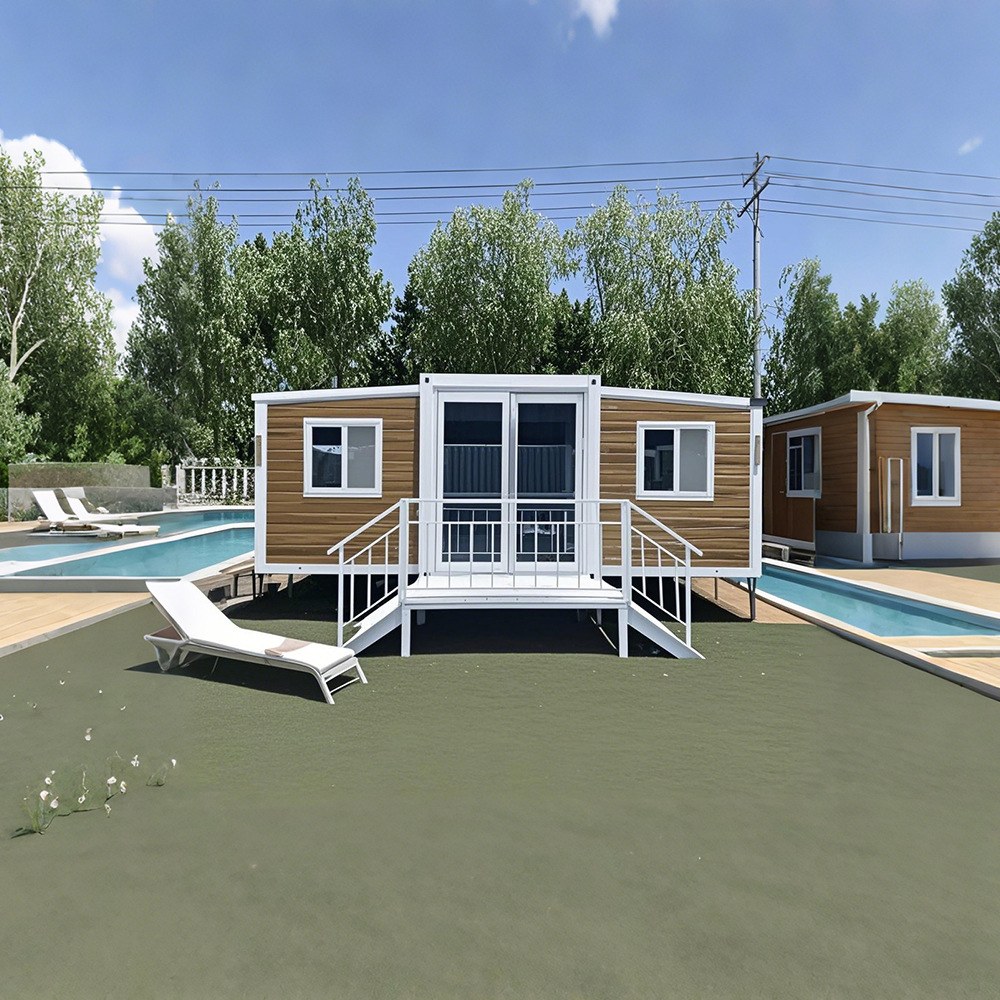
HG Prefab foldable expandable container homes — built to last, delivered worldwide.
Luxury glamping is one of the fastest-growing segments in rural hospitality, and the folding container house is its most practical building block. A glamping container home combines a premium interior with steel-frame durability, arrives as a folded flat-pack unit, and can be expanded on site into 36–76 m² of rentable space in a single day. For landowners who want a high-ROI retreat without a year-long construction project, a 20FT/30FT/40FT folding container house rental cabin from HG Prefab is hard to beat. This guide covers the layouts, interiors, rates and math that make glamping container homes profitable.
Why Glamping Buyers Are Choosing Folding Container Homes
- Speed to revenue: a folding unit ships flat, is offloaded with a crane or forklift, and four workers unfold and assemble the main structure in about two hours — meaning bookings can open weeks after arrival, not months.
- Lower land risk: many rural and agricultural lots can host a relocatable cabin under farm-stay rules that would never allow a permanent hotel building.
- Prefab quality: HG Prefab builds wall panels, glazing, insulation and utilities in a factory, so guests get a consistent finish with none of the weather delays of on-site framing.
- Moveable asset: if one site underperforms, the unit can be re-folded and relocated to a better spot.
- Guest appeal: the industrial-meets-cozy look photographs beautifully, and a well-styled container cabin commands a rate premium of 20–40% over a basic tent or caravan.
Choosing the Right Size and Layout for a Rental Cabin
Match the unit to the market you serve. Couples and small families book the most nights, while groups and events justify the largest units. HG Prefab's fold-out models give you a clear ladder of options:
| Unit | Expanded space | Best guest profile | Typical nightly rate |
|---|---|---|---|
| 20FT | 36 m² | Couples, glamping retreats | $150–$250 |
| 30FT | 56 m² | Families of 3–5 | $200–$320 |
| 40FT | 76 m² | Groups, two-bedroom luxury | $280–$420 |
A popular strategy is to cluster two or three 20FT units as individual cabins around a shared fire-pit area. Each unit rents independently, so occupancy risk is spread and you can close one for maintenance without losing all income.
Interior Fit-Out Ideas That Justify Premium Rates
Guests pay for the bed, the bathroom and the view — in that order. Spend your budget where the reviews are written:
- King bed with hotel bedding: a 20FT studio sleeps two in luxury; white linens and layered throws photograph best.
- Rain shower and heated towel rail: a genuinely hot, high-pressure shower is the #1 "wow" item in off-grid cabins.
- Compact kitchen: induction hob, under-counter fridge and an espresso machine let couples self-cater without a full restaurant kitchen.
- Layered lighting: warm dimmable LED strips and reading lights create the cozy evening mood that drives five-star reviews — see our container home lighting guide.
- Acoustic comfort: quiet mini-split heating and cooling plus insulated panels keep the cabin comfortable at 30°C or −5°C, extending your bookable season.
- Local character: reclaimed timber accents, wool throws and handmade ceramics differentiate your cabin from every other listing in the area.
Outdoor Add-Ons That Lift Revenue
- Deck or veranda: even a 10–20 m² deck adds a rentable "outdoor room" and doubles the usable space guests perceive.
- Hot tub or fire pit: a fire pit is cheap and hugely social; a hot tub lets you raise the nightly rate by $50–$100.
- Off-grid autonomy: solar power and a rainwater or tank water system (see our off-grid water and solar guides) let you place cabins where no grid exists.
- Path and privacy planting: cabins 15–25 m apart with screening between them command higher rates than rows of units.
- Photo corners: a styled porch, an outdoor bathtub or a hammock with a view generates the guest photos that market your listing for free.
Realistic Rental Math: Rates, Occupancy and ROI
Let us model a single 40FT luxury cabin with realistic assumptions:
- Nightly rate: $320 average (seasonal $250–$420)
- Occupancy: 60% in year one, 70% after the listing matures (≈ 220–255 booked nights)
- Gross revenue: 220 nights × $320 = $70,400
- Operating costs: cleaning, utilities, platform fees, maintenance ≈ 30–35% of gross
- Net revenue: ≈ $45,000–$49,000 per year
Against a complete site cost of roughly $40,000–$60,000 (unit at $12,500–$16,500 plus shipping, foundation, fit-out and deck), a well-managed luxury glamping container cabin typically pays for itself in 12–24 months. A 20FT cabin is cheaper to launch — the unit costs $7,200–$9,800 — and is the lower-risk way to test a new market before adding more units.
Budget, Delivery and Set-Up for Your Glamping Unit
- Unit price: 20FT $7,200–$9,800; 30FT $10,500–$14,500; 40FT $12,500–$16,500 (FOB China, excluding shipping).
- Shipping and customs: budget 15–30% of the unit price for a long-haul delivery depending on your region.
- Site works: gravel pad or screw piles, utility stubs, deck and landscaping — typically $5,000–$15,000.
- Furniture and styling: $3,000–$8,000 for a genuinely luxury fit-out.
- Delivery day: a crane or forklift is required to offload the folded unit from the truck; once it is set in position, four workers unfold and assemble the main structure in about two hours.
Check local rules before you book guests. Our container home permits guide explains zoning and short-term rental licensing, and our customization guide shows the window, cladding and interior options HG Prefab offers at the factory so your cabin looks bespoke, not boxy.
Need a folding container house?
HG Prefab manufactures 20FT, 30FT and 40FT folding expandable container houses with the finishes and floor plans glamping operators need — shipped flat-packed worldwide.
Browse modelsFrequently Asked Questions
Which folding container home size is best for a glamping rental cabin?
A 20FT unit (36 m²) is ideal for a couples' glamping cabin and the lowest-risk launch. A 40FT unit (76 m²) supports two bedrooms and rates of $280–$420 a night. Many operators cluster two or three 20FT cabins rather than buying one large unit.
How much can a luxury glamping container cabin earn per night?
Realistic nightly rates are $150–$250 for a 20FT cabin, $200–$320 for a 30FT and $280–$420 for a 40FT luxury fit-out. Actual rates depend on location, season, hot tubs or views, and how well the interior photographs.
Can a folding container house be moved to a new glamping site later?
Yes. The unit can be re-folded and trucked to a new site, which makes it a moveable asset if a location underperforms. Plan the road access and crane or forklift access when you choose the plot, because the folded unit must be lifted off the truck.
Do I need a crane to set up my glamping cabin?
Yes — a crane or forklift is required to offload the folded unit from the truck. Once it is set in position, four workers can unfold and assemble the main structure in about 2 hours.
What should I budget on top of the cabin price?
Allow 15–30% of the unit price for shipping, $5,000–$15,000 for site works and utilities, and $3,000–$8,000 for a luxury furniture fit-out. A complete 20FT glamping site typically lands at $25,000–$40,000 depending on location.