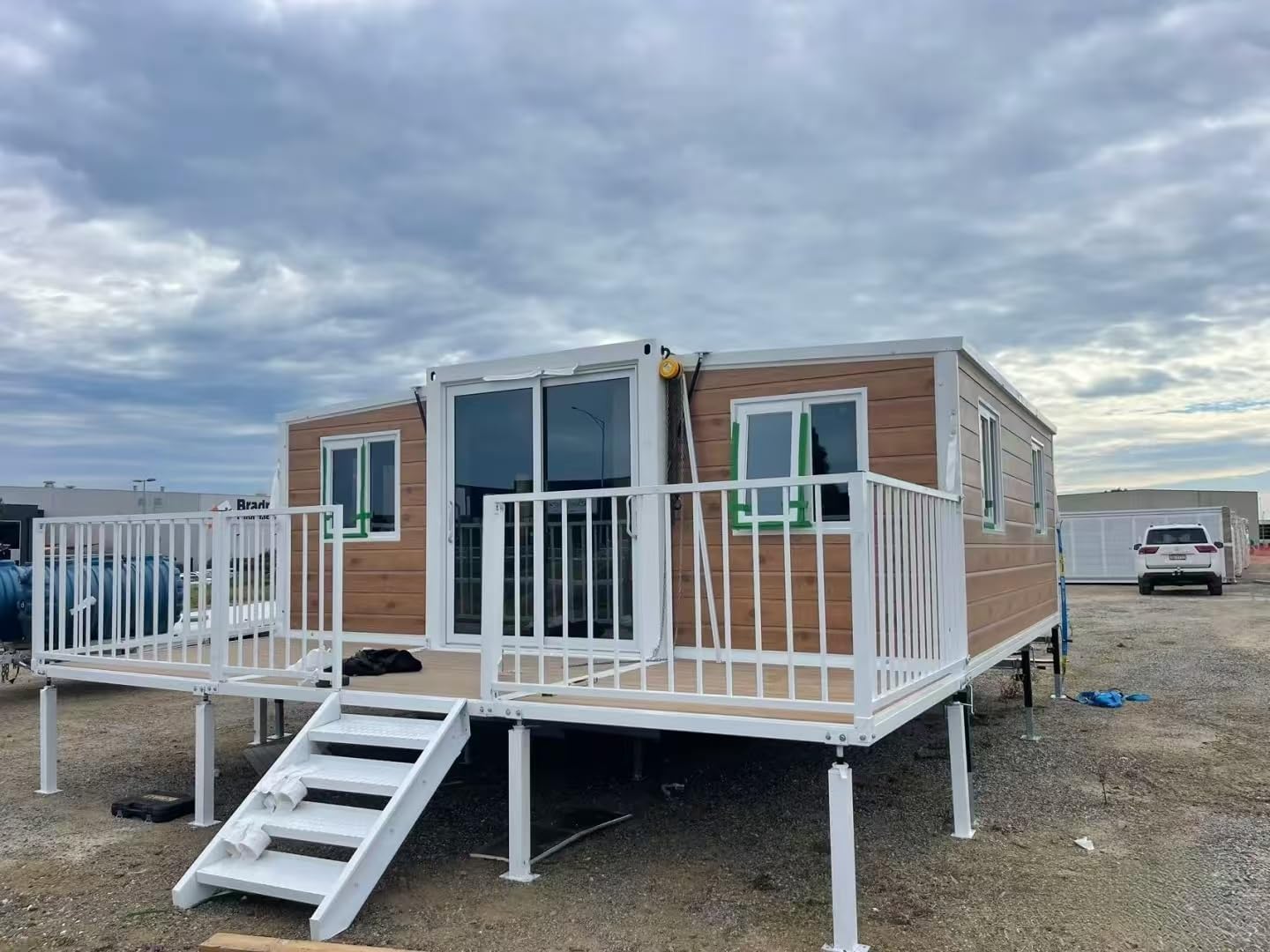
HG Prefab foldable expandable container homes — built to last, delivered worldwide.
Military and defense operations require housing that can deploy anywhere in the world, withstand harsh conditions, and be operational within hours of arrival. Traditional tent camps are lightweight but vulnerable to weather, fire and ballistic threats. Permanent barracks take years to build. Folding container houses occupy the critical middle ground: steel-protected, rapidly deployable, and configurable for everything from troop dormitories to command centers and medical facilities.
Why Defense Forces Choose Container Solutions
Military housing requirements are among the most demanding of any application:
- Rapid deployment — units fold flat, load onto C-130, C-17 or container ships, and assemble in hours. A 100-person camp can be operational in 48 hours.
- Ballistic and blast protection — steel walls provide inherent fragmentation protection. Additional armor panels can be fitted for higher threat environments.
- Weather resistance — withstands 200+ km/h winds, heavy snow, sandstorms and temperature extremes from -40°C to +55°C.
- EMI/RF shielding — steel construction naturally attenuates electromagnetic signals. With sealed joints and filtered power entry, units can serve as SCIFs (Sensitive Compartmented Information Facilities) or command centers.
- Modular flexibility — dormitories, kitchens, clinics, armories, workshops and headquarters — all from the same base unit with different interior fit-outs.
- Asset recovery — when operations shift, units fold and relocate. No abandoned infrastructure.
Container Camp vs Traditional Military Housing
| Factor | Folding container camp | Tent camp | Permanent barracks |
|---|---|---|---|
| Deployment time (100 beds) | 48 hours | 24 hours | 2–3 years |
| Ballistic protection | Steel walls + optional armor | None | Concrete / masonry |
| Weather resistance | Excellent | Limited | Excellent |
| Lifespan | 25–30+ years | 2–5 years | 50+ years |
| Cost per bed | $10,000–$18,000 | $3,000–$6,000 | $50,000–$100,000 |
| Relocatable | Yes (fold-flat) | Yes | No |
| Climate control | Full HVAC compatible | Limited | Full HVAC |
Folding container camps deliver 80% of permanent barracks capability at 20% of the cost, with deployment speed matching tent camps but durability far exceeding them. For cost analysis, see our folding container home cost guide.
Military Container Configurations
Troop Dormitory (40FT, 4–6 beds)
A 40FT unit configured with bunk beds (two-tier) for 4–6 personnel, lockers, a small common area and an attached bathroom. Climate-controlled with split AC and heating. This is the standard accommodation for deployed troops.
Command & Control Center
A 40FT unit fitted with EMI shielding, filtered power, raised flooring for cable management, and workstations for 4–6 operators. External antenna ports for radio and satellite communications. Can function as a tactical operations center (TOC) or intelligence facility.
Field Medical Facility
Multiple 40FT units connected as a field hospital: triage, treatment, surgery, recovery and pharmacy. Units are equipped with medical gas outlets, surgical lighting, sterilization equipment and negative-pressure isolation rooms. For more on medical applications, see our mobile clinic guide.
Kitchen & Dining
A 40FT unit with commercial-grade kitchen equipment serving 100+ meals per hour, connected to a 40FT dining hall with seating for 50 personnel. Refrigeration, dishwashing and food storage in dedicated units.
Armory & Storage
Reinforced 40FT units with security doors, internal racking for weapons and ammunition, and climate control to prevent corrosion. Optional ballistic panels for additional protection.
Ballistic and Blast Protection Options
Standard steel container walls provide Level I fragmentation protection (small arms fire splinters, shell fragments). For higher threat environments, additional protection can be fitted:
- Ballistic steel panels — 6–12 mm AR500 steel plates fitted to interior walls, providing NIJ Level IIIA to Level IV protection
- Sandbag walls — traditional but effective; container walls support sandbag stacking to 2 m height
- Earth berms — containers partially buried or backed by earth berms for blast wave mitigation
- Spall liners — Kevlar or composite liners on interior walls prevent steel spall from ballistic impacts
EMI Shielding for Sensitive Operations
The steel structure of a container house provides ~40–60 dB of electromagnetic attenuation naturally. For SCIF or SIGINT applications, additional measures achieve 80–100 dB:
- Sealed joints — conductive gaskets at all door, window and panel joints
- Filtered power entry — EMI filters on all power lines prevent conducted interference
- Waveguide vents — honeycomb ventilation panels that allow airflow but block RF signals
- Grounding — comprehensive earth bonding for the entire unit
Climate Control in Extreme Deployment Zones
Military operations span every climate on Earth. Container units must adapt:
- Desert deployments — oversized AC (1.5× standard), dust filtration, reflective coatings. See our extreme climates guide.
- Arctic deployments — enhanced insulation, heated floors, air-lock entries, trace heating on all pipes. See our winterization checklist.
- Jungle deployments — elevated foundations, anti-mold finishes, continuous dehumidification, insect screens
- Maritime / coastal — marine-grade anti-corrosion coatings, sealed electrical systems, salt-resistant fixtures
Logistics: Transport by Air, Sea and Land
Folding container houses are designed for multi-modal transport:
- Air — folded dimensions fit standard military pallet configurations. C-130 Hercules can transport 2–3 folded units; C-17 Globemaster can transport 6–8 units.
- Sea — folded units stack 2:1 or 3:1 in standard 20FT/40FT shipping containers, maximizing cargo density.
- Land — flat-bed trucks or rail flatcars. Units are offloaded by crane or forklift at the destination.
Once on-site, four workers assemble each unit in about 2 hours. No specialized tools or heavy equipment beyond the offload crane is required for assembly.
Security Features
Military camps require perimeter and unit-level security:
- Security doors — steel security doors with multi-point locking and forced-entry resistance
- Window bars / shutters — steel bars or roll-down shutters on all windows
- Perimeter fencing — Hesco barriers, concertina wire or welded mesh fencing
- Lighting — motion-activated floodlights and continuous perimeter lighting
- CCTV — pre-wired conduit for camera and sensor installation
For more on security systems, see our container home security guide.
Need rapid-deployment field housing?
HG Prefab supplies folding container houses for military and defense applications — troop dormitories, command centers, field hospitals and secure storage, with ballistic, EMI and climate options.
Browse models