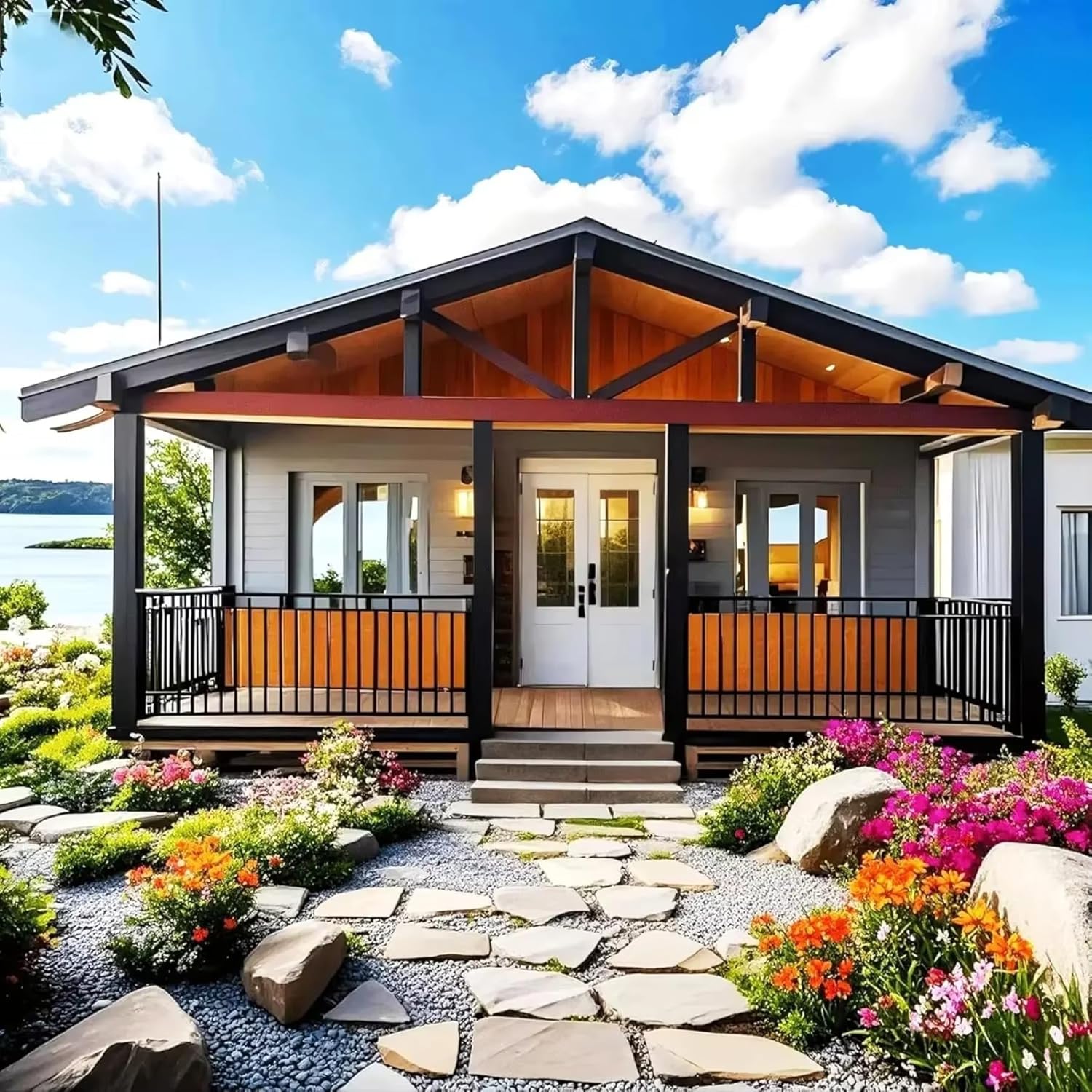
HG Prefab foldable expandable container homes — built to last, delivered worldwide.
Water is the first utility an off-grid site needs, and a folding container house makes it easier than most people expect. The unit's steel roof is an ideal catchment surface, its factory plumbing arrives ready to connect, and its compact footprint keeps tank and pump requirements small. Whether you are equipping a 20FT weekend cabin, a 30FT farm-stay or a 40FT permanent off-grid home, this guide covers the complete water chain: source, storage, pressure and treatment. HG Prefab folding container houses expand to 36–76 m² of living space, which is small enough that a well-designed off-grid water system can run entirely on tanks and a solar-fed pump.
The Four Building Blocks of an Off-Grid Water System
- Source: rainwater harvesting, a drilled or dug well, a spring, or delivered water. Most off-grid container homes combine rainwater for washing with either filtered rainwater or a well for drinking.
- Storage: tanks sized to carry the site through dry weeks. Storage is the cheapest insurance in any off-grid system.
- Pressure: a 12V or 24V DC pump plus a small pressure tank delivers mains-like pressure without a grid connection.
- Treatment: filtration and disinfection make the stored water safe to drink, whatever its original source.
Rainwater Harvesting From a Container Roof
A corrugated steel container roof sheds water cleanly and is the most economical catchment on a folding container house. The expanded roof of a 20FT unit is roughly 36 m², a 30FT about 56 m², and a 40FT about 76 m². Every millimetre of rain falling on one square metre yields one litre of water, so after collection losses you can expect roughly 0.8 litres per square metre per millimetre of rain:
- 20FT unit, 600 mm annual rainfall: ≈ 17,000 L/year of harvestable water
- 40FT unit, 600 mm annual rainfall: ≈ 36,000 L/year
- Double that yield in a 1,200 mm climate such as the tropics; halve it in a 300 mm desert zone.
Fit gutter guards, a first-flush diverter (it discards the first 20–40 L of each rain, which carries dust and bird debris from the roof), and fine mesh at the tank inlet. Keep the roof coating in good condition, since it doubles as your catchment surface.
Water Tanks for Folding Container Homes: Types and Sizing
| Tank type | Typical size | Pros | Watch-outs |
|---|---|---|---|
| UV-stabilised polyethylene | 500–5,000 L | Cheap, light, no corrosion | Degrades in sun if unshielded |
| Galvanised steel | 1,000–10,000 L | Strong, rodent-proof | Heavy; needs lining for potable water |
| Flexible bladder / pillow tank | 1,000–10,000 L | Folds flat for transport, fits under deck | Requires a flat, protected base |
| Concrete or ferro-cement | 5,000 L+ | Permanent, cool water | Permanent build, higher cost |
Size storage around your dry-season gap. A two-person off-grid household using 100 L/day needs about 3,000 L to cover a month with no rain; adding a second tank gives you a full seasonal buffer. For folding container houses, the most popular position is a poly tank or bladder hidden under the deck or the expanded floor, with a second tank on a stand for gravity-fed washing water.
Pumps and Pressure Systems
A container home's compact plumbing is easily served by a 12V or 24V DC pump running from the same battery bank as your solar system — see our solar power sizing guide. The essentials:
- Flow rate: 10–20 L/min for a 20FT–40FT unit with one or two taps running at once.
- Pressure: a pressure switch or variable-speed controller holding 2–4 bar gives showers that feel like city water.
- Pressure tank: a 8–24 L diaphragm tank stops the pump short-cycling when a tap is cracked open.
- Dry-run protection: a float switch or low-level cut-out prevents pump damage when the tank runs empty.
- Layout tip: keep the pump close to the tank and use a coarse inline strainer before the pump so sediment never reaches it.
Filtration and Purification for Safe Drinking Water
Tank water is only as safe as its treatment chain. A robust off-grid configuration stacks these stages:
| Stage | What it removes | Typical position |
|---|---|---|
| Sediment filter (20–50 µm) | Sand, rust, debris | After pump |
| Carbon block filter | Taste, odour, chlorine, some organics | After sediment |
| UV disinfection | Bacteria, viruses, cysts | Last step before the tap |
| Reverse osmosis (optional) | Dissolved minerals, heavy metals | Separate drinking tap |
If you draw from a well or spring instead of rainwater, test the water first: bacteria require UV or chlorination, and hardness, iron or nitrates may demand a softener or RO. Change the sediment and carbon cartridges on a schedule — in an off-grid system, maintenance is the filter.
Wastewater and Greywater
Off-grid living means handling the water after it leaves the unit, too. Greywater from the shower, basin and kitchen can be plumbed to a simple mulch basin or a compact treatment system for subsurface irrigation of ornamentals. Blackwater from the toilet needs a composting toilet, an incinerating toilet, or a certified septic or treatment unit sized to local rules. HG Prefab units can be specified with the plumbing stubs in the positions your wastewater plan requires — decide the bathroom and kitchen layout before production.
Putting It Together: A Typical Off-Grid Setup
- Measure demand: plan 80–150 L/person/day with conservation fixtures and a composting or low-flush toilet.
- Choose the source: roof catchment for all uses, plus a tested well or delivered water where drinking supply is tight.
- Size the tank battery: 3,000 L minimum for a 20FT cabin; 5,000–10,000 L for a 40FT full-time home in a seasonal climate.
- Install the pump train: strainer → pump → pressure tank → sediment → carbon → UV → house manifold.
- Connect to the unit: feed into the HG Prefab factory plumbing inlet, then commission and leak-test every joint.
- Power it: run the 12V/24V pump and UV from the solar battery bank; our solar power guide sizes that side of the system.
With conservation fixtures, a family of four in a 40FT unit can live comfortably on roughly 300–400 L/day — a tank battery of 6,000–10,000 L plus seasonal rain delivers that in most climates.
Need a folding container house?
HG Prefab manufactures 20FT, 30FT and 40FT folding expandable container houses with factory plumbing ready for off-grid tanks and pumps — shipped flat-packed worldwide.
Browse modelsFrequently Asked Questions
How much water does an off-grid container home need per day?
Plan on 80–150 litres per person per day with conservation fixtures, low-flow showerheads and a composting or low-flush toilet. A family of four in a 40FT unit typically uses 300–400 litres per day.
Can I run an off-grid folding container home on rainwater alone?
Yes, in most climates, if you store enough. A 20FT roof (36 m²) harvesting 600 mm of rain yields about 17,000 L a year; a 40FT roof (76 m²) yields about 36,000 L. Match tank size to your dry-season gap and filter before drinking.
Which pump is right for a 20FT–40FT container home?
A 12V or 24V DC pump delivering 10–20 L/min at 2–4 bar, paired with an 8–24 L pressure tank and dry-run protection, is ample for one or two fixtures at a time and runs directly from a solar battery bank.
Do I need filtration if my water comes from a well?
Yes. Test well water first, then treat for what it contains: bacteria need UV or chlorination, sediment needs a 20–50 µm filter, and hardness, iron or nitrates may require a softener or reverse osmosis before the drinking tap.
Can HG Prefab pre-plumb a unit for an off-grid tank system?
Yes. The factory can position the plumbing inlet, bathroom and kitchen stubs to match your tank and pump layout. Decide the layout before production so the unit arrives ready to connect to your off-grid water chain.