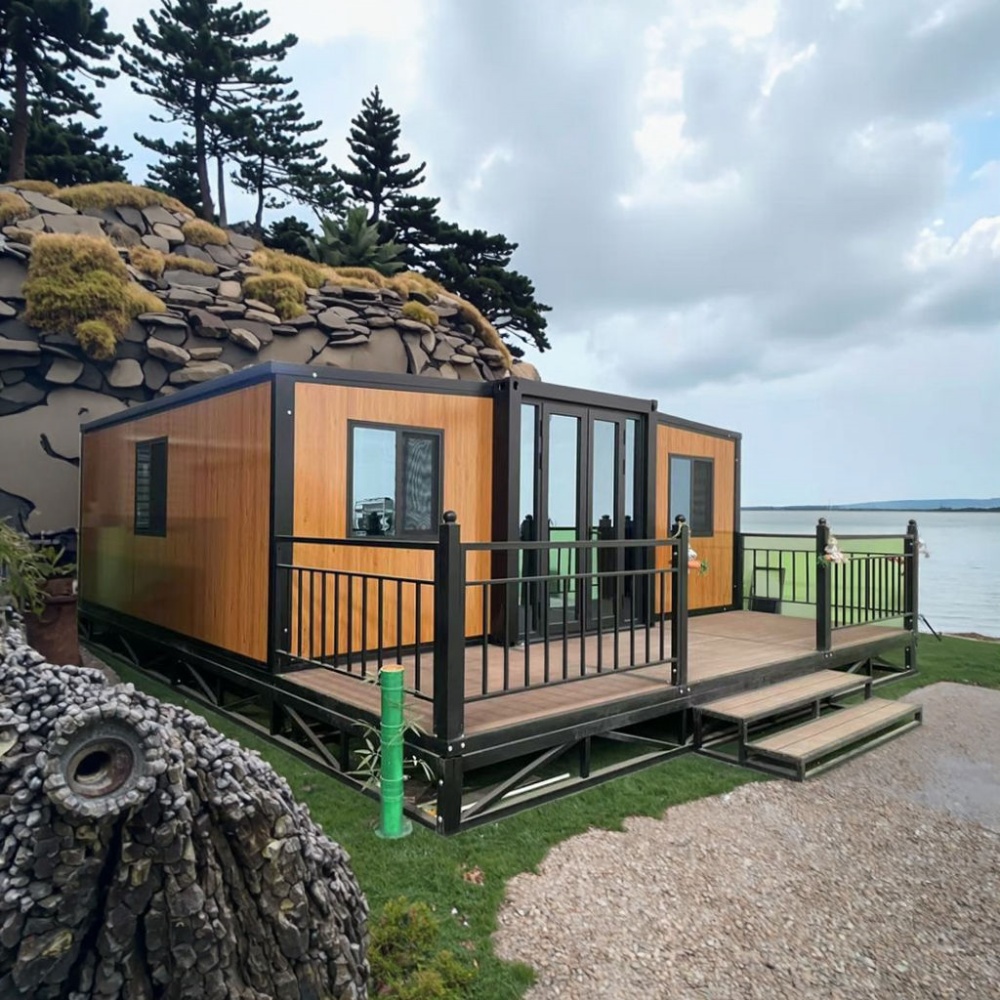
HG Prefab foldable expandable container homes — built to last, delivered worldwide.
A print shop is an unusual retail business because almost none of its revenue comes from the room it occupies. What the customer buys is turnaround, colour accuracy and the ability to walk in with a file and walk out with a finished job. That makes a compact, well-lit, well-ventilated and locally placed unit far more valuable than a large one in an expensive mall — which is exactly the shape a folding container home provides. A 20FT, 30FT or 40FT HG Prefab unit can be placed on a high-street forecourt, an industrial estate entrance, a campus edge or a business park corner, and it can be lifted and moved if the catchment changes. This guide covers the equipment electrical load, ventilation and fume extraction, acoustic control, shopfront layout and realistic 2026 costs.
Why a Container Suits a Print Shop
Printing equipment is heavy, hot and electrically hungry, and a container shell handles all three better than most small retail buildings:
- Loads are concentrated on one wall. Presses, laminators, cutters and the compressor all sit against a single production wall, so a short, accessible service spine carries the whole installation instead of dispersing it through a building.
- Vibration and floor stiffness. A steel floor frame with a reinforced zone under the press resists the vibration that a suspended timber floor amplifies, and a guillotine or a wide-format machine stays level and true.
- Odour and dust are containable. Toner dust, laminating and solvent vapours are best dealt with in a small, sealed volume with a dedicated extract, rather than diluted into a large shared space where you cannot control the airflow.
- Relocatable and financeable. A shop that follows the customer base is worth more than a leasehold fit-out that has to be written off when the lease ends.
Installation is the standard folding-unit sequence. Yes — a crane or forklift is required to offload the folded unit from the truck. Once it is set in position, four workers can unfold and assemble the main structure in about 2 hours, so a pad can go from empty ground to a serviced, glazed shell in a working day.
Equipment Load and Dedicated Circuits
Size the electrical installation from the equipment schedule rather than from the nameplate total, because print equipment draws in short, heavy bursts rather than continuously:
| Equipment | Typical running load | Peak demand | Circuit and notes |
|---|---|---|---|
| Digital press, sheet-fed | 1.5–3.5 kW | High inrush at warm-up | Dedicated 20–32 A circuit, own neutral |
| Wide-format printer | 1.0–2.5 kW | High during heater cycles | Dedicated circuit, stable voltage |
| Laminator or finisher | 2.0–4.0 kW | Very high on heat-up | Dedicated circuit, never shared |
| Guillotine and cutter | 1.0–2.5 kW | Spike on each cut | Dedicated circuit, motor-rated protection |
| Air compressor | 1.5–3.0 kW | Very high inrush | Dedicated circuit or its own sub-panel |
| Lighting, POS and HVAC | 3.0–6.0 kW | Steady | Separate circuits, HVAC on its own |
Add the peaks up before you choose a supply. A 30FT shop with a sheet-fed press, a laminator and a guillotine will usually need 100–125 A of three-phase supply, and a 40FT shop with wide-format capacity and a compressor should be planned around 125–200 A. Single-phase machines still benefit from a three-phase supply, because the load can be balanced across phases and the voltage is far more stable under inrush.
Voltage stability is a business issue, not just a technical one. A press that browns out mid-job wastes paper, toner and an hour of labour, and colour consistency suffers when the fuser temperature drifts. Put the presses on their own panel, keep lighting and HVAC off that panel, and add a voltage logger for the first month so you have evidence if the supply is poor.
Floor loading follows the same logic. A production press with a finisher stack can weigh 600–1,200 kg on a small footprint, and a full pallet of paper adds another 1,000 kg. Tell the factory where the press and the paper store will sit so the floor frame can be reinforced under those zones rather than uniformly.
Ventilation, Odour and Dust Control
Air quality determines whether staff can work comfortably all day and whether a neighbouring business complains:
- General ventilation. Provide 8–12 air changes per hour of mechanical extract with filtered make-up air. A sealed steel box with presses running warms up quickly, and the extract is what stops the room becoming a heat trap as well as an odour trap.
- Local extraction. Laminating, solvent cleaning and any fusing process should have a capture hood or an extract nozzle close to the source, discharging through a filter to a safe outside point above head height and away from air intakes.
- Toner dust. Fit a fine filter on the general extract and use a vacuum rated for toner rather than a domestic vacuum, which simply redistributes the finest fraction back into the air.
- Humidity. Hold 40–60 percent relative humidity. Dry air causes static that jams feeders and attracts dust to freshly printed sheets, while damp air makes paper wavy and ruins registration.
- Temperature. Keep the production wall at 20–24 °C. Toner adhesion and colour reproduction both drift when the room swings widely, and staff comfort in a steel box depends on cooling rather than on opening a door.
- Filtration service. Put the filters, the hood and every duct on a written cleaning schedule. Blocked extraction is the most common cause of both odour complaints and premature equipment faults.
Separate the wet or dirty end of the process from the customer area with a real partition rather than a curtain. Trimming, drilling and laminating all produce offcuts and dust, and a customer watching a guillotine through a glass panel is far better advertising than a customer standing next to it.
Acoustic Control and Shopfront Layout
Print shops are loud in a specific way: guillotines bang, compressors cycle and presses whine. Treat noise as a design item, not an afterthought:
- Equipment placement. Put the compressor and the guillotine at the end of the unit furthest from the counter, and mount the compressor on anti-vibration pads with a flexible connection to its pipework.
- Absorption. Aim for a mid-band reverberation time of about 0.5–0.7 s. An absorptive ceiling, carpet tiles in the customer zone and a fabric panel on one solid wall usually achieve it without looking like a studio.
- Partition performance. Build the production screen as a double-skin panel with a mineral wool core and sealed joints, and target 30–35 dB between the press zone and the counter so staff can hold a normal conversation with a customer.
- Layout. Keep a 1,000 mm circulation lane from the door to the counter, and set the counter so a customer can see finished samples on the wall while they wait. Put the self-service copier beside the counter on its own circuit so a walk-in job never interrupts a production run.
- Glass and light. Use glazing along the customer end of the long wall for daylight and visibility, but keep direct sun off the paper store; UV and heat both degrade stock. Aim for 500 lux at the counter and 750 lux at the inspection bench.
Plan the paper store as a genuine storage room rather than a corner. Stock is the largest single asset in most small print shops, it is sensitive to damp, and a pallet of paper that has to be moved twice a day is a pallet that will eventually be dropped.
Cost Breakdown and Installation Planning
Typical 2026 figures for a container print shop:
- Container unit: 20FT $7,200–$9,800; 30FT $10,500–$14,500; 40FT $12,500–$16,500 depending on size and finish.
- Glazing, shopfront doors, counter and signage: $3,500–$11,000.
- Electrical supply, sub-panel, dedicated circuits and surge protection: $6,000–$18,000.
- Ventilation, local extraction and filtration: $3,500–$10,000.
- HVAC, dehumidification and controls: $3,000–$8,000.
- Acoustic partition, absorption and flooring: $3,000–$9,000.
- Benches, shelving, paper store racking and finishing tables: $2,500–$8,000.
- Foundation, delivery and site works: $2,500–$7,000.
A 20FT unit used as a copy and small-format shop lands at $18,000–$38,000 of fit-out, a 30FT production shop at $26,000–$52,000, and a 40FT shop with wide-format capacity and a separate customer area at $35,000–$75,000 on top of the unit price and before the printing equipment itself.
Running costs are dominated by HVAC, extraction and standby power, because presses sit idle at temperature for long periods. Expect 4–9 kW of average electrical demand during a working day, and budget for the standby consumption of large machines rather than assuming they draw nothing when they are quiet.
Sequence the offload around the equipment delivery. Book a crane or forklift, confirm the truck can reach a firm, level standing area, and have the power trench, the extract duct route and the data connection open before the unit arrives. HG Prefab can factory-prep reinforced press zones, equipment circuit routes, duct sleeves, glazing schedules and the sub-panel position, so the fit-out crew and the equipment installers can work on a prepared shell.
Need a folding container house?
HG Prefab manufactures 20FT, 30FT and 40FT folding expandable container houses with factory-prepared reinforced equipment zones, electrical circuit routes, extract duct sleeves and glazing schedules for print, retail and light production uses — shipped flat-packed worldwide.
Email hgmechequip@gmail.com or WhatsApp +86 191 0388 7380 for a quote, a layout drawing and an equipment load schedule.
Browse modelsFrequently Asked Questions
Can a folding container home be used as a print or copy shop?
Yes. A 20FT unit suits a copy and small-format counter, a 30FT unit takes a sheet-fed press with finishing equipment, and a 40FT unit adds wide-format capacity and a separate customer area. The stiff steel floor carries press and paper loads without the vibration a timber floor would amplify.
How is a container print shop delivered and installed?
Yes — a crane or forklift is required to offload the folded unit from the truck. Once it is set in position, four workers can unfold and assemble the main structure in about 2 hours, after which the glazing, electrical, ventilation and equipment installation follow.
How much power does a container print shop need?
Plan dedicated circuits for the press, laminator, guillotine and compressor, and never share them with lighting or HVAC. A 30FT shop with a sheet-fed press typically needs 100–125 A of three-phase supply, and a 40FT shop with wide-format capacity and a compressor should be planned around 125–200 A.
How do I get a quote for a container print shop?
Email hgmechequip@gmail.com or message WhatsApp +86 191 0388 7380 with your equipment list, paper storage volume and the available power supply. We reply with a unit recommendation, a services layout and a delivered price for 20FT, 30FT or 40FT options.