HG Prefab foldable expandable container homes — built to last, delivered worldwide.
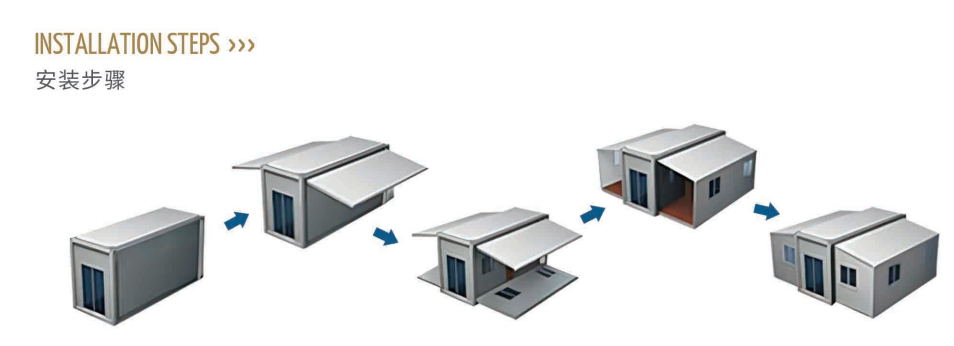
A folding container home is engineered to travel as a compact, closed box and to open into a finished building in a single working day. That compactness is why delivery day hinges on one operation: getting the folded unit off the flatbed truck and onto your pad. The folded unit arrives strapped to a flatbed or semi-trailer as a dense, rigid steel package weighing several tonnes. It cannot be slid, rolled or carried off by hand, and it is not designed to be dragged across its own base. A crane or a forklift is required to offload the folded unit from the truck. Once it is set in position, four workers unfold and assemble the main structure in about 2 hours.
That split is the whole schedule: roughly 30 to 60 minutes of machine time to offload and set, then about 2 hours of manual unfolding. The lift is the shortest part of the day and the part with the longest list of dependencies. Book the wrong machine, forget the overhead line or leave the pad unpoured, and a half-hour operation becomes a stranded truck and a crew standing around. This guide covers the equipment options and what they cost, how the unit should actually be rigged, what the site must look like before dispatch, how to sequence the day, and the safety and insurance checks that protect everybody on site. Pair it with our folding container home site prep checklist, because lift planning and pad preparation are the same decision made twice.
Why the Offload Is the Critical Hour of Delivery Day
Three properties of a folded unit drive every planning decision that follows:
- It is heavy for its size. The whole building — steel frame, wall panels, roof structure, glazing, floor, fixtures and finishes — is concentrated into a package barely wider than the transport envelope.
- It is rigid and finished. Cladding, windows, doors and interior finishes are already installed, so the lift has to spread its force through designated structural points rather than crushing a panel that was never meant to carry a point load.
- It is time-critical. Truck, machine and crew all arrive in the same window. Any one of them waiting is money, and a driver on a timed slot may have to leave and return another day.
What Actually Arrives on the Truck
The unit leaves the factory folded, wrapped and strapped, with its roof folded down and its side walls latched shut, travelling on a flatbed or a standard semi-trailer. The folded shipping weight is documented on the packing list and on the shipping documents — that number is the single input your hire company needs, and it should be confirmed with the factory dispatch team before you book anything.
Two details matter for the lift itself. First, the folded package is tall relative to its footprint, so its centre of gravity is high and it must be lifted level. Second, the unit has to be lifted clear of the bed and then travelled or slewed to the pad in one controlled motion; it is not a load that can be shuffled a few centimetres at a time. Carrier selection and the inland freight leg are covered in our container home shipping guide.
Equipment Options for Offloading a Folding Container Home
There are four realistic ways to get a folded unit off a truck and onto a pad. The right one depends on the folded weight, the distance from where the truck can stand to where the unit has to land, and the ground you have to work from. Indicative daily hire rates below are in USD and vary widely by region, season, fuel surcharge and whether an operator is included — treat them as budgeting ranges, not quotes.
| Equipment | Lifting capacity | Reach | Typical daily hire cost | Ground requirements | Best for |
|---|---|---|---|---|---|
| Telehandler (2.5-4t) | 2.5-4 t, derated as the boom extends | 6-18 m forward reach | $450-$900 / day + operator | Firm compacted gravel or concrete; level travel path | Pad within about 10 m of where the truck can stand |
| Rough-terrain forklift | 3-5 t at close reach | 3-5 m; lift and carry | $400-$800 / day + operator | Uneven, muddy or snow-covered ground | Rough, wet or sloping ground between truck and pad |
| Mobile crane / truck-mounted crane (HIAB) | 8-25 t at radius | 10-30 m; full slew | $900-$2,200 / day; HIAB $300-$600 / hour with minimum | Level within 1-2 degrees; outriggers on plates or mats | Lifting over fences, or a pad set well back from the road |
| Mini crawler crane | 1-3 t | 8-16 m jib | $700-$1,400 / day + operator | Soft ground; rubber tracks; fits gates around 1 m wide | Tight urban sites and narrow access |
A telehandler is the default answer on a prepared site: it lifts, travels a short distance and places the unit in one motion, and it is the cheapest machine that will do the job. A rough-terrain forklift wins when the ground between truck and pad is rough, wet or sloping. A mobile crane or truck-mounted HIAB is the choice when reach is the problem rather than weight — a pad behind a house, over a wall, or anywhere the truck cannot park beside the pad. A mini crawler crane solves the opposite problem: not reach, but access.
Whichever you choose, size the machine against the documented folded weight plus a margin for rigging gear, and against the radius you actually need. Capacity falls sharply as a boom extends, so a telehandler rated at 4 tonnes close in may be rated under 2 tonnes at full reach. Give the hire company three numbers: folded weight, horizontal distance from the truck's standing position to the pad centre, and any height to clear on the way.
Lifting Points and Rigging
A folded unit is lifted from the lifting points the factory built into it. Nothing else on the building is a lifting point, and getting this wrong damages the finishes you paid for.
Factory lifting lugs
HG Prefab units are built with steel lifting lugs welded into the structural frame, positioned so the load is carried by the main chassis and corner posts rather than by cladding or joinery. They are the only attachment points that should ever take the weight. The folded base also incorporates forklift pockets at the correct spacing, so a telehandler or forklift can engage the unit directly from the side or end with no slinging at all — for most offloads this is the fastest and safest method, needing only correctly rated forks of the right length.
Spreader beam and sling angles
Where the unit is slung rather than forked, use a spreader beam with slings running vertically down to the four lugs. The beam keeps the sling legs close to vertical, which removes the inward crushing force that angled slings apply to the top of the unit and keeps the load level so the frame is not twisted during the lift. If slings must run directly to the lugs, keep the included angle as small as possible — every degree away from vertical multiplies the tension in the sling and the compression in the unit. All shackles, slings and the beam must carry a current test certificate and a rating comfortably above the load.
Never lift by window frames or roof edge
Three attachment points are explicitly wrong and cause most avoidable delivery-day damage:
- Window and door frames. Glazing units and their frames carry no structural load. A sling through a window opening bends the frame, breaks the seal and can crack the glass.
- Roof edge or roof sheet. The folded roof edge is a thin folded steel skin; lifting on it peels the sheet and destroys the weather line of the building.
- Floor edges or the folded wall panel lip. These are closing surfaces, not lifting surfaces. Point loads here deform the panel and the unit will never seal correctly afterwards.
If the lugs are not visible on arrival, stop and check the packing list and the unit's marking before anything leaves the truck. The lifting positions are documented; there is no reason to improvise.
Site Requirements Before the Truck Is Booked
Access for a semi-trailer
Allow roughly 16-18 m of clear length and room to turn, or a reversing route with its own clear width and a competent banksman. Check gate widths, the radius at any bend, low bridges, culverts and culvert covers that will not take the axle load, and any verge or ditch the trailer would straddle. On a tight rural road, meet the driver at the junction: a driver who discovers the access problem at the gate will not solve it for you.
Firm, level ground for outriggers
Cranes and telehandlers put far more force into the ground through a single outrigger or wheel than a building ever will through a pad. The machine must stand on compacted, load-bearing ground, level within a degree or two, with steel plates or mats under each outrigger on anything softer than good gravel. Freshly filled ground, a recently trenched service run, a septic tank lid and a retained edge are classic failure points — they look solid and then punch through. Where the pad is on a slope, plan the levelling and the retaining first; our sloped terrain guide covers how the level platform should be built before a machine is brought in.
Overhead clearance
Walk the lift path from the truck's standing position to the pad and look up. Overhead power lines are the item that stops lifts outright and the item most often forgotten: treat any line as live, and if the lift path comes within the exclusion distance required locally, arrange for the utility to isolate and earth the line before delivery day. Also check tree branches the boom or load would sweep, telephone and fibre drops strung across a drive, and the eaves of neighbouring buildings.
Keep the pad inside the reach envelope
The pad is a lift-planning decision, not only a foundation decision. Place it within the machine's rated reach from where the truck can legally and safely stand, on ground the machine can set up on, with clear headroom above the whole swing. A pad 2 m further from the road can move the job from a telehandler to a mobile crane and add hundreds of dollars to the day.
What the Lifting Day Costs
Here is the context that matters when the hire quote arrives. HG Prefab factory prices for the folding unit itself are 20FT $7,200–$9,800; 30FT $10,500–$14,500; 40FT $12,500–$16,500, ex-works, before freight, taxes and local compliance. A complete lifting day — machine hire, operator, banksman, mats and mobilisation — typically lands between $700 and $2,500 depending on the machine and the region. That is roughly 5 to 15 per cent of the unit price, and it is the cheapest insurance on the whole project: the difference between a unit set cleanly on its pad and one damaged, delayed or left on a truck.
Costs vary significantly by market. Rural areas with few machines available command higher rates and travel charges, urban areas add permit and traffic-management costs, and peak building season pushes both rate and lead time up. Always ask for the hourly versus daily rate, whether the operator is included, travel charges, the minimum hire period and cancellation terms. A cheap rate with a four-hour minimum and no flexibility is not a cheap rate.
Where the drive is long or the final approach difficult, take the truck-mounted HIAB option seriously: one vehicle delivers and lifts, which removes the coordination risk of two contractors arriving in the same window. Models such as the 30FT grey folding expandable unit are routinely delivered this way on sites where a second machine cannot easily be sequenced.
Sequencing Delivery Day
- Two to three weeks out. Confirm the folded shipping weight and the lifting point layout with the factory dispatch team, then book the machine for the same window as the truck, with the operator told in writing where the truck will stand and where the unit goes.
- Ten days out. Pad poured or compacted and cured, access graded, overhead clearance dealt with, services marked, neighbours told about road occupancy.
- Day before. Mats or plates on site, exclusion markers ready, a second person confirmed as banksman, weather checked against the machine's wind limit, pad swept clear.
- Delivery day. Truck positions, machine sets up on prepared ground, slings or forks attached to the factory lugs, lift and set — 30 to 60 minutes. Unstrap, then four workers unfold and assemble the main structure in about 2 hours.
The rule that governs all of it: offload and unfold on the same visit. The unit goes from the truck to its final position and straight into unfolding, with the crew already on site. A unit set down and left folded for a week has been handled twice for no reason and sits exposed in the meantime.
Coordination is a named-person job. One site coordinator on the buyer's side should hold every contact: the factory dispatch team, the freight carrier, the machine hire company and the assembly crew. That person confirms the weight, the delivery window and the machine booking, and is the one the driver calls on the morning. Pair this sequence with our folding container home delivery timeline, which maps the same steps against production and transit.
Safety, Operators and Insurance
A lift involving several tonnes over a finished building is a controlled operation, and the controls are well established:
- Certified operator. The machine comes with a licensed, carded operator competent on that class of machine. A general labourer with a machine is not the same thing.
- Banksman. A second competent person directs the machine, stays in the operator's line of sight and is the only person giving signals. Agree the signal set before the lift starts.
- Exclusion zone. Mark and keep clear the area under and around the load, the slew path and the truck's reversing path. The zone is enforced, not suggested.
- Weather limits. Every machine has a wind limit and the boom or load acts as a sail. High wind, lightning and heavy rain stop the lift; build that contingency into the booking.
- Gear certification. Slings, shackles and the beam carry current test certificates and are visually checked before use. Damaged gear is rejected, not used carefully.
- Insurance. Before booking, ask the hire company for its public liability cover and confirm it extends to lifting operations, that the limit reflects the value of the unit and the neighbouring property, and that your own project policy covers the delivery window. Confirm in writing who bears the cost of damage during the lift — that question separates a professional hire company from a cheap one.
Tight-Access Sites
Most difficult sites are difficult in one specific way, and each has a standard answer:
- Narrow gate or side passage. A mini crawler crane or a compact telehandler fits where a truck-mounted machine cannot. Measure the narrowest point of the whole route, not just the gate.
- Pad far from where the truck can stand. This is a reach problem, so buy reach: a larger mobile crane, or a HIAB working over an intervening building or wall. Do not solve a reach problem with a bigger forklift.
- Soft or unfinished ground. More mats, a thicker stone working platform, or a tracked machine. If the ground will not carry the outrigger load, the platform is built first.
- Restricted overhead space. The boom tip and the load have to clear any structure above, so the machine stands further out and the required reach grows. Plan the pad closer to the accessible side rather than lifting through a gap.
- Multiple repositioning. On genuinely constrained sites the unit is set in a staging position within the machine's first reach, the machine is repositioned, and the unit is moved again to the pad. This doubles the handling, so plan it and allow the extra mats and time.
- Roof-first assembly order. The standard unfolding sequence raises the roof structure before the side walls extend, so the crew needs clear space above the footprint of the unit. Under a canopy, between buildings or beneath trees, trim the obstruction before delivery day — the roof lift needs the most vertical clearance.
If a site looks impossible, send photographs and a dimensioned sketch to the factory dispatch team early. Most access problems have a known solution, but they have to be solved before the unit is loaded, not after the truck is at the gate.
Planning a delivery day?
HG Prefab, manufactured by Henan Huangang Machinery Equipment Co., Ltd., builds 20FT, 30FT and 40FT folding expandable container houses with factory lifting lugs and forklift pockets, documented folded shipping weights and dispatch support for your crane or forklift booking. Send your site address, photos and access dimensions for a lift-plan review. Email hgmechequip@gmail.com or WhatsApp +86 191 0388 7380. Full model range on the products page.
Browse modelsFrequently Asked Questions
Do I need a crane to offload a folding container home?
Yes — a crane or forklift is required to offload the folded unit from the truck. Once it is set in position, four workers can unfold and assemble the main structure in about 2 hours. Book a telehandler, rough-terrain forklift or mobile crane for the same window as the truck, confirm the machine's capacity against the unit's shipping weight before booking, and reserve it early in peak season because a missed machine means the truck waits on the clock.
What size of crane or forklift do I need for a 20FT, 30FT or 40FT folding container home?
Match the machine to the folded shipping weight and to the radius, not to the unit's length. A 2.5-4 tonne telehandler or a 3-5 tonne rough-terrain forklift covers most 20FT and 30FT units placed within a few metres of the truck; a 40FT unit, a long reach over a fence, or a pad set well back from the road usually calls for an 8-25 tonne mobile crane or a truck-mounted HIAB. Send the factory the model and let the hire company size the machine from the documented weight and the reach you need.
How much does crane or telehandler hire cost for delivery day?
Indicative hire rates are $450-$900 per day for a telehandler, $400-$800 per day for a rough-terrain forklift, $900-$2,200 per day for a mobile crane, and $300-$600 per hour with a minimum charge for a truck-mounted HIAB that also delivers the unit. Prices vary by region, season and fuel surcharges. Against a unit price of $7,200-$9,800 for 20FT, $10,500-$14,500 for 30FT and $12,500-$16,500 for 40FT, the lifting day is a small fraction of the project.
What site conditions must be ready before the truck arrives?
Four things: access for a semi-trailer with room to turn or reverse out, firm and level ground able to carry outrigger loads, overhead clearance free of power lines and branches, and a prepared pad sitting inside the machine's reach envelope. Pour or compact the pad before dispatch so offload and unfolding happen on one visit, then have a certified operator and a banksman run the lift inside a clearly marked exclusion zone.