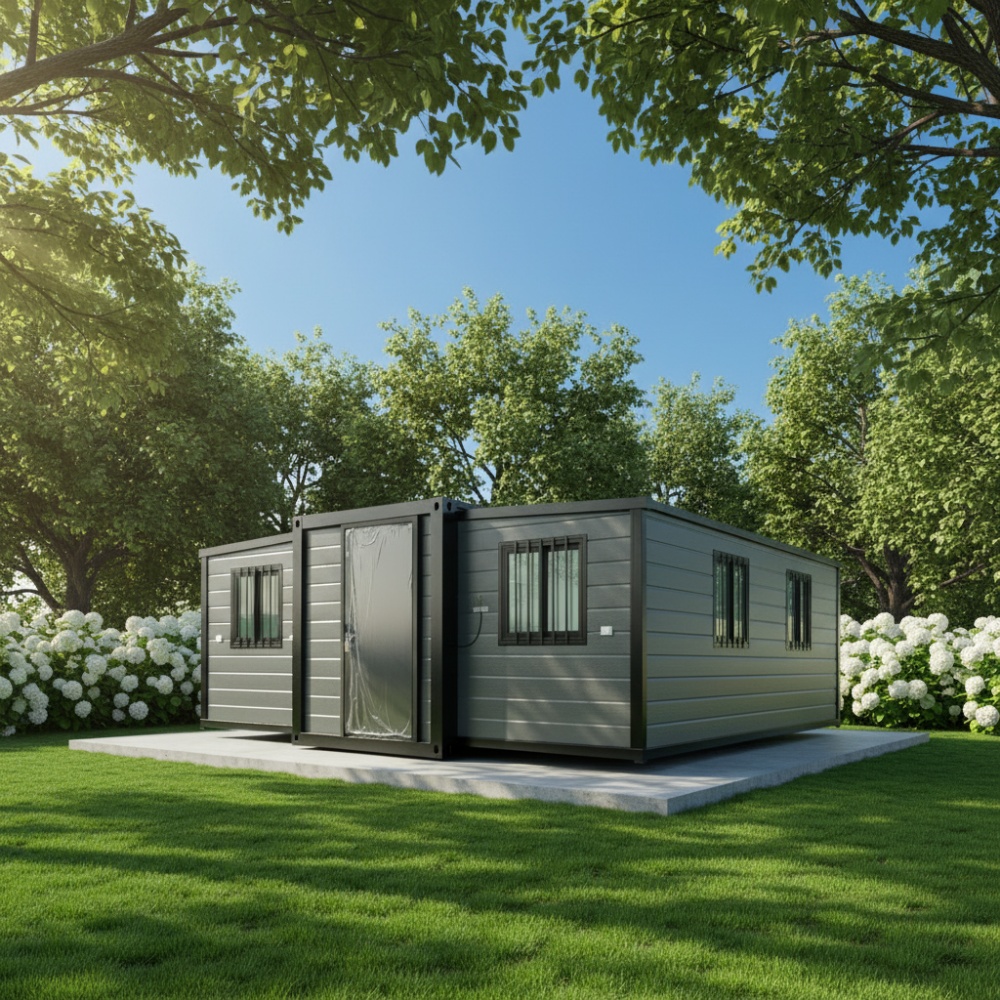
HG Prefab foldable expandable container homes — built to last, delivered worldwide.
An EV charging station and a folding container home are a natural pairing. The container gives you a weatherproof, lockable, relocatable enclosure for switchgear, payment terminals, spare cable and a small staff or waiting room, while the chargers themselves mount on a plinth beside it. For highway service areas, campgrounds, hotel car parks, fleet depots and municipal sites, the combination turns a spare corner of hardstanding into a revenue-producing asset that can be re-sited when the lease or the traffic pattern changes. This guide covers load calculations, charger selection, in-unit layout, canopy design, permits, cost and commissioning for a 20FT, 30FT or 40FT HG Prefab unit paired with AC or DC charging.
Why a Container Enclosure Beats a Purpose-Built Cabinet
Most charging installations start as a bare pedestal on a concrete plinth. That works until the site needs switchgear, a distribution board, a meter cabinet, a payment kiosk, spare cable storage and somewhere for a technician to sit while diagnosing a fault in the rain. A folding container house solves all of those in one delivery:
- Equipment room and switchgear housing — a 20FT unit gives roughly 14 m² of lockable, ventilated floor area, enough for a main distribution board, charger feeder panels, a meter cabinet and a wall-mounted diagnostic laptop station.
- Revenue hardware and payment terminals — card readers, ticket printers and network routers live indoors, out of direct sun and away from vandalism.
- Staff and driver facilities — a 30FT or 40FT unit adds a small accessible restroom, a vending area and a covered waiting space, which raises dwell time and average session value.
- Relocatable asset — if the site is leased, or the highway authority re-routes traffic, the whole hub can be lifted onto a truck and moved to a new pad.
- Fast deployment — the unit ships flat-packed. Yes — a crane or forklift is required to offload the folded unit from the truck. Once it is set in position, four workers can unfold and assemble the main structure in about 2 hours, and the founding pad can be prepared in advance.
The container also acts as the physical boundary between high-voltage equipment and the public, which most electrical inspectors prefer over a padlocked outdoor cabinet.
Site Planning, Traffic Flow and Power Supply
Choosing and Laying Out the Pad
Start with the vehicles, not the building. A charging bay needs a 2.7 m wide stall for a car and a 3.5 m lane for a towing vehicle with a trailer, plus a 1.5 m clear zone in front of each charger so a cable can reach a port on either side of the car. Bays should be angled at 45 or 60 degrees on tight sites so drivers pull in nose-first without reversing into traffic.
Place the container on the non-traffic side of the bay line, with the charger plinths 1.2–1.8 m from the container wall so a technician can walk behind them. Keep at least 3 m between the container and any combustible storage, and confirm the delivery truck can reach the pad with a straight, firm approach — the offload lift needs clear overhead space and solid ground under the outriggers.
Sizing the Electrical Service
The service size drives the whole budget, because it decides whether the utility can reuse an existing transformer or must upgrade. Add up simultaneous demand rather than nameplate ratings — most hubs never run every charger flat out at once, and load management lets you install more ports on a smaller supply.
| Configuration | Typical connected load | Service required | Suitable unit |
|---|---|---|---|
| 2 × 22 kW AC (dual-port) | ~44 kW | 63 A three-phase | 20FT equipment room |
| 4 × 22 kW AC (dual-port) | ~88 kW | 125 A three-phase | 20FT or 30FT |
| 2 × 60 kW DC + 4 × 22 kW AC | ~208 kW | 250–400 A three-phase | 30FT with restroom |
| 4 × 120 kW DC + 4 × 22 kW AC | ~568 kW | 800 A or dedicated transformer | 40FT hub building |
Where the utility will not fund an upgrade, dynamic load management is the standard answer: current transformers on the incoming supply throttle charger output in real time so the site never exceeds its agreed capacity. This typically lets you run four to six AC ports on an existing 100 A supply.
Charger Selection and In-Unit Layout
AC Level 2 or DC Fast Charging?
Match the charger to dwell time. Retail, workplace and hotel sites suit AC; highway and fleet sites need DC.
- AC Level 2 (7–22 kW) — cheapest per port, needs no liquid cooling, and adds 30–80 km of range per hour. Ideal where cars park for one to four hours. Expect $1,200–$4,000 per dual port plus installation.
- DC fast (50–150 kW) — delivers 150–500 km per hour but draws heavily, needs a bigger feeder and often a dedicated transformer. Budget $25,000–$70,000 per unit installed.
- Mixed hub — the most common commercial layout: two or four DC stalls for through traffic plus a row of AC bays for long-stay users, all fed from one container-mounted distribution board.
Fitting Out a 20FT, 30FT or 40FT Unit
The interior plan should keep cable runs short and serviceable:
- Main distribution board on the wall nearest the incoming supply, with a labelled feeder for every charger and a spare 20% of ways for future ports.
- Meter cabinet and CT chamber adjacent to the board so the utility's meter and the load-management current transformers share one accessible zone.
- Network and payment rack — a small 6U wall cabinet holding the router, 4G/5G failover modem, charger controller and a UPS rated for 30 minutes.
- Cable and consumable store — a 60 cm deep shelf run for spare Type 2 and CCS cables, connector cleaning kits and fuses.
- Ventilation and cooling — DC cabinets reject significant heat. A louvred inlet at low level plus an extract fan at high level keeps the equipment room below 35 °C, and a 9,000–12,000 BTU inverter mini-split handles the hottest climates.
- Fire and isolation — an emergency stop inside the door and a clearly labelled external isolator within sight of the bays, both required by most inspectors.
Canopy, Cable Management and Weather Protection
Charging hardware is rated for outdoor use, but drivers are not. A simple steel or tensile canopy over the bay line raises usage in hot, wet and snowy regions and protects the charger screens from glare and driving rain. Two practical details follow from it:
- Cable management — retractable overhead cable reels or spring-loaded arms stop cables lying in puddles and puddles stop cables being driven over. Budget $400–$1,200 per bay.
- Drainage — the pad must fall 1:80 to a channel or soakaway so the bay never floods. Route that drainage away from the container footing, never across it.
- Bollards and wheel stops — a 1 m bollard or a 150 mm wheel stop in front of every charger prevents the most common insurance claim on a charging site.
- Lighting — 30–50 lux at the charger face for safe night use, with the fittings on a photocell so the hub is never dark when a car arrives.
Solar canopies are worth pricing where the site already has a good grid connection but high daytime demand; a 20 kWp array over six bays offsets a meaningful share of AC charging energy and improves the project's payback story to lenders.
Permits, Accessibility and Utility Coordination
Regulatory scope varies widely, but the same five approvals appear on almost every charging project:
- Planning or zoning consent — covers the container, the canopy and the change of use of the parking area.
- Electrical permit and inspection — the utility connection, the distribution board, earthing and the emergency isolation all fall under the electrical code.
- Utility service application — allow 8–24 weeks for a new or upgraded supply, and submit the load calculation and single-line diagram with the application.
- Accessibility rules — at least one charging bay must meet the local accessible-design standard: a 2.4 m wide stall, a 1.2 m side transfer zone, a kerb ramp and controls mounted between 900 mm and 1,200 mm above grade.
- Signage and wayfinding — tariff display, contact number for faults and clear bay markings are required in many jurisdictions and are cheap to add at build time.
For the container itself, confirm whether the local authority treats the unit as a temporary structure or a permanent building — that single question decides whether you need a full building permit or a simple site approval. Our permits & regulations guide walks through the same decision for residential units.
Cost, Revenue and Commissioning
Budget Breakdown
A realistic 2026 budget for a small commercial hub:
- Container unit: 20FT $7,200–$9,800, 30FT $10,500–$14,500, 40FT $12,500–$16,500 depending on finish and factory pre-cuts.
- Foundation pad and civil works: $4,000–$15,000 for the hardstanding, bay markings and drainage.
- Electrical service and switchgear: $6,000–$45,000 depending on whether an upgrade or transformer is needed.
- Chargers: $2,400–$8,000 for four AC ports; $50,000–$140,000 for two to four DC units.
- Canopy, lighting and cable management: $8,000–$30,000.
- Fit-out inside the container (board, meter cabinet, network rack, HVAC, restroom): $5,000–$18,000.
- Permits, utility application and engineering: $3,000–$12,000.
On the revenue side, an AC port in a hotel or workplace car park typically bills $0.35–$0.60 per kWh with 15–25% utilisation, while a well-sited DC stall on a highway corridor can serve 8–15 sessions a day. Most operators target a five to eight year payback including the container and civil works.
Commissioning Checklist
- Book the pad and the offload as one sequence — cure the concrete fully, then schedule the delivery. Yes — a crane or forklift is required to offload the folded unit from the truck. Once it is set in position, four workers can unfold and assemble the main structure in about 2 hours.
- Megger and loop-test every feeder before energising, and record the results for the inspection file.
- Load-bank test the DC units at 50%, 75% and 100% output, and log the temperature rise inside the equipment room.
- Commission the payment and roaming back end — run one live transaction per charger type and confirm the settlement report reaches the operator portal.
- Verify isolation and emergency stops with a simulated fault, and post the emergency contact number at the bay.
- Train the site staff on cable stowage, connector inspection and how to reset a faulted charger before calling a technician.
Plan the hub so it can grow. Run spare ducts from the container to at least two future bay positions, size the board for extra ways, and leave 3 m of clear hardstanding on one side. Adding ports later is then a cable pull and a breaker, not a rebuild.
Need a folding container house?
HG Prefab manufactures 20FT, 30FT and 40FT folding expandable container houses for equipment rooms, charging hubs and site offices — with factory pre-cuts for cable entries, ventilation and service penetrations. Shipped flat-packed worldwide.
Browse modelsFrequently Asked Questions
Does installing a container home for EV charging need a crane?
Yes — a crane or forklift is required to offload the folded unit from the truck. Once it is set in position, four workers can unfold and assemble the main structure in about 2 hours. Schedule the lift after the concrete pad has fully cured, and confirm the delivery truck has a firm, straight approach with clear overhead space.
What electrical service does a container EV charging hub need?
Two dual AC ports need about 44 kW and a 63 A three-phase supply. Four dual AC ports need roughly 88 kW and 125 A. Adding two 60 kW DC units plus four AC ports pushes the connected load to about 208 kW and calls for a 250–400 A service. Dynamic load management lets you install more ports on an existing smaller supply.
Can a folding container home host DC fast charging?
Yes. DC units are usually mounted on plinths outside the container, with the power cabinets, distribution board, meter chamber and network rack housed inside. A 30FT or 40FT unit gives the extra floor area and ventilation capacity that multi-unit DC hubs need, and it keeps payment and networking hardware out of the weather.
How much does a container-based EV charging station cost?
A small AC hub typically lands between $25,000 and $60,000 including the container, pad, switchgear and four AC ports. A DC corridor site with two 60 kW units usually runs $110,000–$250,000, with the utility service upgrade the single largest variable. The container itself costs $7,200–$9,800 for 20FT, $10,500–$14,500 for 30FT and $12,500–$16,500 for 40FT.