HG Prefab foldable expandable container homes — built to last, delivered worldwide.
A field season is short, the shipping window is shorter, and the science does not wait. Universities, geological surveys, conservation trusts and polar and desert programmes all need a building where there are no builders, no grid, no water mains and sometimes no road. Tents fail as soon as instruments, samples or a winter season are involved; a permanent building costs years of permitting and a logistics chain that does not exist at the end of a dirt track. A folding container home sits between the two: factory-finished, shipped compact, opened on a pad in hours, and moved again when the research moves.
Written for the people who specify these camps: what a remote station needs, how to lay out a multi-unit camp, how to run power and water without a grid, how to condition the interior from Arctic cold to tropical heat, how the units get there, and how to budget them.
Why Folding Units Suit Field Science
- It arrives finished. Insulation, wiring, plumbing, windows, doors and interior lining are installed in a factory, so nothing depends on local trades or a crew flown in.
- It ships compact. Remote freight is priced on volume and weight, and a folded unit carries far more finished floor area per shipped cubic metre than a pre-assembled cabin.
- It is relocatable. A camp placed for one survey can be folded and re-set for the next, turning a capital purchase into a reusable asset across grant cycles.
The steel structure matters for science too: a rigid frame, a lockable envelope and a weathertight sealed shell protect instruments, samples and data loggers while the camp is unattended.
What Field Teams Need From a Remote Station
Before choosing layouts, write down the requirements that drive the design. Most field station specifications reduce to seven things:
- Instrument environment. Temperature range, humidity limits, vibration tolerance and clean power for analytical equipment. A dry lab needs stable conditions more than it needs space.
- Sample handling. Bench space, a sink, an extraction path, cold storage and secure shelving.
- Sleeping capacity. Team size and shift patterns, with bunk density respecting fire egress rather than raw floor area.
- Mess and welfare. Cooking, washing, drying of wet field kit, and a heated common space.
- Power budget. The connected load and realistic daily energy in kilowatt-hours, including instruments that run unattended.
- Water and waste. Potable supply, greywater, blackwater and chemical waste — often the strictest constraint on site.
- Comms and data. Roof penetration for antennas, a rack position for networking gear, and sealed cable entries.
The last two items are where camps usually fail. Instruments that must log for weeks while the camp is empty are why a station needs genuine energy autonomy, covered in our solar power setups guide; water and sanitation with no supply network are covered in our off-grid water guide.
Unit Layouts: Sleeping Quarters, Dry Lab, Mess and Utility
A working research camp is rarely one unit. It is a cluster where each unit has one clear function, because mixing functions is how sample contamination, noise and generator fumes in the sleeping area all begin.
Sleeping quarters
A 20FT unit houses two to four researchers in bunks with storage and heating; a 40FT unit can be partitioned into two sleeping rooms plus a drying area for wet field clothing. Keep sleeping units away from the generator and the mess, and give each its own external door so shift patterns do not disturb people asleep.
Dry lab and instrument room
This is the unit that justifies the camp: continuous bench runs, a deep sink, dedicated circuits with surge protection, a clean power feed where required, and vibration-isolated mounts for balances or optical instruments. Sealed lining, filtered positive pressure and a stable temperature band protect instruments between visits.
Mess and galley
A 30FT unit works well as a galley and mess: cooking line, dry stores, a table that seats the team, and a drying rack. Cooking appliances are propane or electric depending on the energy system; extraction and fire separation from sleeping units must be designed at order stage.
Utility and sanitation
One unit should be dedicated to plant: battery bank and inverter rack, charge controllers, distribution board, filtration and pumps. This isolates electrical noise from instruments, keeps fuel and batteries out of sleeping areas, and gives technicians one place to service everything.
Sample multi-unit camp
| Function | Unit size | Key fit-out | People / load served | Typical power draw |
|---|---|---|---|---|
| Sleeping quarters A | 20FT | 4 bunks, lockers, heating, blackout windows | 4 researchers | 0.4–0.8 kW |
| Sleeping quarters B | 20FT | 4 bunks, drying area for field kit | 4 researchers | 0.4–0.8 kW |
| Dry lab / instruments | 30FT | Bench runs, sink, dedicated circuits, cold storage | Shared, 24/7 logging | 1.5–3.0 kW |
| Mess and galley | 30FT | Cooking line, dry stores, mess table, extraction | 8–10 people | 2.0–4.0 kW |
| Utility / plant | 20FT | Battery bank, inverter, filtration, pumps | Whole camp | 0.3–0.6 kW |
| Wash and sanitation | 20FT | Showers, toilets, greywater handling | 8–10 people | 0.5–1.5 kW |
| Camp total | 4×20FT + 2×30FT | Shared solar array, battery bank and genset | 8 researchers + support | 5.0–11.0 kW peak |
Read the power column as a peak concurrent draw. Daily energy in kilowatt-hours — what sizes the battery — is that draw multiplied by running hours, and the dominant load is often the instrument rack that never switches off.
Power Autonomy: Solar, Batteries and Gensets
Design the station as an off-grid system from the first sketch, even if a generator is primary: a solar array charging a lithium battery bank through MPPT controllers, an inverter feeding AC loads, and a genset covering seasonal shortfalls.
- Solar array. Roof-mounted panels add no site work but the roof area is limited; ground-mounted frames give several times the capacity and can be angled for latitude — low sun in polar summers, steep tilt for winter yield.
- Battery bank. Lithium iron phosphate is the practical choice: deep cycling, low maintenance between visits, and wide temperature range with a heated enclosure. Size autonomy in days — three days keeps instruments logging and freezers cold through a storm week.
- Genset. Size it to peak load plus battery charging, with automatic start on low state of charge. Fuel is the heaviest consumable in a remote camp, so a correctly sized genset running fewer hours beats an oversized one.
- Load discipline. Separate the critical bus (instruments, cold storage, comms) from the comfort bus (galley, laundry, heating). When generation is short, shedding comfort protects the science.
Water and Waste in Sensitive Environments
Field stations are often placed exactly where discharge rules are strictest: catchments, wetlands, karst, permafrost and protected reserves. Assume nothing leaves the site untreated.
- Supply. Roof rainwater capture, a borehole or surface abstraction with filtration, or tankered water — specified to the actual source quality.
- Greywater. Kitchen and shower water to a sealed holding tank or treatment step before dispersal; never open ground in a protected area.
- Blackwater. Sealed holding tanks with a defined removal route. If a tanker cannot reach the site, the container must.
- Chemical waste. Store separately in bunded containment; plan removal alongside supply logistics.
- Freeze protection. Trace-heat and insulate pipework, or drain at every shutdown — a burst pipe in an unattended winter camp destroys the interior.
Climate Control From Arctic to Tropics
The envelope does the work in both extremes: insulated sandwich panels with thermal breaks at the steel frame, double or triple glazing, sealed gaskets and a vapour control layer handle most of it; the rest is equipment.
- Cold climates. Thicker insulation, cold-rated seals and hardware, heating sized to the design winter temperature plus wind, and ventilation with heat recovery so an airtight envelope does not accumulate moisture. Roof snow load and pipe freeze protection are design inputs.
- Hot and humid climates. Prioritise shading, roof reflectivity and cross ventilation, size cooling to solar gain, and manage condensation — a cold interior in humid air collects water below dew point, including inside instruments.
- Desert swing. Insulation plus thermal mass smooths the day-night swing.
- Coastal air. Marine-grade coatings and stainless fasteners are cheap at order stage and expensive later.
Full detail on envelope specification and cold-weather operation is in our extreme climates folding container home guide.
Transport: Helicopter, Barge and 4x4 Truck Considerations
Folded units travel as standard container-sized cargo, so ocean, rail and highway legs work like any container shipment. Because they fold, they stack and ship compactly, so several units share freight space that one pre-assembled cabin of equal floor area would consume alone. The final leg is where projects are won or lost:
- 4x4 truck and flatbed. The most common last leg. Check axle limits, bridge ratings, seasonal closures and ground bearing. A prepared, level pad lets the truck be unloaded and the unit opened on the same visit.
- Barge. For river, lake, delta and coastal sites, a barge or beach landing at suitable tide removes the road constraint. Plan the transfer point and the route from landing to pad.
- Helicopter sling-load. The last resort where there is no surface access. The unit needs lifting points and a rigged sling, with weight reduced by shipping interiors, batteries and fuel separately.
At destination, offload and opening are two separate operations, and the second one is fast. Yes — a crane or forklift is required to offload the folded unit from the truck. Once it is set in position, four workers can unfold and assemble the main structure in about 2 hours. A six-unit camp therefore opens in roughly a day once the pads and lifting equipment are on site — which is why site works, not the building, are planned first.
Rapid Deployment and Seasonal Shutdown
A realistic camp programme looks like this:
- Pre-season: site survey, pad and access preparation, permitting, freight booked to the nearest port, railhead or barge landing.
- Deployment: units offloaded onto prepared pads, unfolded and structurally assembled in about 2 hours each with four workers, then connected to plant.
- Commissioning: solar and battery bank energised, water and sanitation commissioned, instruments logging.
- Season: consumables, genset servicing, filter changes, and an unmanned mode with critical loads only.
- Shutdown: water drained or antifreeze-charged, perishables removed, batteries left at partial charge, seals latched, inventory recorded.
The most valuable operational decision is a written camp manual — shutdown checklist, opening checklist, consumables list and contact route. A station closed correctly in autumn opens in an afternoon in spring.
Budget and Procurement for Institutes
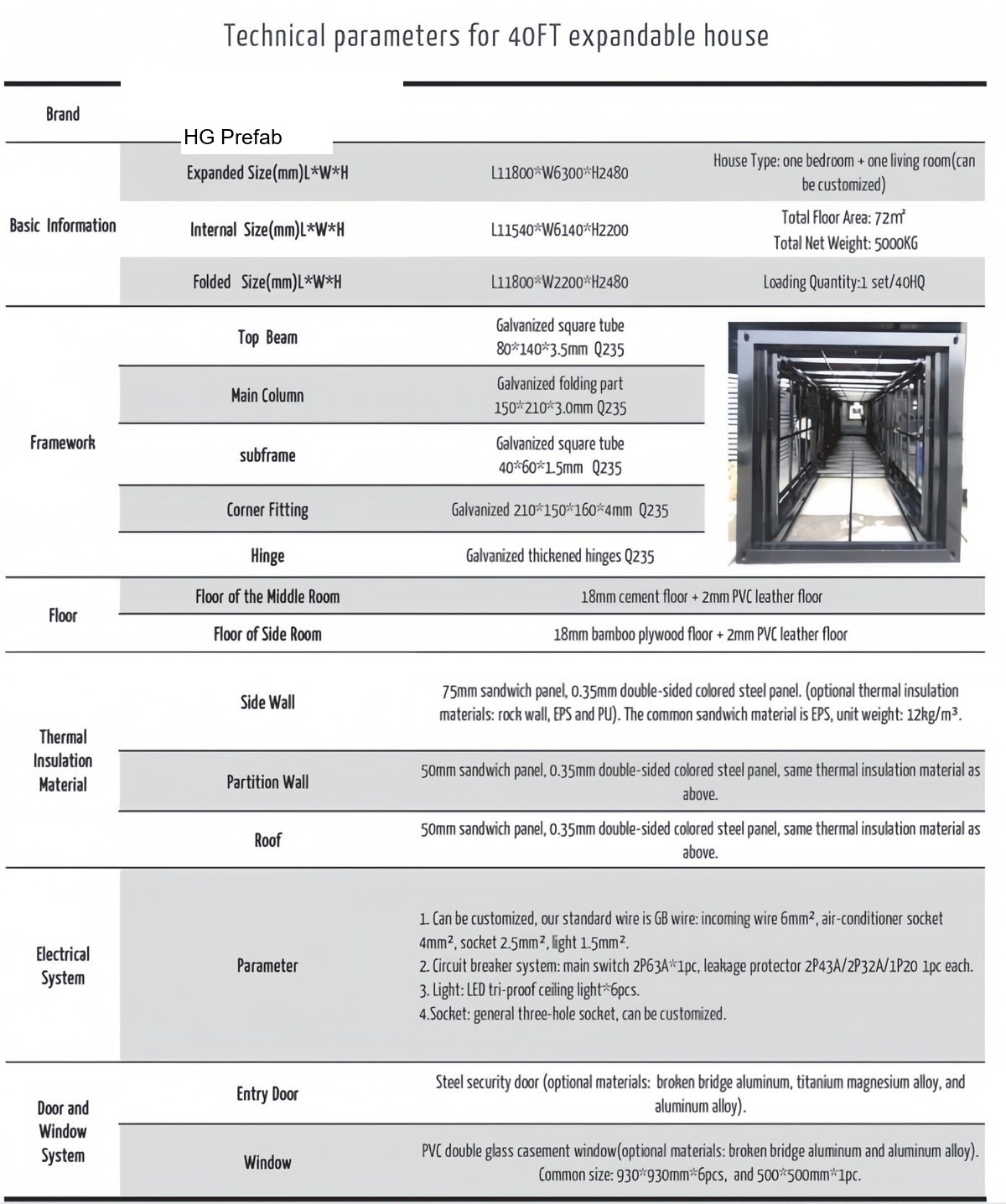
HG Prefab factory prices for the folding unit itself are 20FT $7,200–$9,800; 30FT $10,500–$14,500; 40FT $12,500–$16,500, ex-works, before fit-out, freight and local logistics. For a research camp that is the starting line: fit-out, power and water plant, and freight usually add more than the shells cost.
For the six-unit camp laid out above, shell cost at those prices runs roughly $49,800–$68,200. The rest of the budget is fit-out and logistics, and it usually exceeds the shells:
- Lab fit-out: benches, sink, circuits, cold storage, extraction — $6,000–$18,000.
- Power plant: solar array, lithium battery bank, inverter, genset — $15,000–$45,000.
- Water and sanitation: filtration, tanks, pumps, heating, waste handling — $5,000–$15,000.
- Freight and final leg: ocean, inland, and barge or 4x4 access — $12,000–$40,000.
Practical procurement advice:
- Freeze the scientific specification before ordering. Instrument lists drive circuits, bench layout and power sizing; changes after production starts cost the most.
- Order as one package. One production slot, one shipment, one set of drawings, one freight movement.
- Budget the final leg honestly. The last hundred kilometres can exceed the ocean freight; price the barge or helicopter before committing to a site.
- Buy spares with the units. Seals, filters, pumps and a spare inverter are cheap in the original shipment and costly to air-freight later.
Teams running staffed camps will find the operational overlap useful in our guide to remote workforce camps. Dimensions, floor plans and specifications for 20FT, 30FT and 40FT are on the products page.
Planning a field research station?
HG Prefab, manufactured by Henan Huangang Machinery Equipment Co., Ltd., builds 20FT, 30FT and 40FT folding expandable container houses configured as sleeping quarters, dry labs, mess units and utility plant. Send your site location, team size, instrument list and season dates for a camp layout and budget. Email hgmechequip@gmail.com or WhatsApp +86 191 0388 7380.
Browse modelsFrequently Asked Questions
How fast can a field research camp be deployed?
Once the folded units reach the pad, a small team can set and open several in a single day, because each unit unfolds and is structurally assembled in about 2 hours with four workers. The real schedule driver is what happens before that: permits, freight to the last port or railhead, and preparing a level pad and service points. Plan the site works first and the physical camp build becomes the shortest line in the programme.
Can container units work off-grid year-round?
Yes, if the energy system is sized from a real load list rather than a rule of thumb. A solar array, a lithium battery bank and a backup genset cover most research loads, and the genset carries the winter or monsoon weeks when solar yield drops. Size for the worst month, not the average: heating, instruments and ventilation all peak when generation is lowest.
How are units transported to remote sites?
Folded units travel as standard container-sized cargo on the same ships, rail wagons, barges and trucks that already serve the region, and compact folded units stack and ship efficiently to keep freight per square metre of floor low. The final leg is the constraint: poor roads need a 4x4 flatbed, river and lake sites use a barge landing, and sites with no access at all use helicopter sling-load, which requires the unit to be lightened and rigged for lifting. Offloading at the site needs a crane or forklift onto a prepared pad.
What maintenance does a seasonal station need?
Two visits a year: a shutdown and an opening. At shutdown, drain the water system or charge it with antifreeze, leave batteries at partial charge with the solar controller active, remove perishable stores, close and latch the folding seals, and secure roof penetrations against weather and wildlife. At opening, re-level the unit on its supports, inspect seals and roof seams, test the electrical installation and ventilation, and recommission the water system before the first crew arrives.