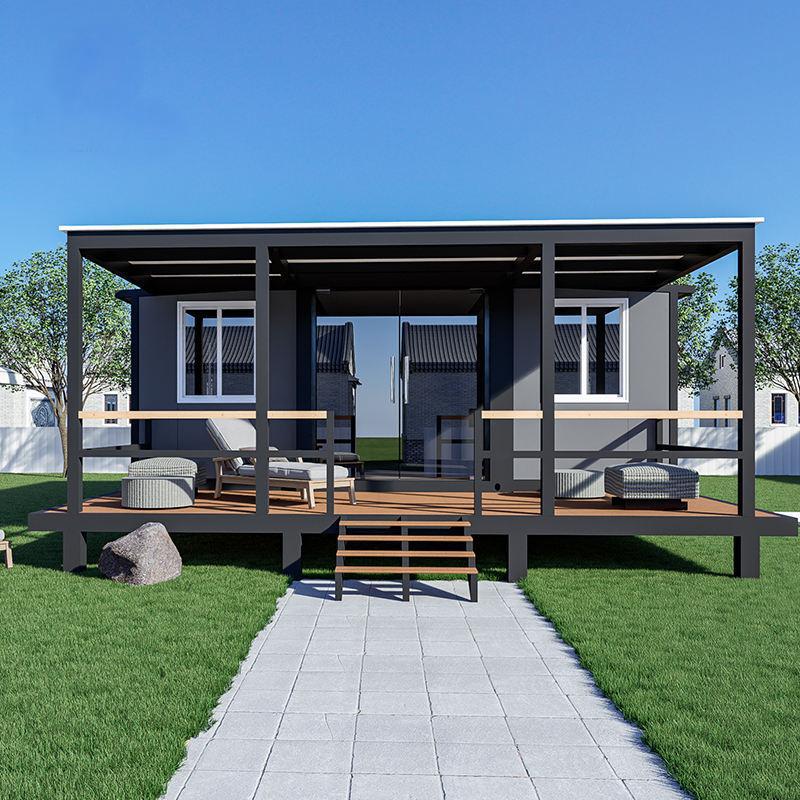
HG Prefab foldable expandable container homes — built to last, delivered worldwide.
The steel skin of a container home is both its structure and its weather barrier, and the only thing standing between that steel and the atmosphere is a film of coating roughly as thick as a sheet of paper. Most buyers spend more time choosing a sofa than choosing that film, and then wonder why the first rust bloom appears at a fold seam in year four. Coating is not decoration on this building type. It is the maintenance budget, the resale appearance and, in coastal climates, the service life of the shell itself.
This guide is written for people specifying a folding expandable unit before it ships and for owners planning their first repaint. Our rust and corrosion guide covers the chemistry of why steel fails and how to find damage early; our cladding and colour guide covers what you can add over the skin for appearance and shade; and our ten-year maintenance checklist puts the coating tasks onto a calendar. Read this one first, because every cladding and maintenance decision is built on the coating underneath.
Why the Finish on a Folding Unit Works Harder
A converted shipping container is a static box welded shut. A folding expandable unit is a machine with hundreds of metres of hinge line, moving panels, telescoping posts and roof sections that rotate through ninety degrees or more every time it is deployed or relocated. That difference matters enormously for coatings, because paint fails where metal moves.
Three consequences follow. First, the film has to be flexible enough to survive folding without cracking at the hinge line, which rules out thick, brittle systems that would be perfectly fine on a static cylinder. Second, edge coverage is everything: coating naturally pulls back from sharp edges as it cures, leaving a thin line exactly where the frame is cut, punched and welded. Third, the unit is transported folded, so panels rub against their neighbours and against tie-down points during shipping, and those contact marks are where owner-applied touch-up normally begins.
Factory prices for HG Prefab folding units are 20FT $7,200–$9,800; 30FT $10,500–$14,500; 40FT $12,500–$16,500, ex-works and before freight, taxes and local compliance. Exterior area is roughly 90–110 m² on a 20FT unit, 130–150 m² on a 30FT and 170–200 m² on a 40FT once you count walls and roof. Those two numbers — price and paintable area — are what turn a coating decision into a budget line.
What Actually Comes From the Factory
Surface preparation
Ask one question before any other: what was the steel surface condition before the first coat went on? Coating life is dominated by preparation, not by brand. Mill scale, the dark blue-grey oxide layer left by hot rolling, looks solid and is not; it loosens and lifts the paint above it. Factory finishes specified to ISO 8501 Sa 2.5 abrasive blast cleaning remove it entirely and leave a defined anchor profile for the primer to grip. Units prepared only by solvent wipe and light abrasion can look identical on delivery day and begin showing failure years earlier.
The standard three-coat logic
Protective coatings work as a system, and each layer has one job:
- Primer. Bonds to prepared steel and carries the corrosion inhibitor. This is where rust protection lives.
- Mid-coat or build coat. Adds film thickness so the barrier is genuinely thick enough to slow water and oxygen transport, and bridges small surface imperfections.
- Topcoat. Takes the ultraviolet radiation, the chalking, the colour fade, the salt spray and the cleaning. Everything visible depends on this layer.
Total dry film thickness for a serious exterior system sits in the 120–250 micron range depending on exposure class. A single decorative paint pass of 30–40 microns over lightly prepared steel is a cosmetic finish, not a protective one, and comparing their prices without comparing their film build is how buyers end up disappointed.
Coating Systems Compared
Here is the practical field guide to what you will be offered, what it does well, and what it costs. Film build and life figures are typical ranges for a well-prepared steel surface in a temperate inland climate; coastal and industrial exposure shortens everything.
| System | How it protects | Typical dry film build | Service life to first major repaint | Relative cost |
|---|---|---|---|---|
| Single-pack alkyd enamel | Basic barrier; limited inhibitor package; easy brush touch-up | 40–80 µm | 4–7 years | Lowest |
| Water-based acrylic exterior paint | Barrier plus good UV and colour stability; flexible enough for fold lines; low odour | 80–150 µm in two coats | 6–10 years | Low |
| Two-component epoxy primer + polyurethane topcoat | Epoxy gives adhesion and chemical resistance; polyurethane carries UV and gloss; strong salt and abrasion performance | 160–240 µm total | 12–18 years | Medium |
| Zinc-rich epoxy primer + epoxy mid-coat + polyurethane topcoat | Zinc dust sacrifices itself cathodically, so scratches do not immediately rust even where the film is breached | 200–280 µm total | 15–25 years | Medium-high |
| Powder coating (factory oven-cured, components and panels) | Thick, uniform, excellent edge coverage; no solvent; very hard-wearing | 60–120 µm per layer | 15–25 years | High, shop-only |
| PVDF fluoropolymer topcoat over epoxy or polyurethane system | Outstanding chalk and fade resistance; the benchmark for high-UV desert and tropical sun | 25–40 µm topcoat over a full system | 20+ years | Highest |
Where powder coating wins
Powder is an electrostatic, oven-cured process, and inside a factory it produces the most consistent, most uniform finish available, particularly on edges, corners and perforated parts where liquid coatings thin out. Powder-coated doors, window frames, shutters and trim that come out of the HG Prefab line are hard to beat for appearance. Its limitation is physics: it needs an oven, so it can never be applied on site to an assembled building, and if you scratch through it at a fold line, the repair is a liquid touch-up, not a re-bake.
Where liquid systems win
Liquid two-component systems — epoxy primer under polyurethane topcoat — are what most serious marine and industrial specifications use, because they can be applied in the field, repaired in the field, and built up locally where exposure is worst. Owners who expect to move, redeploy or repair their unit should keep a compatible liquid touch-up kit in store. Ask for the exact product names and batch of the factory system at handover so your later repairs use the same chemistry rather than something merely similar.
Matching the Coating to the Climate
The same building with the same finish can last seven years or twenty depending purely on where it stands. Use this table as the starting point for a specification conversation before shipping, because upgrading the factory system before dispatch costs a fraction of stripping and recoating on site later.
| Environment | What attacks the coating | Recommended system | Extra measures |
|---|---|---|---|
| Coastal, within 1 km of breaking surf | Chloride-laden salt aerosol; wet salt film on every surface; pitting at edges | Zinc-rich epoxy primer, epoxy mid-coat, polyurethane topcoat; 240 µm minimum | Freshwater rinse every 1–3 months; avoid dissimilar metal contact; sacrificial anodes or isolators on trim |
| Cold continental, freeze-thaw and road salt | Water ingress into micro-cracks, then expansion; de-icing salt wicking up from the ground | Flexible epoxy primer with polyurethane topcoat; pay attention to horizontal surfaces | Keep the skirt clear of snow banks; seal roof panel joints annually; inspect after every thaw |
| Desert and high-altitude UV | Extreme ultraviolet dose; large day/night thermal swing; chalking and colour fade | Epoxy system with PVDF fluoropolymer topcoat | Light colours mandatory on roof; consider a ventilated shade screen for exposed walls |
| Tropical humid and monsoon | Persistent condensation; fungal and mould growth on film; long wet season | High-build epoxy plus polyurethane with fungicidal topcoat additive | Design for drainage and airflow; treat under-floor and shaded faces; wash annually |
| Industrial or agricultural | Sulphur and nitrogen compounds; fertiliser dust; ammonia near livestock | Chemical-resistant epoxy with polyurethane topcoat; heavier build on sheltered faces | Wash deposits off promptly; isolate from ammonia sources; no bare galvanised-to-aluminium contact |
| Dry inland temperate | Mainly UV and thermal cycling; low corrosion drive | Acrylic or epoxy primer plus polyurethane; standard factory system is usually adequate | Annual inspection and wash; touch up chips promptly |
Colour Is a Thermal Decision, Not Just an Aesthetic One
Steel has no thermal mass worth mentioning and no insulation of its own, so whatever temperature the outer skin reaches becomes the load your insulation and air conditioning must deal with. In full summer sun, a dark low-reflectance panel can sit 20–30 °C hotter at the surface than the same panel in a light colour. That heat conducts inward, raises the cooling load and shortens the life of everything in the wall assembly.
Two practical rules follow. Keep the roof light: it receives the largest solar load of any surface and contributes most of the attic-style heat gain. If you want deep charcoal, navy or forest green walls for architectural reasons, balance them with a light or mid-tone roof and, where the budget allows, with a ventilated screen or cladding layer that shades the skin. Modern infrared-reflective pigments also help: they look dark in the visible spectrum while reflecting much more of the near-infrared that carries most of the heat, so you get the colour without the full penalty.
What It Costs, Ten Years On
Purchase price per square metre and ten-year cost are two different numbers. A cheap single-pack paint needs two full repaints in fifteen years, and repainting a deployed unit means scaffolding, masking, weather windows and surface preparation that usually costs more than the paint.
| System | Materials and application, per m² | Repaint interval | Typical 15-year cost for a 20FT unit (about 100 m²) |
|---|---|---|---|
| Single-pack alkyd | $2–$5 | 5–7 years | $1,000–$2,500 including two repaints and prep labour |
| Two-coat acrylic | $4–$8 | 7–10 years | $1,200–$2,400 including one to two repaints |
| Epoxy primer + polyurethane topcoat | $6–$12 | 12–18 years | $900–$1,600 including one renewal |
| Zinc-rich epoxy + polyurethane | $10–$18 | 15–25 years | $1,200–$2,000 over the whole period |
| Powder coat panels + liquid touch-up system | $12–$25 shop applied | 15–25 years | Usually bundled into the factory finish; touch-up kit $80–$250 |
The pattern is consistent and worth internalising: upgrading from the cheapest system to a mid-tier two-component system typically adds somewhere between $400 and $1,000 to a 20FT unit while adding roughly a decade of service life. Against a factory price of 20FT $7,200–$9,800; 30FT $10,500–$14,500; 40FT $12,500–$16,500, it is one of the cheapest durability upgrades you can buy, and unlike almost every other upgrade, it can only be done properly before the unit leaves the factory.
Application Conditions and Cure Time
Coatings fail more often from bad application conditions than from bad products. Every manufacturer publishes a window, and most failures trace back to ignoring one of these:
- Surface temperature above the dew point. The classic rule is at least 3 °C above dew point and rising. Paint applied to a surface with invisible condensation on it blisters and peels within a season.
- Ambient and substrate temperature range. Most two-component systems want roughly 5–35 °C. Below that they cure slowly or not at all; above it they skin over and trap solvent.
- Recoat windows. Two-component epoxies have a minimum and maximum interval between coats. Miss the maximum and you must abrade the surface back to achieve adhesion.
- Full cure versus handling. Touch-dry in a few hours is not cured. Allow the manufacturer's full cure time before folding, stacking, wrapping or exposing the surface to rain or salt spray.
- Film build verification. A wet film thickness gauge during application and a dry film thickness gauge afterwards are the only way to know you got what you paid for.
Maintenance: Small Tasks, Long Life
The coating itself needs less attention than most people expect; it is the details that need attention. Build this into the routine covered in our maintenance checklist:
- Wash annually with water and a pH-neutral detergent, working from the bottom up to avoid streaking, then rinse thoroughly. In coastal locations rinse every one to three months.
- Inspect twice yearly at welds, bolt heads, cut edges, hinge lines, the underside of roof panels and every place two different metals touch.
- Touch up any chip to bare steel within weeks. Abrade the area, degrease it, apply a compatible rust-inhibiting primer, then two topcoats. A five-minute repair today prevents a rust bloom that will cost hours later.
- Check drainage. Standing water on horizontal surfaces, blocked gutters or debris against the skirt are the fastest route to coating breakdown.
- Keep records. Product names, batch numbers and dates. The next person touching that surface — a contractor, a buyer, or you in eight years — needs to know what is already on it.
Repainting After Delivery
Most units arrive with a complete, cured factory finish, so on-site painting is a renewal rather than a first protection step. Sequence matters more than speed. Yes — a crane or forklift is required to offload the folded unit from the truck. Once it is set in position, four workers can unfold and assemble the main structure in about 2 hours. Plan painting around that day, not through it: you want the building deployed, dry, shaded where possible, and accessible before anyone opens a tin.
Then work methodically. Degrease and wash the whole surface; abrade glossy areas to a uniform matt profile; feather-sand chips and scratches and spot-prime every bare area with a primer compatible with the existing system; apply the specified number of topcoats at the specified film build and within the stated recoat window. Avoid painting in direct strong sun on the hottest part of the day if you can — a surface too hot forces solvent off before the film can level, and you get brush marks, poor flow and pinholes. If you cannot confirm what the original chemistry was, ask the HG Prefab team for it before choosing a repair product, and test compatibility on a small hidden area first.
Specify It Before It Ships
Every meaningful coating decision is made before dispatch. Once the unit is on the water, your options narrow to maintaining what it arrived with and eventually repainting over it, and both are more expensive than specifying correctly the first time. When you request a quote, send your location, your distance from the coast and the kind of environment the unit will sit in, and ask for the system to be stated explicitly: preparation standard, primer type, total dry film thickness and topcoat chemistry. A supplier prepared to put those numbers in writing is one that understands the coating actually matters.
Whether you choose a compact 20FT modern white unit, the mid-size 30FT white folding house, the spacious 40FT teak retreat or a cabin finish such as the 20FT mountain cabin, the full range is shown on our products page, and every model ships folded at a standard container shipping footprint for worldwide delivery.
Not sure which coating suits your site?
HG Prefab, made by Henan Huangang Machinery Equipment Co., Ltd., builds 20FT, 30FT and 40FT folding expandable container houses that ship folded worldwide. Tell us where the unit will stand — coastal, desert, tropical or freezing — and we will specify the preparation standard, primer chemistry and film build to match, and quote it before dispatch. Email hgmechequip@gmail.com or WhatsApp +86 191 0388 7380. Full range on the products page.
Browse modelsFrequently Asked Questions
Which exterior coating lasts longest on a folding container home?
The longest-lived systems are multi-coat ones built on a blast-cleaned or thoroughly abraded steel surface, not single-can paints. A zinc-rich epoxy primer under a two-component polyurethane topcoat typically gives 15 to 25 years to first major maintenance in an inland climate, and adding a PVDF fluoropolymer topcoat pushes colour and gloss retention past 20 years in high-UV regions. Plain alkyd or single-pack acrylic paint over a lightly prepared surface is cheapest at purchase and usually needs its first full repaint at five to eight years, so over a 20-year ownership window it is rarely the cheapest option.
Can I repaint my container home after it arrives, and what preparation does the factory finish need?
Yes, and most owners do eventually. The unit arrives with a complete factory-applied finish, so on-site work is either a refresh coat or a colour change rather than a first protect-against-rust treatment. Degrease the surface, wash off salt and dust, abrade glossy areas to a uniform matt profile and feather out any chip or scratch before priming bare spots with a compatible rust-inhibiting primer, then apply two topcoats at the film build the manufacturer specifies. Yes — a crane or forklift is required to offload the folded unit from the truck. Once it is set in position, four workers can unfold and assemble the main structure in about 2 hours, so plan access panels, scaffolding and drying weather around that same day.
Do dark colours really make a folding container home hotter inside?
Yes, measurably. Dark, low-reflectance steel in full sun can run 20 to 30 degrees Celsius hotter at the surface than the same panel in a light colour, and that heat conducts through the wall assembly even with good insulation. Light tones with a high solar reflectance index keep the shell closer to air temperature and cut cooling load. If you want a dark or charcoal exterior for architectural reasons, pair it with a reflective pigment formulation and a ventilated cladding or rainscreen layer, and keep the roof light, because the roof carries the largest heat load of any surface on the building.
Is powder coating better than liquid paint for a folding unit?
Powder coating gives a thicker, more uniform film and better edge coverage than brush or spray-applied liquid paint, which makes it excellent for factory-finished panels, doors, shutters and trim. It is an oven-cured shop process, so it cannot be applied to an assembled unit in the field, and damage at a fold line has to be repaired with a liquid touch-up rather than re-powdered. A practical approach many owners choose is powder-coated components from the factory plus a two-component polyurethane liquid system kept on site for touch-ups and eventual renewal, using compatible chemistries agreed before delivery.
How often should the exterior be inspected and touched up in coastal or industrial areas?
In coastal, industrial or high-humidity locations, inspect the exterior twice a year and after every major storm, paying attention to welds, cut edges, bolt heads, the underside of the folded roof panels and any place where dissimilar metals touch. Fresh water rinse of salt deposits every one to three months near the sea does more for coating life than any single product choice. In dry inland climates one inspection a year with an annual wash is usually enough, and any chip that exposes bare steel should be primed and topcoated within weeks rather than added to a list for next season.