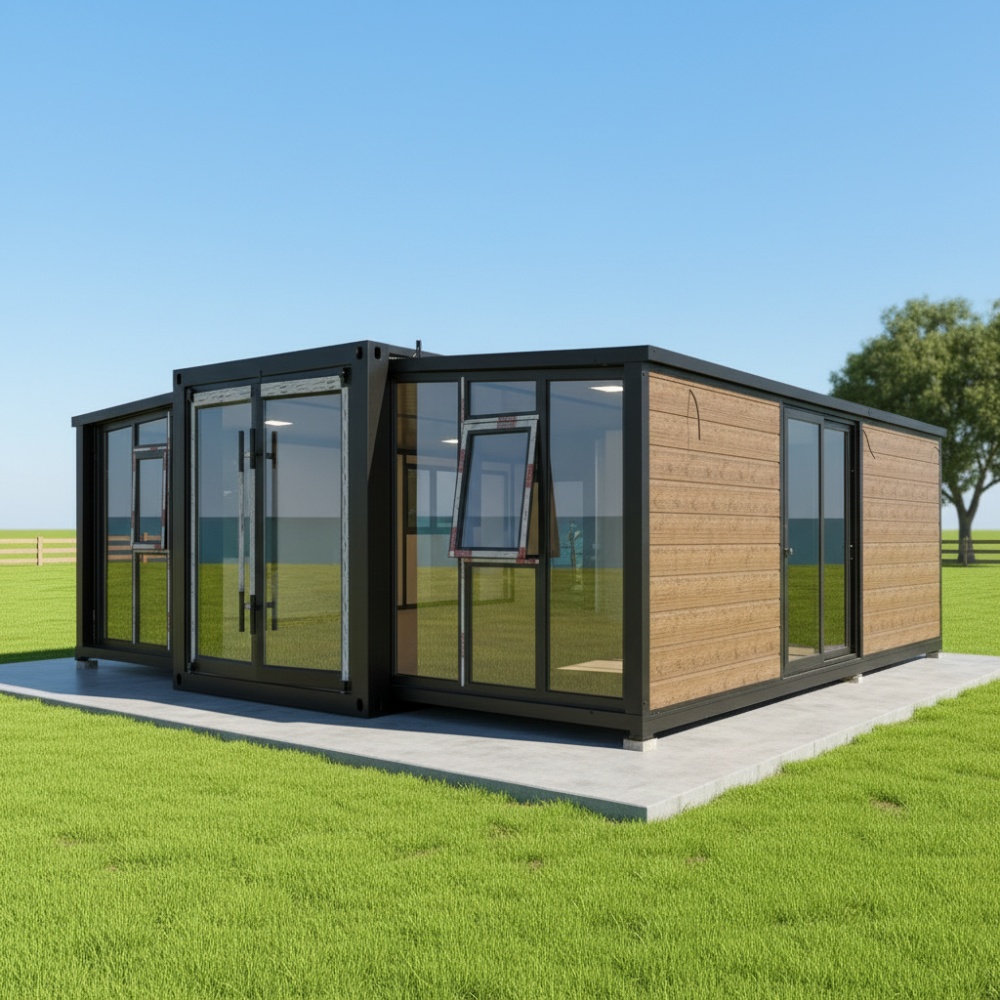
HG Prefab foldable expandable container homes — built to last, delivered worldwide.
Pottery is a craft that punishes improvised space. A kiln draws more current than almost any other home workshop machine, it radiates serious heat, and firing glazes release fumes that must leave the room. Clay dust settles everywhere, and wedging, throwing and glazing all need water and a drain nearby. A folding container unit answers these demands unusually well: the steel shell is fire-resistant, it can be isolated from the house so kiln fumes never reach living space, and the factory electrical rough-in makes a dedicated kiln circuit straightforward. HG Prefab's 20FT, 30FT and 40FT foldable container houses ship flat-packed and unfold on site. This guide covers layout, kiln power, ventilation, dust control, plumbing and costs.
Why a Container Unit Suits a Pottery Studio
- Fire-safe shell — the galvanized steel structure and mineral insulation give a kiln room far better fire separation than a timber shed, and a factory-fitted cement board or tile surround can be specified around the kiln position.
- Fumes kept away from the house — glaze firing releases metal oxide and flux vapours. A separate unit with its own extraction keeps them out of living space entirely.
- Easily-washed surfaces — sealed concrete-effect flooring, FRP or tile wall panels and epoxy benches handle clay, slurry and glaze drips without staining.
- Insulated and usable year-round — clay and greenware dislike frost and rapid temperature swings, and a properly insulated unit holds a stable working temperature.
The unit arrives folded and is placed in one lift. A crane or forklift is required to offload the folded unit from the truck. Once it is set in position, four workers can unfold and assemble the main structure in about 2 hours, after which the kiln circuit and extraction become the critical path.
Sizing: 20FT, 30FT or 40FT
Size by whether the kiln lives inside the studio or in a separate lean-to. Many potters prefer to keep the kiln outside the working room, which lets a 20FT unit work as a serious studio.
| Unit size | Floor area | Wheels | Best fit |
|---|---|---|---|
| 20FT | ~14 m² | 1–2 | Hobby studio, kiln sited in an attached lean-to |
| 30FT | ~21 m² | 2–3 | Teaching studio for small classes, kiln inside with a fire-rated surround |
| 40FT | ~28 m² | 3–4 | Production studio with a separate glaze room, drying shelves and a kiln bay |
Allow about 2.5 m² per wheel once the potter, the stool, a splash pan and a ware board are counted, plus 2 m² for a wedging table and 4–6 m² for storing greenware and bisque on shelves.
Layout: Wet Side, Dry Side, Kiln
A pottery studio works best when wet clay, dry clay and heat never mix in the wrong place. Divide the unit into three bands along its length:
- Wet side (throwing and glazing) — wheels along one long wall with a facing window if you have one, a wedging table in the middle, and a glazing bench with a bucket sink at the far end.
- Dry side (greenware and bisque) — open shelving on the opposite wall, kept away from the wheels so that a splash does not destroy a drying pot. Slatted or wire shelves let air reach the base of a pot.
- Kiln bay — at the end furthest from the door, or outside the unit entirely. Keep at least 500 mm of clearance on every side of the kiln, and never place a kiln under shelving that holds combustible material.
Shelving capacity is the real constraint in a small studio. A 30FT unit can carry roughly 12 running metres of shelf if you use double-height wall racks, which is enough for the output of two wheels working part time.
Kiln Power: Circuits, Load and Protection
The kiln is the single largest electrical decision in the project, and it must be made before you order the unit.
- Typical kiln draw — a small hobby kiln runs 1.8–3.0 kW on a 15–20 A / 240 V circuit. A mid-size 0.15 m³ (5 cu ft) kiln runs 5–7 kW on a 30–40 A circuit. A large 0.3 m³ (10 cu ft) production kiln draws 10–14 kW and usually requires a 60 A circuit at 240 V, or a three-phase connection in 400 V markets.
- Dedicated circuit only — a kiln must never share a circuit. It runs unattended for 8–14 hours, and any other load on the line will either trip it mid-firing or starve the elements and ruin the load.
- Conductor and breaker sizing — kilns are a continuous load, so size the breaker and cable at 125% of the kiln's nameplate rating. A 7 kW kiln therefore needs a 40 A circuit at 240 V with cable rated accordingly.
- Total supply — add wheels (0.4–1.0 kW each), a pug mill, an extruder, a slab roller, an air compressor, lighting and cooling. A 30FT teaching studio with a mid-size kiln typically needs 12–16 kW, so a 63 A single-phase sub-panel or a three-phase supply is the realistic choice.
- Protection and isolation — the kiln circuit wants its own RCD/GFCI-protected breaker with a lockable isolator next to the kiln, plus a thermocouple-fed high-limit cutoff on production kilns.
- Ventilation interlock — wire the kiln so it cannot be energised unless the kiln extractor is running. It is a simple interlock that prevents an expensive mistake.
For the broader picture, see our electrical load guide, and for off-grid sites the solar power guide — note that a kiln is normally far too large a load for an off-grid battery system to carry without a generator.
Heat, Fumes and Ventilation
A kiln at 1,200 °C heats the room around it, and glaze firing releases vapours that must be removed at the source.
- Kiln extraction — a downdraft kiln vent pulls fumes from the bottom of the kiln and discharges outside. For a manual arrangement, a hood over the kiln with a 300–600 m³/h fan and a stainless or galvanised duct does the same job.
- Ducting detail — short, straight runs with as few bends as possible, and a discharge point well away from any window, door or air intake. Never discharge into the ceiling void.
- Room air changes — 6–8 air changes per hour of general ventilation keeps the working space comfortable and clears clay and glaze dust.
- Heat management — a 7 kW kiln firing for ten hours releases a large amount of energy into the room. Insulate the kiln with a proper ceramic fibre jacket, keep clearance from walls, and plan cooling that can cope — a 3.5 kW mini-split is the minimum for a 30FT studio with a kiln inside.
- Carbon monoxide — if the studio ever uses a gas kiln or a raku burner, fit a CO alarm and never fire indoors without forced extraction. A CO alarm beside the sleeping area is a sensible extra safety net.
- Fire safety — a 2 kg CO₂ or dry powder extinguisher within reach of the kiln, and a fire-rated board or tile surround behind and beneath it.
Clay Dust, Water and Drainage
Clay dust is a genuine health hazard — crystalline silica in respirable dust causes silicosis and is classified as a carcinogen. Controlling it is a design requirement, not a preference.
- Wet-clean only — never dry-sweep or use a compressed-air blower in a pottery studio. Mop, or use a wet/dry vacuum with a HEPA filter. A standard workshop vacuum simply redistributes the finest and most dangerous fraction.
- Sealed surfaces — sealed concrete-effect floor, coved skirting, and a floor finish that can be mopped wet without lifting.
- Trapped floor drain — essential for mopping, wheel spills and glaze cleanup. A 50 mm trapped drain with a removable stainless strainer is enough; a 75 mm line is safer if you also run a slab roller or a large bucket sink.
- Clay trap — clay and glaze solids set like concrete in a drain. Fit a settling trap or interceptor ahead of the sewer and clean it weekly. This is the single most important plumbing fitting in a pottery studio, and it is far cheaper than replacing a blocked line.
- Bucket sink — a deep sink with a settling bucket beneath it lets heavy solids drop out before the water leaves the sink. Clean water can then go to the drain or be reused.
- Reclaim water — a 60–100 L reclaim barrel lets slurry settle into reusable clay and keeps solids out of the drain. Rinse water from wheels can be recycled for weeks.
- Water supply — a small 10–15 L under-sink heater is enough for hand-washing, since pottery cleanup is mostly cold. Frost protection matters if the studio is unheated in winter, because ice in a trap will crack it.
Cost Breakdown and Planning
- Container unit — 20FT $7,200–$9,800; 30FT $10,500–$14,500; 40FT $12,500–$16,500 depending on finish and factory options.
- Electrical sub-panel and kiln circuit — $1,800–$6,000 depending on kiln size and cable run.
- Kiln and kiln vent — $1,500–$8,000 depending on chamber size and whether it is new or secondhand.
- Ventilation, hood and ducting — $1,200–$4,000.
- Plumbing, clay trap and bucket sink — $900–$3,000.
- Flooring, wall panels and fire-rated surround — $2,000–$5,500.
- Wheels, pug mill, slab roller and shelving — $3,000–$15,000.
All-in, a hobby 20FT studio typically costs $18,000–$35,000, and a 40FT teaching or production studio commonly runs $50,000–$90,000 before land and lease costs.
Get the pad and the kiln circuit in before the shell lands. Cure the concrete fully, then book the lift. Yes — a crane or forklift is required to offload the folded unit from the truck. Once it is set in position, four workers can unfold and assemble the main structure in about 2 hours, so a pre-installed kiln feed, extraction duct sleeve and drain trench at the pad edge let the studio be commissioned within a fortnight of delivery. HG Prefab can factory-pre-cut the kiln circuit penetration, the extraction duct opening and the floor drain recess, and can specify a fire-rated board around the kiln position — all of which costs a fraction of cutting into a finished, tiled interior.
Need a folding container house?
HG Prefab manufactures 20FT, 30FT and 40FT folding expandable container houses with optional factory pre-cuts for kiln circuits, extraction ducts and floor drains, plus fire-rated surrounds for kiln bays. Shipped flat-packed worldwide.
Browse modelsFrequently Asked Questions
What electrical circuit does a pottery kiln need in a container studio?
A small hobby kiln runs 1.8–3.0 kW on a 15–20 A / 240 V circuit, a mid-size 0.15 m³ kiln 5–7 kW on a 30–40 A circuit, and a large 0.3 m³ production kiln 10–14 kW on a 60 A circuit or a three-phase connection. Because a firing is a continuous load of 8–14 hours, size the breaker and cable at 125% of the nameplate rating and never share the circuit with anything else.
How do I control clay dust in a container pottery studio?
Wet-clean only: mop floors and wipe surfaces instead of dry-sweeping or blowing with compressed air. Use a HEPA wet/dry vacuum rather than a workshop vacuum, seal every surface with a moppable finish, fit a trapped floor drain with a clay settling trap, and keep a reclaim barrel so slurry solids never reach the drain.
Does a container pottery studio need special ventilation?
Yes. Fit a downdraft kiln vent or a hood with a 300–600 m³/h fan discharging well away from any window or intake, and wire the kiln so it cannot run unless the extractor is on. Add 6–8 air changes per hour of general ventilation, and fit a CO alarm if the studio ever uses a gas kiln or raku burner.
How much does it cost to build a container pottery studio?
A hobby 20FT studio typically costs $18,000–$35,000 all-in, and a 40FT teaching or production studio commonly runs $50,000–$90,000. The unit itself is $7,200–$9,800 for 20FT, $10,500–$14,500 for 30FT and $12,500–$16,500 for 40FT; the kiln, its circuit and the extraction are usually the largest remaining items.
Do I need a crane to install a container pottery studio?
Yes — a crane or forklift is required to offload the folded unit from the truck. Once it is set in position, four workers can unfold and assemble the main structure in about 2 hours. Cure the pad and pre-install the kiln feed, extraction duct sleeve and drain trench at the pad edge before delivery so the studio can be commissioned within days.