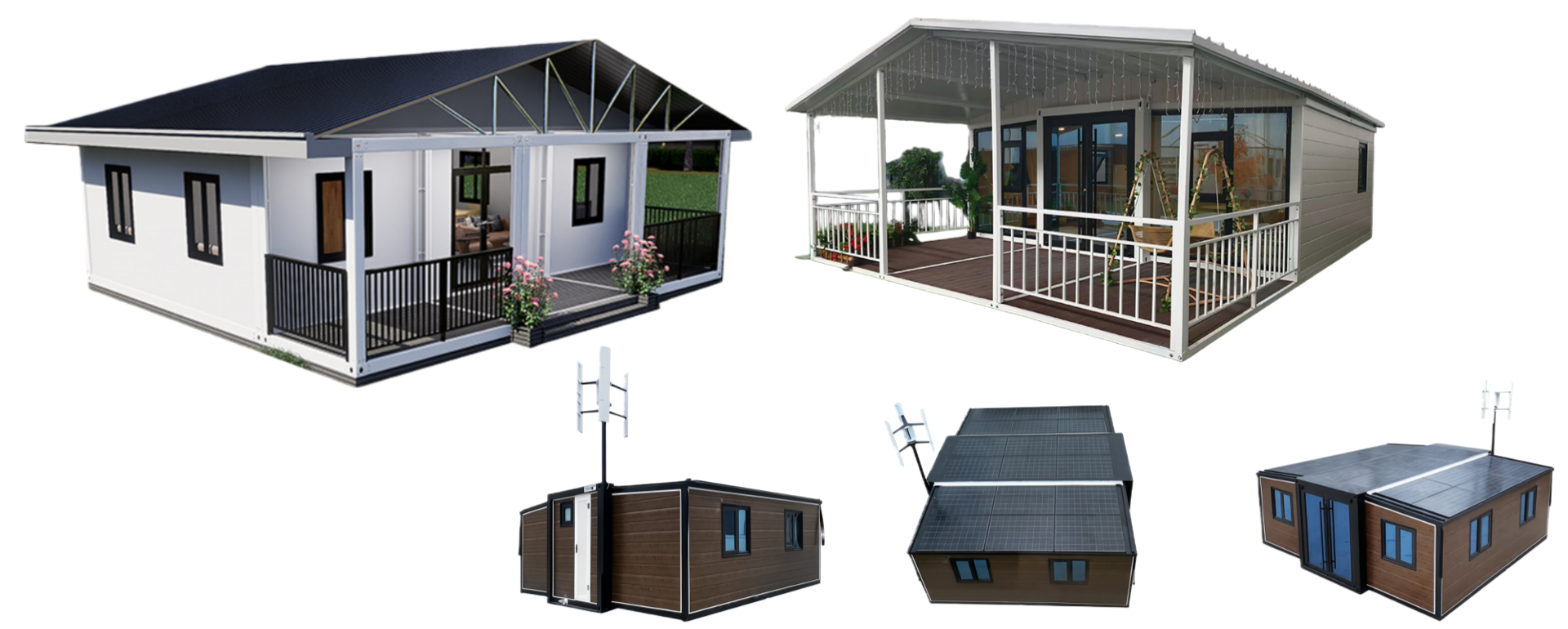
HG Prefab foldable expandable container homes — built to last, delivered worldwide.
The two choices that decide whether an off-grid container home is genuinely liveable both come down to water leaving the building and where it goes. The point of putting a folding expandable unit on a bush block, a coastal lot or a remote work site is precisely that those connections do not exist, which leaves two systems to design: a toilet that needs no water supply, and a way to deal with the sink and shower water a household produces every day. Get both right and the unit runs comfortably for months without a service visit.
For the water coming into the building rather than leaving it, see our companion guide to off-grid water supply for container homes; where a site does need conventional on-site wastewater disposal, the septic systems guide for container homes covers that route.
Why Composting and Greywater Fit Folding Container Homes
A composting toilet and a split greywater system are not simply alternatives to a septic tank — for many folded-unit installations they are the more logical answer:
- Plumbing stays out of moving parts. A folding unit hinges to reach transport width, and every drain crossing a fold joint is a leak risk after several hundred cycles. Removing blackwater from the network takes out the nastiest of those joints.
- The floor build-up is thin. Folding panels carry transport loads, so the floor is not deep enough to give large-diameter waste piping the constant fall it wants.
- The unit may relocate. Owners buy a folding expandable house partly because it can be folded and moved, and a toilet that depends on a buried tank does not travel with it.
- Water demand drops. A household that does not flush needs a smaller catchment, a smaller tank and fewer deliveries — often worth more than the toilet itself.
- Greywater is productive. Water that would otherwise load a drain field can irrigate a garden or windbreak, which matters on dry sites.
None of this makes either system maintenance-free. Both trade a monthly utility bill for twenty minutes of attention every few days, and buyers should accept that trade knowingly.
Composting Toilet Types: Self-Contained vs Central
There are two families of composting toilet, and the choice between them is mostly about how much space you have beneath the bathroom floor and how often you want to handle material.
Self-contained units
A self-contained unit resembles a conventional toilet with a taller seat box: seat, solids tray or drum, liquids container, fan and sometimes a small heater all sit inside one appliance. It needs no floor penetration beyond the vent connection, which makes it the usual choice when the floor cassette is already built at the factory. Better designs separate liquids at the seat, keeping the solids pile comparatively dry — an aerobic damp pile does not smell, while a saturated one does. Drum models rotate to mix contents with bulking material; others rely on a scoop of sawdust, coir or chopped straw after each use.
Central composting systems
A central system puts the processing vessel below the floor, reached by a short chute from the seat. Because the chamber is large and sits within the conditioned envelope, it processes material for months at a time and finished compost is drawn from a lower access door. The trade is installation work: the chamber must be accommodated during manufacture, the chute sealed, and the access door left reachable once the unit is assembled.
Comparison
| Attribute | Self-contained unit | Central composting system |
|---|---|---|
| Capacity | Solids tray roughly 20–40 L; liquids container 8–12 L | Chamber roughly 150–400 L serving the whole house |
| Typical occupancy | Two adults continuous; larger models three to four | Two to five adults continuous, higher for intermittent use |
| Power draw | Continuous vent fan, roughly 2–5 W, plus optional heater | Continuous vent fan, roughly 3–8 W, plus heater option for cold climates |
| Venting | Through-wall or short through-roof run, usually 50–75 mm | Through-roof preferred for stack effect; longer vertical run |
| Maintenance interval | Liquids every 2–4 days; solids tray every 3–6 weeks | Finished compost drawn off a few times per year |
| Floor penetration | None beyond the vent sleeve | Floor opening for chute, plus below-floor chamber space |
| Cost band | Approximately $900–$2,500 per unit | Approximately $2,500–$6,000 installed including chamber and venting |
| Best fit for a folding unit | Yes — simplest, survives transport, no below-floor work | Yes where the chamber is engineered into the factory build |
Read the cost bands as supply-and-install indications only, excluding freight, local tax and electrical work. For most buyers the deciding factor is whether the unit will ever be moved: if yes, self-contained wins almost automatically; if it will sit permanently on one site and the buyer never wants to handle a tray, a factory-integrated central chamber is the more comfortable answer — but it must be specified before production.
Venting and Installation Details
Venting is where most failures happen, and it is the one part that cannot be improvised with generic parts. The principle is simple: keep a slow, continuous airflow from the room, past the waste, out to daylight. When that flow stops, odour reverses into the room.
Through-wall vs through-roof vents on folded units
- Through-roof (recommended). A vertical run creates stack effect, so the toilet keeps working even if the fan stops. It terminates above the roof line, clear of windows and outdoor areas. The roof of a folding unit moves during unfolding, so the penetration must sit where the fold does not pass, using a flexible coupling or marine-grade deck seal rather than a rigid joint.
- Through-wall (practical fallback). Shorter and easier to seal, with no roof penetration at all. The fan must then do all the work, so use a continuously rated low-wattage fan rather than an intermittent-duty bathroom extractor. Terminate clear of decks, paths and air intakes with a screened, bird-proof cowl.
- No dampers. A spring-loaded backdraft damper looks tidy and quietly stops the airflow the system depends on. Use a screened outlet with removable insect mesh.
Four further installation points matter in a steel-framed unit:
- Fan power. Put the fan on a dedicated unswitched circuit. One wired to the light switch will be turned off, and the toilet stops working properly that same evening.
- Vent condensation. Warm moist air leaving through a cold pipe condenses and runs back. Insulate the external section and slope any horizontal length slightly outward.
- Sealing. Use flashing matched to the panel profile with neutral-cure sealant; silicone alone across a moving fold is not a flashing.
- Electrical load. The continuous fan belongs in the always-on off-grid budget alongside every other permanent draw — see our folding container home plumbing and electrical guide.
- Site set-up sequence. Yes — a crane or forklift is required to offload the folded unit from the truck. Once it is set in position, four workers can unfold and assemble the main structure in about 2 hours. The vent terminal and any external greywater connection should be fitted after the structure is standing and the roof is locked, not before.
Greywater: Sources and Reuse
Greywater is everything going down a drain except toilet waste: showers, basins, kitchen sink and laundry. It is far easier to reuse than blackwater, but it is not clean water and it cannot be stored — untreated greywater turns anaerobic and smells within about a day, so anything with storage needs treatment or a very short holding time.
Greywater classifications and what each allows
- Light greywater — showers, baths and bathroom basins. Low in fats and solids, the easiest to reuse and the category most jurisdictions permit for landscape irrigation.
- Kitchen and dishwasher water — high in grease and food particles. Usually routed separately, because grease clogs filters and smears the biological film that reed beds and mulch basins depend on.
- Laundry water — variable detergent salt loads make it unsuitable for repeatedly irrigating the same soil, even where it is legal.
The most useful design decision for a folding unit is therefore a split drain: bath and basin water to a greywater circuit, kitchen sink to a sealed holding tank. One extra pipe run at manufacture removes most of the operational problems that follow.
Reuse options
- Mulch basin. Greywater discharges into a below-surface basin of coarse woodchip hosting the biology that breaks contaminants down while feeding plant roots. Cheap, no moving parts, forgiving of intermittent flow. Keep it covered so water is never exposed.
- Gravel reed bed. A lined cell of graded gravel planted with reeds, fed from a perforated manifold below the surface. Better treatment and higher loads than a mulch basin, at the cost of a liner, excavation and periodic reed cutting.
- Surge tank. Typically 200–1,000 L, evening out the difference between shower peaks and what the bed can absorb. Essential where several showers follow each other — and the component most likely to need winter protection.
- Filter with disinfection. Only required where treated greywater is allowed for toilet flushing or above-ground irrigation, and firmly licensed-installer territory.
Three rules hold whichever route you choose: no standing water accessible to people or animals, no untreated contact with edible crop parts, no spray irrigation. Subsurface distribution satisfies all three, and is also what most codes permit.
Permits and Health Rules
This is where general advice is worth least, because the rules are genuinely local and they change. Contact the authority that will actually enforce them — usually the municipal building department or the environmental/public health agency — before the internal plumbing layout is fixed.
- Is greywater reuse permitted on this parcel at all, and for which sources?
- Is there a simple code path for untreated greywater to subsurface landscape irrigation, or does any reuse need a permitted treatment system?
- Is a licensed installer required, and is there registration or reporting afterwards?
- Does a composting toilet need a permit, a listed certification or an inspection?
- What setbacks apply from property lines, watercourses, wells and bores?
- If reuse is refused, what on-site alternative does the authority expect?
Two cautions. The drain layout inside a folding unit is fixed at manufacture, so changing your mind after delivery means cutting into finished lining panels — resolve the rule during specification, not after. And if a local officer is unfamiliar with folded steel units, ask what documentation they need to review a factory-built dwelling; hesitation is usually about unfamiliarity rather than suitability, and a complete drawing set closes the gap. Some jurisdictions reference performance listings such as NSF/ANSI standards for composting fixtures, so confirm current requirements with your own authority instead of assuming a particular listing applies.
Winter Considerations
Cold is the failure mode owners underestimate most, because both technologies depend on biology and water.
- Indoor composters are the warm option. A unit inside the heated envelope keeps working. One in an unheated annexe or external bathroom slows dramatically and can stop processing; if the unit is left unused in winter, drain the liquids container first.
- Biology scales with temperature. Below roughly 10°C the microbial community becomes sluggish and the pile accumulates instead of reducing. Insulate any chamber near an outside wall, and add a low-wattage heating pad where the climate warrants it.
- Vents ice over. Warm saturated air meeting freezing air builds frost at the terminal and gradually chokes airflow. Insulate the external length and check the outlet after cold snaps.
- Greywater components. Bury distribution below the local frost depth; anything above grade — surge tank, pump, filter, valves — needs insulation plus heat tracing or it will freeze and split.
- Basins and beds go dormant. Plants stop taking water and freeze-thaw can lift new pipe. Oversize the bed, avoid heavy loads in the coldest weeks, and divert to a holding tank in sustained sub-zero spells.
- Airtight envelopes condense. A well-sealed unit in a cold climate needs managed ventilation, or shower and cooking moisture condenses on cold steel — covered further in our cold-climate folding container home guide.
Maintenance Schedule
| Frequency | Composting toilet | Greywater system |
|---|---|---|
| Daily | Add a scoop of bulking material after solids use; check the fan is running | Wipe the sink and shower strainer so hair and lint never enter the line |
| Weekly | Empty the liquids container before it reaches about two-thirds; wipe the seat and seal | Check the outlet into the mulch basin or reed bed for ponding; clear the leaf screen |
| Monthly | Inspect the vent screen and cowl; check the tray or drum is damp, not wet | Clean or backwash the lint filter; check the surge tank for sludge build-up |
| Seasonal | Empty the solids tray; wash seals; check the vent insulation and any heat tracing | Top up mulch as it decomposes; cut back reeds; check for grease accumulation in traps |
| Annual | Replace worn seals and any carbon filter; service the fan | Excavate and inspect the distribution manifold; pump out the surge tank |
Daily and weekly tasks together take a few minutes. The ones protecting the investment are the seasonal items: worn seals, neglected heat tracing and a slowly silting distribution line are how these systems fail, and all three are preventable.
Full System Example for a 30FT Off-Grid Layout
Assume two full-time occupants in a 30FT folding expandable unit on a dry rural block with freezing winter nights.
- Water supply. Roof rainwater to a 5,000 L tank with a first-flush diverter and cartridge filter. Without flushing, household demand lands around 60–80 L per person per day rather than far more.
- Toilet. One self-contained separator unit with a through-roof 75 mm vent, fan on a continuous circuit, connected so nothing crosses a fold joint.
- Drain split. Shower and basin to greywater; kitchen sink to a sealed holding tank.
- Greywater. A 300 L surge tank feeding two mulch basins used on rotation, each roughly 2 m x 1.5 m lined with coarse woodchip, irrigating a small orchard where water reaches roots but never surfaces.
- Winter. Insulated surge tank with heat trace; the basins go dormant while flow diverts to the holding tank through the coldest weeks.
- Energy. Fan plus pump sit in the always-on base load, small enough that a modest solar array covers them.
HG Prefab builds 20FT, 30FT and 40FT models at factory-direct prices of 20FT $7,200–$9,800; 30FT $10,500–$14,500; 40FT $12,500–$16,500, ex-works, before the sanitation package, water storage, solar equipment and freight. The 30FT folding expandable model is where most off-grid buyers land, because it fits a full bathroom with a self-contained composting toilet and a split drain layout without compromise and still folds to one transport envelope. Drain routing, panel build-up and any below-floor decision are settled at specification stage, since none can be changed once the unit leaves the factory.
Planning an off-grid sanitation layout?
HG Prefab, manufactured by Henan Huangang Machinery Equipment Co., Ltd., builds 20FT, 30FT and 40FT folding expandable container houses with split greywater drain layouts, vent penetrations located clear of fold joints and factory-coordinated battery and holding tank connections. Send us your site conditions, climate and occupancy for a specification review. Email hgmechequip@gmail.com or WhatsApp +86 191 0388 7380. Full model range on the products page.
Browse modelsFrequently Asked Questions
Do composting toilets smell in a small container home?
Not when they are vented and managed correctly. Odour comes from a wet, compacted pile with no airflow, not from the fixture itself. Continuous negative pressure created by a low-wattage vent fan pulls air down through the seat and out to daylight, so smells leave the building instead of entering the room. Add bulking material after every solids deposit, keep liquids separate, never close the vent with a damper, and empty the liquids container before it gets close to full. If odour persists, check for a blocked vent screen, a failed fan, or a tray that is running wet rather than damp.
Is greywater reuse legal where I live?
It depends entirely on the jurisdiction, and the rules change at state, provincial and municipal level. Some regions allow untreated greywater from showers and bathroom sinks for subsurface landscape irrigation under a simple code path; others require a permitted treatment system, a licensed installer and periodic reporting; some prohibit reuse altogether and require every drain to discharge to a septic system or municipal sewer. Contact the local building or environmental health department before the plumbing layout is fixed, because the drain routing inside a folding unit has to be built to match the rule you are actually trying to satisfy.
How often does a composting toilet need emptying?
For two full-time occupants, a self-contained unit usually needs the liquids container emptied every two to four days and the solids tray emptied every three to six weeks, depending on capacity and how much bulking material is used. A central composting system with a larger chamber serving the same household often only needs finished compost drawn off a few times a year. Weekend and seasonal occupancy stretch every interval considerably, and keeping the pile damp rather than wet and aerated rather than compacted extends whichever schedule you started with.
Can greywater systems freeze in winter?
Yes, and the exposed components are the vulnerable ones. Buried distribution lines set below the local frost depth generally stay serviceable, but surge tanks, pumps, filters, valves and any pipe run above grade will freeze in a hard winter. Insulate and heat-trace everything exposed, slope lines so they drain back rather than hold standing water, keep mulch basins and reed beds sized so they do not freeze solid, and in sustained sub-zero weather either divert greywater to a holding tank or winterise that circuit completely. A composting toilet installed inside the heated envelope also needs to stay above freezing for the composting process to continue working.