HG Prefab foldable expandable container homes — built to last, delivered worldwide.
Canada is one of the most rewarding markets in the world for a factory-built dwelling, and one of the least forgiving on paperwork. The construction season in most provinces runs from roughly May to October, site labour is expensive, and a very large share of new units are built in places where getting a crew and materials to the site costs more than the materials themselves. A folding container home answers that problem directly: it is manufactured indoors under controlled conditions, it ships flat in a standard ocean container envelope, and it can be set and opened in a single working day. What it does not do is bypass Canadian compliance. This guide walks through the customs side, the certification side, the provincial code side, the winter logistics side and the real numbers, so that a Canadian buyer can budget an import accurately instead of discovering the cost at the port.
Why Canada Suits Folding Container Homes
Four conditions in the Canadian market favour a factory-folded unit over a conventional site build:
- A short building season. In Alberta, Saskatchewan, Manitoba and most of Quebec and Ontario, weather stops or slows site work for four to six months a year. A unit that arrives finished and opens in a day converts a seasonal schedule into a year-round one.
- High site labour cost. Trades in the Greater Toronto Area, Metro Vancouver and the Alberta corridor bill at rates that make any reduction in on-site hours worth real money. Factory assembly moves those hours indoors where they are cheaper and repeatable.
- Remote and northern delivery. Resource, tourism and infrastructure projects routinely need accommodation on sites with no local building capacity. A folded unit travels by rail and truck on the same intermodal network that already serves those regions.
- Secondary suites and backyard homes. BC, Alberta and Ontario have all opened rules for additional residential units, and a compact factory-built dwelling fits the scale of those lots far better than a conventional addition.
There is also a regulatory advantage worth understanding early. Because a folding container home leaves the factory as a completed building rather than a kit of parts, it fits the Canadian category of a prefabricated building — and that category has its own, well-defined approval route, which is the subject of the next two sections. Buyers comparing markets should read our companion guide on importing a folding container home to the USA, where the federal and state structure works quite differently, and on importing to Europe, which uses CE marking and EN standards instead of CSA.
CBSA Duties and Taxes: HS 9406 and GST/HST
Every shipment into Canada is accounted for with a B3 Canada Customs Coding Form, filed by a licensed customs broker on behalf of the importer. The importer needs a Business Number (BN) registered with the Canada Revenue Agency, and the carrier needs the cargo controlled at the port of arrival before release.
Classification
Prefabricated buildings are classified under HS heading 9406, which covers prefabricated buildings whether or not complete or assembled. Sub-headings within 9406 distinguish between buildings of different materials and types. Duty rates under this heading are low or free for most origins, but the classification decision still has to be made and defended. If the unit is shipped with furniture, appliances or loose equipment, expect those items to be treated separately from the building itself — invoice them on separate lines so the broker is not forced to allocate values after the fact.
What you actually pay
- Customs duty: applied on the value for duty, at the rate for the correct 9406 sub-heading. Low or nil for most prefabricated building entries.
- GST / HST: 5% GST federally, or HST at 13% to 15% in participating provinces. This is the tax that surprises importers, because it is charged on the declared value plus freight and insurance, not on the factory invoice alone.
- Provincial sales tax: where applicable, on top of GST in non-HST provinces.
- Brokerage and port fees: customs entry, terminal handling, and any examination or hold charges.
Documents to prepare before the vessel sails: a commercial invoice with HS codes and separate freight and insurance values, a packing list with net and gross weights, the ocean bill of lading, a certificate of origin, and any wood packaging declaration for dunnage and crates. If the classification is unusual, ask the broker to request a CBSA advance ruling before shipping — it costs little and removes the risk of a re-assessment after the goods have already landed. The freight mechanics themselves, including container loading and port handling, are covered in detail in our container home shipping and customs guide.
CSA A277 and Electrical Certification
CSA A277: the prefabricated building procedure
CSA A277 is not a design standard, which is the single most common misunderstanding. It is a procedure for certification of prefabricated buildings, and it verifies that the manufacturer operates a certified factory quality-control program under the ongoing inspection of an accredited certification agency. The outcome is a CSA A277 label applied to the unit, which tells the provincial or municipal authority that the building was produced under an audited system and that the design was reviewed to the applicable code.
In practice, this is what makes a building permit achievable for an imported unit. The alternative route — a local professional engineer reviewing and stamping an unfamiliar factory product — is available in some jurisdictions but costs more, takes longer, and often ends with the engineer asking for destructive verification. Ordering the certification package with the unit, not after it lands, is the cheapest compliance decision in the whole project.
Electrical: CSA / ULC and the Canadian Electrical Code
Electrical equipment in Canada must be certified to CSA or ULC standards for use in Canada, and installations must meet the Canadian Electrical Code (CSA C22.1) as adopted by the province. Points to settle before production:
- Wiring and devices: Canadian-certified cable, breakers, receptacles and luminaires installed in the factory, or an agreed blank-panel approach for a local electrician.
- Panel and service size: declared early, because the service size drives the utility connection application, which is usually the slowest external dependency in the schedule.
- Field evaluation: where a component is not already certified, an inspection body such as ESA in Ontario, Technical Safety BC or the Alberta safety authority can apply a field evaluation label — but this must be arranged, not hoped for.
- Gas appliances: must carry Canadian certification; propane and natural gas appliances are not interchangeable between markets.
National Building Code 2020 and Provincial Adoption
Canada has no single national building regulation with force of law. The National Building Code of Canada 2020 (NBC 2020) is a model code; each province and territory adopts it, in whole or in part, on its own timetable and with its own amendments. Four markets cover most import demand:
- British Columbia: adopts the BC Building Code, aligned with NBC 2020, plus the BC Energy Step Code, which lets municipalities require performance tiers above the base code. Check the local step requirement by municipality — it is a local decision, not a provincial one.
- Alberta: the Alberta Building Code is based on NBC 2020 under the Safety Codes Act. Permits are municipal, inspections may be municipal or accredited agency, and the province does not add a separate energy step system, so NBC Section 9.36 governs.
- Ontario: the Ontario Building Code, with its own energy requirements in SB-12, plus mandatory electrical inspection through the Electrical Safety Authority. SB-12 offers prescriptive packages and a performance alternative — the prescriptive route is usually the faster permit.
- Quebec: the Quebec Construction Code with provincial amendments, the Quebec electrical code, and a contractor licence requirement through the Régie du bâtiment du Québec. Documentation and labelling in French is a practical requirement, not a formality.
The permit sequence is the same everywhere: confirm zoning and permitted use first, then apply for the building permit with the CSA A277 documentation, then schedule inspections at foundation, service connection and occupancy. Zoning is the step that kills projects — establish whether a relocatable factory-built dwelling is a permitted use on the lot before a unit is ordered.
Energy Efficiency: NBC 9.36 and Ontario SB-12
NBC Section 9.36 sets energy-efficiency requirements for houses and small buildings through a prescriptive path and a performance path. For a container-based dwelling, the prescriptive path is usually the practical one, because it is a checklist of assembly values rather than a whole-building model.
- Envelope thermal resistance: effective R-values for walls, roof and floor are set by climate zone. A folding unit needs continuous insulation with thermal breaks at the steel frame — steel conducts heat roughly 300 times faster than insulation and will bypass any insulation that is interrupted by it.
- Airtightness: NBC 9.36 sets an airtightness target and requires a blower door test in most adoption paths. Factory assembly helps here, because the critical seals are made under controlled conditions rather than on a windy site.
- Fenestration: window and door U-values are specified by zone; double glazing with a low-e coating is the usual baseline, triple glazing in colder zones.
- Ventilation: a heat or energy recovery ventilator is required in an airtight envelope, and is also the correct answer to condensation in a Canadian winter.
- Ontario SB-12: uses its own package system with trade-off options between envelope, equipment and air tightness. Pick a package at design stage; changing package mid-project means re-submitting.
Winter performance is a design question as much as a compliance one, and the insulation, heating and freeze-proofing detail is covered separately in our cold-climate folding container home guide.
Shipping Routes and Winter Delivery
Ports and inland routing
- Vancouver: the shortest Pacific transit from East Asia and the primary gateway for BC, Alberta, Saskatchewan and Manitoba. Intermodal rail from Vancouver reaches Calgary, Edmonton, Saskatoon, Winnipeg and Toronto; final delivery is truck from the rail terminal.
- Montreal: serves Quebec and Ontario directly, reached by all-water services via transshipment or by rail from the west coast. The best choice for Quebec delivery, where French documentation matters.
- Halifax: the gateway for Atlantic Canada, typically via transshipment, with shorter inland truck legs once landed.
Budget the inland leg honestly. For a folded unit, the ocean freight is a single container movement, but the inland rail plus truck combination across a country the size of Canada can rival the ocean leg in cost and exceed it in time.
Winter-specific risks
- Low-temperature transport condensation. A unit loaded in a warm factory and discharged into a Canadian winter will condense moisture inside the envelope. Ship dry, use desiccant, keep the unit sealed in transit, then ventilate and warm it before closing interior finishes.
- Snow load. Design the roof for the local ground snow load. Values across Canadian municipalities span a wide range, and a coastal value is not a Prairie value and certainly not a northern one.
- Arrival freeze protection. Drain plumbing before shipping, use antifreeze in traps during transit, and arrange a heated bay or an immediate service connection so the unit is not left unconditioned after offload.
- Spring load restrictions. Many secondary roads impose axle weight limits during spring thaw, which can delay final-mile delivery more than winter snow does.
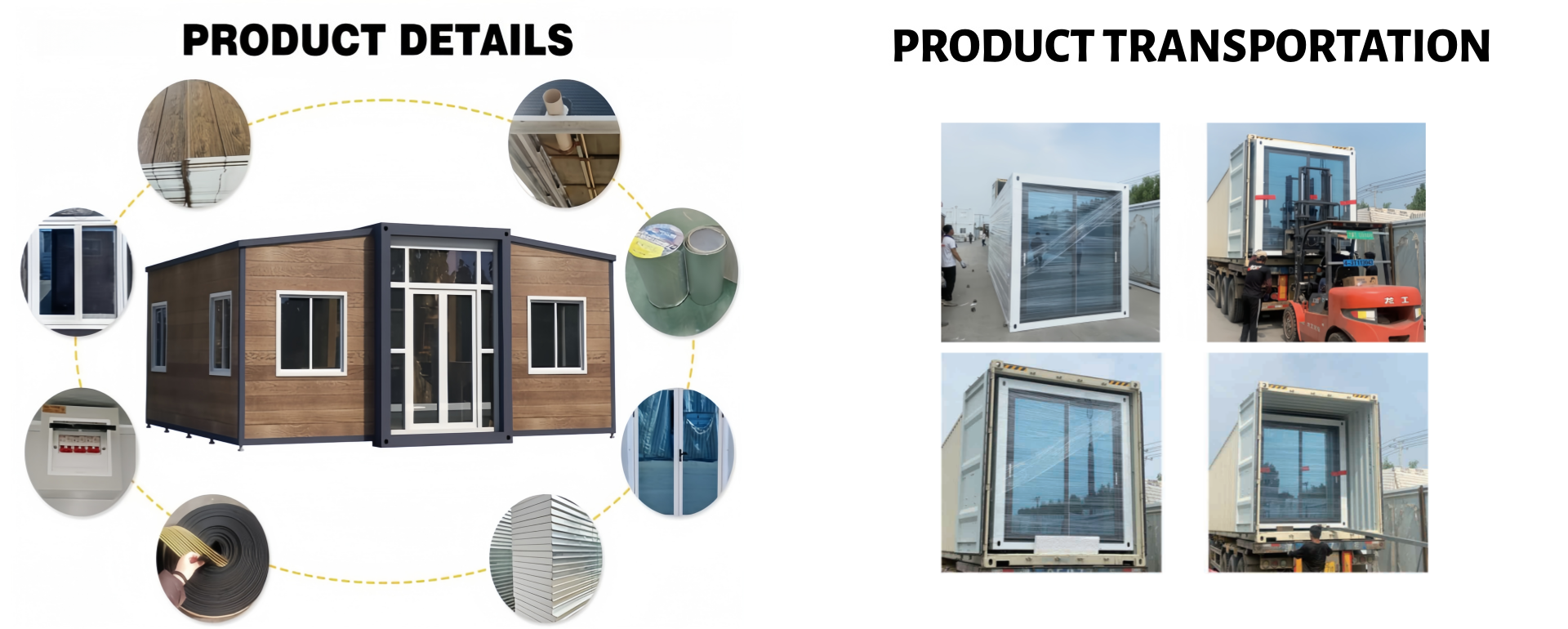
- Offload planning. Yes — a crane or forklift is required to offload the folded unit from the truck. Once it is set in position, four workers can unfold and assemble the main structure in about 2 hours. Confirm crane access, ground bearing and overhead clearance in advance, and pour the pad before the truck arrives so offload and assembly happen on the same visit.
Landed Cost Budget
HG Prefab factory prices for the folding unit itself are 20FT $7,200–$9,800; 30FT $10,500–$14,500; 40FT $12,500–$16,500, ex-works, before freight and Canadian compliance. That is the starting point, not the landed cost. The table below converts it into a realistic landed estimate per size.
| Unit size | Unit price | Ocean freight (est.) | Duties & taxes | Compliance budget | Landed estimate |
|---|---|---|---|---|---|
| 20FT | $7,200–$9,800 | $2,200–$4,000 | $900–$2,000 | $1,500–$3,500 | $11,800–$19,300 |
| 30FT | $10,500–$14,500 | $2,800–$5,200 | $1,300–$2,900 | $1,800–$4,000 | $16,400–$26,600 |
| 40FT | $12,500–$16,500 | $3,400–$6,500 | $1,600–$3,500 | $2,000–$4,500 | $19,500–$31,000 |
Read the columns as ranges, not quotes. Ocean freight moves with the market and with the port — Vancouver is usually the least expensive Pacific discharge, Montreal and Halifax carry transshipment premiums. Duties and taxes scale with declared value plus freight, and the HST line is the one that scales fastest. The compliance budget covers CSA A277 certification, electrical certification or field evaluation, engineering review where required, permit applications and inspection fees. The landed estimate excludes site work, foundations, service connections and crane hire, which are local and site-specific. Larger layouts such as the 40FT folding expandable model spread the fixed compliance cost over more floor area, which is why the 40FT landed figure is proportionally better than the 20FT one.
Timeline From Order to Occupancy
- Weeks 0–1: specification freeze, compliance route confirmed, HS classification agreed with the broker, zoning checked on the site.
- Weeks 1–5: factory production under the certified quality-control program, with CSA A277 documentation prepared in parallel.
- Weeks 5–8: ocean transit to the chosen Canadian port.
- Weeks 8–9: CBSA clearance, B3 filing, duty and GST/HST payment, terminal release.
- Weeks 9–11: inland rail and truck delivery to site; pad and services prepared in advance.
- Week 11: offload, unfold and structural assembly in about 2 hours with four workers, followed by service connections.
- Weeks 12–14: electrical, plumbing and heating completion, blower door test, municipal inspections, occupancy.
The two items that most often extend this schedule are not manufacturing or shipping — they are the utility service application and the municipal permit review. Start both before the vessel sails.
Planning a Canadian import?
HG Prefab, manufactured by Henan Huangang Machinery Equipment Co., Ltd., builds 20FT, 30FT and 40FT folding expandable container houses with CSA A277 documentation packages, Canadian-certified electrical options, cold-rated insulation and winter shipping preparation. Send your province, postal code and intended use for a landed-cost estimate. Email hgmechequip@gmail.com or WhatsApp +86 191 0388 7380. Full model range on the products page.
Browse modelsFrequently Asked Questions
Which HS code and taxes apply when importing a folding container home into Canada?
Prefabricated buildings are classified under HS heading 9406, and most Canadian duty rates under that heading are low or free. You still pay GST at 5 percent, or HST at 13 to 15 percent in participating provinces, calculated on the declared value plus freight and insurance. A licensed customs broker files the B3 accounting document, and a CBSA advance ruling before shipping removes the classification risk.
Do I need CSA A277 certification for a folding container home in Canada?
In practice, yes. CSA A277 is the procedure provinces use to confirm that a prefabricated building was manufactured under a certified factory quality-control program, and the unit carries a CSA A277 label that accompanies the building permit application. Where a province allows an alternative, a local professional engineer review is accepted, but it costs more and adds several weeks to the schedule.
Can a folding container home be shipped and installed during a Canadian winter?
Yes, and most projects do. Ocean freight runs year-round to Vancouver, Montreal and Halifax, but inland trucking slows in snow and spring load restrictions can close secondary roads. Order cold-rated door seals, ship the unit dry with desiccant, allow it to warm and ventilate before closing interior finishes, and design the roof for the local ground snow load rather than a national average.
How is the folded unit offloaded and assembled on the site?
Yes — a crane or forklift is required to offload the folded unit from the truck. Once it is set in position, four workers can unfold and assemble the main structure in about 2 hours. Confirm site access, ground bearing and overhead clearance for the crane before the truck is dispatched, and pour the pad first so the offload and the assembly happen on the same visit.