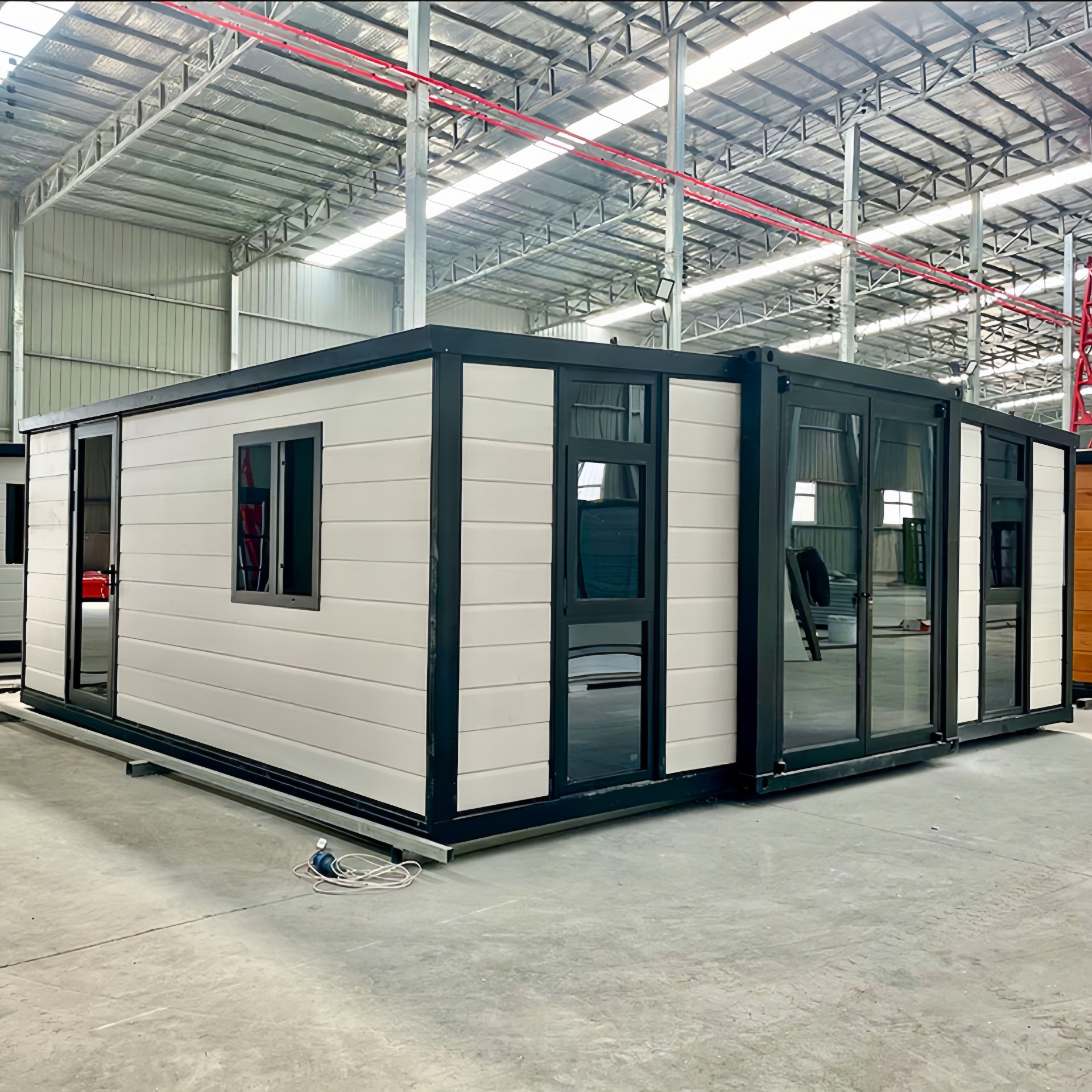
HG Prefab foldable expandable container homes — built to last, delivered worldwide.
Ghana rewards importers who prepare and punishes those who improvise. The demand side is straightforward and growing: mining and oil services companies that need site offices and accommodation on remote concessions, road and housing contractors who need supervision space at the work front, school and health operators who need rooms faster than conventional construction can deliver them, and hospitality developers who want rooms placed lightly on coastal land. The friction sits on the supply side. A folding container house is classified as a building rather than a machine, it is handled through a single-window customs platform that rewards complete documentation and penalises guesswork, and it lands in a country where the last hundred kilometres to site often decide the schedule more than the ocean voyage does. This guide is written for the buyer who has a site, a budget and a deadline, and needs to know exactly what happens between the factory gate and the day the unit opens on its plinth.
Henan Huangang Machinery Equipment Co., Ltd. ships folding expandable container houses to Ghana as standard containerised cargo through Tema or Takoradi. What follows is the full sequence — classification, Ghana Standards Authority conformity, the duty and VAT stack, port selection, the inland leg to Accra, Kumasi and Tamale, climate specification, use cases and site placement — with the numbers that decide whether your project lands on schedule. Because Ghanaian tariff lines, levy combinations and conformity procedures are revised, every rate figure in this guide is framing rather than advice: confirm the current position with your clearing agent before you commit money to a vessel.
What You Are Actually Importing
Classification: a building, not a piece of machinery
The first decision in any Ghanaian import is the tariff line, because the HS code determines the import duty band under the ECOWAS Common External Tariff, the levies that apply on top, and the list of documents the Ghana Revenue Authority expects to see. A completed, habitable prefabricated unit belongs in the heading that covers prefabricated buildings, the family that includes structures assembled from panels and modules, with sub-lines distinguishing a wood-frame build from one of other materials. A folding galvanised steel unit with insulated sandwich wall and roof panels, a floor, doors, windows, internal linings and pre-installed electrical wiring sits on the non-timber side of that heading, and it does not belong under a machinery, vehicle or parts heading.
Get this right early, because the classification also drives the conformity route. If the consignment is presented as a kit of parts rather than as a finished structure, officers may treat it as a collection of separately rated goods — steel articles, panels, doors, cable — each with its own duty line and its own standards obligation. That is almost always worse for the importer. Present the built unit as one finished structure, supported by a specification sheet, a packing list whose contents are described as belonging to that structure, and photographs of the unit folded for transport. Ask your clearing agent to confirm the classification in writing before the vessel sails, not after the declaration has been lodged, because re-classifying a consignment that is already in the yard costs you rent by the day.
Why the folding design changes the freight economics
The folding format exists to solve a freight problem, and on a West African routing it solves several at once. A rigid volumetric module occupies the same shipping volume whether it is furnished or empty, so on a long voyage from China to the Gulf of Guinea you pay to move air. A folding unit collapses to a compact transport envelope and travels as standard containerised freight at standard rates rather than as out-of-gauge breakbulk or flat-rack cargo. For a Ghanaian importer the benefit compounds: fewer special-equipment surcharges, more carriers willing to quote the routing, less exposure to a roll-over when a vessel is tight on space, and a far simpler road leg, because the folded envelope is much more likely to sit within standard motor vehicle dimension and axle limits on the final haul to site.
The practical consequence is that you can buy Ghanaian delivery the way you would buy any other import: a freight quotation, a transit time, a port, and a truck. That is the whole point of the product, and it is why a folding unit can be handed over in a single working day while a conventional block-and-mortar build of the same floor area is still waiting on materials. The table below summarises how the main import variables stack up for Ghana.
Folding Container Home Import to Ghana: Main Variables at a Glance
| Import variable | What applies in Ghana | What it means for your project |
|---|---|---|
| Classification | Presented as a finished prefabricated structure under the HS 9406 heading, on the non-timber side | Determines the ECOWAS CET duty band and the levy and VAT base; confirm with your clearing agent before the vessel sails |
| Standards | Ghana Standards Authority conformity assessment reaches a defined list of regulated products; scope for a finished unit must be confirmed | Clarify in writing before production, or you risk a clearance hold charged by the day at Tema |
| Duty stack | ECOWAS Common External Tariff import duty band, then statutory levies, then VAT on the duty-inclusive value | VAT compounds on duty, so budget an all-in landed figure per unit rather than a single rate |
| VAT treatment | VAT at the standard rate on import; input tax generally recoverable by a registered business importing for a taxable activity | Import in the name of a properly registered entity, keep the declaration, and confirm recovery with your tax adviser |
| Port choice | Tema for Accra, the east, Kumasi and the northern corridor; Takoradi for the western belt and oil and gas sites | Choose by total landed cost to site including inland haulage, not by the ocean freight rate |
| Dwell time | Free time, then demurrage to the line and rent to the terminal; detention if the box is held outside | Upload documents before arrival, book the truck before clearance, and negotiate free time at booking |
| Inland corridors | Short haul to Accra, a day to Kumasi with weighbridges and checkpoints, a long two-day run to Tamale | Survey the route and the last fifty metres, and prepare the site access track before dispatch |
| Climate specification | Coastal salt air, high humidity, tropical downpours, and December to February harmattan dust | Specify coating and galvanised fixings, roof drainage, seals and gaskets, insulated panels and cross-ventilation |
| Placement | Crane or forklift required to offload; four workers unfold the structure in about 2 hours | Book the machine and the crew with the truck, on a base that is level and cured |
| Factory prices | 20FT $7,200–$9,800; 30FT $10,500–$14,500; 40FT $12,500–$16,500 ex-works | Add freight, insurance, duty, VAT, levies, port charges, inland haulage, the base and the crane to reach your landed figure |
Ghana Standards Authority and Conformity
What GSA conformity assessment means for your consignment
The Ghana Standards Authority is the national standards body and it operates a conformity assessment regime that reaches a defined list of regulated products imported into the country. Where a product falls inside that list, the importer is expected to demonstrate conformity before or at the point of entry, typically through documentation and, depending on the product and the risk profile, an inspection of the shipment. The list has historically focused on consumer goods, electrical and electronic products, building materials and food-contact articles rather than on complete imported buildings, and that distinction is the one your clearing agent needs to resolve for you in writing.
Be precise, because this is where importers lose weeks. Steel building products and electrical accessories sold in Ghana are the kind of goods that attract standards attention, but a complete imported structure is not automatically treated as the sum of the separate products it was made from, and scope is determined by the wording of the applicable order and by how the consignment is presented and declared. The responsible sequence is: send your clearing agent the full specification, the HS line, the country of origin and the value; ask them to confirm whether any conformity certificate, shipment inspection or pre-arrival assessment is required for the consignment as declared; and where a covered electrical component would otherwise be fitted at the factory, decide with them whether it is simpler to buy that component locally in Ghana with the required marking and have it installed on site by a licensed electrician. Do all of this before production, not after shipment. A consignment held at Tema accrues rent, demurrage and delay on every line of your programme.
Documents to assemble before the vessel sails
- Taxpayer identification and importer registration. Your business registration and TIN must be current and consistent across the declaration, because a mismatch between the importer record and the invoice is a routine and avoidable delay.
- Commercial invoice and packing list. Matched to the HS line, stating the value and the freight and insurance components separately so the customs value can be established correctly.
- Bill of lading and arrival notice. Check that the consignee name matches your importer record before the vessel berths, not after.
- Certificate of origin. Requested routinely, and required if any preferential or regional treatment is being claimed on the consignment.
- Insurance and specification sheet. The technical dossier is what your clearing agent uses to defend the classification and to answer a standards or valuation query.
- Clearing agent authorisation and single-window filing. Declarations are lodged electronically through Ghana’s integrated customs platform; your agent files there and uploads the supporting documents.
Customs Duty, VAT and Levies: The Real Landed Cost
How the duty stack is built
Ghanaian import charges are a stack rather than a single rate, and understanding the order of the stack is what lets you forecast landed cost. The base is the import duty band applied under the ECOWAS Common External Tariff, which is set against the specific HS line and generally falls into one of a small number of standard bands. On top of the duty sit statutory levies and charges applied to the customs value or to the duty-inclusive value, and then value added tax at the standard rate, which is charged on a base that already includes the duty. Because VAT compounds on top of duty rather than sitting beside it, the effective tax on a consignment is materially higher than the headline duty band alone suggests.
Two things change your number most: the CET band attaching to your declared line, and the combination of levies and VAT in force on the date of declaration rather than the date of your quotation. Ghana has revised its levy and VAT arrangements in successive budgets, and the practical implication for an importer is simple — do not budget from a blog post, ours or anyone else’s. Ask your clearing agent to pull the current tariff line and the current levy schedule, and to return the answer as an all-in landed figure per unit, inclusive of duty, VAT, levies, port charges, agency fees and inland haulage. If you are importing several units, ask for it per unit at each size, because duty is ad valorem and the three sizes land differently.
VAT: whether it is a cost or a pass-through
For a VAT-registered Ghanaian business importing for use in a taxable activity, VAT paid at import is generally treated as input tax and recoverable against output tax, which is the single strongest reason to import in the name of a properly registered trading entity rather than an individual. Confirm the recovery position with your tax adviser before you order, and keep every customs document, because the declaration is the evidence that supports the claim. If the unit is imported by an entity that is not registered, or for a use that does not give credit, the VAT becomes a genuine cost and your budget must treat it that way. This one question can move the comparison against a locally fabricated alternative by a wide margin, and it is worth an hour with your accountant before a pro forma invoice is signed.
One further valuation point catches first-time importers out. Customs value is not simply the number on the commercial invoice: ocean freight and insurance are normally brought into the base on which duty and VAT are calculated. A quotation that looks cheap on an ex-works basis can be more expensive on a landed basis than a higher-priced unit shipped on better freight terms. This is why the only honest comparison between suppliers is the all-in landed figure per unit, calculated on the same basis, and why you should ask for freight and insurance to be stated separately on the invoice.
Choosing a Port: Tema or Takoradi
Tema and Takoradi compared
Tema is the principal commercial port and the default answer for most importers. It handles the overwhelming majority of Ghana’s container traffic, it has the widest carrier coverage from China and the deepest supporting infrastructure — container terminals, bonded yards, clearing agents, banks and inspection facilities all within a short distance of the gate. It also sits next to the Accra–Tema motorway corridor, which means a site in Accra or Tema itself is a very short haul from the terminal, and it is the natural gateway for the eastern corridor, the Volta Region and the road north through Kumasi to Tamale. The trade-off is congestion: when the yard is tight, free time disappears quickly and rent and demurrage start.
Takoradi, in the Western Region, is the second port and it is a genuinely better answer for a specific set of projects. If your site is in the western gold belt, in the Sekondi-Takoradi industrial area, around the oil and gas supply base, or anywhere west of Cape Coast, the hundreds of kilometres of inland haulage you avoid frequently outweigh any difference in ocean freight or terminal charges. Takoradi has less frequent direct carrier coverage from China than Tema, so your forwarder may quote a transhipment routing with a longer transit time; set that against the road distance saved and price both routings to the door before deciding. The rule is the same one that applies everywhere: choose the port by total landed cost to site, not by the port-to-port rate.
Free time, demurrage, rent and the cost of a slow file
Three separate clocks run against you at a Ghanaian port, and a slow file starts all three. Demurrage is charged by the shipping line for a container held beyond free time. Rent, or storage, is charged by the terminal for the space the container occupies. Detention is charged by the line for the box being held outside the terminal, which matters if you have cleared but cannot move the unit. Free time on West African import routings is typically shorter than the time a valuation or standards query can take to resolve, so the defences are procedural and effective: have the declaration prepared and the documents uploaded before the vessel arrives rather than after, use a clearing agent who works your terminal daily, and where a delay is possible, negotiate extended free time with the line at booking rather than after the deadline has passed.
The most expensive thing you can do is dispatch the truck after clearance. Book the haulage before clearance, book the crane or forklift with the haulage, and treat the three as one appointment. If the consignment is several units, negotiate free time for the whole consignment in the contract rather than one container at a time, and consider clearing and moving in two batches if the site can absorb the first units while the second clears. Sequencing saves dwell time, and dwell time is the cost that most often blows a Nigerian-scale budget in West Africa. See the practical sequence in our guide to container home delivery timelines.
Inland Delivery: Accra, Kumasi and Tamale
The three corridors and what each one costs you
Accra is the easy leg. Tema to Accra is a short urban haul, and for a site inside the capital or the industrial corridor the inland component is a small fraction of the landed cost even with urban traffic and a police checkpoint or two. The constraint is not distance but timing and access: a loaded trailer moving through Accra traffic is slow, and many sites are reached through streets that will not take a long vehicle in daylight hours. Plan a night or early morning delivery window and confirm the turning circle at the site entrance in advance.
Kumasi is the middle corridor and the one most often underestimated. The Accra–Kumasi road is a good highway by regional standards and the run is a manageable day, but it carries heavy traffic, it has weighbridges and checkpoints that cost time, and the folded envelope still needs to be checked against Ghanaian vehicle dimension and axle load limits before the truck is dispatched. If your model on your route requires an abnormal load permit from the highway authority, obtain it in advance; a permit arranged on the day of the move costs more in standing time than it does in fees. For sites in the Ashanti and Brong Ahafo belt, Kumasi is normally served from Tema without debate.
Tamale and the north is the corridor that needs real planning. It is a long two-day run from Tema, the road surfaces vary, and the northern stretch crosses areas where a wet-season detour or a slow section can add hours with no warning. Two rules apply. First, survey the route with the transporter rather than assuming: bridge and culvert condition, ferry or crossing points, seasonal restrictions, and the condition of the final access road. Second, and more commonly overlooked, the last fifty metres. The road from a highway to a project site in northern Ghana is frequently a laterite track that will not carry a loaded trailer after rain, and the cheap fix is to lay a stone or aggregate base, or a geotextile and compacted fill, before the truck is dispatched rather than after it is stuck. Preparation at the site end is always cheaper than recovery at the site end.
- Book the machine with the truck. A crane or forklift has to be on site when the trailer arrives; a trailer waiting is detention and idle crew charged to you.
- Finish the base before dispatch. A reinforced slab, strip footings under the perimeter and hinge line, or pad piers — level and cured, not level and green.
- Survey the last fifty metres. Laterite tracks fail under loaded trailers after rain; a stone or aggregate base solves it cheaply and in advance.
- Check axle load and dimension limits. Confirm with the transporter whether your folded envelope needs an abnormal load permit on the route, and get it before dispatch.
- Check ground bearing at the lift point. Outriggers on soft or recently filled ground need mats or a prepared hardstanding, especially after rain.
- Confirm access for the crew. Four workers for about 2 hours, with hand tools, a ladder and the electrical connection ready.
Harmattan and Tropical Climate: Specifying for Ghana
Heat, humidity, salt and dust
Ghana asks a building to do four different things, and a specification that answers only one of them will disappoint. The coast, including Accra, Tema and Takoradi, is hot and humid year round with two rainy seasons and a persistent saline atmosphere; salt-laden air attacks coated steel and fixings within a few hundred metres of the shore, so the coating system and the fixings are specification items, not afterthoughts. The middle belt, including Kumasi, is humid with heavy seasonal rainfall and a slightly wider diurnal temperature range. The north, including Tamale, has a single rainy season followed by a long dry season, higher peak temperatures, and the harmattan: from roughly December to February a dry north-easterly wind carries fine Saharan dust across the country, visibility drops, and everything with a gap in it acquires a layer of dust.
For the wet and humid zones, specify to move water and air. Roof geometry and guttering should be sized for tropical downpours rather than for European drizzle — a Ghanaian storm delivers more water in an hour than a temperate month, and undersized outlets overflow into the wall build-up. Set the unit on a plinth above local flood level with a damp-proof break between the ground and the floor structure. Inside, prioritise cross-ventilation, a vapour-aware internal liner, and a ceiling fan layout, because mechanical cooling in a Ghanaian summer is expensive to run and ventilation is what makes a room habitable when the power is off. Full detail in our guide to container homes in tropical and humid climates.
For harmattan, specify against fine dust. Door and window seals, panel joint gaskets and cable entry points are the paths dust takes into a building, and a unit specified with a proper seal package stays clean inside while an unsealed one needs cleaning daily for three months. Air conditioning filters need more frequent attention during the season, and external plant needs siting that accounts for a wind that blows from one direction for weeks. The dry season also brings wide day-to-night temperature swings in the north, which is an argument for insulated sandwich panels with a core chosen for thermal performance rather than for price, and for a roof build-up that reflects rather than absorbs. Rock wool core panels additionally give you fire and acoustic performance, which matters for dormitory and classroom use.
Use Cases: Where Folding Units Earn Their Cost in Ghana
Site offices and worker housing on mines, roads and oil services
The strongest and most common use in Ghana is the project site office, and the economics are uncomplicated. A mining concession, a road or housing contract, or an oil services yard needs office and supervision space at the start of the works, needs it secure, air-conditionable and lockable, and needs it gone or moved when the job ends. A folding unit delivers an enclosed, wired, insulated workspace within days of arrival, and because it refolds, it can be moved along an alignment as the work front advances or relocated to the next concession. For a contractor carrying several sites, the same unit serves project after project instead of being written off at one, and that reusability is what turns the purchase into a depreciating asset on the books rather than a cost line. See the layouts that suit this in our guide to construction site offices.
Worker accommodation is the volume-sensitive sibling of the same argument, and it is where transport density pays. Because units fold, more usable floor area fits into a given shipping volume, which lowers the freight and duty component per worker housed — useful when the crew count drives the order. On a project that must house a workforce before a peak season or before the rains, the ability to have accommodation placed and closed within days of clearance is worth more than the marginal saving on an alternative. Specify for occupancy as well: cross-ventilation and fan points in every room, a roof build-up that sheds heavy rain, screened openings for insect control, and internal finishes that can be washed down.
Schools, classrooms and rural clinics
Education and health are where a folding unit does something conventional construction in Ghana struggles to do: deliver an enclosed, secure, weathertight room to a community on a timeline measured in weeks. Additional classroom space where enrolment has outgrown the building stock, a temporary teaching space while a permanent block is built, a rural health room or a community-level clinic serving a catchment that currently travels hours for basic care — all are uses where the unit arrives finished and needs only a base and a power connection. Specify deliberately for these uses: a floor finish that cleans, cross-ventilation sized for occupancy rather than for floor area, a veranda or canopy that shades the entrance and keeps sun and rain off the door line, and anchoring appropriate to local wind conditions. Relevant reading on portable classrooms and mobile clinics.
Hospitality: beach resorts, eco-lodges and guest rooms
The third use case grows fastest and is the most site-specific. Beach resorts along the coast, eco-lodges and guest-house operators use folding units as rooms where a permanent structure is either not permitted or not wanted, and the format suits it precisely: a finished, insulated, glazed room that can be placed lightly on pad piers with minimal excavation, removed without leaving a slab behind, and relocated within the property as the business evolves. For a coastal site, treat the coating system and the hot-dip galvanised or stainless fixings as non-negotiable, because a saline atmosphere punishes a specification chosen on price. Plan the services with equal care: the plumbing and the electrical connection are local work, and the electrical connection must be made by a licensed electrician to Ghanaian wiring practice at the local supply voltage and frequency. See container hotels for layout thinking, and the model range on the products page for the sizes that suit a guest-room layout.
Offloading and Assembly on Site
Placement is a plant operation
The last hour determines whether the whole import goes smoothly, so plan it as a lift rather than as a delivery. The sequence that works is: base finished, cured and certified level; crane or forklift booked for the same window as the trailer and confirmed for the lift radius; route surveyed and the last fifty metres prepared; ground bearing at the outrigger positions checked; a crew of four booked with hand tools and a ladder; and the electrical connection arranged with a licensed electrician for the same day. Then the unit is set in position and closed, and the interior is usable immediately.
Yes — a crane or forklift is required to offload the folded unit from the truck. Once it is set in position, four workers can unfold and assemble the main structure in about 2 hours. That is the whole reason a folding unit can be handed over in a single working day while a conventional site build of the same floor area is still waiting for its roof. Mobile cranes and heavy-capacity forklifts are straightforward to hire in Accra, Tema, Takoradi and Kumasi; on a remote concession or a northern site, arrange the machine several days ahead and hold it, because the nearest available unit may be a region away. More on lift planning in our guide to container home crane offloading.
Pre-Order Checklist for Ghanaian Buyers
- Confirm the HS classification in writing with your clearing agent before production, and ask them for an all-in landed cost per unit, inclusive of duty, VAT, levies, port charges and haulage.
- Confirm the Ghana Standards Authority position for the consignment as declared, and decide whether any covered electrical component is better sourced locally with the required marking.
- Verify your importer registration and TIN, and confirm with your tax adviser whether VAT paid at import will be recoverable by the importing entity.
- Choose the port by total landed cost to site across Tema and Takoradi, and negotiate container free time for the whole consignment at booking.
- Sequence the clearance, the truck and the crane as one appointment, with documents uploaded before the vessel arrives rather than after.
- Survey the inland corridor and the last fifty metres, check axle load and dimension limits, and prepare the site track before the truck is dispatched.
- Book the crane or forklift and the four-person crew for the same window as the trailer, on a base that is level and cured.
- Specify for the climate: coating system and galvanised fixings for coastal salt, seals and gaskets for harmattan dust, roof drainage sized for tropical downpours, insulated panels and cross-ventilation for heat.
Importing to Ghana? Get the landed cost before you commit.
HG Prefab, manufactured by Henan Huangang Machinery Equipment Co., Ltd., supplies 20FT, 30FT and 40FT folding expandable container houses to Ghana as standard containerised freight through Tema or Takoradi. Factory prices are 20FT $7,200–$9,800, 30FT $10,500–$14,500 and 40FT $12,500–$16,500 ex-works, including the folding galvanised steel frame, insulated sandwich wall and roof panels, floor, doors, windows, internal linings and pre-installed electrical wiring. Tell us your port, your nearest city and your site access and we will quote a through-rate with a stated validity period, plus a specification sheet your clearing agent can work from. Email hgmechequip@gmail.com or WhatsApp +86 191 0388 7380. Full model range on the products page.
Get a Quote Browse modelsDo I need a crane or forklift to unload a folding container house in Ghana?
Yes — a crane or forklift is required to offload the folded unit from the truck. Once it is set in position, four workers can unfold and assemble the main structure in about 2 hours. Book the machine for the same window as the trailer, confirm the lift radius and that the ground will carry the outriggers, and have the base finished and cured before dispatch. Mobile cranes and heavy-capacity forklifts are readily available in Accra, Tema, Takoradi and Kumasi; for a remote mining concession or a site in the north, arrange the machine several days ahead and hold it, because the nearest suitable unit may be a region away and a trailer waiting on site is charged to you.
What do folding container houses cost for delivery to Ghana?
HG Prefab factory prices are 20FT $7,200–$9,800, 30FT $10,500–$14,500 and 40FT $12,500–$16,500 ex-works, and each includes the folding galvanised steel frame, insulated sandwich wall and roof panels, floor, doors, windows, internal linings and pre-installed electrical wiring. On top of that, budget ocean freight to Tema or Takoradi, marine insurance, import duty under the ECOWAS Common External Tariff as applied by the Ghana Revenue Authority, the applicable levies, VAT, port and agency charges, inland haulage to site, the prepared base and the crane for the lift. Because freight and insurance normally form part of the customs value and VAT is charged on a duty-inclusive base, ask your clearing agent for an all-in landed figure per unit rather than estimating with a single percentage.
Does a folding container house need Ghana Standards Authority approval to be imported?
It depends on whether the consignment falls within the scope of the conformity assessment requirements that are in force, and on how it is declared, and this is worth resolving before production rather than at the port. Regulated product lists in Ghana have concentrated on consumer goods, electrical products and building materials rather than on complete imported buildings, but scope is determined by the wording of the applicable instrument and by how the goods are presented. Send your clearing agent the specification, the HS line, the origin and the value, and ask them to confirm in writing whether any conformity certificate, shipment inspection or pre-arrival assessment is required. Where a covered electrical component would otherwise be fitted at the factory, it is often simpler to source it locally in Ghana with the required marking and have it installed on site by a licensed electrician.
Should I import through Tema or Takoradi?
Choose by total landed cost to your site, not by the ocean freight rate. Tema handles the great majority of Ghana’s container traffic, has the widest carrier coverage from China, and is the natural gateway for Accra, the eastern corridor, Kumasi and the road north to Tamale. Takoradi suits sites in the western gold belt, the Sekondi-Takoradi industrial area and around the oil and gas supply base, because the inland haulage saved frequently outweighs any difference in ocean freight; the trade-off is less frequent direct carrier coverage, which can mean a transhipment and a longer transit. Ask your forwarder for a through-rate to the door under both routings and compare those two numbers, including realistic dwell time at each terminal.
How should I specify a folding container home for the Ghanaian climate?
Specify against four conditions at once. For the coast, including Accra, Tema and Takoradi, treat the coating system and hot-dip galvanised or stainless fixings as non-negotiable, because a saline atmosphere attacks coated steel quickly. For the humid south and the middle belt, size the roof geometry and guttering for tropical downpours, set the unit on a plinth above local flood level, and prioritise cross-ventilation and ceiling fans over mechanical cooling as the primary strategy. For the north and the December to February harmattan, specify a proper seal package at doors, windows, panel joints and cable entries, and expect air conditioning filters to need more frequent attention. Across all zones, choose insulated sandwich panels with a core selected for thermal performance, and a roof build-up that reflects rather than absorbs.