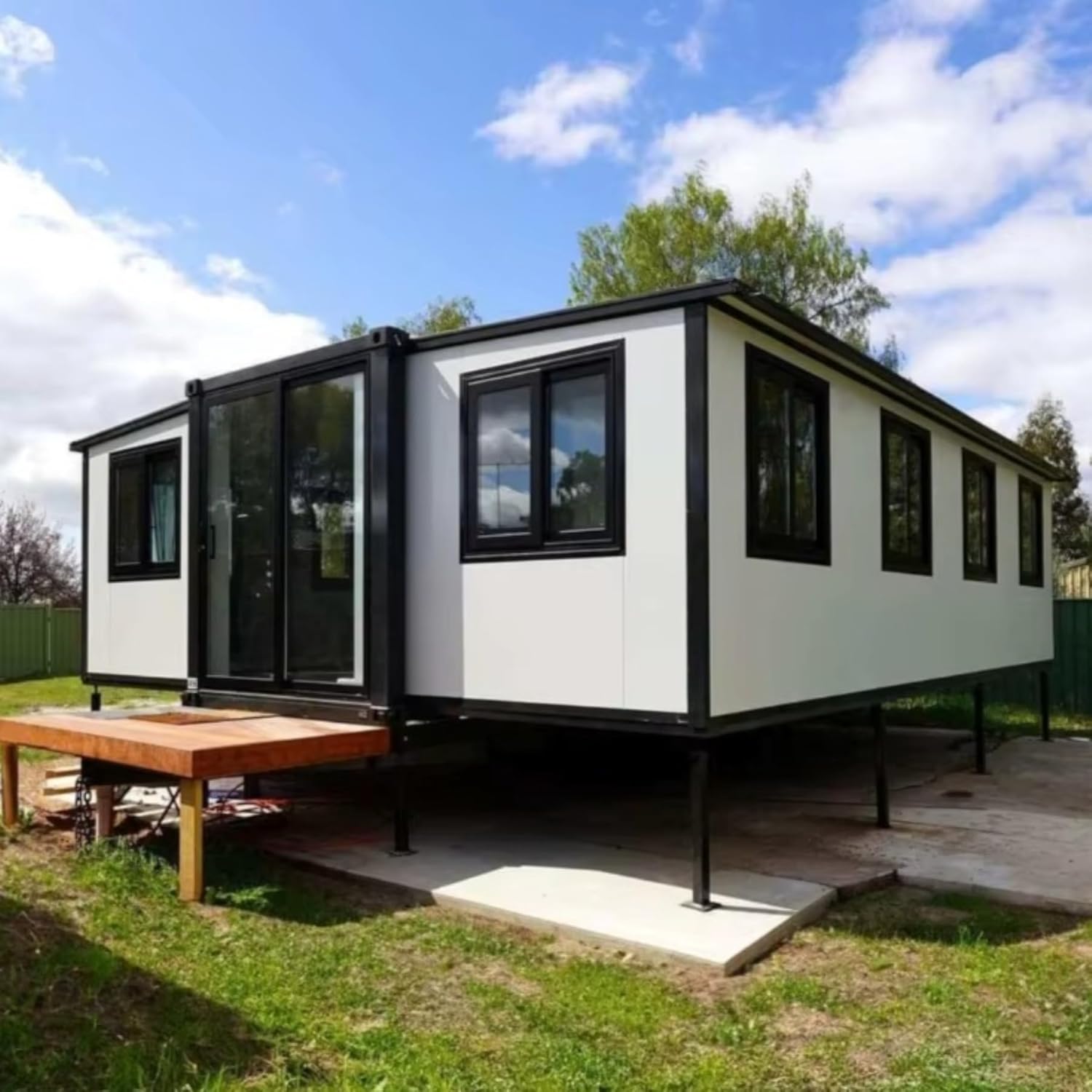
HG Prefab foldable expandable container homes — built to last, delivered worldwide.
Most buyers imagine inspection as the moment the truck pulls in and somebody walks around the box with a clipboard. By then it is already the most expensive possible place to find a problem. A dented wall panel discovered in the factory costs the factory a panel; the same dent discovered after a six-week voyage costs you a freight claim, a replacement lead time and an argument about who caused it. The building itself has not changed in between — only the cost has.
A folding container home passes through four separate gates: factory quality control, packing and loading, delivery arrival, and the unfold-and-assemble sequence. Each one catches the defects the others miss, and each one gets cheaper to act on as you move earlier in the list. This article turns those four gates into a working checklist you can copy, tick and file.
Two related guides cover the surrounding detail. Our factory QC and inspection guide covers buying from China and contracting with inspectors; our crane and forklift offloading guide covers machine selection and hiring. Use those for depth and this page for the running order of checks.
Why Inspection Has to Be Staged
Each gate catches what the next one cannot
Factory checks catch workmanship that becomes inaccessible later. Once the corrosion protection is on and the lining panels are closed up, you will never see the hinge reinforcement or the sealant behind a corner post again — and those are exactly the places that fail in year five rather than week one.
Delivery checks catch handling damage, which is the most common claim category on any long voyage. Packing checks catch theft and short shipment, which nobody notices until the doors will not hang. Assembly checks catch installation errors, which are neither the factory's fault nor the carrier's, and which nobody will pay for unless you recorded them while the crew was still standing there.
Where money changes hands
Time the checks to the payments. Your leverage over factory quality lasts exactly as long as there is unpaid balance; after the final payment, the factory's incentive to rework anything drops sharply even with the best intentions. Equally, your leverage over the carrier lasts exactly as long as the driver has not yet left with a clean signature — that is why delivery-day inspection happens before signing, never after.
HG Prefab, manufactured by Henan Huangang Machinery Equipment Co., Ltd., supplies 20FT, 30FT and 40FT folding expandable container houses worldwide at factory prices of 20FT $7,200–$9,800; 30FT $10,500–$14,500; 40FT $12,500–$16,500, before freight, taxes and local compliance. A single day of third-party inspection costs a small fraction of that spread and protects the whole of it.
Stage 1: Factory QC — What to Request Before You Release the Balance
Documents that should exist before shipment
Ask for three categories of paperwork and check the dates on all of them. Material records cover what the unit is made of: steel mill certificates for the frame members, the specification and thickness of insulation, glazing specifications and the coating or paint system used on the frame and panels. Test records cover what was verified after assembly. Identification records tie everything to your specific unit — a serial number stamped or plated on the frame, and that same number appearing on every document you receive.
Serial-number matching sounds trivial and prevents the most common disappointment: receiving another customer's test reports. If the QC sheet does not carry your unit's number, it is a sample, not evidence.
Photos and videos worth asking for
A good factory sends progress media without being chased. Ask specifically for the set below, taken at the stated moment in the build rather than at the end, because once the cladding is closed the interesting parts disappear:
- Frame before lining. Corner posts, hinge reinforcement plates, welds and any rust treatment, photographed from several angles with enough light to read weld quality.
- Hinge and folding mechanism. Close-ups of each pivot point and locking bolt, plus a short video of the unit actually folding and unfolding once before packing.
- Seal runs. Every joint where water could enter — roof seams, wall-to-roof transitions, window perimeters and floor-to-wall junctions — photographed before trims cover them.
- Electrical panel and terminations. Inside the distribution board with the cover off, showing circuit labels and the earth connection.
- Wet room base. Before fixtures are set, showing the waterproofing layer and the drain connection.
- Final folded state. Six sides plus the folded profile, taken outdoors, which is also the reference set you compare against on delivery day.
The fold-unfold video deserves emphasis. A folding unit's distinguishing feature is moving structure; watching it move once under factory conditions is worth more than a dozen static photographs.
Factory tests and what "pass" means
Numbers are more useful than adjectives. Instead of asking whether everything "works", ask for the test and its recorded value, then compare against the pass criterion below.
| Test | What is measured | Pass criterion to agree in advance | Evidence to keep |
|---|---|---|---|
| Electrical insulation resistance and earth continuity | Resistance between live conductors and earth, and continuity of the protective earth path | Insulation resistance above 1 MΩ per circuit; earth continuity within the value in the applicable standard; no reading below 0.5 MΩ anywhere | Signed test sheet with per-circuit values and the tester's calibration date |
| Plumbing pressure test | Holding pressure on the cold and hot runs with the system closed | Holds 1.5× working pressure for 30 minutes with no drop | Pressure gauge photographs at start and end, plus the written record |
| Wet-room and window water test | Water applied to the sealed envelope under controlled conditions | No moisture at any interior joint after the agreed spray period | Before and after photographs of interior joints |
| Door and window operation | Open-close cycles and latch alignment | Every sash and leaf opens, closes and latches without force; locks engage fully | Short video per opening type, at minimum a representative sample |
| Coating thickness | Dry film thickness and coverage on steel surfaces | Meets the specified micron figure with no bare spots at edges or welds | Gauge readings logged against a marked-up diagram |
| Fold cycle test | One complete fold and unfold of the assembled unit | Moves freely, hinge points show no binding, gaps stay even after cycling | Video of the cycle plus post-cycle gap photographs |
| Dimensional check | Folded shipping dimensions and key level readings | Within tolerance of the drawing, and doors remain square | Measurement sheet signed by the QC lead |
Agree these criteria before production starts and put them in the order documents. A pass criterion negotiated after a failure is a negotiation about who pays, not about whether the unit is acceptable.
When to bring in a third-party inspector
Hire one when the order covers several units, when you have specified unusual finishes or services, or when you cannot be at the factory yourself. A competent inspector works to your agreed criteria, photographs against a checklist, and produces a report that carries independent weight in a dispute. They cost a few hundred dollars per day and they are most useful at two moments: mid-production, while corrections are still easy, and pre-shipment, when everything is finished and countable.
Even without a third party, insist on factory media at the same two moments. The point is not distrust; it is that nobody can fix something they were never shown.
Stage 2: Packing and Loading — The Stage Nobody Watches
Count the package, not the paperwork
Ask for a packing list that itemises everything travelling loose: fastener kits, spare seals, keys, handles, appliance brackets, external steps, spare panels and any tools that were quoted. Loose parts are the most frequently short-shipped items on any factory order, and they surface at exactly the wrong time — during assembly, with the crew waiting.
Request photographs of the loose-parts packs laid out and counted, then confirm the count against the list before shipment. If something must ship separately, get the tracking number and a list of what went where, so that "it should already be there" becomes a factual check rather than a hope.
Lashing, blocking and the fold locks
The folded unit is secured to the trailer or container with lashing and blocking, and the folding mechanism is secured with transport locks. Ask for photographs of both. Confirm that the transport locks are actually fitted rather than merely supplied in the parts bag — a folded unit that can move even slightly in transit will generate wear at the hinge interfaces before it arrives.
Then check how the load is protected against water. Sealed wrapping, desiccant quantity appropriate to the voyage length, and intact protective film on glazing and panel surfaces all matter on a multi-week sea leg. Surface film is cheaper than a replacement glazing unit and it is applied for a reason.
Stage 3: Delivery Day — Inspect Before You Sign for Anything
Seal, documents and count
Start before anything touches a jack or a sling. Photograph the truck and trailer, the unit as it sits, and the seal with its number legible. Compare the seal number to the shipping documents: a seal that does not match, or one that is missing, means the load was opened in transit and every subsequent damage question gets harder.
Check the count against your packing list at the same time, while everything is still in one place. Then, and only then, allow the offload to begin — and note any exception on the carrier's delivery document before signing it.
Exterior damage sweep
Walk the folded unit at arm's length on all six accessible faces. Use raking light rather than direct flash; shallow creases and panel distortion disappear under a straight-on flash and appear clearly under light from an angle. Work in a fixed order so you can say you covered everything:
- Corner castings and corner posts. Impact here is structural, not cosmetic. Look for deformation, fresh metal, cracked coating.
- Roof panel and seams. Standing water, staining and any crease across a seam; check along gutter lines and ridge joints.
- Side panels. Dents, scrape tracks, torn protective film, and any pattern suggesting contact with a fixed object rather than a soft one.
- Base rail and under-frame. Forklift strike marks are common and easy to miss unless somebody looks along the rail from a low angle.
- Doors and glazing. Chipped edges, cracked panes, misaligned frames — photograph glass from both sides where possible.
- Protective wrapping. Tears and resealed areas indicate handling or inspection during transit; photograph before unwrapping anything further.
Wet rooms, electrics and interior surfaces
Open the unit once you can do it safely and dry. Check the interior while it is still in the folded state first, because the folded configuration is where transit stress concentrates. Look along the fold lines for any rubbing or distortion, then open up and repeat the electrical and plumbing checks the factory already did: every light and socket on every circuit, water through every fixture, every drain under real flow.
Water running under flow, not sitting still, is the only version of that test that means anything. Run taps and showers long enough that a partially blocked connection shows as a backup.
Recording damage so a claim is accepted
| Finding | How to record it | Why it matters to the claim |
|---|---|---|
| Visible dent, crease or scrape | Two photographs per defect: one wide shot for location, one close shot for detail, both timestamped | A close shot alone cannot be located; a wide shot alone cannot be assessed |
| Suspected hidden damage | Write "subject to further inspection after unpack/unfold" on the delivery note | Preserves the claim window for damage that appears after opening |
| Missing or short-shipped items | Note the item and quantity on the carrier document and cross-reference the packing list | Short shipment not recorded at delivery becomes a voluntary gift later |
| Broken or mismatched seal | Photograph the seal and note the number discrepancy before unloading | Establishes when and where responsibility transferred |
| Water ingress evidence | Photograph staining patterns and moisture, and keep the wrapping until the claim closes | Drying out destroys the only evidence of how water entered |
Never sign a clean delivery receipt and follow up afterwards with a damage note. Signing clean is the single most common reason valid transport claims are refused.
Stage 4: Offload Safety — Check the Ground Before the Machine Starts
The offload is the one stage where an inspection failure injures someone rather than costing money, so it gets its own hold point. Yes — a crane or forklift is required to offload the folded unit from the truck. Once it is set in position, four workers can unfold and assemble the main structure in about 2 hours. The consequence for inspection is simple: you need firm, roughly level standing ground for a machine, clear headroom over the whole lift path, and a defined exclusion zone before any hook is attached.
Hold-point checks before the first lift
- Ground bearing. Compacted and level enough for outrigger or wheel loads; no trench backfill, no soft shoulder, no recent fill anywhere in the machine's footprint or along the route to it.
- Actual weight. The operator needs the unit's real weight and centre of gravity, not an estimate. Get the figure from the factory documents.
- Lifting points. Confirm they match the factory drawings and that they are undamaged after transit.
- Overhead clearance. Power, telephone and fibre along the entire boom path, not just above the pad.
- Exclusion zone. Physically marked, with only the lift team inside, and a single nominated person giving signals.
- Weather. Wind is the criterion operators cite most for stopping a lift; plan the delivery day with a fallback hour.
Which machine, and what it changes about your checks
| Machine | Typical use | Site requirements | Extra checks |
|---|---|---|---|
| Forklift or heavy telehandler | Tight paddings where the truck can get close beside the pad | Firm level approach at least as good as the pad; straight push-in route | Check fork pockets and load rating against actual unit weight; mind overhead clearance at the mast |
| Mobile crane | Longer reach where the truck cannot get beside the pad, or soft ground requiring reach | Outrigger pads and adequate bearing under each outrigger | Larger exclusion zone, boomed-work buffer, wind limits and stricter overhead survey |
| Two-machine pick | Largest units where a single machine lacks capacity | Standing room for both machines plus a coordinated lift plan | Requires a written lift plan and one clearly identified person in charge |
Whichever machine you use, the pad answer and the machine answer belong to the same conversation. Our site prep checklist covers building the standing area, and our crane offloading guide covers hiring and cost.
Stage 5: Assembly Day — The Two-Hour Unfold and Sign-Off
Checks while the structure is moving
Do not stand back for two hours and inspect at the end. Several items can only be observed during the move, and correcting them afterwards means reversing work you have already accepted:
- Level across the diagonals as the unit comes down onto its supports — a twist here propagates into every subsequent alignment problem.
- Hinge travel through the whole arc, listening for binding and watching for uneven contact or a hinge working against its travel stops.
- Floor and roof alignment as panels seat, checking that gaps close evenly rather than one corner leading.
- Seal behaviour at every closing joint, confirming gaskets compress cleanly and are not pinched, rolled or left trapped outside the closing line.
- Locking bolts torqued in the specified sequence — random tightening order is the usual cause of a roof line that never sits flat.
Final sign-off: what "approved" actually covers
- Structure level, fully bearing on its prepared supports, no voids under any bearer
- All hinges, locking bolts and roof panels seated and torqued to specification
- Every door and window opens, closes and latches; every lock engages
- All internal walls and ceilings presented without damage introduced during assembly
- Water through every fixture, every drain flowing freely, no leaks at any visible joint
- Every electrical circuit energised, lights and sockets working, earth continuity confirmed
- Loose-parts kit reconciled against the packing list; spares and keys handed over
- Photographs taken of the finished unit from four elevations, filed with the QC documents
Record outstanding items in writing with an agreed remedy and a deadline before the crew leaves. Our assembly-day timeline walks the two-hour sequence hour by hour, and our buyer mistakes guide covers the errors that turn small defects into long disputes.
Keeping the Paperwork Together
Assemble one indexed folder per unit, digital and physical: the order and specification, serial-number-matched factory documents and test sheets, the pre-shipment photo and video set, the packing list with the loose-parts reconciliation, the shipping documents with the recorded seal number, the signed delivery note with any exceptions, the lift plan and operator details, and the dated assembly sign-off with its photographs.
Two audiences will want that folder later. A building inspector may ask for material declarations and electrical test evidence during permitting or final inspection. An insurer or a warranty claim handler will ask how you know what you say happened. Both are unanswerable documents-wise unless you built the file while the unit was still new — six months later nobody remembers which answered email had the weld photographs in it.
Match the Checklist to the Model You Ordered
The sequence is identical for every unit; what changes is surface area and weight. A compact 20FT modern white unit at roughly 36 m² is the quickest to walk. The 30FT white folding house at about 56 m² adds roof seam and hinge points to cover. The 40FT teak retreat at roughly 76 m² has the longest fold lines and usually pushes the offload from a telehandler to a mobile crane, so allow more time for the stage four and stage five checks. A cabin-clad model such as the 20FT mountain cabin has more external trim to examine in the exterior sweep.
All four are built by Henan Huangang Machinery Equipment Co., Ltd. under the HG Prefab brand, ship folded at a standard container shipping footprint, and carry factory prices of 20FT $7,200–$9,800; 30FT $10,500–$14,500; 40FT $12,500–$16,500. Once the unit is set in position, four workers unfold and assemble the main structure in about 2 hours, which is why the inspection checklist, not the labour, is what decides how those two hours end.
Want the inspection criteria written into your order?
HG Prefab, made by Henan Huangang Machinery Equipment Co., Ltd., builds 20FT, 30FT and 40FT folding expandable container houses that ship folded worldwide. Send us your delivery address, site photos and the access measurements and we will confirm what the factory photo set, the pre-shipment tests, the offload arrangement and the assembly sign-off should cover for your unit. Email hgmechequip@gmail.com or WhatsApp +86 191 0388 7380. Full range on the products page.
Browse modelsFrequently Asked Questions
What factory documents and tests should I request before paying the balance on a folding container home?
Request the steel mill certificates and paint thickness readings, the electrical test report with insulation resistance and earth continuity results, a plumbing pressure test record, a door and window operation test, and photo sets of the folded unit's hinge points and seals before the anti-rust treatment is closed up. Ask for them before you release the balance payment, because after shipment every defect becomes your problem and every replacement becomes a freight question. Package them with the serial-numbered QC sheet and keep one indexed folder, since these same documents are what an inspector or an insurer asks for later.
How do I inspect a folding container home on delivery day and record damage so a claim is accepted?
Start before anything moves: photograph the trailer, the seal and the seal number, then check the count against the packing list. Walk the folded unit at close range for creases, scrape marks, torn protective film, bent corners and water staining at the base rail, using raking light so shallow dents show. Note every finding on the carrier's delivery document itself, not only on your own list, then photograph each defect twice: once wide enough to identify the location and once close enough to read the damage. Timestamped images plus a written exception note on the delivery paperwork is the combination insurers accept.
What has to be true on site before the crane or forklift starts the offload?
Yes — a crane or forklift is required to offload the folded unit from the truck. Once it is set in position, four workers can unfold and assemble the main structure in about 2 hours. Before that machine starts, confirm the standing area is compacted and roughly level, that the operator has the actual unit weight and centre of gravity, and that nobody outside the lift team is inside the exclusion zone. Check overhead lines along the boom path, confirm the lifting points match the factory drawings, and hold a short briefing so everyone knows who is giving hand signals.
What should be on the assembly day sign-off for a folding container home?
Sign off in order, not at the end. Confirm the unit is level across the diagonal and sitting fully on its prepared supports, then check that every hinge, locking bolt and roof panel has been seated and torqued in the sequence the manufacturer specifies. Open and close every door and window, run water through every fixture and check each drain under flow, and energise each circuit for both lights and sockets. Record the results on a dated checklist, photograph anything outstanding, and note the agreed remedy and deadline before the installation crew leaves the site.
Should I hire a third-party inspector instead of doing the inspection myself?
Hire one when the order is large, when the unit has many custom options, or when you cannot be present at the factory. A third-party inspector costs a few hundred dollars per day and gives you an independent report with photographs that carries weight in a dispute, plus someone who knows which factory practices are normal and which ones are workarounds. Keep the factory's own photos and test records regardless, because the external report reviews those documents rather than replacing them. For a single standard unit you can often do the pre-shipment stage yourself using the checklist in this article.