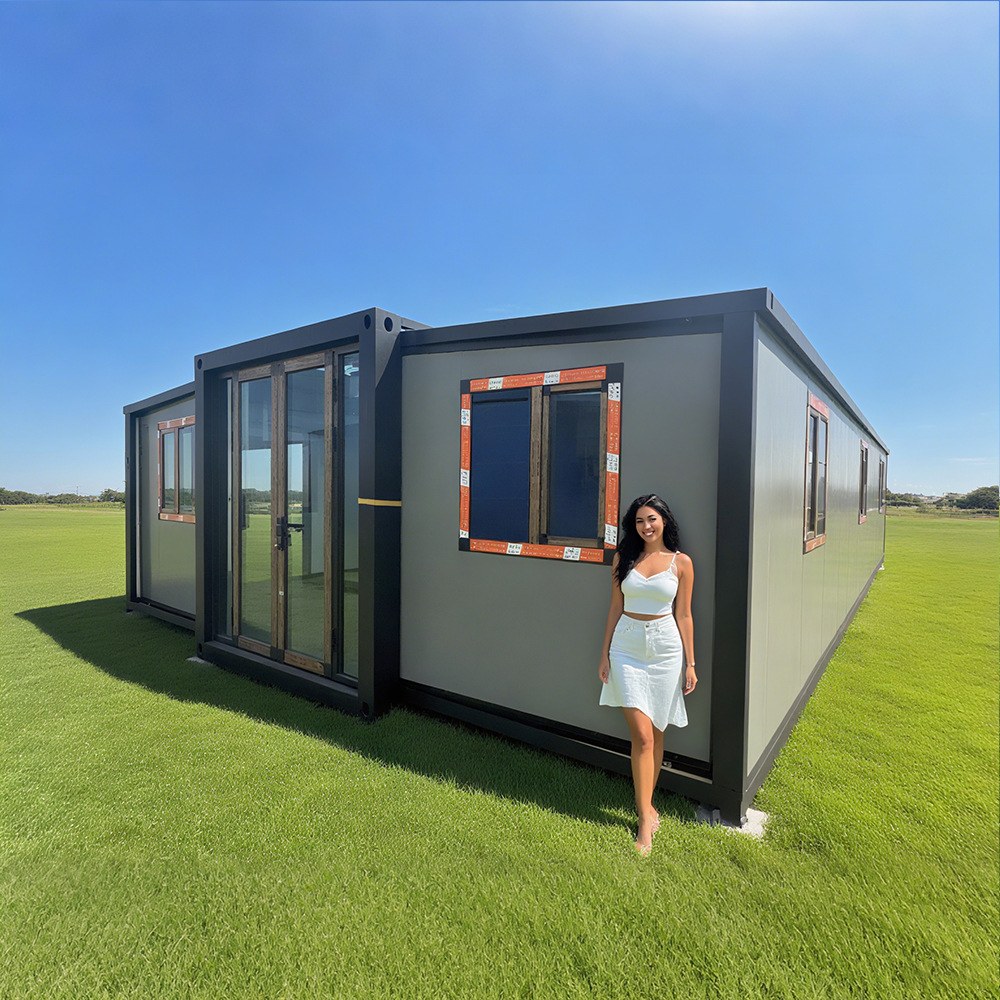
HG Prefab foldable expandable container homes — built to last, delivered worldwide.
A folding container home starts with a security advantage no timber-framed building has: a welded steel shell and a cargo-grade door that resist kicking, prying and casual leverage far better than studwork and plasterboard. But that advantage is only half the story. The unit still has glazing, a lock cylinder, a hinge line and a set of service penetrations, and it is often sited somewhere a conventional house is not — a back lot, a farm track, a coastal plot, a construction compound. Empty for weeks, far from neighbours, full of tools and electronics, it is exactly the target profile that opportunistic theft looks for.
This guide walks through how to build a layered smart security system for a 20FT, 30FT or 40FT HG Prefab unit: where the real weak points are, how many zones and cameras each size needs, which detection technologies actually work in a steel box, how to control access without carrying keys, how much power and bandwidth the system consumes, and what the whole package costs in 2026.
Why Container Homes Need a Purpose-Built Security Plan
What the steel shell does and does not protect
Corten or galvanised steel wall panel of 1.5–2 mm over a welded frame is genuinely hard to breach quietly. Cutting it takes an angle grinder, several minutes and a lot of noise, which is a deterrent in itself. What burglars actually use on container units are the same three entry points they use anywhere else: a window pane, the door lock, and the hinge side of the door leaf where a crowbar gets purchase.
So the security design does not start with cameras. It starts with the physical envelope — laminated or polycarbonate-glazed windows, a marine-grade multi-point lock, hinge bolts or security studs, and a hasp and high-shackle padlock as a second line. Our door and window security guide covers the hardware layer in detail; everything below assumes that layer is already specified.
The risk profile of a container home is different
Three characteristics shape the electronics. First, isolation: a unit on a rural plot may have no neighbour within 300 m, so a siren alone does nothing and remote notification becomes the primary response. Second, intermittent occupancy: holiday units and site offices sit empty for weeks, so the system must be self-testing and self-reporting rather than dependent on someone noticing. Third, transportability: a folding container home can be relocated, so the system should be mounted to the unit rather than to the ground, and should survive a move without rewiring.
A fourth factor is often overlooked: because the unit arrives folded and is assembled on site, the security cabling is far cheaper and cleaner to install before the wall panels are closed. That single scheduling decision is worth more than any device choice in this article.
Security Zones by Unit Size: 20FT vs 30FT vs 40FT
Security zones are not rooms. A zone is a detection area with its own trigger logic — an entry perimeter, an interior volume, or a high-value sub-area. The table below maps realistic zone counts and device loads to each unit size.
| Parameter | 20FT | 30FT | 40FT |
|---|---|---|---|
| Usable floor area | ~14 m² | ~21 m² | ~28 m² |
| Openings to protect | 1 door + 2 windows | 1 door + 3 windows | 2 doors + 4 windows |
| Detection zones | 1–2 | 2–3 | 3–4 |
| Camera channels recommended | 2 | 3–4 | 4–6 |
| PIR motion sensors | 1 | 2 | 2–3 |
| Door/window contacts | 3 | 4 | 6 |
| Siren output | 100 dB | 105 dB | 105–110 dB |
| NVR storage for 14 days | 2 TB | 4 TB | 6 TB |
| Continuous system draw | 35–55 W | 55–75 W | 70–100 W |
| 24 h backup battery | 1.5 kWh | 2.0 kWh | 2.6 kWh |
| Typical security kit cost | $450–$1,400 | $900–$2,600 | $1,600–$4,200 |
| Base unit price (2026) | $7,200–$9,800 | $10,500–$14,500 | $12,500–$16,500 |
Read the camera column carefully. Camera count is driven by approaches and by interior length, not by floor area. A 40FT with two external doors has two approach paths, and a single interior camera cannot resolve a face at both ends of a 9 m room — so four to six channels is the honest number, not a sales figure.
Cameras: Types, Resolution and Placement
Choosing the right camera for each position
| Type | Best position | Strength | Watch out for | Indicative cost |
|---|---|---|---|---|
| 4 MP turret / dome | Interior ceiling corners | Wide 100–110° view, hard to knock out of alignment, discreet | Domes reflect IR at night if flush to a shiny panel | $45–$120 |
| Bullet camera | Door approach, eaves, perimeter | Visible deterrent, long IR throw 20–30 m, easy to aim | Can be grabbed or sprayed; mount at 2.8 m+ | $50–$150 |
| PTZ | Yard or driveway approach | One camera covers 360° with optical zoom on demand | Moving parts, higher draw 12–20 W, costly | $180–$600 |
| Video doorbell | Main entry door | Two-way talk, package view, person detection | Needs Wi-Fi at the door; battery units dislike cold | $60–$250 |
| Thermal / PIR-triggered | Long fence lines, unlit yards | Sees heat, almost no false alarms from rain or insects | No facial detail; expensive | $300–$1,200 |
| Solar / 4G cellular | Remote plots with no power or LAN | Works completely standalone, ships with own data plan | Slow wake-up, needs good signal and winter sun | $120–$400 |
Placement rules that matter in a steel box
- Cover the approach, not just the door. A camera pointed at the door from 1 m away records a hoodie. Mount it 3–4 m back and off-axis at 2.8–3.2 m height so it captures the walk-up path and the face.
- Never point a camera at bare steel in direct sun. The corrugated wall is a reflector; IR LEDs bounce off it and wash out the image at night. Angle interior cameras slightly downward.
- Avoid backlit windows. If the only interior position faces a bright window, use a camera with true WDR (wide dynamic range) of 120 dB or better, or move it.
- Mount to the structure, not the cladding. Use the frame or a backing plate, and seal every external penetration with butyl tape plus silicone.
- Resolution target: 4 MP minimum for identification-grade footage; 2 K or 4 K only where you also have the storage and bandwidth to keep it.
- Protect the recorder. The NVR is the single point of failure. Put it inside the insulated envelope in a lockable cabinet, not in an external service box.
Intrusion Detection: Contacts, Motion, Glass and Vibration
Magnetic contacts on every opening
Reed-switch contacts on the door and each window are the cheapest and most reliable layer in the whole system, at roughly $8–$25 each. Fit the magnet to the moving leaf and the sensor to the frame, keep the gap under 10 mm, and run a recessed contact where the panel thickness allows it. On a folding unit, remember that the fold seam itself is a movement point — route the contact cable with a service loop so the first unfold does not tear it out.
PIR motion sensors and their limits in a metal room
A passive infrared sensor detects a warm body moving across its field of view. Inside a container home two things cause false alarms: a heater or air-conditioner blowing directly across the detection field, and direct sunlight falling on the sensor through a window. Mount PIRs in a corner at 2.0–2.4 m aimed across the room, away from HVAC outlets and glazing, and use pet-immune models (up to 25 kg) if a dog lives on site. Dual-technology sensors that require both PIR and microwave to trigger are worth the extra $20–$40 in units that sit near a heat source.
Glass-break and vibration sensors
Acoustic glass-break sensors listen for the specific frequency signature of shattering glass and cost $25–$70. One covers all the glazing in a single volume, which makes them excellent value in a 20FT. Vibration or shock sensors, $15–$40, mount directly on the door leaf or the wall panel and trigger on prying or grinding before entry is achieved — the earliest warning available and the one most likely to scare off an attempt in progress.
Alarms, Sirens and Notification
A siren has two jobs: to end the attempt and to bring help. In an isolated location only the first applies, so pair it with notification.
- External siren + strobe: 100–110 dB with a weatherproof IP65 housing, tamper switch and its own backup battery. Fit it under the eaves where it cannot be reached from the ground.
- Internal siren: 90–100 dB inside the volume. In a steel box this is genuinely unpleasant and highly effective.
- Notification path: push notification to phone, plus SMS or voice call for critical zones, plus email with a 10-second video clip. Test the path quarterly.
- Professional monitoring: $10–$40 per month where a cellular or IP path exists and local response is available. Worth it only if someone will actually attend.
- Self-monitoring fallback: if there is no monitoring service, give a trusted neighbour or site manager app access with their own credentials rather than sharing yours.
Access Control: Locks, Keypads, Cards and Biometrics
Access control replaces the thing most likely to be lost, copied or stolen: the mechanical key. For a container home the practical options are:
- Keypad deadbolt ($80–$250): the workhorse. Codes can be issued per person and revoked instantly — ideal for rental units, cleaners and contractors. Choose one with a mechanical key override and an IP55 or better rating.
- Fingerprint smart lock ($120–$350): fast for a single household, no code to share. Cold, wet or dusty fingers fail more often than marketing suggests, so keep a code or key as backup.
- RFID card or fob reader ($100–$400 + panel): the right answer for a site office, a shared studio or a rental fleet. Every entry is logged with a user identity, and a lost fob is deactivated in seconds.
- Smart padlock and hasp ($40–$150): for the second-door or storage-side leaf. Look for a shrouded shackle of 10 mm or more.
- Time-limited guest codes: essential for short-term rental. Issue a code that expires at checkout and never reuse it.
Two rules apply regardless of technology. Always keep a non-electronic override — a keyed cylinder in a lockbox outside, or a mechanical key with a neighbour — because batteries die at the worst moment. And always log door events; an access log that shows who opened the unit and when resolves most disputes without any footage review.
Network, Storage and Power Budget
Wired beats wireless on a steel shell
Corrugated steel is a Faraday cage in miniature. Wi-Fi from an external router degrades badly through the wall, and battery cameras inside a metal box burn through their cells re-associating. Run PoE (Power over Ethernet) cable to every fixed camera and to the access point — one cable carries both data and power, and it removes the battery entirely. Cat6 costs roughly $0.40–$1.20 per metre and is the cheapest reliability insurance in the system.
Power budget for a typical 30FT system
| Device | Qty | Draw each | Duty | Daily energy |
|---|---|---|---|---|
| 4 MP PoE turret cameras | 4 | 5 W | 24 h | 480 Wh |
| NVR with 4 TB drive | 1 | 18 W | 24 h | 432 Wh |
| 8-port PoE switch | 1 | 8 W | 24 h | 192 Wh |
| Router / 4G modem | 1 | 12 W | 24 h | 288 Wh |
| Smart lock + keypad | 1 | 2 W | 24 h | 48 Wh |
| Alarm panel + 2 keypads | 1 | 8 W | 24 h | 192 Wh |
| PIR motion sensors | 2 | 1 W | 24 h | 48 Wh |
| Door/window contacts | 4 | 0.5 W | 24 h | 48 Wh |
| External siren (standby) | 1 | 1 W | 24 h | 24 Wh |
| Total | — | ~76 W | 24 h | ~1,750 Wh |
That is about 1.8 kWh per day, close to 55 kWh a month — comparable to a small fridge. On grid power it is negligible. Off-grid, size for two days of autonomy at 50% depth of discharge: roughly 7 kWh of usable battery capacity, with 600–800 W of solar in a sunny climate and 1.0–1.2 kW in a cloudy one. Full off-grid design guidance is in our solar power setup guide and our electrical load planning guide.
Add a 4G or 5G failover SIM on a router that supports dual WAN. The most common way a security system fails at a remote site is not a break-in; it is a broadband outage nobody noticed for three weeks.
Installation: Pre-Wire at the Factory, Not on Site
Every cable run in a finished folding container unit means cutting a finished surface. Every penetration made on site with a hole saw is a corrosion path and a cosmetic repair. Order the following at manufacture and the security fit-out becomes a same-day job:
- Conduit or draw-string from a central service cabinet to each camera position, the door frame and the window heads.
- Back boxes or blank plates at each device location, so nothing is drilled later.
- A lockable 400 × 400 mm service cabinet lined up with the cable entry point.
- Weatherproof external cable entries with gland plates, positioned under the eaves.
- Mains or DC spur to the cabinet on its own protected circuit.
- Reinforced backing plates where cameras, sirens and the access reader mount.
HG Prefab fits these during production at a fraction of the retrofit cost. See the current range on our products page, and read our smart technology guide for the wider connected-home picture.
Cost Breakdown 2026
- Folding container unit: 20FT $7,200–$9,800; 30FT $10,500–$14,500; 40FT $12,500–$16,500 depending on size and finish.
- Physical hardware upgrades (multi-point lock, laminated glazing, hinge bolts, hasp): $300–$1,500.
- Camera kit (2–6 channels, PoE, NVR, cabling): $450–$2,500.
- Detection layer (contacts, PIR, glass-break, vibration): $150–$700.
- Alarm panel, siren and strobe: $180–$900.
- Access control (keypad, fingerprint or RFID): $120–$900.
- Network and failover (router, 4G SIM, UPS): $150–$600.
- Off-grid power if required (battery + panels + controller): $1,500–$6,000.
- Professional monitoring: $10–$40 per month where available.
- Foundation, delivery and crane: $1,500–$6,000 depending on site access.
A well-specified 30FT system therefore lands at roughly $1,200–$3,500 of electronics on top of the unit, and most of that is one-time capital cost rather than subscription.
Delivery, Offloading and Assembly
Security planning starts before the truck arrives. Decide the approach path, the camera sightlines and the cable entry point while the site is still empty, and check that the planned foundation leaves a clear route for both the crane and the cable duct.
Delivery itself is fast and predictable. Yes — a crane or forklift is required to offload the folded unit from the truck. Once it is set in position, four workers can unfold and assemble the main structure in about 2 hours. If the conduit, back boxes and device power were factory-prepared, cameras, sensors and the lock can be fitted and commissioned the same afternoon instead of after a week of cutting and patching.
Need a secure folding container home?
Henan Huangang Machinery Equipment Co., Ltd. (HG Prefab) manufactures 20FT, 30FT and 40FT folding expandable container houses with factory-prepared conduit runs, back boxes, service cabinets, reinforced device mounting plates and protected circuits for cameras, alarms, sensors and access control — shipped flat-packed worldwide. Email hgmechequip@gmail.com or WhatsApp +86 191 0388 7380 for a security layout drawing and quote.
Browse modelsFrequently Asked Questions
Is a steel container home already secure without an alarm system?
The corrugated steel shell and cargo door are far tougher than timber studwork, but the weak points are the same as in any building: the glazing, the door lock cylinder and the hinge side. Most break-ins on container units happen through a window or by levering the door leaf, not by cutting through the wall. A layered system of contacts on every opening, a PIR in the main volume, a siren and cameras covering the approach is what actually stops a loss.
How many cameras does a 20FT, 30FT or 40FT container home need?
A 20FT unit needs two: one outside covering the door approach and one inside covering the single volume. A 30FT needs three to four, adding a rear-approach camera and a second interior view. A 40FT with two doors needs four to six, because each external door is a separate approach and the interior is long enough that one camera cannot cover both ends at usable resolution.
Can a smart security system run off-grid on solar power?
Yes. A complete four-camera system with NVR, PoE switch, 4G router and alarm panel draws roughly 60–90 W continuously, about 1.8–2.2 kWh per day. Size the battery for two days of autonomy at 50 percent depth of discharge, so around 7–9 kWh of usable capacity, and pair it with 600–800 W of solar panel in a sunny climate. Put the NVR and the battery inside the insulated envelope, not in an external box.
Do I lose recordings if the internet goes down?
No, if you record locally. A wired PoE system with a local NVR keeps recording to its hard drive with no internet at all; only remote viewing and push notifications stop. Always specify an NVR with at least 4–6 TB of storage for 14–30 days of retention, and add a 4G or 5G failover SIM so the panel can still send an alert if the site broadband drops.
How is a folding container home delivered and installed?
Yes — a crane or forklift is required to offload the folded unit from the truck. Once it is set in position, four workers can unfold and assemble the main structure in about 2 hours. If you order factory-prepared conduit, back boxes and cable runs, the security kit can be fitted the same day instead of after a week of surface cutting.