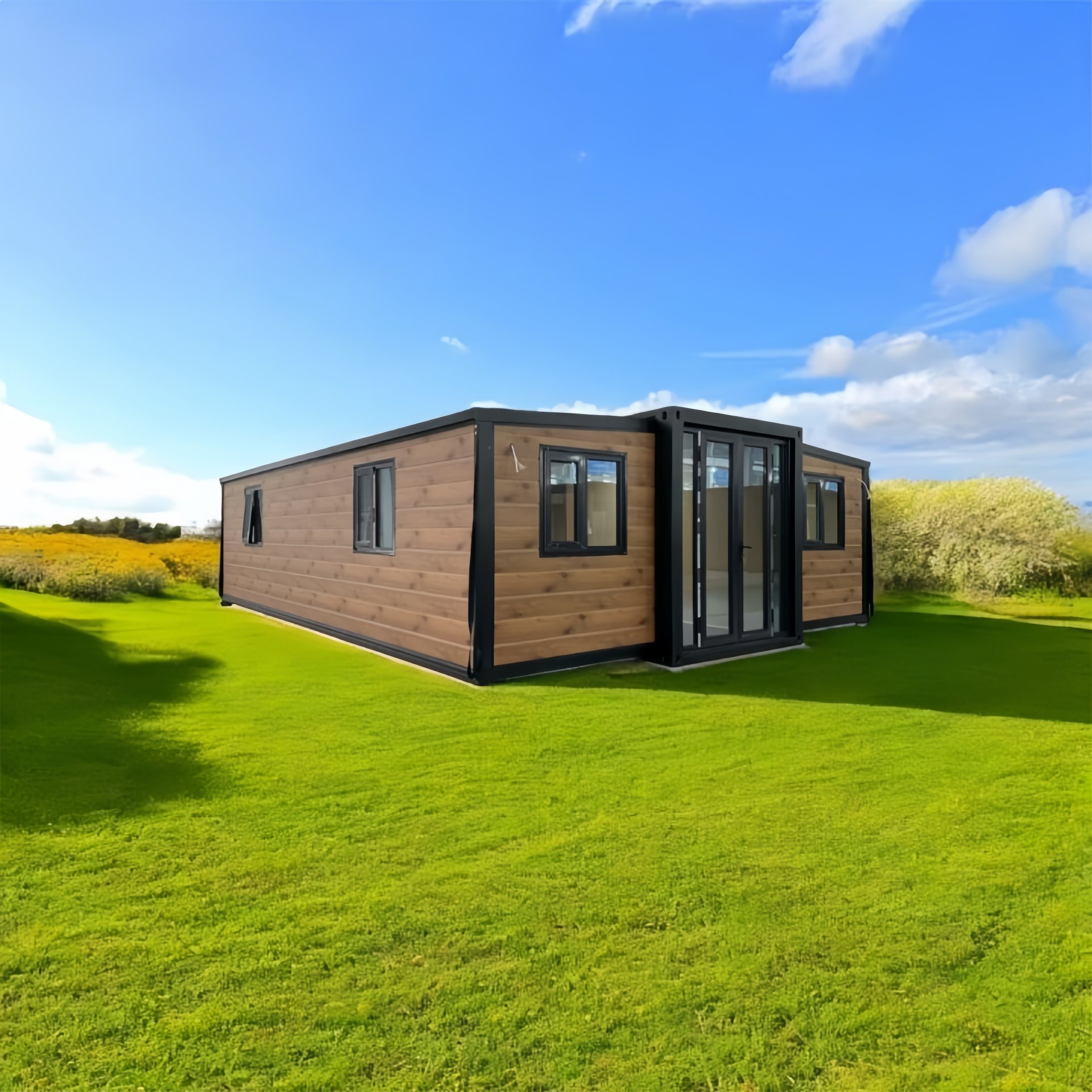
HG Prefab foldable expandable container homes — built to last, delivered worldwide.
A folding container home arrives with its internal electrical system already installed: a distribution board, lighting, socket outlets, the kitchen circuit, the water heater feed and the air-conditioning spur, all factory-wired and tested. What it does not arrive with is a source. On a site with a reliable grid connection that is a one-day job for an electrician. On a remote plot, a worksite, a farm or a storm-exposed coastal location, the generator is the single most consequential piece of equipment you will buy after the building itself, and it is the one most often specified by guesswork.
Guessing fails in two directions. Undersized, the generator starts cheerfully, runs the lights and the fridge, and then collapses the moment the air-conditioning compressor and the well pump call for current at the same time. Oversized, it burns far more fuel than necessary, runs wet-stacked and carbon-fouled because it never reaches a healthy working temperature, and costs two or three times what the job required. This guide replaces the guess with an arithmetic sequence: audit the load, size against surge, choose a machine type, choose a fuel, choose a transfer method, and then deal with the earthing, siting, noise and maintenance that decide whether the thing still starts when you actually need it. It sits alongside our electrical load planning guide, our solar power setup guide and our solar, battery and generator microgrid guide, and the load audit below feeds directly into all three.
Why Backup Power Matters More for a Folding Unit
The sites these buildings go to
Folding expandable container houses are bought precisely because they can be put somewhere conventional construction cannot easily reach. That means the three use cases that dominate generator demand are also the three that dominate the product's appeal: remote and rural plots beyond the last utility pole, temporary worksites and camps where no permanent service will ever be installed, and sites in storm or wildfire country where the grid exists but cannot be trusted.
On a remote plot the generator is not a backup at all — it is the primary source, and it will accumulate hundreds of hours a year. Duty cycle, service access and fuel logistics therefore matter more than purchase price, and a cheap portable petrol set sized for occasional emergency use will simply wear out. On a worksite the pattern is the opposite: high load for a few months, then nothing, which favours a rugged conventional machine that can be moved to the next job. In storm country the generator may run twenty hours a year, which makes start reliability and fuel storage the entire problem, because a machine that has sat for eleven months either starts or does not.
What an outage actually costs you
The consequence of losing power in a small, well-insulated steel-framed building is disproportionate to its size. A 20FT unit with no power in winter loses heating within an hour or two and can drop below freezing overnight in a cold climate, which puts the plumbing at risk as well as the occupants. The water pump stops, so the cistern stops delivering. The refrigerator reaches unsafe temperatures in roughly four hours if the door stays shut, and faster in a hot climate. Any medical equipment, any remote-work connectivity and any security or alarm system go with it. Sizing backup power is therefore not a comfort decision but a building-protection decision, and that is the standard this guide applies throughout.
Step 1: The Load Audit
Running watts and surge watts are different numbers
Every generator carries two ratings, and the second one is the one that decides the purchase. Running watts (also called rated or continuous watts) is what the machine can deliver indefinitely. Surge watts (also called starting or peak watts) is what it can deliver for a few seconds while an electric motor accelerates from standstill to speed. An induction motor draws roughly three to six times its running current during that first half-second, and a generator that cannot supply it will stall, trip its breaker or drop its voltage far enough that the motor overheats instead of starting.
The practical method is to build two columns. Add up everything that could plausibly be on at once to get the running figure. Then take the single largest motor in the building, multiply its running watts by three, and add that to the running total minus that motor's own running contribution. That gives the surge figure. Do the same exercise with the second-largest motor as a check, because in a 40FT with air conditioning and a well pump the answer can differ.
Appliance-by-appliance wattage
The table below gives typical figures for the appliances found in a folding container home. Treat them as planning values and confirm against the nameplate on the actual appliance, because a cheap kettle and a premium induction hob can differ by 30 percent.
| Appliance | Running watts | Surge / starting watts | Notes |
|---|---|---|---|
| LED lighting, whole unit (12–18 fittings) | 60–180 W | None | Negligible on modern LED; halogen or fluorescent fittings can triple this |
| Refrigerator, 120–200 L inverter compressor | 40–120 W average | 300–700 W | Soft-start inverter models are dramatically gentler on a generator |
| Freezer or fridge-freezer | 60–150 W average | 400–800 W | Defrost cycle adds 200–400 W for 20 minutes |
| Induction hob, single zone at medium setting | 900–1,800 W | None | Electronic control board is sensitive to waveform quality |
| Microwave, 900 W cooking output | 1,300–1,600 W | None | Short duty; pairs badly with an induction hob on a small set |
| Kettle or electric coffee machine | 1,800–2,200 W | None | The most common cause of nuisance trips on a 3 kW portable |
| Electric water heater, 30–50 L element | 1,500–3,000 W | None | Best scheduled off-peak or fed from solar; 30–50 L recovers in about 1–2 hours |
| Instantaneous electric shower | 5,500–8,500 W | None | Usually excluded from generator plans; use the stored tank instead |
| Mini-split heat pump, 9,000 BTU (2.6 kW) | 700–1,000 W | 1,800–2,500 W | Inverter drive soft-starts; heating mode adds defrost cycles |
| Mini-split heat pump, 12,000 BTU (3.5 kW) | 1,000–1,500 W | 2,500–3,500 W | The single largest load in most 30FT installations |
| Mini-split heat pump, 18,000 BTU (5.2 kW) | 1,600–2,400 W | 4,000–5,500 W | Governs generator sizing in a 40FT; consider two smaller units |
| Well pump or pressure pump, 0.75–1.1 kW | 750–1,100 W | 2,200–3,300 W | Hard-start motor; a soft-start kit can cut surge by half |
| Washing machine | 400–800 W wash, 300–500 W spin | 1,800–2,500 W | Surge comes from the internal heater, not the drum |
| Heat-pump tumble dryer | 600–1,000 W | 1,400–2,000 W | Resistive dryers at 2,500–3,500 W rarely justify generator capacity |
| Television, laptops, router, phone charging | 80–250 W | None | Small in watts, but the reason to care about waveform quality |
Worked example for a 30FT with two occupants: lighting 120 W, fridge 90 W average, router and laptops 150 W, water heater 2,000 W on a timed cycle, 12,000 BTU mini-split 1,300 W, well pump 900 W when it runs, induction hob 1,500 W at dinner. If the water heater is interlocked so it cannot run while the hob is in use, the realistic simultaneous running load is about 4.0–4.5 kW. Add the mini-split surge of 2,500 W against its 1,300 W running draw and the figure the generator must deliver for a few seconds is about 5.2–5.7 kW. A 7 kW machine covers that with margin; a 5 kW machine will not reliably restart the compressor while dinner is cooking.
Step 2: Sizing by Unit Size
Because the internal fit-out of our units is consistent, the load audit produces repeatable answers by size. The table below is a sizing shortcut, not a substitute for your own audit — but if your audit lands far outside these brackets, recheck it, because the usual cause is an appliance that belongs on a different circuit or on no circuit at all.
| Unit | Floor area | Typical running load | Surge requirement | Recommended generator | Notes |
|---|---|---|---|---|---|
| 20FT folding expandable unit | ~36 m² | 3–5 kW | 6–8 kW | 7–8 kW inverter, or 8–9 kW conventional | One or two occupants; single mini-split; 3 kW portable suffices only if the water heater is excluded |
| 30FT folding expandable unit | ~56 m² | 5–8 kW | 9–12 kW | 10–12 kW inverter or conventional; dual-fuel preferred | Couple or small family; two mini-splits; load management between hob and water heater |
| 40FT folding expandable unit | ~76 m² | 8–12 kW | 14–18 kW | 14–16 kW standby set, or two 7–8 kW machines with load management | Four to six occupants; consider a critical-loads panel so the whole house never has to run at once |
Three refinements almost always pay for themselves. First, fit a soft-start kit to the air-conditioning compressor and to the well pump: a 30–60 dollar device that cuts starting current by 40–60 percent effectively buys you a generator one size smaller. Second, interlock the water heater so it cannot run while the hob or the dryer is drawing power; this is a relay and a contactor, not a lifestyle change. Third, decide deliberately what will not run on generator power. A tumble dryer, an electric oven and an instantaneous shower are the usual candidates, and removing them from the audit is often the difference between a 16 kW installation and a 10 kW one.
Step 3: Generator Types and What Each Suits
- Portable open-frame gasoline set (2–7 kW). The cheapest entry point at roughly $400–$1,200, light enough for two people to move and available everywhere. It is also the loudest option at 70–85 dB, the thirstiest per kilowatt-hour, and the least durable, with typical lifespans of 500–1,500 hours. Best for occasional emergency use on a 20FT, or for the first season while you decide what you actually need.
- Portable inverter generator (2–8 kW). Enclosed, quiet at 50–65 dB, clean output and variable engine speed that cuts fuel burn by 30–50 percent at light load. Costs $800–$2,800 and is the right answer for most 20FT and many 30FT installations, particularly where electronics are involved or where neighbours are within earshot. Above about 8 kW the price premium over a conventional set stops being worth paying.
- Diesel standby genset (8–30 kW). An engine and alternator on a skid, often with a sound-attenuated canopy, designed for 10,000–30,000 hours of service. Costs $5,000–$15,000 installed with an automatic transfer switch. This is the correct choice where the generator is the primary source for a remote home or a camp, where run hours will be high, and where diesel is the fuel already on site for plant and vehicles.
- Propane or dual-fuel standby set (7–20 kW). Runs on LPG from a site tank, or on natural gas where a line exists, with gasoline or diesel as a fallback on dual-fuel models. Costs $4,500–$12,000 installed. Propane stores indefinitely, which solves the stale-fuel problem that kills emergency generators, and it burns cleanly, which matters for a machine that runs few hours a year.
- DC generator or engine-driven battery charger (2–5 kW). A small petrol or diesel engine feeding a battery bus through a charger rather than an alternator, used in hybrid systems where the batteries supply the loads and the engine only replenishes them. Highly efficient because the engine runs at its optimal point or not at all. Discussed further in the hybrid section below.
Step 4: Inverter Output Versus Conventional AVR
A conventional generator is an engine driving an alternator at a fixed speed — 3,000 rpm for 50 Hz, 3,600 rpm for 60 Hz — with an automatic voltage regulator holding the output voltage steady as the load changes. It is simple, robust and cheap per kilowatt. Its weakness is waveform: the raw output typically carries 6–20 percent total harmonic distortion, the frequency wanders by a few hertz as the governor hunts under changing load, and the voltage sags noticeably when a motor starts.
An inverter generator generates AC, rectifies it to DC, and then synthesises a new AC waveform electronically. Total harmonic distortion is typically under 5 percent, often under 3 percent, and frequency and voltage are held within about 1 percent. Crucially, the engine speed is decoupled from the output frequency, so at 20 percent load it idles instead of screaming, which is where the fuel saving and most of the noise reduction come from.
The threshold that matters is THD of 5 percent. Below it, switch-mode power supplies, laptop chargers, televisions, LED drivers, induction hob electronics and inverter-driven mini-splits all behave normally. Above it, you see audible transformer hum, erratic behaviour in touch controls, nuisance shutdowns on some air-conditioning units, and in the worst cases damaged power supplies. If your critical loads are pumps, heaters and motors, a conventional AVR machine is entirely adequate and considerably cheaper. If they include a home office, a television or a modern inverter mini-split — which in a folding container home they almost always do — buy the inverter output, or budget for a double-conversion UPS on the sensitive circuits.
Step 5: Choosing a Fuel
Energy content, shelf life and cold behaviour
- Gasoline (petrol): about 8.8–9.0 kWh per litre (32–34 MJ/L). Highest energy density by volume of the common liquid fuels and the easiest to find anywhere in the world. The problem is stability: untreated gasoline begins to oxidise and form varnish in as little as 3–6 months, and ethanol-blended fuel also absorbs water from the air. With a quality stabiliser and a sealed container it lasts 12–24 months. Excellent cold-start behaviour down to about −30 °C.
- Diesel: about 9.8–10.2 kWh per litre (35–37 MJ/L), so roughly 12–15 percent more energy per litre than gasoline, and diesel engines are more efficient again, giving 25–40 percent more work per litre in practice. Shelf life is 6–12 months untreated and up to 24 months with a stabiliser and biocide. The cold-weather weakness is waxing: standard summer diesel clouds around 0 °C and gels near −7 °C, so winter-grade fuel, a tank heater or a fuel-line heater is mandatory in cold climates.
- Propane (LPG): about 6.9–7.1 kWh per litre measured as liquid (roughly 25 MJ/L), so a given tank holds less energy than the same volume of diesel, but it stores indefinitely without degrading and burns very cleanly, leaving far less deposit in an engine that runs rarely. The cold-weather limitation is vapourisation: propane boils at −42 °C, but tank pressure falls as temperature drops, so a small cylinder in a cold snap may not deliver enough vapour to run a large engine. Size the tank generously and keep it out of the wind.
- Natural gas: about 9.6–11 kWh per cubic metre (34–39 MJ/m³) delivered by pipeline. No storage, no refuelling, no degradation, and the lowest running cost per kilowatt-hour in most markets. The catch is total dependence on the pipeline — which in a severe storm, an earthquake or a flood may be exactly the infrastructure that has failed — and a meaningful derating of generator output, typically 10–20 percent compared with the same engine on gasoline.
Storage rules
Fuel storage is regulated, and the rules are not arbitrary. In most jurisdictions you may keep roughly 25–50 litres of flammable liquid in approved portable containers inside or next to a dwelling. Beyond that you need an approved cabinet, a detached store, or a double-walled tank with a bund. Diesel is far more permissive than gasoline because of its higher flash point, which is one reason large standby sets are usually diesel. LPG cylinders must stand upright, outdoors, on a non-combustible base, at least 1–3 m from openings and from the generator itself depending on local rules. Whatever the fuel, store it with a written rotation plan: first in, first out, with the date on every container.
Fuel burn and tank sizing at 50 percent load
The figures below are typical consumption at 50 percent of rated output, which is the load point manufacturers quote and the one you should design around. Consumption rises disproportionately at full load and, on a conventional fixed-speed machine, falls only slightly at light load — which is a large part of why running a 16 kW set to power a 1.5 kW load is so wasteful.
| Generator rating & load | Gasoline (L/h) | Diesel (L/h) | Propane, liquid (L/h) | Fuel for 24 h | Fuel for 72 h |
|---|---|---|---|---|---|
| 3 kW at 50% load (1.5 kW) | 0.9–1.1 | 0.6–0.8 | 1.0–1.3 | 20–30 L | 60–90 L |
| 5 kW at 50% load (2.5 kW) | 1.4–1.8 | 0.9–1.2 | 1.6–2.0 | 30–45 L | 90–135 L |
| 8 kW at 50% load (4 kW) | 2.2–2.8 | 1.4–1.8 | 2.6–3.2 | 50–70 L | 150–210 L |
| 12 kW at 50% load (6 kW) | 3.4–4.2 | 2.2–2.8 | 4.0–5.0 | 75–100 L | 225–300 L |
| 16 kW at 50% load (8 kW) | 4.5–5.6 | 2.9–3.6 | 5.3–6.6 | 100–135 L | 300–400 L |
Read that table as a storage specification, not as a running cost. A 72-hour outage on a 30FT with a 10 kW set is roughly 200–300 litres of diesel, which is a 1,000 litre tank at a sensible fill level, or about ten 20-litre jerrycans. If your climate gives you 48 hours of warning before a storm, propane and natural gas remove the problem entirely; if it gives you none, stored liquid fuel with a rotation plan is the only answer.
Step 6: Duty Cycle and the 50 Percent Load Rule
Engines are built to work. A diesel genset run continuously at 10–20 percent of rating for months will glaze the cylinder bores, wet-stack, carbon up the injectors and eventually need a costly top-end overhaul, all while consuming fuel out of proportion to the work done. The widely applied rule is to size so that the normal running load sits between 50 and 80 percent of rated output, with periodic runs at 80 percent or higher under load to clear deposits. For a standby machine that is rarely used, the equivalent discipline is the monthly exercise: run it for 20–30 minutes with at least 30–50 percent load applied, because an unloaded generator does not reach working temperature and the exercise achieves nothing but fuel consumption.
The corollary is that a single oversized generator is usually worse than two right-sized ones. Two 7 kW inverter sets on a 40FT — one running the base load efficiently and the second brought online for cooking and laundry — will use less fuel over a year than one 16 kW machine idling at 15 percent, and they give you redundancy and a service interval you can stagger. Parallel-capable inverter models make this simple; on conventional machines it requires a proper synchronising panel and is usually not worth the cost.
Step 7: Getting the Power Into the Building
Manual interlock kit
A listed interlock kit is a mechanical sliding plate fitted to the existing distribution board that makes it physically impossible to have the main breaker and the generator back-feed breaker on at the same time. It is the cheapest compliant option at roughly $80–$300 for the kit plus $400–$1,000 for installation and a power inlet, and it lets the generator feed any circuit in the board. The discipline required is manual: you must go to the board, switch off the main, slide the interlock, start the generator, plug in, and then switch on only the branch circuits you need. Load management is entirely down to the operator, which is fine for a 20FT and marginal for a 40FT.
Manual transfer switch
A manual transfer switch is a separate device, usually feeding a dedicated critical-loads sub-panel containing perhaps six to twelve circuits: lighting, refrigerator, well pump, a socket ring, the communications circuit and one mini-split. Utility and generator sources are selected with a lever or a rotary switch, and the break is positive and visible. Expect $300–$900 for the switch plus $800–$2,000 installed. Its virtue is that it forces you to decide in advance what matters, which prevents the classic failure mode of plugging in a 5 kW generator and immediately overloading it with the whole house.
Automatic transfer switch
An automatic transfer switch monitors the utility supply, starts the generator after a short delay, transfers the load once the generator output is stable, and reverses the process when the mains returns. Delays are deliberate and adjustable: typically a 3–15 second delay on loss of mains so that brief recloser operations do not start the engine, 30–120 seconds for the engine to reach speed and voltage stability, and a 5–30 minute unloaded cool-down run before shutdown after the mains returns. An ATS costs $500–$2,500 depending on rating and is effectively mandatory for an unattended site, a rental property, or any installation where the occupants may be absent when the power fails.
Critical-loads panel
A critical-loads panel is not an alternative to the above but a design decision that makes all of them work better. Rather than backing up the whole building, you move the circuits that genuinely matter onto a dedicated panel fed from the transfer device. In a 20FT that is usually lighting, the fridge, the water pump, the communications outlet and one heating or cooling circuit — often under 2 kW in total, which a small inverter generator can carry all night quietly. In a 40FT it is the same list plus a second mini-split and one kitchen circuit. Everything else is shed, and shedding is what keeps the generator small.
Backfeed prevention and utility rules
This is the part of the installation where improvisation is genuinely dangerous. Connecting a generator to building wiring through an outlet, a lead or a fabricated double-ended cable back-feeds the distribution network through the transformer, putting several thousand volts on conductors that a lineworker has every reason to believe are dead. It has killed utility workers, and it is illegal essentially everywhere. Every compliant method — interlock, manual transfer switch or ATS — is a break-before-make device that guarantees the two sources are never connected simultaneously. Utilities and inspectors also commonly require a visible, lockable, outdoor-rated disconnect within a defined distance of the meter, and most jurisdictions require the installation to be permitted and inspected. Our permits guide covers the paperwork; the electrical work itself should be done by a licensed electrician in every market where that term exists.
Step 8: Grounding, Bonding and Protection
Earthing is where generator installations most often go quietly wrong, because the answer depends on whether the generator is a separately derived system. A portable generator with its neutral bonded to its frame is one thing; a permanently installed standby set feeding a building that already has a neutral-to-earth bond at the main panel is another, and having both creates a parallel path for neutral current that will trip RCDs, heat up cable sheaths and, on metal-framed buildings, put current on surfaces people touch.
The working rules: a permanently installed generator feeding a fixed distribution board should have its neutral bonded at one point only, usually at the main panel, with the generator neutral switched by the transfer device if it is a separately derived system. A portable generator used with cord-and-plug-connected loads follows the manufacturers bonding arrangement. Either way, the generator frame needs its own earthing electrode connected with a correctly sized conductor, bonded to the building's existing earthing system so that everything rises together during a fault. Transfer equipment that switches the neutral is more expensive and is required in many jurisdictions for this reason — specify it explicitly rather than assuming it is included.
Protection on the generator side also matters. Residual-current devices or GFCI protection on socket circuits should be tested monthly with the test button, because damp, dust and vibration are hard on these devices. Overcurrent protection should be sized for the cable, not for the generator's maximum output, and the cable from generator to inlet should be sized for the run length: a 10 m run at 32 A needs 6 mm² conductor, and a 30 m run needs 10 mm², or the voltage drop will undo all the care you took over waveform quality.
Step 9: Placement and Enclosure
Where the generator sits determines whether it is tolerated, whether it is safe and whether it can be serviced. The governing constraints are exhaust, noise, access and weather.
- Distance from openings: place the machine at least 3–5 m from any door, window, vent or air intake, and further if the generator is large or the wall is combustible. Carbon monoxide is odourless and heavier than air in cold conditions; it enters buildings through the very openings you would otherwise rely on for ventilation.
- Prevailing wind and exhaust direction: orient the exhaust away from the building and away from any neighbour, and check the prevailing wind for the season you are most likely to be running. A site plan that works in summer can blow exhaust straight into the unit during a winter storm.
- Carbon monoxide alarms: fit battery-backed CO alarms inside every sleeping area and in the main living space, regardless of how the generator is sited. This is the single cheapest life-safety measure in the whole installation.
- Weather hood and ventilation: a generator needs a canopy that sheds rain and snow while still passing the airflow the engine and alternator require. Purpose-made weather hoods and sound enclosures are engineered for this; a homemade plywood box is not, and overheating or rain ingress on the alternator windings are the predictable results.
- Condensation: an enclosure that is sealed when shut and unheated when idle will condense water inside the alternator. Provide a small anti-condensation heater on standby sets, keep drainage paths open, and never let the machine sit in a puddle.
- Base and security: a compacted gravel pad or a small concrete slab on a level site, clear of the frost heave line where the ground freezes, with the machine bolted down and the fuel line protected. Portable sets are the most stolen item on a remote site, so chain them.
- Service access: leave enough room to change the oil, pull the air filter and reach the spark plugs or injectors without dismantling the enclosure. A generator that is awkward to service is a generator that will not be serviced.
Step 10: Noise
Noise is measured in decibels at a stated distance, normally 7 m, and the scale is logarithmic: a 10 dB increase sounds roughly twice as loud. Typical figures at 7 m are 50–65 dB for a closed-frame inverter set at part load, 65–75 dB for a portable open-frame machine, and 60–70 dB for a canopy-enclosed diesel genset. For reference, 60 dB is a normal conversation and 70 dB is a vacuum cleaner at close range — and it is the 70 dB at 2 a.m. that generates complaints, not the average.
Four measures work, in ascending order of cost: site the machine further away and behind a solid barrier, because distance alone gives roughly 6 dB of attenuation per doubling of distance; fit anti-vibration mounts, which removes the structure-borne hum that travels through a steel-framed building far better than through air; add an acoustic enclosure or a purpose-made sound-attenuated canopy, worth 10–25 dB; and run a larger machine at lower speed, because a 16 kW diesel at 1,500 rpm is quieter than a 3 kW petrol set at 3,600 rpm. Check local bylaws before you buy, because many rural and residential jurisdictions set night-time limits of 45–55 dB at the property boundary, which an unenclosed portable machine will breach at 30 m.
Step 11: Integration With Solar and Battery
A generator and a solar-and-battery system are complements, not alternatives, and the pairing is where most of the fuel saving is available. The battery carries the overnight and low-load hours, so the generator never runs at 10 percent; the generator carries the multi-day cloudy stretch, so the battery never has to be sized for the worst week of the year. The practical configuration is a hybrid inverter-charger with a generator input: when the battery state of charge falls to a set threshold, typically 20–40 percent, the inverter starts the generator automatically, runs it at 60–80 percent of rating while it both serves the loads and recharges the battery, and then shuts it down once the target state of charge is reached.
That duty cycle is dramatically healthier than the alternative. Instead of 200 hours a year at light load, the machine runs perhaps 40 hours a year at proper working load, which cuts fuel by half or more and extends service intervals accordingly. The requirements are a generator with clean output and stable voltage (inverter output, not a cheap AVR set), a charger sized at roughly 0.2–0.4 C for the battery bank, and a control system that respects the generator's minimum run-time so it is not started for two minutes at a time. Our microgrid guide covers the control logic and the battery sizing in detail, and our solar setup guide covers the array side. Note also that a generator can run the well pump and pressure system directly, which is often the most valuable load on the board during an outage.
Step 12: Maintenance Schedule
A generator is an engine that is expected to start after months of neglect. The schedule below is what makes that expectation realistic.
- Every use, or monthly: visual check for leaks, fuel level, oil level, coolant level, air filter condition, battery condition on electric-start machines, and a walk-around for rodent damage, which is a genuine and common cause of failure on machines that sit idle.
- Exercise run every 2–4 weeks: start the machine and run it for 20–30 minutes with at least 30–50 percent load applied — a load bank, a space heater, or simply the water heater circuit. An unloaded exercise does not reach working temperature and does not clear carbon or moisture from the exhaust.
- First service at 20–50 hours or one month: change the oil and check the valve clearances on a new machine, because early wear debris is real.
- Every 100–200 hours or annually: oil and oil filter change, air filter change, spark plug on petrol sets, fuel filter on diesel sets, and a look at the drive belt.
- Every 400–500 hours or every two years: coolant change on liquid-cooled sets, injector or carburettor service, exhaust and mounting inspection, alternator insulation resistance test.
- Continuously: a battery tender or a small solar maintainer on the starter battery, because a flat starter battery is the most common single reason an otherwise healthy generator fails to start. Expect to replace the starter battery every 3–5 years regardless.
- Fuel management: fuel stabiliser in every fill of gasoline or diesel that will be stored more than a month, a biocide dose in diesel tanks annually, water drained from the sediment bowl at each service, and a written rotation record.
- Records: a logbook or a spreadsheet with hours, dates, oil changes, fuel added and any faults. It is the single best predictor of resale value and the fastest diagnostic tool you will ever have.
Step 13: Cold Weather Starting and Winterization
Below about 0 °C, diesel waxes and battery capacity falls; below −20 °C, engine oil thickens and starting becomes genuinely marginal. The measures, in order of cost: use winter-grade diesel and a fuel conditioner from the first cold forecast; fit a block heater or a coolant heater on a standby set, drawing 300–1,500 W, which keeps the engine within 20–30 °C of ambient and makes a cold start nearly as easy as a warm one; fit a battery blanket or keep the starter battery on a maintainer and replace it at the first sign of weakness; use the correct low-viscosity synthetic oil for the season, typically 5W-30 or 0W-30 rather than 15W-40; and keep the exhaust clear of snow and ice so the engine is not starting against back pressure. For petrol sets, fresh fuel matters more than anything else, because old fuel loses its volatile fractions and will not vapourise in the cold.
Where the generator is only needed in summer, winterize it: stabilise or drain the fuel, run the carburettor dry, remove the battery to a warm place on a maintainer, fog the cylinder with storage oil on larger engines, and cover the machine with something breathable rather than a plastic sheet that traps condensation. Then commission it in spring with a fresh oil change and a full-load test before you depend on it.
Step 14: Permits and Inspection
Almost every jurisdiction treats a permanently installed generator as building work plus electrical work plus, for LPG or large liquid-fuel tanks, a separate fuel-storage approval. Expect an electrical permit for the transfer equipment and inlet, a building or mechanical permit for a permanent pad and enclosure, setback compliance against property lines and openings, a fuel-storage approval above the exempt quantity, and in many areas a noise assessment or a fixed hours-of-use condition. In Europe the relevant frameworks are the national wiring rules and the ATEX or equivalent requirements for fuel storage; in North America it is the electrical code plus the fire code plus the local authority having jurisdiction. Budget four to ten weeks for approvals and build it into the programme before the delivery date, not after. Our permits guide walks through the sequence in more depth.
What a Backup Power System Costs
The table below gives typical installed figures for a single folding unit, excluding the building and excluding any solar or battery equipment. Labour dominates the smaller installations, which is why the jump from a portable set to a standby set is far less than the equipment price difference alone would suggest.
| Solution | Equipment | Installation | Total installed | 5-year running | 5-year total |
|---|---|---|---|---|---|
| Portable 3–4 kW inverter + interlock kit — suits 20FT | $900–$1,800 | $600–$1,400 | $1,500–$3,200 | $900–$2,800 fuel, filters and one replacement set | $2,400–$6,000 |
| Dual-fuel 7–8 kW portable + manual transfer switch — suits 20FT to 30FT | $1,300–$2,800 | $900–$1,900 | $2,200–$4,700 | $1,800–$5,000 fuel and service | $4,000–$9,700 |
| Propane or LPG standby 12–16 kW + ATS and tank — suits 30FT to 40FT | $5,500–$12,000 | $2,500–$6,000 | $8,000–$18,000 | $3,000–$7,500 fuel, service and tank rental | $11,000–$25,500 |
| Diesel standby 10–12 kW + ATS and bunded tank — suits 30FT to 40FT, high hours | $5,000–$11,000 | $2,500–$6,000 | $7,500–$17,000 | $4,000–$9,000 fuel, service and one major service | $11,500–$26,000 |
| Solar + battery hybrid with a 5–7 kW inverter generator as backup | $9,000–$22,000 | $3,500–$8,000 | $12,500–$30,000 | $800–$2,500 generator fuel and service | $13,300–$32,500 |
By unit size, the realistic brackets are:
- 20FT (~36 m²), 3–5 kW running: $1,500–$3,200 for a portable inverter with an interlock kit, or $2,200–$4,700 if you want a dual-fuel machine and a proper transfer switch. Five-year ownership lands around $2,400–$9,700 depending on how often it runs.
- 30FT (~56 m²), 5–8 kW running: $2,200–$4,700 for a portable solution, or $7,500–$18,000 for a standby set with an ATS. Five-year ownership $4,000–$26,000.
- 40FT (~76 m²), 8–12 kW running: $8,000–$18,000 for a standby installation is the normal answer; a portable solution is possible at $3,500–$6,000 but requires genuine load discipline. Five-year ownership $11,000–$26,000, or $13,300–$32,500 if you pair it with solar and battery and downsize the generator accordingly.
Two conclusions follow. Fuel and maintenance, not equipment, dominate the ten-year picture on any installation that runs more than a few dozen hours a year — which is why spending more on a machine that runs at its proper load point usually pays back. And against factory prices of 20FT $7,200–$9,800; 30FT $10,500–$14,500; 40FT $12,500–$16,500, backup power is a comparable order of magnitude to a third to a full unit. It belongs in the first budget conversation, alongside the load calculation and the water supply plan, not in the snagging list.
Delivery and Installation Sequence
Power work happens before and after the truck, never during. Have the generator pad poured, the inlet and transfer device installed, the earthing electrode driven and the permit signed off while the unit is in production. Then, on delivery day, the sequence is short: Yes — a crane or forklift is required to offload the folded unit from the truck. Once it is set in position, four workers can unfold and assemble the main structure in about 2 hours. The generator feed is terminated into the distribution board immediately afterwards, every circuit is tested, and the transfer device is demonstrated to the owner before the crew leaves.
Nothing about the generator changes the shipped footprint: the unit still folds to roughly a fifth of its expanded volume and travels at a standard container shipping footprint. Browse the folding container home range, pair a compact 20FT unit with a 3–4 kW inverter set, or a family-sized 30FT white folding house with a dual-fuel machine and a critical-loads panel.
Specifying backup power for your container home?
HG Prefab, made by Henan Huangang Machinery Equipment Co., Ltd., builds 20FT, 30FT and 40FT folding expandable container houses with a factory-installed distribution board, pre-wired lighting, socket and appliance circuits and a single grouped utility connection face, shipped folded worldwide at a standard container shipping footprint. Send us your site location, occupancy, appliance list and whether you have grid, solar or no source at all, and we will confirm the circuit schedule, the utility stub positions and the model that suits your plan. Email hgmechequip@gmail.com or WhatsApp +86 191 0388 7380. Full range on the products page.
Browse modelsFrequently Asked Questions
What size generator do I need for a 20FT, 30FT or 40FT container home?
Work from the load audit, not from the floor area, but the pattern is consistent across our range. A 20FT folding unit at roughly 36 square metres typically runs 3–5 kW of simultaneous load and needs 6–8 kW of surge capacity, which points to a 7–8 kW inverter or an 8–9 kW conventional set. A 30FT at about 56 square metres runs 5–8 kW with 9–12 kW of surge, so size for 10–12 kW. A 40FT at roughly 76 square metres runs 8–12 kW with 14–18 kW of surge, which means 14–16 kW continuous or two smaller machines with load management. In every case the surge figure is what decides the purchase, because an undersized generator will start and run fine until the air conditioner and the water pump call for power at the same moment.
Can I plug a portable generator straight into the container home inlet?
Only if the inlet feeds a properly installed transfer device. A generator must never be connected to the unit or to any building wiring through a normal outlet, an extension cord or a fabricated double-ended cable, because that backfeeds the grid and can energise the service conductors outside your property while a lineworker believes they are dead. The compliant options are a listed interlock kit on the main panel, a manual transfer switch feeding a critical-loads sub-panel, or an automatic transfer switch. All three physically prevent the utility source and the generator source from being connected at the same instant, and all three are what an inspector will look for during sign-off.
Should I choose an inverter generator or a conventional AVR generator?
Choose an inverter generator for anything under about 8 kW that will feed electronics. An inverter set produces raw AC, rectifies it to DC and then synthesises a clean sine wave with total harmonic distortion typically under 5 percent, and it varies engine speed with load, which cuts fuel burn and noise dramatically at part load. A conventional generator with automatic voltage regulation holds its output at a fixed 3,000 or 3,600 rpm, gives total harmonic distortion in the 6–20 percent range, weighs less per kilowatt and costs less per kilowatt, which is why it remains the sensible choice for a large standby set that only ever feeds motors, heaters and pumps. The dividing line is what is plugged in: laptops, televisions, induction hobs with electronic controls and modern mini-split inverters all prefer clean power.
How much fuel does a backup generator use and how big should the tank be?
Fuel burn tracks output far more closely than it tracks engine size, and at 50 percent load it is roughly 0.35 to 0.45 litres per kilowatt-hour for gasoline, 0.25 to 0.32 litres per kilowatt-hour for diesel and 0.40 to 0.50 litres per kilowatt-hour for propane measured as liquid. In practice a 5 kW set at half load drinks about 1.4 to 1.8 litres per hour on diesel, 2.2 to 2.8 litres per hour on gasoline and 2.6 to 3.2 litres per hour on propane, so a 24-hour outage costs 35 to 70 litres and a three-day storm costs 100 to 200 litres. Size the stored fuel against the longest outage you realistically expect, then derate it: stored gasoline degrades in 3 to 6 months without stabiliser, diesel in 6 to 12 months, while propane and natural gas keep indefinitely.
Does adding a generator change how the folding unit is delivered and installed?
The generator is site equipment, so it does not change the folding mechanism, the utility stubs or the shipped footprint of the unit, but the pad and the electrical rough-in have to be ready before the truck arrives. Have the generator base, the inlet, the transfer device and the earthing electrode installed and inspected first, and leave a clear approach for the delivery vehicle. Yes — a crane or forklift is required to offload the folded unit from the truck. Once it is set in position, four workers can unfold and assemble the main structure in about 2 hours. The generator feed, the earthing bond and the transfer switch are then terminated into the unit distribution board and every circuit is tested before the unit is occupied.
Talk to HG Prefab
Henan Huangang Machinery Equipment Co., Ltd. (HG Prefab) manufactures folding expandable container homes in 20FT, 30FT and 40FT sizes and ships them folded worldwide. Factory prices are 20FT $7,200–$9,800, 30FT $10,500–$14,500 and 40FT $12,500–$16,500. For backup power planning, send us your site location, the number of occupants, your appliance list, whether you have grid, solar or no source yet, and your winter low temperature — those five facts determine the whole generator, fuel and transfer specification.
Email hgmechequip@gmail.com or message us on WhatsApp at +86 191 0388 7380. You can also browse the full range at products.html or request a quotation at contact.html.