HG Prefab foldable expandable container homes — built to last, delivered worldwide.
Brazil is the largest construction market in Latin America and one of the most procedurally demanding countries in the world to import into. That combination surprises buyers who assume a straightforward factory purchase becomes a straightforward delivery. It does not: customs clearance runs through a digital single-window system, four separate levies apply to the same import in sequence, the state tax rate changes at the state border, and the technical standards regime is built around Brazilian ABNT texts rather than around European or North American ones. A folding container home handles the physical side of that journey well — it ships inside a standard ocean container envelope and opens into a finished insulated shell in hours — but the paperwork still has to be right. This guide sets out the sequence that works: classification and registration first, duty simulation second, standards and municipal approval third, then the port and the final mile. Where a figure must be confirmed rather than assumed, it says so.
Why Brazil Suits Folding Container Homes
Three features of the Brazilian market make a factory-folded unit a rational choice, particularly outside the big metropolitan cores:
- Speed on remote and coastal sites. Beachfront plots in Santa Catarina, rural properties in Minas Gerais and eco-lodge sites along the Bahia coast are all hours from the nearest reliable trades network. A unit that arrives weathertight and opens in a single morning removes most of that exposure from the programme.
- Tourism and short-term rental demand. Brazil's pousada, eco-lodge and glamping sector is large and seasonal. Operators need capacity they can add between seasons, and a folding unit can be delivered, opened and fitted out inside one low season.
- Industrial and agricultural support buildings. Site offices, farm accommodation, storage and worker housing on large properties are among the most active use cases, and none of them justify a conventional build programme on a distant site.
Set against those advantages is a real compliance burden, and one specific characteristic of Brazilian practice: almost every step is executed in Portuguese. Customs declarations, technical documentation, the engineer's responsibility term and municipal correspondence all run in Portuguese, and unlike neighbouring Spanish-speaking markets you cannot fall back on a Spanish version of a document. Expect to work through a Brazilian despachante aduaneiro (licensed customs broker) and a locally registered engineer rather than handling clearance directly. Buyers comparing markets should also read our guide on importing a folding container home to Europe.
Brazilian Import Rules at a Glance
Classification, NCM codes and Mercosur
Brazil classifies goods under the NCM (Nomenclatura Comum do Mercosul), an eight-digit code derived from the Harmonized System and shared across the Mercosur bloc. Prefabricated buildings are typically declared under heading 9406, with the Brazilian sub-position determined by material and type. The code your broker declares sets your Imposto de Importação rate, so it is not a formality — a mis-declared NCM is a liability that survives delivery and can be reassessed years later. Goods originating in China pay the full Mercosur Common External Tariff; the preferential intra-bloc rates that apply to Argentine or Uruguayan goods do not help an Asian import. Ask your despachante to confirm the code and the rate in writing before the vessel sails, and invoice furniture, appliances and loose equipment on separate lines so they are not swept into the building classification.
Registration before you can import at all
Importers must be enabled in Siscomex, the government foreign-trade system, through the RADAR habilitation process, which is tied to your CNPJ and to a declared import capacity. Without it no declaration can be filed. Imports are then registered in the Portal Único de Comércio Exterior, where the DUIMP (Declaração Única de Importação) has progressively replaced the older DI, and where a Licença de Importação may be required depending on the NCM and the regime. First-time importers routinely underestimate how long this registration takes. Start it before production finishes, not after the vessel sails.
Documents to prepare before sailing
- Commercial invoice with NCM codes, incoterm, and freight and insurance shown separately — the customs value depends on it.
- Packing list with net and gross weights and the folded dimensions of the unit.
- Bill of lading, consigned correctly, with the consignee CNPJ matching your Siscomex registration.
- Certificate of origin, required for tariff treatment and routinely checked.
- Wood packaging declaration for any dunnage, crating or pallets, treated and marked to the applicable ISPM standard.
- Technical file in Portuguese where the municipality or the engineer will ask for it: material certificates, insulation values, glazing data and electrical test records.
Import Duties and Taxes: II, IPI, ICMS and PIS/COFINS
Brazilian import taxation is cumulative and calculated on a base that grows at each step, which is why the headline tariff rate understates the real cost. Four levies apply in sequence.
Imposto de Importação (II)
The federal import duty, applied to the customs value — goods plus international freight and insurance. For lines under heading 9406 the rate is commonly in the region of 14%, but the rate is set by the declared NCM and changes with Mercosur tariff decisions. Confirm the current figure for your code rather than relying on a rate quoted for a different product.
IPI
The Imposto sobre Produtos Industrializados is a federal excise tax. On imported goods it is calculated on a base that already includes the customs value plus the II, so it compounds rather than stacks flat. The rate follows the TIPI table for the declared NCM.
PIS/COFINS-Importação
Social contributions levied on imports, generally around 11.75% combined under the cumulative regime for most importers, though the regime and the rate depend on your company's tax classification. Your accountant should confirm whether you fall in the cumulative or non-cumulative regime before you budget.
ICMS
The state value-added tax is the one that surprises importers most, for two reasons. First, the rate is set by the destination state: broadly 18% in São Paulo, 17% in Santa Catarina, and in the 17% to 20% band elsewhere. Second, ICMS is calculated por dentro — on a grossed-up base that includes the II, IPI and PIS/COFINS themselves, so the effective burden is materially higher than the nominal rate suggests. In addition, AFRMM applies to the maritime freight leg and a Siscomex fee applies per declaration. Some states offer ICMS deferral or reduction regimes for capital goods and for importers with an industrial establishment; whether your project qualifies is a question for a Brazilian tax adviser, not for the supplier. The freight mechanics themselves are covered in our container home shipping and customs guide.
Standards, INMETRO and Municipal Approval
INMETRO: understand its scope before you budget for it
INMETRO is Brazil's national metrology, standardisation and industrial quality institute, and it operates compulsory certification for products within its regulated scope. That scope includes electrical plugs and sockets, cables, certain appliances, and various safety-critical products — it does not automatically include a complete prefabricated building. The practical risk is not the building; it is the components inside it. If the unit ships with Brazilian-market electrical fittings, those components need to be compliant, and plugs and sockets are covered by ABNT NBR 14136 (the Brazilian three-pin standard). Confirm with your Brazilian engineer which items in your specification fall inside the regulated list, and decide at specification stage whether electrical fittings ship from the factory or are completed locally.
ABNT standards your engineer will reference
The technical regime is built on ABNT NBR texts applied by a locally registered engineer, who takes professional responsibility for the project. Standards commonly referenced in this kind of project include:
- ABNT NBR 5410 — low-voltage electrical installations, the baseline for any Brazilian electrical sign-off.
- ABNT NBR 14762 and NBR 8800 — cold-formed and hot-rolled steel structure design, relevant to the frame and to anchoring calculations.
- ABNT NBR 15575 — performance requirements for residential buildings, referenced where the unit is used as a dwelling.
Confirm the current text and edition with your engineer rather than working from a summary: Brazilian standards are revised, and the applicable edition is the one in force at the time of the project.
Prefeitura approval and the ART/RRT
Regardless of the national standards, installation is a municipal matter. The prefeitura issues the alvará and applies its own building code and zoning rules, and approval normally requires a project signed by a Brazilian-registered engineer or architect who issues an ART (Termo de Responsabilidade Técnica, through CREA) or RRT (through CAU). Coastal municipalities frequently add setback rules, height limits and environmental licensing requirements that override a rural expectation. Get the municipal position in writing before ordering, because the specification follows from it.
Anti-Corrosion for Humid Coastal Climates
Brazil's population and its tourism economy sit overwhelmingly on or near the coast, and the Brazilian coast is hot, humid and salt-laden for most of the year. Salt aerosol combined with high relative humidity is the single most aggressive environment a steel-framed building can sit in, and corrosion shows first at the points where the protective system is thinnest: cut edges, weld seams, fastener penetrations and the underside of the frame where condensation sits and never dries.
- Specify a marine-grade coating system. Ask the factory for the full specification — surface preparation standard, primer type, dry film thickness and topcoat — rather than accepting the word "painted". On a coastal Brazilian site the difference between a standard and a marine specification is measured in years.
- Break the thermal bridge. Insulated sandwich panels with proper thermal breaks at the steel frame reduce condensation on internal steel faces, which is where hidden corrosion starts in an air-conditioned unit on a humid coast.
- Protect the underside and the anchoring. Ground contact and anchor points need the same attention as the visible envelope, and should be specified with the foundation rather than improvised on site.
- Plan a wash-down and touch-up regime. A scheduled rinse of the exterior and annual inspection of fasteners and sealant costs very little and is what actually keeps a coastal unit sound. Full detail is in our guide to rust and corrosion protection.
Ports and Delivery: Santos and Itajaí
Port of Santos
Santos is the largest container port in Latin America and the natural gateway for São Paulo state, Minas Gerais, Goiás and the Centre-West. It carries the densest coverage of Asia–East Coast South America services, so sailing frequency is good and transshipment is minimised. Its drawback is congestion: berth waiting and terminal dwell times vary through the year, and clearance through Santos can be slower than through smaller ports when volumes peak.
Port of Itajaí and Navegantes
Itajaí, with the neighbouring Navegantes terminals, is the leading gateway for Santa Catarina and serves Paraná and Rio Grande do Sul efficiently. It is generally less congested than Santos and well suited to coastal Santa Catarina destinations, which is exactly where much of the Brazilian tourism demand for folding units sits. Fewer direct Asia services call there, so a transshipment leg is more likely and transit is typically a few days longer.
Choosing between them
Choose by final delivery address, not by headline freight rate. A cheaper ocean rate into Santos is easily erased by a long inland haul to Santa Catarina, and the ICMS rate of the destination state applies regardless of the port. Give your forwarder the full delivery address — including the CEP — before booking, and let them price the two routings with inland legs included.
Route restrictions and final-mile planning
A folded unit travels as a standard container load on the ordinary road network, but the final mile is where Brazilian deliveries fail. Before dispatch, check access width, height and surface on approach roads, gateways and under bridges or cables; ground bearing for both the delivery truck and the crane or forklift outriggers, since laterite and sand sub-grades soften badly after rain; turning space on narrow coastal lanes and steep rural tracks; and any municipal timing restrictions on vehicle movements. Prepare the base, arrange the machine and book the crew before the truck leaves the terminal: demurrage at a Brazilian port is charged per day and is the most avoidable cost in the whole project.
Offload and assembly
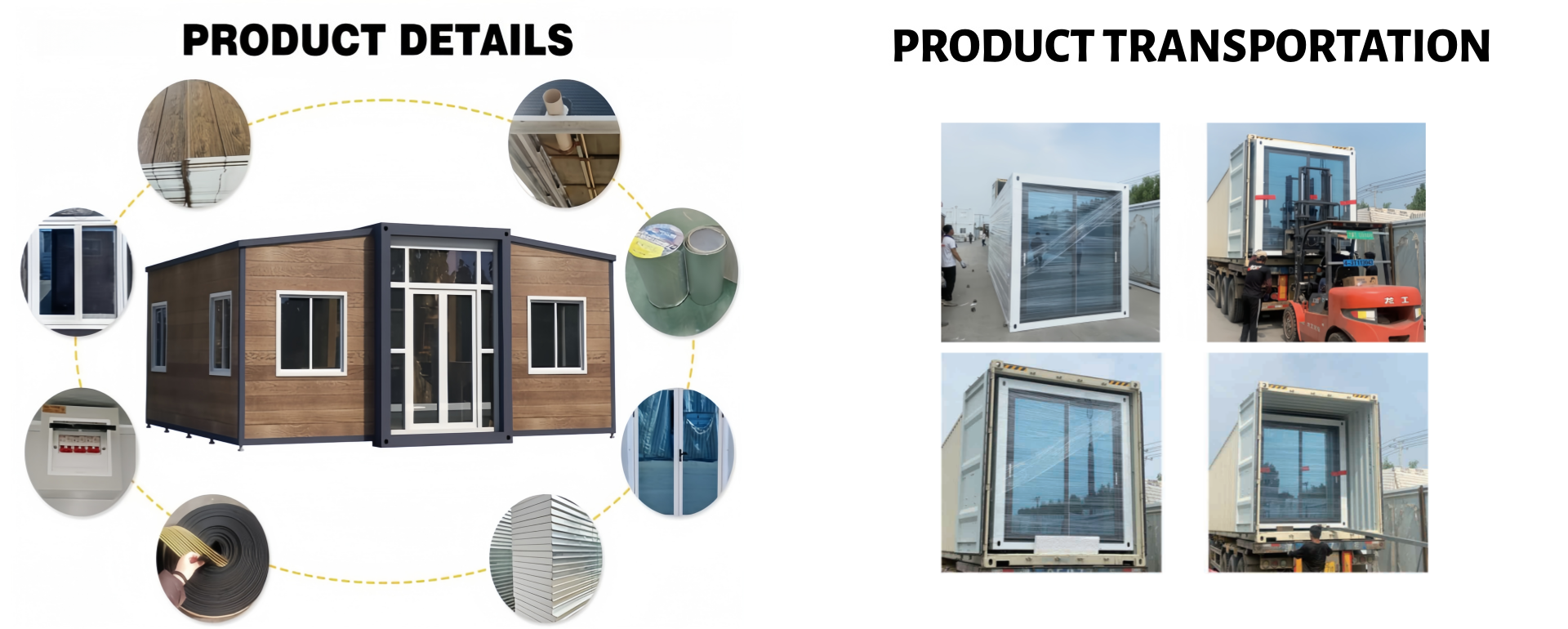
Offloading is a plant operation and must be planned as one. Yes — a crane or forklift is required to offload the folded unit from the truck. Once it is set in position, four workers can unfold and assemble the main structure in about 2 hours. Site the base first, confirm the machine has adequate reach and bearing, and keep the delivery crew on site through the opening so the unit is weathertight the same day it arrives — an afternoon tropical downpour on an unsealed unit does damage that no coating will undo.
Landed Cost Budget
HG Prefab factory prices for the folding unit itself are 20FT $7,200–$9,800; 30FT $10,500–$14,500; 40FT $12,500–$16,500, ex-works, before freight and Brazilian compliance — a starting point rather than the landed cost. The table below converts it into a realistic landed estimate per size. All freight and tax figures are estimates for budgeting and must be confirmed against a written simulation from your despachante for your NCM and destination state.
| Unit size | Unit price | Ocean freight (estimate) | II + IPI + PIS/COFINS (estimate) | ICMS & charges (estimate) | Landed estimate |
|---|---|---|---|---|---|
| 20FT | $7,200–$9,800 | $2,600–$4,500 | $3,000–$5,200 | $2,200–$3,900 | $15,000–$23,400 |
| 30FT | $10,500–$14,500 | $3,400–$5,800 | $4,300–$7,200 | $3,200–$5,400 | $21,400–$32,900 |
| 40FT | $12,500–$16,500 | $4,000–$6,800 | $5,100–$8,200 | $3,800–$6,200 | $25,400–$37,700 |
Read every column as a range, not a quote. Ocean freight moves with the market and with the service; the federal column assumes II in the region of 14% on goods plus freight and insurance, with IPI on the compounded base and PIS/COFINS near 11.75%, all dependent on the declared NCM and on your tax regime; and the ICMS column assumes a state rate in the 17% to 20% band calculated on the grossed-up base, plus AFRMM and the Siscomex fee. The landed estimate excludes site works, foundations, service connections, crane hire, engineer and ART fees, and municipal charges, all of which are local. Larger layouts such as the 30FT folding expandable model spread fixed compliance and freight costs across more floor area, which is why cost per square metre improves as size increases.
Working With Your Supplier
The difference between a smooth Brazilian import and a difficult one is usually decided before production starts. Agree the following with the factory in writing: the declared NCM position and the documentation that supports it; the coastal anti-corrosion specification, covering surface preparation, primer, film thickness and topcoat; the tropical climate package, meaning insulation, thermal breaks at the steel frame, glazing and cross-ventilation, covered in more detail in our guide to tropical and humid climates; the electrical strategy, meaning Brazilian-specification fittings to NBR 5410 with NBR 14136 sockets, or a distribution board left ready for a Brazilian electrician to complete under an ART; the shipping configuration, including folded dimensions, weight, internal securing and moisture protection for a long humid voyage; and after-sales support, covering spare seals, panels, fixings and a named technical contact during installation.
Because Brazil runs on Portuguese documentation while much of the surrounding region runs on Spanish, be explicit about which language your technical pack must be issued in — a Spanish-language file is not accepted by a Brazilian prefeitura or by Siscomex. Payment structure, production milestones and inspection arrangements are covered in our container home ordering and payment guide, and the full model range — including the 20FT, 30FT and 40FT platforms — is on the products page.
Planning a Brazilian import?
HG Prefab, manufactured by Henan Huangang Machinery Equipment Co., Ltd., builds 20FT, 30FT and 40FT folding expandable container houses with coastal anti-corrosion packages, tropical insulation, Brazilian electrical options to NBR 5410 and sea-freight preparation for Santos and Itajaí. Send your CEP, intended use and target date for a landed-cost estimate. Email hgmechequip@gmail.com or WhatsApp +86 191 0388 7380. Full model range on the products page.
Browse modelsFrequently Asked Questions
What import duties apply when bringing a folding container home into Brazil?
Four federal levies apply in sequence: Imposto de Importação (II), typically around 14 percent under Mercosur Common External Tariff lines for prefabricated buildings; IPI, which for imported goods is calculated on the customs value plus II; PIS/COFINS-Importação at roughly 11.75 percent combined; and ICMS, a state tax of roughly 17 to 20 percent calculated on a grossed-up base that includes the taxes themselves. Add AFRMM for the maritime freight leg and Siscomex fee. Exact rates depend on the NCM code your despachante aduaneiro declares, so obtain a written simulation before the vessel sails.
Does a folding container home need INMETRO certification in Brazil?
INMETRO certification applies to products inside its regulated scope, such as certain electrical equipment, cables, plugs and appliances, not automatically to a complete building. What matters in practice is that the electrical installation complies with ABNT NBR 5410 and uses plugs to ABNT NBR 14136, that structural design follows the applicable ABNT NBR steel and performance texts, and that the prefeitura and the responsible engineer sign off the project with an ART or RRT. Ask your Brazilian engineer which certifications apply to your intended use before ordering.
Which Brazilian port should I ship to, Santos or Itajaí?
Santos is the largest container gateway in Latin America and the best choice for São Paulo state, Minas Gerais and the Centre-West, with dense shipping-line coverage from Asia and strong road and rail hinterland connections. Itajaí and the neighbouring Navegantes terminals serve Santa Catarina, Paraná and Rio Grande do Sul efficiently and are usually less congested. Choose the port by final delivery address, not by headline freight rate, because the inland leg and the state ICMS rate often outweigh the ocean saving.
How long does shipping from China to Brazil take?
Ocean transit from major Chinese ports to Santos is typically around 35 to 45 days, and to Itajaí usually a few days longer, depending on the service and on whether the sailing is direct or transshipped via Singapore, Durban or a Pacific hub. Add factory production time before sailing, and port handling, customs clearance and inland delivery after discharge. Plan the whole sequence in weeks rather than days and book the crane before the truck is dispatched.
Is a crane or forklift required to offload the unit?
Yes — a crane or forklift is required to offload the folded unit from the truck. Once it is set in position, four workers can unfold and assemble the main structure in about 2 hours. Prepare the base first, confirm the machine has adequate reach and ground bearing for its outriggers, and keep the crew on site through the opening so the unit is weathertight the same day it arrives.