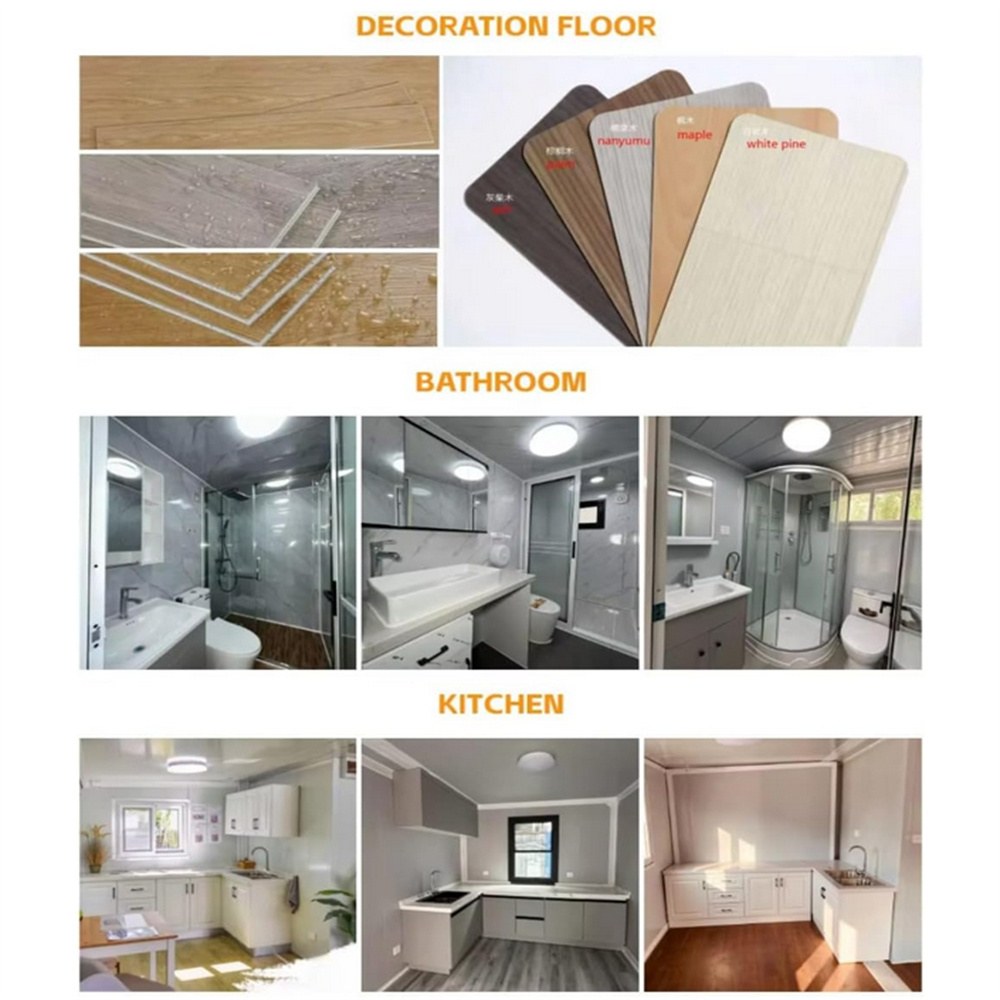
HG Prefab foldable expandable container homes — built to last, delivered worldwide.
Folding expandable container homes now ship to some of the most demanding climates on earth: the rainforest belts of Southeast Asia and Central America, the monsoon coasts of West Africa, the islands of the Caribbean and the Pacific, and the humid tropics of northern Australia. In these regions the relative humidity rarely drops below 70% for months at a time, an afternoon downpour can dump 100 mm of rain in a single hour, salt-laden coastal air eats unprotected steel, and termites treat any timber in reach as a food source. A container home configured for a dry, temperate climate will struggle in these conditions. A unit specified correctly for tropical conditions will outperform most local construction for decades, because the galvanized steel frame simply does not rot, warp or feed insects.
The difference is not the frame — welded Q235B steel with hot-dip galvanizing is indifferent to humidity. The difference is everything around the frame: where the vapor barrier sits, which insulation fills the walls, how many windows open on the windward side, how the roof sheds a cloudburst, whether the floor sits on piers above wet ground, and which fasteners and coatings hold it all together. Get those details right and you control mold, corrosion and heat with modest equipment. Get them wrong and you fight condensation, rust streaks and musty smells every rainy season, no matter how new the building is.
This guide works through each system in turn — humidity targets, mold prevention and insulation, ventilation, AC sizing, corrosion-resistant materials, roof and monsoon preparation, foundations, drainage and pest control — then closes with a 20FT vs 30FT vs 40FT comparison for tropical deployment, FOB pricing and the adaptation add-on costs we quote most often. For adjacent reading, see our container home ventilation guide, the hurricane resistance guide, the foundation comparison guide and, for the opposite problem, the cold climate guide.
Why tropical and humid climates demand a different container build
A folding container house is a steel box with insulation in the cavity, and steel is the most condensation-prone wall material there is. Warm tropical air holds enormous amounts of moisture; the moment that air touches a surface cooler than its dew point — a steel wall panel cooled by night-time radiative cooling, or a ceiling chilled by an overworked air conditioner — the water vapor turns liquid. In a dry climate this is a nuisance; in a rainforest or coastal zone it is a daily event that drives every design decision below.
Indoor humidity targets: keep RH between 50% and 60%
Everything in this article serves one number: keep indoor relative humidity between 50% and 60% year round. That band is low enough that mold spores cannot germinate and high enough that wood floors and furniture do not dry out and crack. The practical targets look like this:
- RH above 70% for 24–48 hours: mold germinates on dust films, fabric, leather and wood finishes — even without a leak.
- RH above 80%: corrosion accelerates on any scratched or cut steel edge, and dust mites thrive.
- RH 50–60%: the safe band; verify it with two hygrometers placed at opposite ends of the unit, not just one near the AC.
- RH below 45%: unlikely in the tropics, but a sign the AC is oversized and short-cycling.
How this differs from dry-climate builds
Buyers who first researched container homes for arid or cold regions should reset their assumptions. In a cold climate build, the priorities are heat retention and a vapor barrier on the interior warm side. In the tropics the interior is the cool side, so vapor drives from the humid exterior inward, and the barrier must move to the outside face of the insulation. EPS panels that perform well in dry heat can trap interstitial condensation in monsoon conditions. And where a desert unit can rely on a few operable windows, a tropical unit needs a deliberate cross-ventilation path, marine-grade coatings and a drainage plan. The rest of this guide covers each of those systems.
Mold prevention: vapor barriers, insulation and dehumidifier sizing
Mold needs three things: moisture, a surface and time. You cannot eliminate spores and you cannot eliminate surfaces, so the engineering effort goes into moisture control — keeping humid air out of wall cavities, keeping surfaces above the dew point and drying the air inside the room.
Closed-cell spray foam vs EPS sandwich panels
Our standard units ship with 50 mm EPS or rock-wool sandwich panels, which are cost-effective and perform well across most markets. In hot-humid zones we recommend the upgrade: closed-cell spray foam applied over the panel seams and steel studs, or the factory foam-filled wall option. Closed-cell foam is three products in one — insulation, air seal and vapor barrier — and it adheres directly to the steel skin with zero air gaps, so there is no cavity where humid air can condense unnoticed. EPS batts in a cavity, by contrast, rely entirely on the vapor barrier staying perfect for the life of the building. If your site sits within a few kilometers of the ocean or in a 3,000 mm-plus annual rainfall zone, the foam upgrade is the single best adaptation you can buy.
Vapor barrier on the warm side
Vapor always migrates from the warm side to the cool side. In a tropical home cooled by air conditioning, the warm side is the exterior. That means the vapor barrier belongs on the outer face of the insulation — which is exactly what closed-cell foam or a foil-faced panel achieves — and the interior finish should stay vapor-open so any residual moisture can dry inward. Installing an interior polyethylene sheet, the way a Canadian builder would, reverses the physics and locks moisture inside the wall. This one rule separates tropical specs from cold-climate specs.
Sizing a dehumidifier for each unit size
Even with good insulation and ventilation, most tropical households run a dedicated dehumidifier through the wet season. Dehumidifier capacity is rated in pints (or liters) of water extracted per day, and tropical ratings assume the harsher conditions. Our sizing guidance:
- 20FT (13 m²): 20–30 pints/day unit, placed centrally, drained via hose to the exterior.
- 30FT (20 m²): 30–45 pints/day, or two small units at each end to avoid a dead spot.
- 40FT (27 m²): 45–70 pints/day, ideally a ducted whole-house model paired with a humidistat.
Size up one step if the site is beside open water, under 100 m elevation in a rainforest belt, or closed up unoccupied for weeks at a time — an unventilated shut-down unit is the most common mold scenario we hear about from resort owners.
Ventilation: louvered windows, cross-breezes, ridge vents and fans
Dehumidifiers remove moisture that is already inside; ventilation stops it arriving and carries heat out with it. In the tropics, airflow is not a luxury feature — it is the primary climate system, and the air conditioner is the backup.
Window placement for the prevailing breeze
Cross-ventilation needs a pressure difference: an inlet on the windward wall and an outlet on the leeward wall, ideally offset so air actually sweeps the room diagonally instead of short-circuiting. When you order, tell us the prevailing wind direction at your site and we will position the openings accordingly. The rules we apply:
- Orient the long axis perpendicular to the prevailing breeze so the largest wall catches it.
- Place inlets low on the windward side and outlets high on the leeward side; rising warm air then reinforces the flow.
- Choose louvered (jalousie) glass windows — their angled slats admit airflow during rain showers, which ordinary sliding or casement windows cannot do while open.
- Fit insect screens on every opening; tropical airflow comes with mosquitoes.
- Keep at least two openings clear on each long wall; furniture against an outlet kills the stack effect.
Ridge vents and ceiling fans
A continuous ridge vent along the roof apex lets the hottest air in the unit escape continuously, cutting ceiling cavity temperatures by 10°C or more on a sunny afternoon and reducing the radiant load on the room below. Inside, ceiling fans do two jobs: they create air movement over skin that makes 28°C feel like 25°C, and they prevent stale air from stratifying against the cool ceiling, which is where condensation and mold patches start. Run fans at low speed even when the AC is on; the mixing lets you raise the setpoint 2°C and cut energy use.
Whole-house dehumidifier strategy
For permanent residences in the wettest zones, we recommend a ducted whole-house dehumidifier with a humidistat set to 55% rather than portable units. It draws air from the room, dries it and returns it continuously, drains to the exterior, and works overnight and during absence — exactly the hours when portable units sit switched off. Combined with louvered windows and a ridge vent, it keeps the 50–60% band through a monsoon without anyone touching a dial. Deeper airflow planning, including mechanical ventilation rates, is in our ventilation guide.
AC sizing for hot-humid zones
Air conditioning in the tropics does two jobs: sensible cooling (dropping temperature) and latent cooling (removing moisture). Undersized units run forever; oversized units hit the temperature setpoint quickly and shut off before extracting enough water, leaving the room cold, clammy and mold-friendly. Sizing for humidity is therefore more important here than in dry climates.
The 12,000 BTU per 25 m² tropical rule
For tropical zones with high latent load, size approximately 12,000 BTU per 25 m² of floor area, then round up rather than down:
- 20FT (13 m²): 9,000–12,000 BTU inverter split — the minimum worthwhile size given moisture pull-down.
- 30FT (20 m²): 12,000 BTU minimum; 12,000–18,000 BTU if the unit gets full afternoon sun.
- 40FT (27 m²): 18,000 BTU, or two 12,000 BTU heads for faster, quieter dehumidification in each half.
Inverter units and dry mode
Choose inverter-driven mini-splits: they ramp down instead of cycling off, which means continuous latent removal and stable humidity. Learn the dry mode on the remote — on overcast, rain-soaked days when the temperature is fine but the air is heavy, dry mode removes water with minimal cooling cost. The full sizing math, including heat loads from cooking and equipment, is in our container home HVAC guide.
Materials and corrosion protection for humid, salt-laden air
Corrosion in the tropics is not a maybe; it is a rate. Unprotected carbon steel can rust through a paint film within a couple of monsoon seasons near the coast, and mixed-metal connections corrode fastest of all. The coating stack and fastener specification are where a tropical unit earns its price premium.
Marine-grade coatings and finishes
Our standard finish is hot-dip galvanizing plus powder coat, which suits most inland sites. For coastal and island deliveries we quote the marine-grade package:
- Substrate: hot-dip galvanized steel frame as the base layer.
- Primer: zinc-rich epoxy, which sacrificially protects scratches and drill holes.
- Topcoat: polyurethane or PVDF finish rated for C5-M marine exposure, UV-stable against equatorial sun.
- Interior finish: washable marine enamel or PVC panels that tolerate condensation wipe-downs.
- Maintenance: a fresh-water rinse of exterior surfaces every one to two months in salt-air zones.
Stainless fasteners, hinges and sealed penetrations
Fasteners are the hidden failure point. We spec 316 stainless screws, hinges and locks for tropical units — 304 stainless is acceptable inland but pits within a season near surf. Just as important is avoiding mixed metals: a stainless screw in bare carbon steel creates a galvanic cell that eats the surrounding panel. Every wall penetration for pipes, cables and conduits gets sealed with butyl tape under the flange and exterior silicone over it, because each unsealed hole is both a leak and a corrosion starter. Galvanized components get galvanized or coated hardware; isolation washers go anywhere dissimilar metals must meet.
Roof design: steep pitch, reflective coating, gutters and monsoon preparation
The roof takes the worst of a tropical climate: downpours measured in millimeters per hour, equatorial UV, and in exposed coastal zones, cyclonic winds. Our folding units offer roof options, and the tropical spec differs from the standard one in three ways.
Pitch, reflective coating and rain shedding
For tropical deployment choose the steeper gable roof option rather than a near-flat profile. A pitch of roughly 10–15° or more sheds cloudbursts efficiently and dries fast between showers, which keeps the surface temperature cycling instead of staying damp. Over it, apply a reflective cool-roof coating (white or light-elastomeric): it cuts roof surface temperature by 15–20°C at midday, which reduces heat radiating into the ceiling cavity and can lower AC consumption by 10–20%. The coating also blocks the UV that otherwise chalks and thins the paint film within a few seasons. Roofing system comparisons, including standing seam and membrane options, are in our roofing materials guide.
Gutter sizing for tropical downpours
Tropical rainfall intensity routinely exceeds 100–150 mm/hour in a storm cell, so gutters sized for European drizzle will overflow in the first wet season. Our tropical spec: 100 mm half-round or K-style gutters with a downpipe for every 40 m² of roof plan, oversized 100 mm downpipes discharging at least 3 m from the foundation, leaf guards over the entire gutter run (palm fronds and debris arrive fast), and splash blocks or a shallow swale at each outlet so the water leaves the site rather than soaking the ground under the piers.
Cyclone and monsoon preparation
In cyclone-exposed regions — the Caribbean basin, the Philippines, northern Australia, the Bay of Bengal — anchoring is part of the purchase, not an afterthought. See our hurricane resistance guide for full wind-load engineering; the tropical checklist is:
- Ground anchors: 8 for a 20FT, 12 for a 30FT and 16 for a 40FT unit, concreted or screw-in type rated for the site wind zone.
- Tie-down straps: rated straps over the roof structure connecting frame to anchors, tensioned before each season.
- Storm shutters: corrugated metal or polycarbonate shutters over every window and the entry door.
- Pre-season routine: clear gutters and drains, trim trees within falling distance, photograph anchor tension points, and secure loose site items.
Foundation, drainage and pest control in wet ground
Tropical sites often mean high water tables, clay soils that hold water and active termite populations. The foundation system has to solve all three at once.
Raised pier foundations and French drains
We recommend elevating the unit on concrete or steel piers — typically 300–500 mm above grade — so air circulates under the floor and the structure never sits in ground moisture. Six to twelve piers carry the three sizes comfortably; the subfloor stays dry and the frame bolts stay out of the splash zone. Around the perimeter, a French drain — a gravel-filled trench with a perforated pipe wrapped in geotextile, sloped to daylight or a soakaway — intercepts surface water before it ponds beneath the unit. On flood-prone or low-lying sites, raise the piers further and check the foundation comparison guide for slab-versus-pier trade-offs; a slab in standing water is the one option to rule out.
Termite skirting, rodent barriers and sealed penetrations
The steel shell gives you a huge head start against pests, but the connections to the ground are the weak points. Close them deliberately:
- Termite shields: metal flashing on top of every pier so subterranean termites cannot bridge from soil to structure.
- Base skirting: a sealed steel or fiber-cement skirt around the base gap, backed with 6 mm galvanized mesh as a rodent barrier — rats can pass anything larger.
- Sealed penetrations: every pipe, cable and duct entry foamed from inside and silicone-sealed outside; an unsealed conduit is a rodent highway.
- Site hygiene: keep vegetation at least 1 m from the walls, store firewood away from the unit and fix drips promptly — termites follow moisture.
Choosing a size and budgeting: 20FT vs 30FT vs 40FT for tropical deployment
All three HG Prefab sizes adapt well to the tropics; the right choice depends on occupancy, site exposure and budget. The table below compares the three sizes on the parameters that matter most in humid climates, using the tropical add-on package (marine coating, stainless fasteners, louvered windows, dehumidifier, marine wiring, gutters and cyclone anchors) as the add-on baseline.
| Tropical spec | 20FT (6 m) | 30FT (9 m) | 40FT (12 m) |
|---|---|---|---|
| Interior footprint (floor area) | ~13 m² | ~20 m² | ~27 m² |
| Cross-vent louvered windows (recommended) | 3 | 4–5 | 6–8 |
| Dehumidifier capacity (very damp zone) | 20–30 pints/day | 30–45 pints/day | 45–70 pints/day |
| Raised pier foundation cost (incl. labor) | $600–$900 | $900–$1,300 | $1,200–$1,800 |
| Cyclone ground anchors | 8 | 12 | 16 |
| Est. tropical add-on package | $1,300–$2,200 | $1,900–$3,200 | $2,400–$4,000 |
| FOB price range | $7,200–$9,800 | $10,500–$14,500 | $12,500–$16,500 |
Pricing reflects the standard foldable expandable configuration with EPS sandwich panel walls, PVC interior finish, one pre-hung door and factory electrical prep; the tropical adaptation package is quoted separately and scales with the number of windows and anchors. A 20FT suits a guest room or site office for two to three people; a 30FT fits a small family home; a 40FT is the choice for full-time family living or staff housing where each extra square meter of cross-ventilated space reduces the moisture load per person. Browse all models in our product catalog.
Tropical adaptation add-on cost guide
Indicative FOB pricing for the items we add most often for tropical and coastal buyers:
- Marine-grade C5-M coating package (primer + topcoat): $450–$850
- 316 stainless fastener, hinge and lock kit: $150–$300
- Louvered window upgrade (per window): $80–$150
- Whole-house dehumidifier, 50–70 pints/day: $350–$700
- Marine-grade tinned wiring and IP66 fixtures: $300–$600
- Reflective roof coating plus gutters and downpipes: $250–$500
- Storm shutters (per opening): $60–$120
- Ground anchor and tie-down strap cyclone kit: $200–$450
Delivery and on-site assembly
Every unit ships flat-packed as a single 20FT, 30FT or 40FT ISO container footprint, FOB from Qingdao or Tianjin. Typical transit runs 7–15 days to Southeast Asian ports, 30–40 days to Central America, the Caribbean and West Africa, and 20–30 days to Oceania. A crane or forklift is required to offload the folded unit from the truck. Once it is set in position, four workers can unfold and assemble the main structure in about 2 hours. Prepare the piers, French drain and utility connections before delivery day, and budget a further half-day for electrical and water hookup — the full logistics walkthrough is in our shipping guide.
Ready to spec a tropical-ready folding container home?
HG Prefab manufactures 20FT, 30FT and 40FT folding expandable container homes with marine-grade coatings, stainless hardware, louvered cross-ventilation windows and cyclone anchoring packages — shipped flat-packed worldwide. Tell us your site conditions, rainfall and wind zone; we will spec the tropical package, send a layout drawing and quote FOB.
Browse tropical-ready modelsWhatsApp: +86 191 0388 7380 · Email: hgmechequip@gmail.com
Frequently Asked Questions
What indoor humidity level should I maintain in a tropical container home?
Keep indoor relative humidity between 50% and 60% year round. Above 70% RH for more than 24–48 hours, mold spores germinate on dust films, fabric and wood finishes even inside a steel shell. Place two hygrometers at opposite ends of the unit, run a correctly sized dehumidifier or the AC in dry mode overnight, and ventilate in the late morning when outdoor air is driest.
Is EPS insulation okay in a humid climate, or do I need closed-cell spray foam?
EPS sandwich panels are fine for inland, shaded sites with good ventilation, but for coastal, rainforest or monsoon locations we recommend upgrading to 50 mm closed-cell spray foam over the panel seams, or ordering the factory foam-filled wall option. Closed-cell foam is its own vapor barrier, adheres directly to the steel skin with zero air gaps, and stops the interstitial condensation that EPS cavities can trap during long rainy seasons.
How do I size the air conditioner and dehumidifier for a 30FT or 40FT unit?
Use the tropical rule of 12,000 BTU per 25 square meters, then round up for latent load. A 30FT unit (about 20 square meters) wants a 12,000 BTU inverter split as a minimum, and a 40FT unit (about 27 square meters) wants 18,000 BTU, or two 12,000 BTU heads for faster moisture pull-down. Match it with a 30–45 pint/day dehumidifier for the 30FT and 45–70 pints/day for the 40FT in very damp zones.
How do you keep termites and rodents out of a folding container home?
The steel shell removes most of the food source, so the weak points are the floor edge, wall penetrations and anything connected to the ground. Set the unit on concrete or steel piers with metal termite shields on top, close the base gap with a steel skirt backed by 6 mm galvanized mesh as a rodent barrier, seal every pipe and cable penetration with foam plus exterior silicone, and keep vegetation trimmed back at least one meter from the walls.
How is the container delivered and installed on a tropical site?
Every unit ships flat-packed in a standard ISO container footprint to the nearest port. A crane or forklift is required to offload the folded unit from the truck. Once it is set in position, four workers can unfold and assemble the main structure in about 2 hours. Prepare the pier foundations and drainage before delivery day, then budget a half-day for electrical and water hookup.