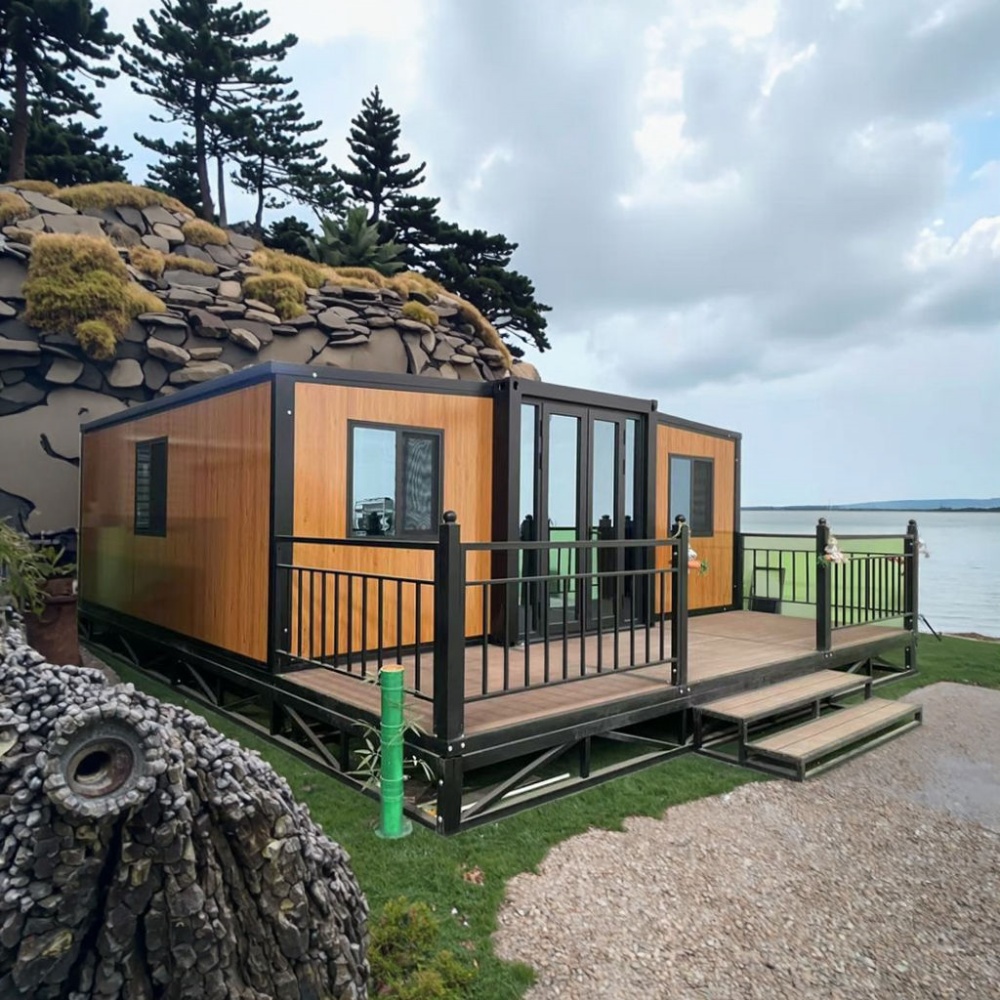
HG Prefab foldable expandable container homes — built to last, delivered worldwide.
A laundromat is one of the most utility-heavy small businesses you can put in a container, and that is exactly why a folding container unit works well for it. The shell is steel, the floor can be reinforced at the factory, and the plumbing and drainage runs are short, straight and accessible. HG Prefab's 20FT, 30FT and 40FT foldable container houses can be specified with a reinforced floor, a raised wet-room zone and factory-prepared waste penetrations, so a laundry fit-out starts from a shell that already understands water. This guide covers machine layout, floor loading, hot water and drainage, ventilation, electrical capacity, payment systems and realistic cost ranges.
Why a Container Laundromat Makes Commercial Sense
Laundries are judged on three numbers: machines per square metre, water throughput per hour, and downtime. A container unit helps with all three because every service runs in a single line rather than through a scattered building.
- Dense machine walls — a 20FT unit takes six to eight front-loading machines on one wall with a 1.4 m circulation aisle, or a mix of washers and stack dryers on both walls.
- Short service runs — the water heater, main isolation valve, drainage manifold and electrical panel all sit within a few metres of the machines, which cuts pipe runs, heat loss and leak risk.
- Reinforced floor at the factory — a commercial machine weighs 90–140 kg empty and 250–450 kg loaded. Factory floor upgrades are far cheaper than on-site steelwork.
- Accessible maintenance — a straight run of machines with a removable back panel or a rear service corridor reaches every pump and inlet filter without moving equipment.
- Site flexibility — forecourts, petrol-station corners and apartment car parks often have a spare 30–40 m² that a relocatable unit can occupy under a temporary use permit.
Machine count drives the unit size. Six washers and four dryers fit comfortably in a 20FT. Ten washers, six dryers, a folding table and a customer waiting bench need a 30FT. A 40FT allows twelve to fourteen machines plus an attended service counter, an ironing station and a vending area. Running costs dominate the business case well before the shell cost does, which is why the utility sections below matter more than the fit-out finish.
Machine Layout, Floor Loading and Circulation
Lay machines along the long walls and keep the middle of the unit clear. A 900 mm minimum aisle is tight; 1,200 mm is comfortable and lets two customers pass with baskets.
- Washer wall — front loaders on 100 mm plinths so the door sill sits at 500–600 mm, which reduces bending and keeps floor water away from the machine base.
- Dryer wall — stack dryers double the machine count on the same wall length. Leave 600 mm clear above the top machine for the exhaust duct and 300 mm behind for the gas or electrical connection.
- Floor loading — allow 3.0 kN/m² for an evenly loaded machine area; where machines are concentrated against one wall, specify 4.0 kN/m² locally under the plinth line.
- Folding table — 1,800 × 750 mm at 900 mm height serves two customers at once; place it between the washer and dryer walls so baskets never travel far.
- Wet zone — falls of 1:80 to a linear floor drain, epoxy or vinyl flooring with a coved skirting, and a 40 mm drain connection per two machines with a clean-out at the end of the manifold.
- Wait area — a bench for four people, a counter for card and coin payment, and a wall-mounted changing mat. In a 30FT or 40FT, add a small staff corner with a sink and a first-aid point.
Plan the door position on the long side facing the parking or street frontage so customers see the machines before they commit. In a 20FT, that means a 1,500 mm glazed entrance with a 900 mm leaf; in a 30FT or 40FT, a double 1,800 mm opening keeps the aisle clear at peak times and helps cooling air move through the space.
Hot Water, Drainage and Ventilation
Water heating is the largest single running cost in a laundry after rent. The design goal is to store enough hot water to serve a full wash cycle without running the heater at peak electrical demand.
- Water demand — a commercial front loader uses 50–70 L per cycle. Eight machines running four cycles a day is roughly 1,600–2,200 L daily, which must be supplied at 3–4 bar and 20–25 L/min to keep cycle times predictable.
- Storage — a 300–500 L cylinder with a 3–6 kW element covers a 20FT unit; a 30FT or 40FT with ten or more washers needs 800–1,500 L of storage, often as two linked cylinders.
- Heat-pump or gas heating — a heat-pump water heater cuts heating energy by 55–65 percent but recovers slowly. Hybrid designs that pair a heat pump with a booster element give the best balance of running cost and peak throughput.
- Drainage capacity — a washer discharges 60–80 L in under 90 seconds, so size the manifold for 1.2 L/s per machine bank and use 75 mm or 100 mm pipe rather than a network of 40 mm branches.
- Ventilation — dryers push 150–250 m³/h of hot moist air each. Either duct each dryer outside through the container wall, or install a lint-intercepted manifold with a rooftop fan; never recirculate dryer exhaust inside the unit.
- Humidity and condensation — target 6–10 air changes per hour in the laundry area and keep the internal dew point below the steel surface temperature. Insulated walls and a vapour-sealed ceiling prevent the interior rain that ruins poorly ventilated laundries.
- Lint control — a lint trap on every duct run, cleaned weekly, is the one maintenance habit that prevents most dryer fires. See our fire safety guide.
Water reclaim is worth considering above about ten machines. A simple grey-water heat recovery unit on the drain line pre-heats incoming cold water and returns 20–35 percent of the heating energy, typically paying back inside three years. On water-scarce sites, a rainwater tank feeding the wash cycle through a filtration train cuts mains consumption significantly; see our rainwater harvesting guide.
Electrical Capacity, Payment and Security Systems
A laundry is an electrical load problem before it is a construction problem. Get the supply size wrong and the whole business is capped at the meter.
- Connected load — a commercial washer draws 2.0–3.0 kW during heating and a dryer 3.0–5.5 kW. Allow 12–18 kW for a 20FT with eight machines, 20–30 kW for a 30FT, and 30–45 kW for a large 40FT installation with electric dryers.
- Three-phase supply — a 40FT laundry should be designed for 3-phase at 63 A or 100 A so the load is balanced across phases. Single-phase laundries above 20 kW will dim lights on the same transformer.
- Machine circuits — a dedicated circuit per machine, an RCBO per circuit, and a lockable main isolator inside the plant corner rather than only at the external meter box.
- Payment — coin, card or app. Card readers on every machine add $200–$500 per unit but lift average revenue and remove cash handling; central controllers let you price cycles, apply off-peak discounts and monitor machine faults remotely.
- Lighting and signage — 300–500 lux over the machine walls with LED industrial fittings, plus a lit fascia. A laundry that reads as bright and dry from 20 m away attracts more first-time customers than any other single investment.
- Security — a lockable steel shell, a camera covering the door and the payment counter, a floor-mounted safe for coin boxes, and a rear service door that is alarmed and openable from inside. See our security guide.
Monitoring is the cheapest operational upgrade. A remote controller reporting water temperature, cycle counts and fault codes lets you service a machine before it strands a customer mid-wash, and it tells you which dryer is being run with a full lint filter. Our smart technology guide covers the sensor and remote-management options.
Delivery, Commissioning and Budget Planning
Commission a laundry in this order: slab and services, unit assembly, plumbing rough-in, electrical fit-out, machine installation, then a full wet test with every machine running simultaneously for one hour. That last test is the only way to prove the drainage manifold and the hot-water storage are actually sized for peak demand.
Delivery day sets the schedule. Yes — a crane or forklift is required to offload the folded unit from the truck. Once it is set in position, four workers can unfold and assemble the main structure in about 2 hours, so have the reinforced slab cured, the water main capped and the electrical trench backfilled before the unit lands. A 150 mm reinforced slab with a 1:80 fall to the drain line and a 200 mm perimeter apron is the standard base for a machine-loaded laundry unit; add a bunded area if the local authority requires containment for detergent storage.
Budget the Laundry Fit-Out
Allow roughly $18,000–$32,000 of fit-out for a 20FT self-service laundry: eight commercial machines at $1,800–$3,200 each is the bulk of it, followed by the three-compartment utility sink and water heater at $1,200–$3,000, drainage and manifold work at $1,500–$3,500, epoxy flooring and wet-zone lining at $1,800–$4,000, ventilation and ducting at $1,200–$2,800, electrical distribution at $2,000–$4,500, and lighting, signage and payment controllers at $1,500–$3,500. A 40FT attended laundry with a service counter, ironing station and vending area typically lands between $45,000 and $85,000 of fit-out on top of the shell.
| Unit size | Unit price range | Typical laundry fit-out | Machine capacity |
|---|---|---|---|
| 20FT | $7,200–$9,800 | $18,000–$32,000 | 6–8 washers, 4 dryers |
| 30FT | $10,500–$14,500 | $30,000–$52,000 | 10 washers, 6 dryers, folding area |
| 40FT | $12,500–$16,500 | $45,000–$85,000 | 12–14 machines plus service counter |
Revenue modelling is straightforward. A 20FT laundry running eight machines at a $5 average cycle and 30 cycles per machine per week grosses about $62,000 a year; utilities typically consume 25–35 percent of that, and the shell plus fit-out is usually recovered inside two to three years. Because the unit is relocatable, it retains resale value if the pitch stops working. Pair the fit-out with a solar array if the site is sunny — a 10 kW array covers a meaningful share of daytime heating load; see our solar power guide.
Need a folding container house?
HG Prefab manufactures 20FT, 30FT and 40FT folding expandable container houses with reinforced floors, factory-prepared waste penetrations, insulated wet-zone walls and custom glazed shopfronts — shipped flat-packed worldwide.
Browse modelsFrequently Asked Questions
Does a folding container unit need a crane on delivery for a laundromat build?
Yes — a crane or forklift is required to offload the folded unit from the truck. Once it is set in position, four workers can unfold and assemble the main structure in about 2 hours. Have the reinforced slab cured and the water main capped before the offload so machine installation can start the following day.
How many washing machines fit in a container laundromat?
A 20FT unit takes six to eight washers plus four dryers on a 1.2 m aisle. A 30FT takes ten washers and six dryers with a folding area, and a 40FT takes twelve to fourteen machines plus an attended service counter, ironing station and vending area.
How much hot water and electrical capacity does a container laundromat need?
A commercial washer uses 50–70 L per cycle, so a 20FT laundry needs 300–500 L of hot-water storage and a 30FT or 40FT needs 800–1,500 L. Allow 12–18 kW connected load for a 20FT and 30–45 kW for a large 40FT, ideally on a 3-phase 63 A or 100 A supply with an RCBO on every machine circuit.
How much does it cost to build a container laundromat?
The folding unit runs $7,200–$9,800 for a 20FT, $10,500–$14,500 for a 30FT and $12,500–$16,500 for a 40FT. Laundry fit-out adds roughly $18,000–$32,000 for a 20FT self-service layout and $45,000–$85,000 for an attended 40FT with a service counter and ironing station.