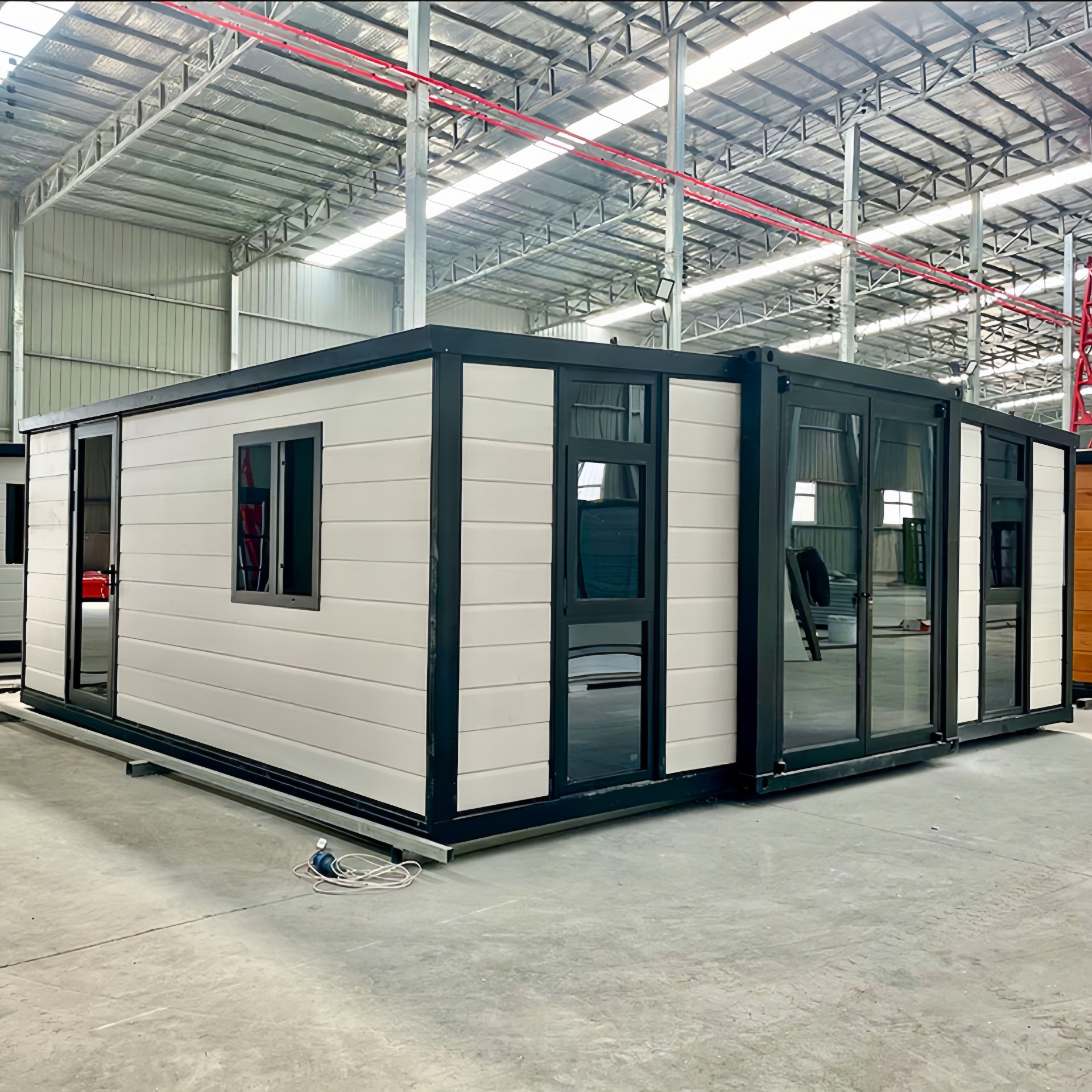
HG Prefab foldable expandable container houses — engineered for stable, dry ground, delivered worldwide.
A houseboat and a folding container house appeal to the same instinct. Both let you live somewhere a conventional mortgage would not reach, both arrive as a complete steel structure rather than a building site, and both have communities of owners who insist they have found the better way to live. They are, however, engineering answers to completely different problems, and the difference shows up in the money long before it shows up in the lifestyle. One is a vessel whose hull is in permanent contact with water; the other is a building whose frame is bolted or set on dry, compacted ground.
That single distinction drives everything downstream: how you are permitted, what you pay every month for the right to be there, how much it moves under you, what the maintenance calendar looks like, whether an insurer will quote at all, and what the thing is worth in fifteen years. This article is written for buyers standing at that fork, particularly those looking at waterfront or lakeside land who are genuinely undecided between mooring a boat and setting a house on the shore. It sits alongside our comparisons with a tiny house on wheels and a manufactured mobile home, and our detailed look at coastal and beachfront placement.
Purchase Price: Two Completely Different Markets
What a houseboat actually costs
Houseboat pricing spans an unusually wide range because "houseboat" covers everything from a converted pontoon cruiser to a purpose-built two-storey floating residence. The realistic bands:
- Used small cruiser or pontoon conversion, 8–12 m: $30,000–$90,000. Habitable, but usually needing immediate work on hull, systems and interior.
- Used purpose-built liveaboard houseboat: $80,000–$250,000 depending on age, hull material, engine hours and whether the interior has been refitted.
- New entry-level floating home, 10–14 m: $120,000–$250,000 before delivery, mooring and fit-out of services.
- New custom or two-storey floating residence: $250,000–$600,000+, with the upper end approaching waterfront property pricing rather than alternative-housing pricing.
- Survey and condition inspection before purchase: $1,000–$4,000, and you should never skip it. A hull survey that finds osmosis, wasted steel plate or a saturated core changes the deal.
- Delivery, craning into the water and commissioning: $3,000–$20,000 depending on distance from the builder and the launch site.
Add the mooring, which is not optional and is usually not included: a residential berth or liveaboard mooring runs $200–$1,500 a month in most markets, with marina residential berths in popular cities considerably higher and waiting lists measured in years. Some buyers pay a mooring transfer fee of $5,000–$50,000 simply to take over a berth that has residential consent attached to it.
What a new folding container house costs
The container side is one number rather than a negotiation. HG Prefab factory prices for new steel units are 20FT $7,200–$9,800; 30FT $10,500–$14,500; 40FT $12,500–$16,500. That is the complete delivered structure: welded galvanised steel frame, insulated sandwich wall and roof panels, floor, door and window package, factory-applied corrosion-resistant coating, and the folding hinge and locking mechanism that is the whole point of the product. Electrical and plumbing are installed in the factory to your specified layout rather than sourced as a separate marine trade.
On top of that you budget for the site and the logistics: pad or foundation work of roughly $1,500–$6,000 depending on whether you use a concrete slab, piers or ground screws; delivery and the lifting machine on the day, typically $800–$3,000 depending on distance and crane availability; and utility connections from $500 for a simple shore-power hookup to $5,000–$15,000 for full mains water, sewer and power. A realistic all-in figure for a liveable 30FT folding home on prepared land is $14,000–$28,000. If you own the land, that is the entire housing cost; there is no monthly fee for the right to remain there.
The ten-year running-cost gap
This is where the comparison stops being close. A houseboat carries berth or mooring fees of $2,400–$18,000 a year, haul-outs and antifouling at $1,500–$6,000 every 12–24 months, engine and generator servicing at $500–$2,000 a year, anode replacement, seacock and through-hull servicing, bilge pump replacement, marine insurance, and in cold climates winterisation or a heated berth. A folding container house carries site rates or rent if you do not own the land, electricity, and periodic coating inspection. Over ten years the difference is commonly $80,000–$250,000, and the houseboat's largest line — the mooring — never stops and is indexed upward.
Foundation versus Mooring: What You Stand On
Houseboat: a mooring is a licence, not a property right
When you buy a houseboat you are buying a vessel, and you are renting the piece of water it sits on. That distinction has consequences buyers underestimate. A berth licence is a contract that the marina or the waterway authority can decline to renew; residential status is granted at the operator's discretion and is increasingly restricted, with some authorities capping the number of liveaboard vessels and others banning residential occupancy outright. Mooring fees rise with the market, and the berth can be lost through no fault of your own if the marina is redeveloped or the authority changes its policy.
There is also the navigation question. If your houseboat is capable of moving — and most are — you need to comply with the rules for vessels on that waterway: registration or licensing, safety equipment, in some jurisdictions a boat operator's licence or a certificate of competence, insurance with third-party liability, and compliance with noise, discharge and black-water rules. If it is not self-propelled and is classed as a floating structure rather than a vessel, you may avoid some of that but then lose the ability to move it out of harm's way before a storm.
Folding container house: a foundation you own
A folding container house takes the building route. You prepare a compacted, level pad, or you cast a slab, or you drive ground screws or piers, and then the unit is set on it and anchored. The foundation detail is part of the permit submission, and once the structure is approved you have a fixed asset on land you own or lease under a normal tenancy, with an address and the legal standing of a building rather than a licence.
Setup is fast and mechanical rather than marine. Yes — a crane or forklift is required to offload the folded unit from the truck. Once it is set in position, four workers can unfold and assemble the main structure in about 2 hours. The lifting machine needs firm, compacted, level ground within reach of the pad, so the access route and the pad itself have to be prepared before delivery day — the same principle covered in our crane offloading guide. There is no launch, no water ingress risk during commissioning, and no dependence on a third party's continuing consent to stay where you are.
Stability and Motion: The Daily Difference
What living on water actually feels like
A houseboat moves. Not dramatically in a sheltered marina, but continuously: boat wake from passing traffic, wind against a large flat superstructure, changes in water level from lock operation, tide, or seasonal drawdown, and the slow trim shift as you fill a water tank on one side or stack firewood on the other. Modern hulls — wide-beam or catamaran configurations especially — handle this well, and many liveaboards stop noticing it after a fortnight. It is still a real design constraint. Everything aboard has to tolerate motion, which means lightweight fittings, latches on every cupboard, rounded corners, fiddles on worktops, and nothing that depends on being perfectly level. Guests feel it immediately; some never get used to it.
In exposed water the stakes rise. Storm mooring is a genuine skill and a genuine risk: lines part, fenders burst, and a hull driven against a concrete wall or a rocky bank loses that argument. Marine insurers know this, which is why policies carry named-storm deductibles and specific storm-mooring requirements. Freeze is the other seasonal hazard — a hull sitting in freezing water needs a heated berth, bubblers or winterisation, and a frozen through-hull can sink a boat.
A building on a pad does not move
A folding container house is anchored to a foundation and rated for wind and roof snow load. Because it does not move, you can specify and use ordinary things: level floors, standard hinged doors that stay shut without a latch, a full-height shower tray that drains correctly, flat-pack furniture, a washing machine, and a kitchen run built to domestic tolerances rather than marine ones. The seals stay compressed because the frame stays square; joinery does not rack; nothing needs re-levelling after a storm.
The honest counterpoint is that a houseboat offers something no land structure can: the view from the middle of the water, the ability to untie and go somewhere else, and a relationship with a place that is genuinely different from owning a plot. If that is the point, no cost comparison matters. If what you actually want is a stable, dry, low-maintenance home near water, a 30FT lakeside unit on a decked pad delivers most of the view with none of the motion.
Maintenance: The Real Cost of a Hull
Every material decays. The question is how fast and at what price, and this is the category where the two options diverge most sharply. Water is the most aggressive environment a structure can sit in: constant contact, dissolved oxygen, electrolysis between dissimilar metals, marine growth, ultraviolet exposure above the waterline, and freeze-thaw cycling right at the waterline where the damage is hardest to see.
The houseboat maintenance calendar
- Haul-out every 12–24 months: pressure wash, hull inspection, antifouling repaint, anode replacement, through-hull and seacock servicing, plus yard and lift fees. Typically $1,500–$6,000 per visit.
- Engine, generator and drive servicing: $500–$2,000 a year, plus a major overhaul budget measured in thousands once hours accumulate.
- Hull defects: osmosis and blisters on ageing glassfibre, wasted plate and weld repair on steel, corroded aluminium, and saturated or delaminated cores. Survey findings of this kind routinely cost $5,000–$40,000 to put right.
- Decks, windows and seals: continuous resealing. Leaking deck fittings and portlights are the most common source of interior damage on any boat.
- Condensation and mould: a hull in cold water is a cold surface for much of the year, and managing interior humidity is a permanent job rather than a seasonal one.
- Systems: bilge pumps, batteries, shore-power isolation, galvanic isolators, holding tanks and macerators all have shorter service lives than their domestic equivalents.
None of this is optional. A hull deferred is a hull devalued, and the survey at resale will find it.
The folding container house maintenance calendar
Comparatively short. Inspect the factory coating every 2–3 years and touch up any damage to the galvanised or painted surface, particularly at cut edges and around fixings; check door and window seals and the compression of the folding joint gaskets annually; keep the pad free-draining so water never ponds against the base; and service the folding mechanism — hinge pins, locking hardware and any seals — on the schedule in the manual. Interior upkeep is ordinary domestic maintenance. There is no haul-out, no antifouling, no anode budget, no engine, and no survey to renew. Our cost guide sets out the full ten-year ownership picture with these lines included.
Space, Layout and Liveability
Houseboat interiors are constrained by beam, headroom and weight distribution. A typical liveaboard of 12–15 m gives roughly 30–70 m² over one or two levels, but the usable figure is lower because hull shape cuts into floor area at the ends, weight has to be balanced fore and aft and port and starboard, and adding a second storey raises the centre of gravity — which is exactly what you do not want on a floating structure. Storage is tight and everything is built in, curved or tapered to fit the hull.
A folding container house expands sideways as well as lengthwise and the numbers scale cleanly: a 20FT unit opens to about 36 m², a 30FT to about 56 m², and a 40FT to about 76 m². Those are rectangular, full-height, square-cornered metres with level floors, so the whole area is usable, and the width supports a separate bedroom, a full kitchen run, a proper bathroom and a living area without any bespoke joinery. A 40FT glazed unit delivers more usable floor area than most single-level houseboats at a fraction of the price, and a 20FT modern unit gives a couple more usable space than an entry-level cruiser conversion.
Being fair to the houseboat: it wins on one spatial dimension the container house cannot match, which is the relationship between inside and outside on the water. A aft deck at water level, the ability to swim off the back, and the changing view are genuinely valuable, and they are the reason people accept the maintenance burden.
Power, Water and Sanitation
On a houseboat these are marine systems. Fresh water lives in tanks of typically 200–600 litres, filled from a marina hose; black water goes into a holding tank that must be pumped out at a facility, because direct discharge is illegal in almost every inland and coastal waterway; grey water is usually also retained. Power comes from a shore-power hookup with a marine-grade isolation transformer and galvanic isolator, a generator, or a battery bank with solar on a roof that is small, curved and often shaded. Heating is a diesel or solid-fuel stove, or a reverse-cycle unit on shore power. All of it has to be marine-rated, and all of it is more expensive per unit of capacity than its domestic equivalent.
A folding container house is wired and plumbed in the factory to a layout you choose, with domestic-grade cable runs, a consumer unit, RCD protection and proper wet-room drainage. Because it does not move, you can do the things a vessel cannot: connect to mains water and sewer, install a septic system or a treatment plant, run a heat-pump water heater, and fit a solar array on the roof or a ground frame sized to the load rather than to the available roof. Our insurance guide matters here because insurers ask how the electrical and plumbing work was done and by whom — factory-installed services with documentation are straightforward to underwrite, whereas a self-modified marine installation is not.
Head-to-Head Comparison
Six categories that decide the outcome, both options, no hedging:
| Factor | Houseboat (liveaboard) | Folding container house (HG Prefab) |
|---|---|---|
| Purchase price | $60,000–$400,000+ for a liveaboard-capable vessel; new custom builds reach $600,000; plus $1,000–$4,000 survey, $3,000–$20,000 delivery and launch, and $5,000–$50,000 for a residential berth transfer where applicable | 20FT $7,200–$9,800; 30FT $10,500–$14,500; 40FT $12,500–$16,500; plus roughly $2,500–$12,000 for pad, delivery, lifting and services |
| Foundation / mooring | A berth licence or mooring permit, not a property right: $200–$1,500 a month, renewable at the operator's discretion, subject to liveaboard caps and redevelopment risk; storm mooring is the owner's responsibility | A prepared compacted pad, concrete slab, piers or ground screws on land you own or lease; anchoring detail forms part of the building permit and is inspected |
| Stability | Floats: continuous motion from wake, wind and water-level change; must be trimmed as loads shift; storm mooring and freeze protection are real risks; interiors built to tolerate movement | Anchored to a foundation with a rated wind and roof snow load: does not move, so level floors, standard doors, domestic furniture and ordinary finishes all work |
| Maintenance | Haul-out and antifouling every 12–24 months at $1,500–$6,000; engine and generator servicing $500–$2,000 a year; anodes, seacocks, bilge pumps; osmosis or wasted plate repairs $5,000–$40,000; permanent condensation management | Coating inspection every 2–3 years, annual seal and gasket checks, keep the pad free-draining, service the folding mechanism; ordinary domestic interior upkeep; no haul-out, no engine, no anodes |
| Insurance | Specialised marine policy: hull material, survey history, cruising range and storm-mooring plan all asked for; $1,000–$4,000 a year typical, with named-storm deductibles and exclusions for unattended moorings | Insured as a small building or portable structure against a documented factory replacement cost; fixed specification makes valuation and underwriting straightforward |
| Lifespan | 30–50 years for a well-maintained steel or glassfibre hull, but only with the full annual regime; value falls steeply once a survey finds osmosis, blisters, wasted plate or a tired engine | Welded galvanised steel frame on a maintained pad with a factory warranty and a service life measured in decades; condition is visible and does not require a survey to verify |
Which One Suits Which Buyer
Choose a houseboat if the water is the point. If you want to untie and cruise, if the view from the middle of a lake or a river is worth $2,400–$18,000 a year to you, if you are comfortable with a marine maintenance calendar and a licence that someone else controls, and if you have access to a residential berth with secure tenure, then a houseboat is the right tool and the arithmetic is beside the point. It also suits people who want to be part of a liveaboard community, which is a real and distinctive social world.
Choose a folding container house if you want a low-maintenance home near water rather than on it. If you own or can buy a plot on the shore, if you want an address and a building permit rather than a berth licence, if you want 36 to 76 m² of square, level, full-height floor area with domestic electrics and plumbing, and if you would rather spend your weekends using the house than maintaining it, the container house wins on every axis except the view from the middle of the water. You accept a crane and a prepared pad on delivery day; in exchange you own something that does not need to be lifted out of anything.
The middle case deserves a mention: buyers who want a waterside lifestyle but discover that residential berths are unavailable, capped or priced beyond reach. That is increasingly common, and it is the situation where a folding unit on shorefront land is not a compromise but the only practical route to the same outcome — water views, immediate access, and a building you own outright.
Comparing a folding container house to a houseboat?
HG Prefab, made by Henan Huangang Machinery Equipment Co., Ltd., builds 20FT, 30FT and 40FT folding expandable container houses that ship folded worldwide and unfold on a compacted, level pad. Send us your site dimensions, climate, intended use and whether you need off-grid services, and we will confirm the model, the pad type, the delivery route and the lifting plan. Email hgmechequip@gmail.com or WhatsApp +86 191 0388 7380. Full range on the products page.
Browse modelsFrequently Asked Questions
Is a houseboat or a folding container house cheaper to live in?
The folding container house is dramatically cheaper on both fronts. A new HG Prefab unit is 20FT $7,200-$9,800, 30FT $10,500-$14,500 and 40FT $12,500-$16,500, while a liveaboard-capable houseboat runs $60,000-$400,000 or more depending on size, age and build quality. On running costs the gap is even wider: a houseboat carries berth or mooring fees of $200-$1,500 a month, haul-out and antifouling every 12-24 months at $1,500-$6,000 a visit, anode replacement, hull and engine servicing, and marine insurance. A folding container house on owned land carries none of those lines. Over ten years the difference is commonly $80,000-$250,000.
Is a houseboat stable enough to live in full time?
A well-designed houseboat with a catamaran or wide-beam hull is stable in sheltered water, and thousands of people live aboard happily. But it is a floating structure: it moves continuously with wind, passing boat wake and changing water level, it must be trimmed as loads shift, and in an exposed berth a storm can put the hull against the dock or the bank. Everything inside is built to tolerate that motion, which means lightweight fittings, rounded corners and nothing that relies on being level. A folding container house sits on a compacted pad, piers or ground screws and does not move at all, so it can use normal domestic furniture, level floors, standard doors and conventional finishes.
How much maintenance does a houseboat really need?
Far more than most first-time buyers budget for. Plan on a haul-out every 12-24 months for hull inspection, antifouling paint, anode replacement and through-hull servicing, typically $1,500-$6,000 each time plus yard fees. Add engine and generator servicing at $500-$2,000 a year, bilge pump and seacock checks, hull blisters and osmosis on ageing glassfibre hulls, deck and window resealing, and the constant fight against condensation and mould in a hull that sits in cold water. Steel houseboats add rust management and anode budgets. A folding container house needs a coating inspection every 2-3 years, seal checks and routine servicing of the folding mechanism, plus normal domestic upkeep.
Can I insure a houseboat and a folding container house?
Both can be insured, but the process differs. Houseboat cover is a specialised marine policy: insurers ask for the hull material, the build or survey history, the age, the navigation or cruising range, whether it is a liveaboard, and lay-up and storm-mooring arrangements. Premiums commonly run $1,000-$4,000 a year, with named-storm deductibles and exclusions for unattended moorings. A folding container house is insured as a small building or as a portable structure against a documented factory replacement cost, which is far easier to underwrite because the specification is fixed and the value is known.
Which lasts longer, a houseboat or a folding container house?
A folding container house has the longer structural life and the gentler decay curve. A welded galvanised steel frame on a maintained pad, with coating inspection every 2-3 years, is measured in decades and does not depend on a survey to prove it is sound. A houseboat hull lives in the most corrosive environment available: constant water contact, electrolysis, marine growth, ultraviolet exposure and freeze-thaw cycles at the waterline. A well-maintained steel or glassfibre hull can reach 30-50 years, but only with the full maintenance regime every year, and resale value falls steeply once a survey finds osmosis, blisters, wasted plate or a tired engine.
Talk to HG Prefab
Henan Huangang Machinery Equipment Co., Ltd. (HG Prefab) manufactures folding expandable container homes in 20FT, 30FT and 40FT sizes and ships them folded worldwide. Factory prices are 20FT $7,200–$9,800, 30FT $10,500–$14,500 and 40FT $12,500–$16,500, with expanded floor areas of roughly 36 m², 56 m² and 76 m² respectively. If you are weighing a houseboat against a container home on shorefront land, send us your intended location, whether the plot is owned or leased, your climate and your utility situation — those four facts determine the model, the pad, the services and the delivery plan.
Email hgmechequip@gmail.com or message us on WhatsApp at +86 191 0388 7380. You can also browse the full range at products.html or request a quotation at contact.html.