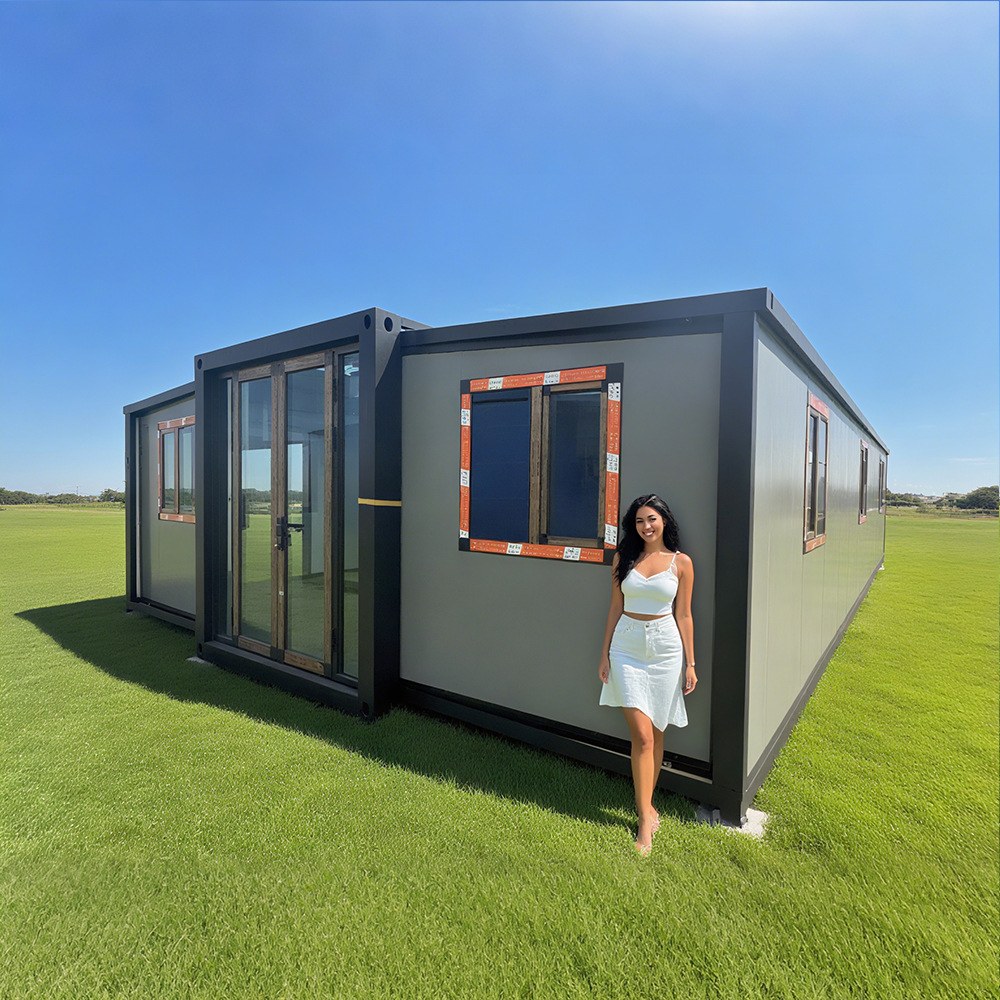
HG Prefab foldable expandable container homes — built to last, delivered worldwide.
A skoolie and a folding container house look like answers to the same question, and in the first month they are: both are small, both are steel, both cost far less than a conventional house, and both have an active online community convinced it has found the cheat code. They diverge on everything that matters after the first year, and the divergence is not a matter of taste. One is a road vehicle that happens to contain a bed; the other is a building that happens to arrive folded.
That single difference drives the money, the paperwork, the insurance, the comfort and the resale outcome. A bus keeps its engine, its registration and its road tax forever, and it inherits every rule that applies to a 7-metre, 8-tonne vehicle parked on a residential street. A folding unit gives up self-mobility entirely and in exchange becomes a code-compliant building on a foundation, with an address, a permit, a warranty and a re-saleable structure. This article is written for buyers standing at that fork. It sits alongside our comparisons of a folding container house with a tiny house on wheels and with a manufactured mobile home, which cover the two neighbouring options in the same depth.
Upfront Cost: The Numbers Side by Side
What a skoolie conversion actually costs
The skoolie budget is famous for being lower than it turns out to be. The shell is cheap and the build is not. A decommissioned school bus at auction typically sells for $3,000–$15,000 depending on age, mileage, engine, rust and whether it is a short or full-length chassis; a clean low-mileage full-size bus with a good diesel is usually $7,000–$12,000. Then the conversion:
- Shell and purchase: $3,000–$15,000, plus transport to your build site of $500–$2,500 if you cannot drive it home.
- Rust remediation and floor: $1,500–$6,000. Almost every bus needs at least some floor pan and skirt work, and this is where budgets die.
- Insulation, vapour control and interior lining: $3,000–$8,000 for a proper job with closed-cell foam or rigid board, a vapour layer and thermal breaks at every rib.
- Electrical: $2,500–$12,000 depending on whether you run a generator, shore power only, or a lithium bank with solar and an inverter.
- Plumbing: $1,500–$5,000 for fresh and grey tanks, a pump, a water heater and a shower that actually drains.
- Kitchen, bathroom, joinery and finishes: $6,000–$20,000. Cabinetry built to survive road vibration costs more than domestic flat-pack.
- Windows, doors, roof raise or roof deck: $1,500–$8,000.
- Heating and cooling: $1,000–$5,000.
- Mechanical refresh before it is roadworthy: $1,500–$8,000 for tyres, brakes, belts, fluids, batteries and whatever the inspection finds.
Add it honestly and a DIY skoolie lands at $30,000–$80,000+, with professional shop conversions running $90,000–$150,000. The figure excludes your labour, which for a first-time builder is realistically 800–1,500 hours, and it excludes the tools, the storage, the covered workspace and the winter you spend not living in it.
What a new folding container house costs
The container side is simpler because the money is one number. HG Prefab factory prices for new steel units are 20FT $7,200–$9,800; 30FT $10,500–$14,500; 40FT $12,500–$16,500. That is the complete delivered structure: welded galvanised steel frame, insulated sandwich wall and roof panels, floor, door and window package, factory-applied coating, and the folding hinge and locking mechanism that is the whole point of the product. Electrical and plumbing are pre-installed in the factory to your specified layout rather than being a separate trade you have to find and manage.
On top of that number you budget for the site and the logistics: pad or foundation work of roughly $1,500–$6,000 depending on whether you use a concrete slab, piers or ground screws; delivery and the lifting machine on the day, typically $800–$3,000 depending on distance and crane availability; and utility connections from $500 for a simple shore-power hookup to $5,000–$15,000 for a full mains water, sewer and power service. A realistic all-in figure for a liveable 30FT folding home on prepared land is $14,000–$28,000, and land is the variable that moves it most.
Ten-year running cost
This is where the bus starts losing badly. A skoolie carries engine servicing at $400–$1,200 a year, tyres at $1,500–$3,000 every five to seven years, brakes, batteries, coolant and belts, annual inspection and registration fees of $100–$600, and insurance on a heavy vehicle. Fuel at 6–12 miles per gallon means a 500-mile relocation trip costs $200–$400 in diesel alone, which is why most skoolies stop moving after year two. A folding container house has none of those lines: no engine, no tyres, no road tax, no inspection, and no fuel. Its running costs are site rent or rates, electricity, and periodic coating inspection. Over ten years the difference is commonly $15,000–$40,000 before you count depreciation.
Legal Status and Residency: The Deciding Factor
Skoolie: a registered vehicle, with everything that implies
A skoolie is legally a motor vehicle. To live in it you typically need the title reclassified from a bus to a motorhome or house car, which in most jurisdictions requires the conversion to be substantially complete and to meet specific criteria — usually a fixed bed, cooking facilities, and in some states and countries a toilet and a fresh water system — followed by an inspection. Once reclassified you have an RV, not a dwelling, and that is the important limitation: an RV is a vehicle you travel in, not a residence you occupy.
Consequences that catch people out. Municipal parking ordinances restrict or prohibit living in a vehicle on a street, in a driveway or on many private lots, and enforcement is complaint-driven, which means a neighbour ends your arrangement. Zoning codes rarely recognise vehicle residency at all, so you cannot simply declare a bus to be an accessory dwelling unit. RV parks and campgrounds will take you, usually with a limit of 14–30 days at a time and nightly rates of $25–$70, which is $750–$2,100 a month — more than a small apartment in many markets. Long-stay RV parks exist but are seasonal, remote, or both. Larger buses with a gross vehicle weight rating above 26,000 lb may require a commercial or non-commercial class B licence in the United States, and height and length limits restrict bridge, tunnel and ferry routes everywhere.
Folding container house: the building permit route
A folding container house takes the other path and it is the more durable one precisely because it is slower. You apply for a building permit as you would for any small dwelling: submit the site plan, the structural specification, the foundation or anchoring detail, the electrical and plumbing layouts and the energy compliance documentation, then build to the approved drawings and pass inspection. Where a jurisdiction treats a relocatable unit as a temporary structure, you may instead get a temporary or renewable placement permit, which is easier to obtain but usually carries a time limit and does not create residency rights.
Once approved, though, you have something the bus cannot give you: an address, a lawful full-time residence, eligibility for a mailing address and utilities in your own name, and a structure that appears on the assessment roll. For most buyers who intend to live somewhere for more than two years, that is the entire game. It also interacts with financing — lenders and insurers treat buildings very differently from self-built vehicles, which is covered in our container home financing guide.
What to confirm before you commit to either
Before money changes hands, ask the planning office four questions in writing, whichever route you take. Is full-time residential occupancy of the structure permitted on this parcel? If it is a building, what is the permit path, the setback requirement and the minimum floor area? If it is a vehicle, how many consecutive days may it be occupied on private land? And what services are required to be connected — sewer, water, power — before an occupancy certificate is issued? The answers vary enormously between counties and countries, and they are worth more than any amount of forum research. Our permits guide walks through the process and the documents usually requested.
Mobility: Drive Away vs Crane Relocation
This is the one category the skoolie wins outright, and it should be stated plainly. A bus starts, turns around and leaves. You can follow work, chase weather, leave a bad neighbour, or take the whole house to a national park for a fortnight, and the cost of doing so is fuel. Nobody needs to be hired, no permits are pulled and no crane is booked.
A folding container house moves, but it moves as freight rather than as a vehicle. The unit folds down to roughly a fifth of its expanded volume, travels on a standard flatbed or in a container, and is lifted into place at the destination. Yes — a crane or forklift is required to offload the folded unit from the truck. Once it is set in position, four workers can unfold and assemble the main structure in about 2 hours. So relocation is a project with a cost — typically $1,500–$5,000 for a move including transport, lifting and re-levelling — rather than an impulse.
In practice that difference shrinks. Most skoolies stop being mobile surprisingly quickly: owners settle on a leased plot, build a deck, install a fence, plant a garden and connect to mains power and water, at which point the bus is a fixed dwelling that still pays road tax and insurance on an engine it no longer uses. The honest question is not "which one can move" but "how often will I actually move in the next five years". If the answer is more than once a year, the skoolie earns its keep. If it is once or never, you are paying a permanent premium for capability you do not use.
Insulation, Structural Durability and Weather
Thermally, a bus is a poor starting point. Its shell is designed to carry passengers, not to retain heat: a single-skin steel body on ribs with no cavity insulation, a large windscreen and a row of windows that are single-glazed and leaky. Every rib is a thermal bridge, the floor is a steel plate over a chassis, and the roof is a large unshaded solar collector. Converting it to something comfortable means adding insulation everywhere, and the moment you do, you create the classic bus problem: warm moist interior air meeting cold steel behind your insulation, condensing, and rusting the shell from the inside out where you cannot see it.
A folding container house is engineered rather than adapted. It is built on a welded galvanised steel frame with insulated sandwich panels for wall and roof, factory-fitted gaskets and door seals, a rated roof snow load and a wind rating, and it is delivered with a manufacturer's warranty on the structure and the mechanism. Thermal bridges are addressed in the panel detailing rather than discovered six months in. Because it sits on a pad, piers or ground screws rather than on suspension, it does not move, and the seals stay compressed and the joinery stays square.
In weather, the gap is wider still. A bus on rubber mounts and air suspension has given up the one thing a building has, which is a fixed connection to the ground; a folding unit anchored to a foundation is designed for the wind and snow loads of its rating. In hot climates the container house reflects rather than absorbs because you specify the coating and can add a shading canopy or a green roof; the bus has 20 square metres of glass and a dark roof you cannot easily change. In cold climates the container house holds heat with a continuous insulation layer; the bus fights condensation all winter.
Space: What You Actually Get
Interior width is the decisive dimension, and it is not close. A school bus body is about 2.3–2.4 m wide on the outside, which leaves roughly 2.1–2.2 m of usable interior width. That is enough for a bed across the bus and a narrow aisle, and not much else; everything has to be built along two walls, and any layout with a proper bathroom eats a fifth of the floor.
A folding container house expands sideways as well as lengthwise, and the numbers scale cleanly: a 20FT unit opens to about 36 m², a 30FT to about 56 m², and a 40FT to about 76 m². Against a full-size bus conversion at 18–25 m² of interior, the 20FT folding unit already offers around 50 percent more floor area, and the 40FT offers three times as much in a space wide enough for a separate bedroom, a real kitchen run, a full bathroom and a living area. Ceiling height is comparable or better, and crucially the folding unit's width allows furniture you can buy rather than furniture you have to build.
Worth being fair about: a bus has an advantage in one small respect. Storage under the floor is genuinely useful — the belly compartments of a school bus swallow camping gear, tools and seasonal kit that a container house has to keep inside or in a separate shed. If your lifestyle is gear-heavy and your space expectation is modest, that matters.
Power, Water and Plumbing
Both options can be fully self-sufficient, and both can be fully connected. The difference is in what is designed and what is improvised.
On a skoolie, water lives in tanks: typically 100–250 litres fresh and a similar grey capacity, with a 12 V pump, a cassette or composting toilet, and a shower that drains into the grey tank. Everything has to be winterised or drained before a freeze, and everything has to survive vibration. Power is usually a 200–600 Ah battery bank charged by 300–1,200 W of roof solar and/or a generator, with shore power as a backup. It works, and it works well when it is designed by someone who understands DC systems, but it is a vehicle electrical system and it is sized to the roof area of a bus, which limits the solar array.
A folding container house is wired and plumbed in the factory to a layout you choose, with domestic-grade cable runs, a consumer unit, RCD protection and proper wet-room drainage. Because it does not move, you can do the things a vehicle cannot: connect to mains water and sewer, install a septic system or a treatment plant, run a heat pump water heater, and fit a solar array on the roof or on a ground frame sized to the load rather than to the available roof. Our insurance guide matters here too, because insurers ask how the electrical and plumbing work was done and by whom — and factory-installed services with documentation are far easier to underwrite than a self-built bus system.
Insurance
Skoolie insurance is awkward. During the conversion it is usually a commercial or storage policy on a bus; after reclassification it becomes an RV policy, and many mainstream carriers decline self-built conversions outright because there is no recognised valuation and no certified build standard. Specialist RV and converted-vehicle insurers exist but the premium reflects the uncertainty, commonly $600–$2,000 a year for full coverage, and claims on custom interiors are settled on receipts and photographs rather than on a schedule of values.
A folding container house is insured like a small building or like valuable contents, depending on how it is permitted and whether it is classed as permanent or temporary. Because the structure comes from a factory with a fixed specification and a known replacement cost, valuation is straightforward and cover is easier to place. Where the unit is permitted as a dwelling it can be added to a homeowner's or landlord's policy; where it is temporary, a portable-structure or contents policy applies. The practical difference is that a total loss on the container house is settled against a documented factory price, while a total loss on a skoolie is settled against an argument.
Resale and Depreciation
A skoolie's resale ceiling is set by its worst asset. The interior you spent two years building is worth a fraction of what it cost, because the next buyer cannot verify it and does not want your taste; the drivetrain is a decade older and has a mileage number on it; and the buyer pool is a narrow enthusiast market of people who specifically want to live in a converted bus. Realistic outcomes for a ten-year-old conversion are $15,000–$35,000 against $40,000–$80,000 spent.
A folding container house depreciates like equipment, not like a vehicle, and its buyer pool is much wider: a used 20FT or 30FT unit can be a home, a rental unit, a garden office, a site cabin, a studio or a workshop, and it can be rebuilt and reconfigured. Steel-frame units with a documented specification retain value far better than a one-off amateur build, and because the unit does not have an engine, there is no mileage clock forcing the price down. Our resale value guide covers the factors that move the number: condition of the coating, whether the mechanism has been serviced, and whether the original documentation is intact.
Head-to-Head Comparison
Eight categories, both options, no hedging:
| Factor | Skoolie (converted school bus) | Folding container house (HG Prefab) |
|---|---|---|
| Upfront cost | $30,000–$80,000+ DIY, $90,000–$150,000 by a shop; plus 800–1,500 hours of your labour | 20FT $7,200–$9,800; 30FT $10,500–$14,500; 40FT $12,500–$16,500; plus roughly $2,500–$12,000 for pad, delivery and services |
| Legal status | Registered motor vehicle, title reclassified to motorhome or house car; full-time occupancy restricted by local vehicle and parking ordinances | A building: permit, inspection and code compliance, or a temporary placement permit; creates an address and lawful full-time residency |
| Mobility | Drives away under its own power; fuel is the only direct cost; licence class, height and length limits apply | Moves as freight: folds down, ships on a flatbed, and is lifted into place; a crane or forklift is required to offload the folded unit from the truck |
| Insulation | Single-skin steel on ribs with large glazing; every rib is a thermal bridge; condensation risk behind added insulation | Factory insulated sandwich wall and roof panels with sealed joints, detailed thermal breaks and a specified roof load and wind rating |
| Setup time | 6–18 months of build time before it is habitable, plus inspection and reclassification; mechanical refresh first | Site prep in days to weeks, then about 2 hours to unfold and assemble the main structure with four workers once the unit is set in position |
| Lifespan | Shell life of 15–25 years after conversion; drivetrain is the limiting factor and rust from the inside out is the common failure | Steel-frame structure with a factory warranty and a service life measured in decades on a maintained pad; coating inspection every 2–3 years |
| Insurance | Specialist RV or converted-vehicle policies, $600–$2,000 a year, hard to value, many carriers decline self-builds | Insured as a small building or portable structure against a documented factory replacement cost; straightforward to underwrite |
| Resale | Narrow enthusiast market; value capped by mileage and by the unverifiable quality of a one-off build | Broad market as home, office, rental or cabin; equipment-style depreciation with no mileage clock and a documented specification |
Which One Suits Which Buyer
Choose a skoolie if your plan genuinely involves moving. If you intend to travel for seasons at a time, if your work follows a circuit, if you want to wake up somewhere different every month and you are comfortable maintaining a diesel drivetrain and dealing with vehicle regulations, the bus is the right tool and no amount of cost analysis changes that. It also suits people who genuinely enjoy the build — for some owners the conversion is the point, not the housing.
Choose a folding container house if you want a home rather than a project. If you will stay in one place for more than two years, if you want a legal address and a permit, if you want factory-installed electrics and plumbing with a warranty, if you want 36 to 76 m² instead of 18 to 25, and if you would rather be living in it in weeks than building it for a year, the container house wins on almost every axis. You give up the ability to drive away on a whim and you accept a crane and a prepared pad on delivery day; in exchange you get a building.
The middle case is worth naming: people who buy a skoolie for the mobility and then stop moving. Within about two years that owner is paying vehicle insurance, registration and maintenance on a structure that functions as a fixed dwelling, with less space, weaker insulation and no permit. If you suspect that is you, buy the building.
Comparing a folding container house to a bus conversion?
HG Prefab, made by Henan Huangang Machinery Equipment Co., Ltd., builds 20FT, 30FT and 40FT folding expandable container houses that ship folded worldwide and unfold on a compacted, level pad. Send us your site dimensions, climate, intended use and whether you need off-grid services, and we will confirm the model, the pad type, the delivery route and the lifting plan. Email hgmechequip@gmail.com or WhatsApp +86 191 0388 7380. Full range on the products page.
Browse modelsFrequently Asked Questions
Is a skoolie or a folding container house cheaper to live in?
On purchase price the folding container house wins outright: a new 20FT unit is $7,200-$9,800, a 30FT is $10,500-$14,500 and a 40FT is $12,500-$16,500, against $30,000-$80,000 or more for a finished skoolie conversion. On running cost the gap widens, because the container house has no engine, no road tax, no mandatory vehicle inspection and no tyre or brake budget, while a bus carries all of them plus fuel at 6-12 miles per gallon. Add the cost of renting or buying land, which both options need, and the container house is typically $15,000-$60,000 cheaper over ten years.
Can I legally live full time in a skoolie or a folding container home?
It depends entirely on your local authority, and the two options sit in different legal categories. A skoolie is a motor vehicle: you need the title reclassified from bus to motorhome or house car, an inspection in most jurisdictions, and a lawful place to park it, because residential occupancy of a vehicle is restricted or banned in many city and county zoning codes. A folding container house is treated as a permanent or semi-permanent building: you apply for a building permit, meet the residential code and the setback and foundation rules, and once approved you have an address and lawful full-time residency. Always confirm with the planning office before you buy either one.
Do I need a crane to install a folding container house?
Yes. A crane or forklift is required to offload the folded unit from the truck. Once it is set in position, four workers can unfold and assemble the main structure in about 2 hours. The lifting machine needs firm, compacted, level ground within reach of the pad, so the access route and the pad have to be prepared before delivery day. A skoolie needs none of this because it arrives under its own power, which is the single real advantage the bus keeps.
Which holds up better in extreme weather, a bus conversion or a folding container house?
The folding container house. It is built on a welded galvanised steel frame with insulated sandwich wall and roof panels, factory-fitted seals and a rated roof load, and it is anchored to a pad or ground screws rather than standing on suspension. A bus is a steel shell designed for passengers, not for thermal performance: unwanted windows and the large windscreen are heat losses in winter and solar gains in summer, condensation forms behind DIY insulation, and the rubber mounts and air suspension that make it comfortable on the road give it nothing in a wind event. Steel-frame units also carry a factory warranty; a self-built bus conversion carries none.
Which one is easier to resell?
The folding container house resells more easily and holds a larger share of its value. A used unit has a broad market because it can be a home, an office, a rental, a site cabin or a workshop, and the buyer pool is not limited to people who want to drive it away. A skoolie resells into a narrow enthusiast market, the value is tied to the quality of a one-off amateur or semi-professional build that a buyer cannot verify, and the ageing drivetrain sets a hard ceiling on price regardless of how good the interior is. Expect a well-kept container house to retain a far higher percentage of purchase price than a ten-year-old conversion with a tired engine.
Talk to HG Prefab
Henan Huangang Machinery Equipment Co., Ltd. (HG Prefab) manufactures folding expandable container homes in 20FT, 30FT and 40FT sizes and ships them folded worldwide. Factory prices are 20FT $7,200–$9,800, 30FT $10,500–$14,500 and 40FT $12,500–$16,500, with expanded floor areas of roughly 36 m², 56 m² and 76 m² respectively. If you are weighing a skoolie conversion against a container home, send us your intended location, whether you will move in the next five years, your climate and your utility situation — those four facts determine the model, the pad, the services and the delivery plan.
Email hgmechequip@gmail.com or message us on WhatsApp at +86 191 0388 7380. You can also browse the full range at products.html or request a quotation at contact.html.