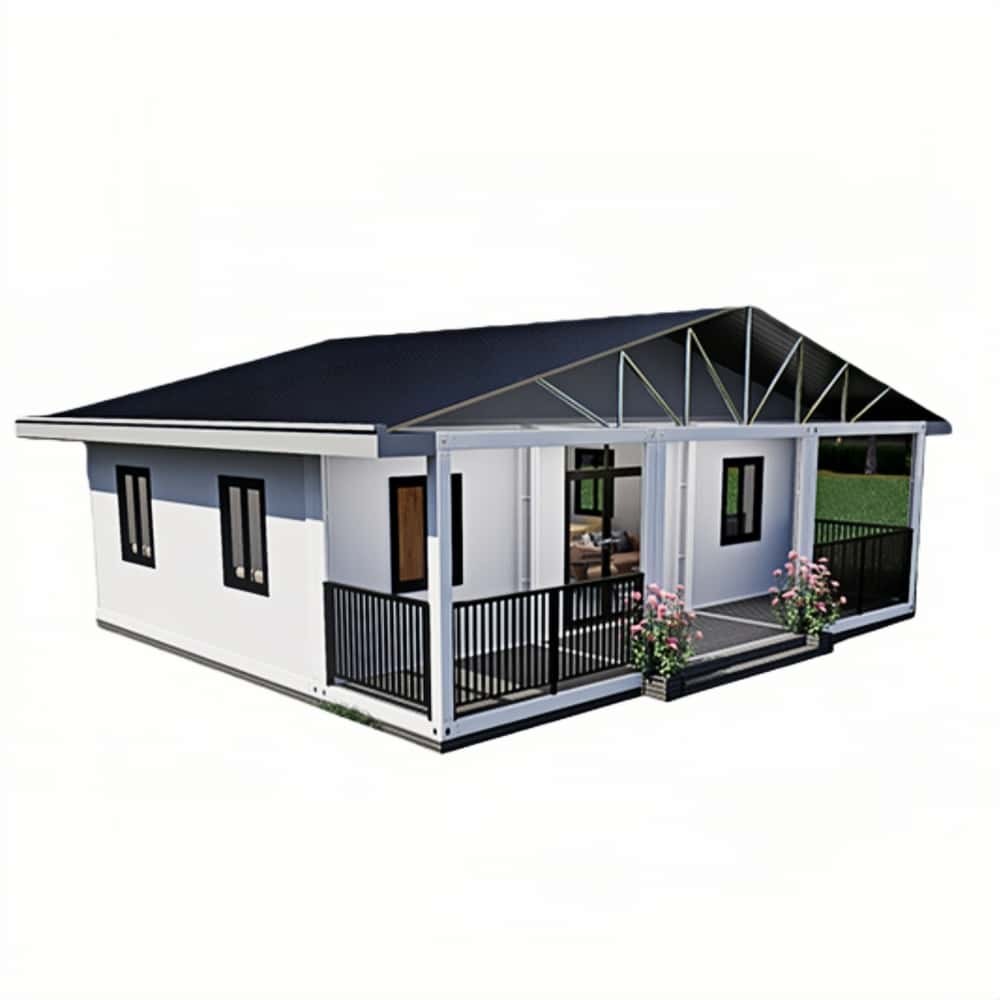
HG Prefab foldable expandable container homes — built to last, delivered worldwide.
Japan is one of the most attractive markets in the world for a compact prefabricated building, and one of the most exacting. Few countries combine such strong demand for small-footprint structures — rural second homes, glamping and farm-stay accommodation, satellite workspaces, disaster-resilient backup buildings — with such a rigorously enforced building regulatory culture. The good news for overseas buyers is that the physical logistics are genuinely easy: a folding unit leaves the factory inside a standard ocean container envelope, the China–Japan short-sea voyage is measured in days rather than weeks, and the unit is designed to open into a finished, insulated shell quickly on arrival. The demanding part is everything around it: tariff classification, consumption tax at import, JIS-aware component specification, and above all the Building Standards Act process that governs whether your unit may lawfully be occupied as a building. This guide walks that sequence in the order it actually happens, and where a figure or a rule has to be confirmed locally rather than assumed, it says so plainly.
Why Japan Suits Folding Container Homes
Three features of the Japanese market make a factory-folded unit a rational choice, particularly outside the dense metropolitan cores:
- Compact plots and narrow access. Japanese residential plots are small and irregular, and access roads in older neighbourhoods are narrow. A conventional site build generates months of material deliveries, scaffolding and waste removal on a street that can barely take a kei truck. A single folded unit arrives on one vehicle and opens on site, which is often the difference between feasible and not.
- Rural and secondary-home demand. Regional municipalities have actively encouraged relocation, workation and second-home use, and the stock of vacant houses — the akiya phenomenon — has made small rural structures a mainstream topic rather than a niche one. A folding unit suits a holiday house, a studio, a guest annexe or a farm-stay cabin on land where a full construction programme would be uneconomic.
- Resilience and disaster preparedness. Seismic, typhoon and flood awareness is embedded in Japanese building practice and in household planning. A steel-framed, factory-welded structure that is anchored to a properly designed foundation and delivered weathertight addresses a concern that buyers here take seriously rather than theoretically — though, as set out below, the seismic design must be verified locally.
Set against those advantages is a compliance burden built around Japanese-language documentation and Japanese-registered professionals. Technical files, customs declarations and building applications all run in Japanese, and the structural responsibility for a building sits with a locally qualified architect or structural engineer. Plan for that from the specification stage. Buyers comparing markets should also read our guide on importing a folding container home to Europe.
Japanese Import Rules at a Glance
HS classification and duty rates
Japan classifies imports under the Harmonized System as implemented in its national tariff schedule. Prefabricated buildings are typically declared under heading 9406, with the Japanese sub-heading determined by material and type. The code matters for two reasons: it sets the duty rate, and it determines whether any additional regime applies. Rates commonly cited for prefabricated building lines are in the low single digits, which is low by international standards — but that figure is an illustrative budgeting estimate, not a quote. The applicable rate is the one attached to the sub-heading your customs broker declares, and tariff schedules and preference programmes change. Ask your broker for a written classification and rate confirmation before the vessel sails, and invoice furniture, appliances and loose equipment on separate lines so they are not swept into the building classification.
Consumption tax at import
Japan levies consumption tax on imported goods, assessed on the CIF value plus the customs duty paid — so the tax is calculated on a base that the duty has already enlarged. The standard rate of 10% is generally applied to building imports. The cash-flow point matters for business buyers: a registered taxable business can normally credit consumption tax paid at import against its output tax, which makes it a timing item rather than a final cost. Whether that treatment applies to your entity, and how it interacts with your filing position, is a question for your Japanese accountant or tax agent, not for the supplier. The mechanics of the freight and customs leg are covered in more detail in our container home shipping and customs guide.
Documents to prepare before sailing
- Commercial invoice with HS codes, incoterm, and freight and insurance shown separately — the customs value depends on it.
- Packing list with net and gross weights and the folded dimensions of the unit.
- Bill of lading with the consignee details matching your importer registration.
- Certificate of origin, required for tariff treatment and routinely checked.
- Wood packaging declaration for any dunnage, crating or pallets, treated and marked to the applicable ISPM standard.
- Technical file for your architect or engineer: steel material certificates, coating specification, insulation values, glazing data, electrical ratings and test records.
Building Standards Act, JIS Awareness and Seismic Design
The Building Standards Act in context
Japan's Building Standards Act (建築基準法) is the national framework setting minimum standards for structural safety, fire safety, egress, ventilation and sanitation. It is administered locally: municipal building authorities assess applications, and in urban planning areas a building confirmation (確認申請) is normally required before construction begins, followed by inspections. Requirements vary by municipality, by zoning designation and by the classification of the structure — and small structures below the commonly referenced floor-area threshold may receive lighter treatment, which is precisely why you should confirm your specific case rather than rely on a general rule. The decisive practical point for an imported unit: the confirmation application must be prepared and submitted by a Japanese-registered architect or structural engineer, who takes professional responsibility for the calculations. Engage that person before you finalise the specification, not after the unit lands.
Seismic considerations and why a steel frame helps
Seismic design is the area where Japanese requirements are most demanding and where generic overseas documentation is least useful. The relevant point for a folding unit is physical rather than bureaucratic. Seismic force is proportional to mass: a lighter building attracts less force during ground motion. A steel-framed unit with insulated sandwich panels weighs substantially less per square metre of floor area than an equivalent masonry or concrete structure, which reduces the demand the frame and its anchors have to resist. Steel also behaves ductilely — it deforms and dissipates energy rather than cracking suddenly — and factory-controlled welding produces more consistent connection quality than variable site welding.
Three further points belong in any Japanese seismic conversation:
- Design parameters are site-specific. Ground conditions, soil classification, local seismic zoning and the applicable design method determine the numbers. A factory cannot certify these from abroad.
- Foundations and anchoring govern performance. The connection between the unit and its base is where seismic performance is won or lost. Your engineer specifies the foundation type, anchor layout and holding-down capacity for your ground and your region.
- Confirmation by a local professional is required for permitted construction. For any structure you intend to occupy or to declare as a building, treat local engineer or architect confirmation as mandatory. Factory documentation supports that review; it does not replace it.
JIS awareness, electrical frequency and component compliance
JIS (Japanese Industrial Standards) is the national standards system, and while a complete imported building is not simply "JIS certified" as a unit, your engineer and your inspector will look for JIS-referenced materials and recognised conformity marks in the specification. Steel products are commonly referenced against JIS G-series texts for structural steel and metallic-coated sheet; building boards, insulation, glazing and hardware carry their own applicable standards. In addition, Japan's electrical regime has two characteristics that catch overseas buyers out:
- Voltage is 100 V, not the 220–240 V used across most of Asia, Europe and Oceania. Appliances and fittings must be specified accordingly.
- Frequency differs by region — 50 Hz in eastern Japan including Tokyo and Yokohama, 60 Hz in western Japan including Osaka, Kyoto and Kobe. Frequency-sensitive equipment must be matched to the delivery region.
- Electrical appliances fall under the Electrical Appliance and Material Safety regime, which requires the relevant conformity marking. The simplest route for most importers is to have the unit supplied with a distribution board and wiring ready for completion by a licensed Japanese electrician, rather than shipping 230 V appliances that cannot be connected.
Snow, wind and coastal exposure
Japan's climate range is wide, and the loads follow it. Northern and mountainous regions — Hokkaido, Tohoku, the Japan Sea side — impose significant snow loads that directly affect roof and frame design. Typhoon exposure governs wind design in the south and along the Pacific coast, and salt-laden air affects corrosion on coastal sites. All three are inputs your engineer must convert into the specification before the factory builds, and all three are worth stating explicitly at order stage. Further guidance on wet and humid conditions is in our article on container homes in tropical and humid climates, and on protective systems in our guide to rust and corrosion protection.
Compact Sites and Rural Secondary-Home Use Cases
Fitting a unit onto a Japanese plot
Most folding-unit projects in Japan are constrained by the site rather than by the building. Before ordering, work through four checks with your local professional: road access, since Japan's building rules include access requirements for building sites that narrow frontages can fail; setback and coverage limits, which vary by zoning and can leave less buildable area than the plot size suggests; base preparation, whether strip footings, pad foundations or a slab, sized to your ground and snow or seismic zone; and service connections, including water, sewer or septic, power and communications, which on rural land are often the longest-lead items in the whole programme. Our planning guide on buying land for a container home covers these in more depth.
Where the demand actually sits
- Weekend and holiday houses in Nagano, Yamanashi, Gunma, Hokkaido and the Izu peninsula, where land is affordable and the building season is short.
- Glamping, farm stays and micro-accommodation, a sector with strong domestic demand and established operators who need capacity they can add between seasons.
- Garden studios and workation rooms on existing residential land, where the compact footprint avoids the setback and coverage problems a larger structure would trigger.
- Disaster-resilience and backup buildings, including community facilities, storage and temporary accommodation held in readiness — a category where the ability to site a complete structure quickly is the point.
Ports and Delivery: Yokohama and Osaka
The China–Japan trade lane is short, dense and reliable by global standards, which makes port choice mostly a question of inland distance rather than ocean risk.
| Factor | Port of Yokohama | Port of Osaka |
|---|---|---|
| Best for | Kanto region — Tokyo, Kanagawa, Saitama, Chiba, Shizuoka | Kansai region — Osaka, Kyoto, Kobe, Nara, Wakayama |
| Asia service density | Very high, with frequent direct short-sea sailings from Shanghai, Ningbo, Qingdao and Shenzhen | High, with strong coverage from East and South China; Kobe nearby as an alternative |
| Typical port-to-port transit (estimate) | About 3–7 days from major Chinese ports | About 4–8 days from major Chinese ports |
| Inland haul consideration | Long haul if the site is in western Japan | Long haul if the site is in Kanto or Tohoku |
Port of Yokohama
Yokohama is the leading container gateway for the Kanto region and the natural choice for anywhere around the Tokyo conurbation. Its container terminals carry very frequent direct short-sea services from the major Chinese ports, so waiting time for the next sailing is usually short and transshipment is rarely needed. Its drawback is not congestion in the emerging-market sense but the density of the last mile: the approach to a compact Kanto plot competes with urban traffic, height and width restrictions, and tight municipal timing windows. Plan the delivery slot, the machine and the base together, well before discharge.
Port of Osaka
Osaka serves the Kansai conurbation and is the better gateway for western Japan, with Kobe as a nearby alternative that may price more favourably on some services. Sailing coverage from China is slightly less dense than Yokohama's, so transit is typically a day or two longer, but for a Kyoto, Kobe or Osaka destination that difference is trivial next to the inland haul it avoids.
Route restrictions and final-mile planning
A folded unit travels as a standard container load on the ordinary road network, but the final mile is where Japanese deliveries fail, and the reasons are specific. Before dispatch, check approach road width and corner radii on narrow residential lanes; overhead clearance under bridges, wires, gates and eaves; ground bearing and space for outriggers, since a crane needs firm, level footing that a narrow urban frontage may not provide; turning and staging space for the delivery vehicle; and any municipal timing or permit restrictions on vehicle movements. Where a truck-mounted crane cannot physically reach a compact plot, plan for the machine to work from the road with adequate reach, or arrange a transfer point. Prepare the base, arrange the machine and book the crew before the truck leaves the terminal: demurrage and storage at a Japanese port are charged per day and are the most avoidable cost in the project.
Offload and assembly
Offloading is a plant operation and must be planned as one. Yes — a crane or forklift is required to offload the folded unit from the truck. Once it is set in position, four workers can unfold and assemble the main structure in about 2 hours. Site the base first, confirm the machine has adequate reach and bearing, and keep the delivery crew on site through the opening so the unit is weathertight the same day it arrives — a sudden rain shower on an unsealed unit does damage that no coating will undo. A fuller hour-by-hour sequence is set out in our assembly day timeline.
Landed Cost Budget
HG Prefab factory prices for the folding unit itself are 20FT $7,200–$9,800; 30FT $10,500–$14,500; 40FT $12,500–$16,500, ex-works, before freight and Japanese compliance — a starting point rather than the landed cost. The table below converts it into a realistic landed estimate per size. All freight and tax figures are estimates for budgeting only and must be confirmed against a written classification and rate confirmation from your customs broker.
| Unit size | Unit price | Ocean freight (estimate) | Customs duty (estimate) | Consumption tax (estimate) | Landed estimate |
|---|---|---|---|---|---|
| 20FT | $7,200–$9,800 | $700–$1,400 | $300–$500 | $900–$1,200 | $9,100–$12,900 |
| 30FT | $10,500–$14,500 | $900–$1,800 | $400–$700 | $1,300–$1,800 | $13,100–$18,800 |
| 40FT | $12,500–$16,500 | $1,100–$2,100 | $500–$800 | $1,600–$2,100 | $15,700–$21,500 |
Read every column as a range, not a quote. Ocean freight on the China–Japan lane is low by long-haul standards but moves with bunker prices and peak-season surcharges. The duty column assumes a low-single-digit rate on the CIF value under the declared sub-heading. The consumption tax column assumes 10% applied to CIF plus duty, and for a registered taxable business it is normally creditable rather than a final cost. The landed estimate excludes site works, foundations, service connections, crane hire, architect and engineer fees and municipal charges, all of which are local and, on a Japanese site, often the larger share of the budget. Larger layouts such as the 30FT folding expandable model spread fixed compliance and freight costs across more floor area, which is why cost per square metre improves as size increases.
Realistic Project Timeline
The voyage is the shortest part of a Japanese import, and planning around it is the most common mistake. A realistic sequence runs as follows: specification and engineering review with your Japanese architect or structural engineer, which sets the foundation, anchoring and electrical specification and gates everything downstream; classification and document preparation, ideally running in parallel; production at the factory; export clearance and loading; ocean transit, typically a few days; import clearance and tax payment; inland delivery; and installation and completion. Because the ocean leg is so short, a document error that would be harmless on a five-week voyage arrives at the terminal almost immediately after it is made. Prepare the paperwork before production finishes, not after the vessel sails.
Working With Your Supplier
The difference between a smooth Japanese import and a difficult one is usually decided before production starts. Agree the following with the factory in writing: the declared HS position and the documentation that supports it; the full steel specification, covering material certificates, coating system and dry film thickness, with a marine upgrade where the site is coastal; the climate package, meaning insulation, thermal breaks at the steel frame, glazing and, where relevant, snow-load provision for northern sites; the electrical strategy, meaning 100 V, 50 Hz or 60 Hz to match the delivery region, with fittings either compliant or left ready for a licensed Japanese electrician to complete; the shipping configuration, including folded dimensions, weight, internal securing and moisture protection; and after-sales support, covering spare seals, panels and fixings and a named technical contact during installation.
Be explicit that technical documentation must be issued in Japanese or in a form your local professional accepts, because an English-only file slows the confirmation review rather than satisfying it. Payment structure, production milestones and inspection arrangements are covered in our container home ordering and payment guide, and the full model range — including the 20FT, 30FT and 40FT platforms — is on the products page.
Planning a Japanese import?
HG Prefab, manufactured by Henan Huangang Machinery Equipment Co., Ltd., builds 20FT, 30FT and 40FT folding expandable container houses with steel-frame structures suited to seismic design review, marine-grade anti-corrosion packages, cold-climate insulation, Japanese 100V 50/60Hz electrical options and sea-freight preparation for Yokohama and Osaka. Send your delivery postcode, intended use and target date for a landed-cost estimate. Email hgmechequip@gmail.com or WhatsApp +86 191 0388 7380. Full model range on the products page.
Browse modelsFrequently Asked Questions
What taxes apply when importing a folding container home into Japan?
Two layers apply. First, customs duty assessed on the CIF value under the HS tariff schedule — for prefabricated building lines the rate is commonly cited in the low single digits, but the exact figure depends on the sub-heading your customs broker declares and must be confirmed before shipping. Second, consumption tax applies to the CIF value plus the duty paid. The standard national consumption tax rate of 10 percent is generally applied to building imports. If your company is a registered taxable business, the consumption tax paid at import is normally creditable against output tax, so it is a cash-flow item rather than a final cost — confirm the treatment with your Japanese accountant or tax agent.
Can a folding container home be approved as a permanent dwelling under Japan's Building Standards Act?
It can be, but approval is a local process and it is not automatic. Structures intended for human occupancy are assessed under the Building Standards Act against structural safety, fire safety, egress, ventilation and sanitation requirements, and in urbanised areas a building confirmation application is normally required before work starts. The application is prepared and submitted by a Japanese-registered architect or structural engineer, who takes professional responsibility for the structural calculations — including the seismic design, foundation design and anchoring to the base. Requirements vary by municipality, by zoning, and by whether the site is inside or outside an urban planning area, so obtain the local position in writing before you order. For non-habitable uses such as storage, site offices or agricultural buildings, the process is generally lighter, but the local authority position should still be confirmed in advance.
Which port should I ship to, Yokohama or Osaka?
Choose by final delivery address, then by service frequency. Yokohama is the natural gateway for Tokyo, Kanagawa, Saitama, Chiba and the whole Kanto region, with the densest short-sea coverage from Shanghai, Ningbo, Qingdao and Shenzhen. Osaka serves Kansai — Osaka, Kyoto, Kobe and Nara — and is the better choice for western Japan, with Kobe as a nearby alternative. On a short China–Japan routing the ocean differential between the two is small, while the inland leg across Honshu is not, so delivering to the wrong port can cost several times the freight saving. Give your forwarder the full address and postcode before booking and have both routings priced with inland legs included.
How long does shipping from China to Japan take?
The ocean leg is short: from major Chinese ports to Yokohama or Osaka, transit is typically in the range of three to seven days port to port on direct short-sea services, plus sailing frequency waiting time. The rest of the programme is what dominates. Allow production time at the factory, then export clearance and loading, then discharge, import clearance, inland delivery and installation. Most of the elapsed time and most of the avoidable cost sit in documentation and in final-mile preparation rather than in the voyage itself, so start the classification and specification work early and book the offloading machine before the truck is dispatched.
Is a crane or forklift required to offload the unit?
Yes — a crane or forklift is required to offload the folded unit from the truck. Once it is set in position, four workers can unfold and assemble the main structure in about 2 hours. Prepare the base first, confirm the machine has adequate reach and ground bearing for its outriggers, and keep the crew on site through the opening so the unit is weathertight the same day it arrives. On narrow Japanese approach roads, confirm the machine can physically reach the site before dispatch, because the last hundred metres are where deliveries fail.