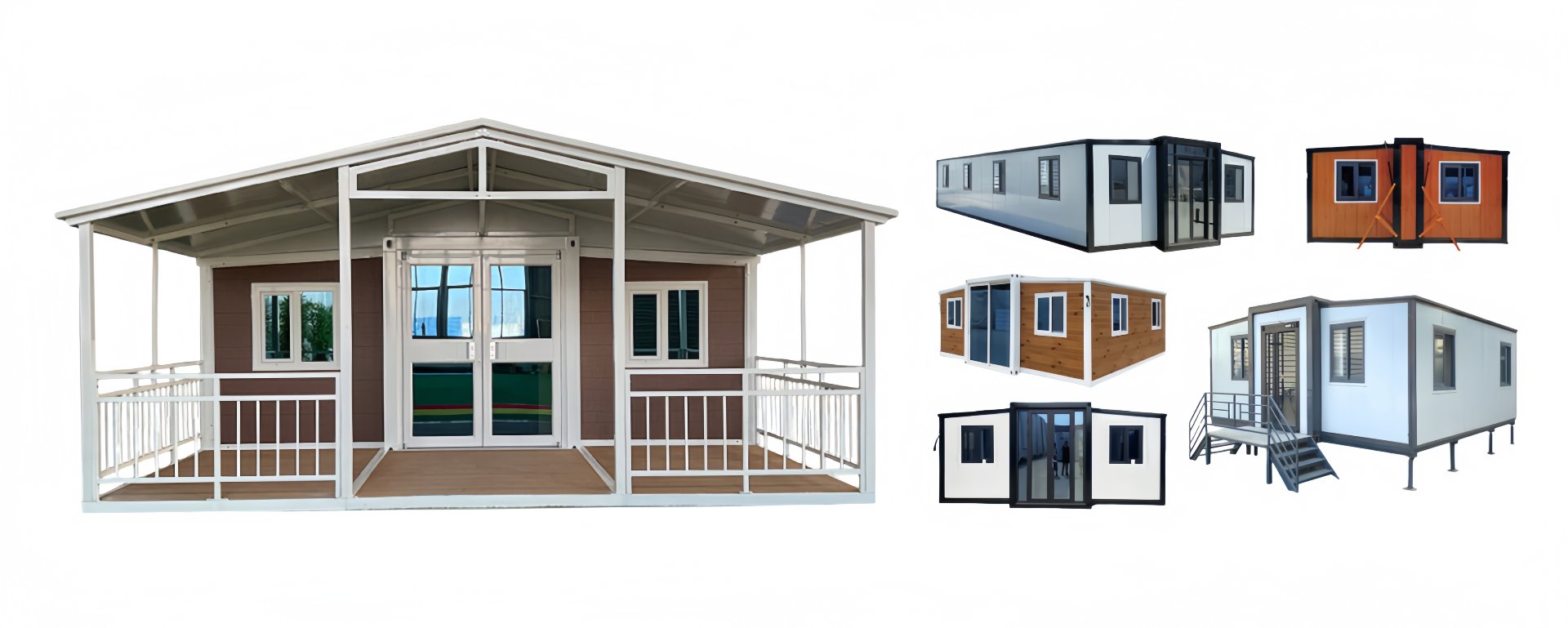
HG Prefab foldable expandable container homes — built to last, delivered worldwide.
Most buyers research a folding container home the same way: they compare purchase prices, pick a size, and budget for delivery. Then they move in, and the questions change. How much will the heating cost in January? What does the water bill look like? Is insurance even available for a steel-framed prefab unit? How much should be set aside each year for upkeep? Those are the costs that actually decide whether the home stays affordable for the next ten years, and they are far less documented than the sticker price.
This article is about living in the building rather than buying it. For reference, HG Prefab factory prices for the folding unit itself are 20FT $7,200–$9,800; 30FT $10,500–$14,500; 40FT $12,500–$16,500, ex-works and before freight, taxes and local compliance. That is one line in the budget, paid once. Everything below is the part that repeats every month for as long as you own the home. Our folding container home cost guide covers the purchase side in detail; this is the companion piece on the running side.
Purchase Price Is a One-Off. Running Costs Are the Real Decision.
A useful way to think about the split: the unit price, the freight, the lifting day and the ground works are all capital costs, paid once and then finished. Electricity, water, internet, insurance, tax and maintenance are operating costs, paid forever and rising with tariffs and inflation. On a typical project the operating side overtakes the capital side somewhere between year four and year seven, and from that point on it is the dominant number.
The one-time side is worth stating plainly so the comparison is honest. Beyond the unit price, budget for ocean or inland freight, for site works and service hookups, and for delivery day. On delivery day, Yes — a crane or forklift is required to offload the folded unit from the truck. Once it is set in position, four workers can unfold and assemble the main structure in about 2 hours. A complete lifting day typically runs $700 to $2,500 including machine, operator and mats, depending on region and machine class. Planning that day properly is covered in our crane and forklift offloading guide.
Everything after that point is the subject of this article.
Why the Building Envelope Sets Your Heating Bill
Heating is the single largest variable in a container home's running cost, and it is decided by physics that were fixed at the factory. Heat leaves a building through the roof, walls, floor, glazing and air leaks. The rate of loss is proportional to the area, to the temperature difference between inside and outside, and to how well each surface resists that flow. You can change the temperature difference with your thermostat and the area by choosing a size, but the resistance of the envelope is bought once.
Rock wool and PU sandwich panels
HG Prefab units are built with insulated sandwich panels — an inner and outer steel skin bonded to a core of rock wool or polyurethane (PU) — rather than with bare shipping-container corrugation and a later internal lining. This matters for three reasons, each of them a running-cost item rather than a specification-sheet detail:
- Continuous insulation. A sandwich panel insulates across its whole area with no gaps, whereas a stick-built internal lining leaves voids, cold spots and compressed insulation around every fixing.
- Thermal break. The core separates the outer steel skin from the inner skin, so the frame does not act as a continuous metal path conducting heat straight outdoors. Untreated steel is an excellent conductor and a terrible insulator; a thermal break is what turns a steel box into a house.
- Airtightness. Factory-assembled panels and compression seals close the envelope against uncontrolled infiltration. Drafts are the cheapest thing to prevent at the factory and among the most expensive to chase later.
Our container home insulation guide and thermal bridge guide go deeper into why this is the highest-return specification decision on the whole build.
What insulation is worth in money
Translated into bills, an insulated envelope means the heating system runs a smaller load for fewer hours, cycles less often, and holds temperature between cycles instead of crashing. In practice it is the difference between a home that costs roughly the same to heat per square metre as a modern small apartment, and a home that costs several times that. It also stabilises the summer side: the same resistance that keeps heat in keeps it out, so cooling loads stay modest where an uninsulated steel shell would bake.
Electricity: The Dominant Running Cost
For a grid-connected folding container home, electricity is typically 40 to 65 per cent of the monthly running total, and it splits into three distinct loads with very different behaviours: space heating and cooling, water heating plus cooking, and the constant baseline of lighting, refrigeration, electronics and network equipment.
Space heating and cooling, by climate
Three climate profiles cover most projects, and the differences are much larger than most buyers expect:
- Mild or temperate. Winters hovering near or above freezing, summers warm but not extreme. Heating is occasional, cooling is seasonal, and the annual space-conditioning bill is modest.
- Cooling-dominant. Hot, humid or arid regions where the cooling season runs most of the year and heating is rarely needed. Energy goes to dehumidification and sensible cooling, and the load is steady rather than spiky.
- Cold winters. Sustained sub-freezing periods, where the indoor-to-outdoor temperature difference is at its maximum for weeks at a time. This is where the envelope earns its cost, and where equipment choice matters most.
Indicative electricity use for space conditioning, for a properly insulated unit with a heat pump:
| Climate profile | 20FT (approx. 36 m²) | 30FT (approx. 56 m²) | 40FT (approx. 76 m²) | What it means |
|---|---|---|---|---|
| Mild / temperate | 120–230 kWh per month | 185–330 kWh per month | 250–430 kWh per month | Short heating season; light summer cooling |
| Cooling-dominant | 150–270 kWh per month | 230–390 kWh per month | 310–510 kWh per month | Cooling runs most of the year; little or no heating |
| Cold winters | 350–650 kWh per month | 520–930 kWh per month | 700–1,230 kWh per month | Sustained heating demand; heat pump efficiency dominates |
At a typical residential tariff, that translates to roughly $25–$45 per month for a 20FT unit in a mild climate and $70–$130 in a cold winter climate. All figures here are indicative ranges, not quotes: real bills depend on your local tariff, your thermostat habits, the glazing area of your specific layout and the equipment you install.
Heat pump versus resistive heating
This is the single biggest controllable decision in the whole running-cost picture. A resistive heater — a panel heater, a fan heater, an electric radiator — converts one unit of electricity into at most one unit of heat. A heat pump moves heat instead of creating it, delivering roughly three to four units of heat per unit of electricity under typical conditions. For the same room at the same temperature, that is a 60 to 70 per cent reduction in the heating portion of the bill.
Two further points make the case stronger. A heat pump reverses, so the same appliance provides summer cooling at no extra capital cost, which matters in a compact building with generous glazing. And because a well-insulated unit has a small peak load, the heat pump is usually a small, inexpensive machine — the payback period on cold-climate projects is often short enough to be measured in heating seasons rather than years.
Sizing matters more than brand. A 20FT unit at approximately 36 m² needs only modest capacity and one indoor head. A 30FT unit at approximately 56 m² is comfortable with one well-placed head or two small ones. A 40FT unit at approximately 76 m² usually wants two indoor heads so that distant corners do not run cold and one zone is not overheated to satisfy another. Our HVAC guide for container homes covers sizing and placement in more detail.
Water heating, cooking and the constant baseline
These loads are driven by occupancy, not by climate or size, which is why they are the most predictable part of the bill. Electric water heating for one or two people typically adds $12–$30 per month; cooking adds a little more where the hob and oven are electric. The baseline — a fridge, lighting, a router, laptops, phone charging, a television — runs $18–$40 per month for most households and barely varies between a 20FT and a 40FT unit. Choosing LED lighting throughout, a modern inverter fridge and a heat-pump or solar-assisted water heater trims this line without any change in comfort.
Water and Sewer: Two Very Different Models
Municipal hookup
Where mains water and sewer are available, the bill behaves exactly like any small home's: a standing charge plus volumetric usage, typically $18–$50 per month for one or two occupants. Connection charges and any road-opening permit are capital costs paid at setup, not running costs. Metered supply rewards the obvious behaviours — efficient appliances, short showers, fixing drips promptly — and a compact home with a small household will sit at the bottom of that range.
Well and septic
Off-grid supply removes the monthly water bill and replaces it with two smaller, lumpier costs. The first is electricity for the pump: a typical domestic well pump adds roughly $5–$15 per month to the electricity bill depending on draw, depth and duty cycle. The second is periodic septic pumping, usually every three to five years for a small household at $200–$600 per visit, which annualises to roughly $5–$15 per month. Add a modest allowance for filters, water testing and occasional servicing. Our septic systems guide and off-grid water guide cover sizing and maintenance intervals.
The honest comparison: mains supply usually costs a little more per month but is predictable and somebody else's problem; a well and septic system usually costs a little less but requires you to remember the pump, the tank and the water test. Neither is wrong.
Internet, Waste and the Bills That Never Change
These are the same as in any other dwelling and should be budgeted at the same level: internet $30–$70 per month for a fixed line, or more where only satellite or fixed wireless is available; waste collection $10–$35 per month where a municipal service exists. Remote sites often add a small generator or solar-hybrid running allowance. None of these scale with the size of your unit — a 40FT home pays the same router bill as a 20FT home — which is why running costs grow more slowly than floor area.
Insurance, Permits and Property Tax
Insurance for a prefab steel home is widely available but not identical to a conventional policy. Insurers generally want to know the construction type, whether the unit is on a permanent foundation or on piers, the occupancy pattern, and whether it is a primary residence, a rental or a seasonal unit. Indicative premiums land around $15–$70 per month depending on value, location, deductible and use; a unit used as a short-term rental generally prices differently from owner-occupied use.
Property tax treatment varies enormously by jurisdiction. Some authorities treat a permanently sited unit on a foundation as an improvement to the land and assess it accordingly; others treat a movable unit more like a vehicle or do not assess it at all. There is no universal answer, so the useful action is a single phone call to the local assessor before you buy, not after. Where an annual permit or renewal fee applies, amortise it into the monthly figure so the comparison stays honest. Our insurance guide and property tax guide cover the questions to ask.
Maintenance: The Annualised Budget
A container home is a steel building with a painted finish, sealed joints and mechanical equipment. None of it is demanding, but all of it is cheaper when done on a schedule than when done after a failure. Budget $120–$380 per year — roughly $10–$32 per month set aside — across five items:
- Exterior coating checks. Inspect the painted steel annually for scratches, chips and any rust bloom, especially at the base, at cut edges and around fixings. Touch up with matching paint before a cosmetic mark becomes corrosion. Allow $30–$120 per year depending on whether you do it yourself.
- Roof and gutters. Clear debris, check that water leaves the roof and does not pond, and confirm that gutters and downpipes run free. Blocked drainage is the most common cause of avoidable water damage on any compact building.
- Door and window seals. Compression seals are consumables. Expect to renew them every few years; a set costs little, and failed seals show up as drafts in winter and as dust and insects in summer.
- HVAC filters and service. Clean or replace filters quarterly in dusty or high-use environments, keep the outdoor unit clear of vegetation and debris, and budget for a periodic professional check. This is the line that protects the efficiency you paid for.
- Plumbing and fixtures. Check for slow drips, reseal where needed, and exercise any shut-off valves so they work when you need them.
Our container home maintenance guide gives the full seasonal schedule, and the rust and corrosion guide covers coating care in coastal and humid locations.
Monthly Running Cost at a Glance
The table below combines every category above into one monthly figure, per size, for a mild climate and for a cold-winter climate. All ranges are indicative: they vary by country, by tariff, by occupancy, by equipment choice and by whether water is mains-supplied or private. Use them to size a budget, not to write one.
| Category | 20FT mild | 20FT cold | 30FT mild | 30FT cold | 40FT mild | 40FT cold |
|---|---|---|---|---|---|---|
| Space heating and cooling | $25–$45 | $70–$130 | $38–$65 | $105–$185 | $50–$85 | $140–$245 |
| Water heating and cooking | $12–$20 | $16–$26 | $18–$30 | $24–$38 | $24–$38 | $30–$48 |
| Lighting, appliances, electronics | $18–$30 | $18–$30 | $22–$34 | $22–$34 | $25–$40 | $25–$40 |
| Water and sewer (mains) | $18–$35 | $18–$35 | $22–$42 | $22–$42 | $26–$50 | $26–$50 |
| Internet and waste | $40–$105 | $40–$105 | $40–$105 | $40–$105 | $40–$105 | $40–$105 |
| Insurance and property tax | $15–$40 | $15–$40 | $22–$55 | $22–$55 | $30–$70 | $30–$70 |
| Maintenance (annualised) | $10–$20 | $10–$20 | $14–$26 | $14–$26 | $18–$32 | $18–$32 |
| Indicative monthly total | $130–$260 | $180–$350 | $165–$320 | $240–$450 | $205–$385 | $300–$555 |
Three patterns are worth reading out of the table. First, the gap between mild and cold climate is almost entirely a heating effect; every other line is the same in both columns. Second, doubling the floor area does not double the bill — going from approximately 36 m² to approximately 76 m² raises the mild-climate total by roughly half, because the baseline loads are fixed and only the conditioning load scales. Third, the biggest lever is equipment choice, not size: heating with resistive heaters instead of a heat pump would move the cold-climate figures substantially higher on every row.
Five-Year Total Cost of Ownership: A Worked Example
Take a 30FT folding unit, approximately 56 m², used as a full-time one-to-two-person home on a connected site, and look at five full years.
- Unit, ex-works (mid-range of $10,500–$14,500): $12,500
- Freight and inland delivery: about $2,200
- Delivery-day lifting and assembly: about $1,400 — a crane or forklift is required to offload the folded unit from the truck, and four workers complete the main structure in about 2 hours
- Pad, ground works and service hookups: about $3,000
- Running costs, mild climate, at roughly $195 per month: $11,700 over 60 months
- Running costs, cold-winter climate, at roughly $330 per month: $19,800 over 60 months
That gives a five-year total of roughly $30,800 in a mild climate and $38,900 in a cold-winter climate. The purchase price is about 40 per cent of the mild-climate total and about 32 per cent of the cold-climate total. Over ten years the operating share grows further still, while the unit keeps working. Read the other way round: every dollar spent on better insulation, a heat pump instead of resistive heaters, and a well-sealed envelope compounds for the life of the home.
Layout choices move these numbers too. A compact single-zone plan such as the 20FT modern white unit is the cheapest home to condition; a mid-sized family layout like the 30FT white folding unit roughly doubles the floor area for a fraction more running cost; and a large glazed plan such as the 40FT glass unit trades a higher conditioning load for daylight and views. Our unit size guide helps match floor area to occupancy before you commit.
Eight Ways to Lower Your Monthly Bill
- Specify a heat pump, not resistive heaters. The largest single reduction available, and it doubles as cooling.
- Confirm the insulation core at order stage. Rock wool and PU sandwich panels are the cheapest efficiency you will ever buy, because you buy them once.
- Control glazing by orientation. Large south-facing glazing adds useful solar gain in cold climates and unwanted load in cooling-dominant ones; place it deliberately.
- Seal and draught-proof on day one. Walk the envelope with a lit incense stick or your hand on a windy day and close what you find.
- Use LED lighting and a modern inverter fridge. Small percentages on the baseline load, but they run 24 hours a day.
- Add shading outdoors. An awning, pergola or deciduous planting beats any interior blind, because it stops the heat before it reaches the glass.
- Service the heat pump and clean filters on schedule. A blocked filter quietly costs you efficiency every month.
- Budget the maintenance sinking fund. Ten to thirty dollars set aside monthly prevents the four-figure repair that arrives when nothing was set aside.
Budgeting a folding container home?
HG Prefab, manufactured by Henan Huangang Machinery Equipment Co., Ltd., builds 20FT, 30FT and 40FT folding expandable container houses with insulated rock-wool and PU sandwich panels, documented electrical load data and dispatch support for your delivery day. Tell us your climate, occupancy and layout and we will size the unit and the equipment to your running-cost target. Email hgmechequip@gmail.com or WhatsApp +86 191 0388 7380. Full model range on the products page.
Browse modelsFrequently Asked Questions
How much does it cost to run a container home per month?
For a connected, grid-served folding container home the indicative monthly total is about $130-$260 for a 20FT unit, $165-$320 for a 30FT unit and $205-$385 for a 40FT unit in a mild climate; in a cold-winter climate the same homes run roughly $180-$350, $240-$450 and $300-$555. The spread is driven by space heating, by local electricity tariffs and by whether water comes from a municipal main or from a private well and septic system. Figures are indicative ranges, not quotes, and they exclude mortgage or land payments.
Does a folding container home cost a lot to heat in winter?
Less than most people expect, because the envelope is the deciding factor. HG Prefab walls and roof are insulated sandwich panels, rock wool or PU, rather than bare corrugated steel, so the heating load of a 20FT unit of about 36 m2 is comparable to a well-built small apartment rather than to a steel box. In a cold-winter climate budget roughly $70-$130 per month for a 20FT unit, $105-$185 for a 30FT unit of about 56 m2 and $140-$245 for a 40FT unit of about 76 m2 when heating with a heat pump. Resistive panel or fan heaters on the same home typically cost two to three times more for the same comfort.
Is a heat pump worth it in a 20FT, 30FT or 40FT folding container home?
Yes, in almost every climate where the home is lived in year round. A heat pump moves heat instead of creating it, delivering roughly three to four units of heat per unit of electricity, so it cuts the single largest running cost by 60 to 70 per cent compared with resistive heaters. Because it reverses, the same unit provides cooling in summer, which matters for a compact steel-framed building with large glazed areas. Sizing matters more than brand: a small 20FT unit needs only a modest capacity, while a 40FT unit of about 76 m2 may want two indoor heads to avoid cold corners.
What running costs do container home buyers forget to budget for?
Five items are most often missed. First, annualised maintenance of roughly $120-$380 per year for exterior coating checks, roof and gutter cleaning, door and window seal replacement and HVAC filters. Second, insurance and any property tax or permitting renewal, typically $15-$70 per month. Third, water and sewer: a municipal bill of $18-$50 per month, or the pumping electricity and periodic tank pumping of a private well and septic system. Fourth, internet and waste collection, which cost the same as any other home. Fifth, the delivery-day lifting cost of $700-$2,500, because a crane or forklift is required to offload the folded unit from the truck.