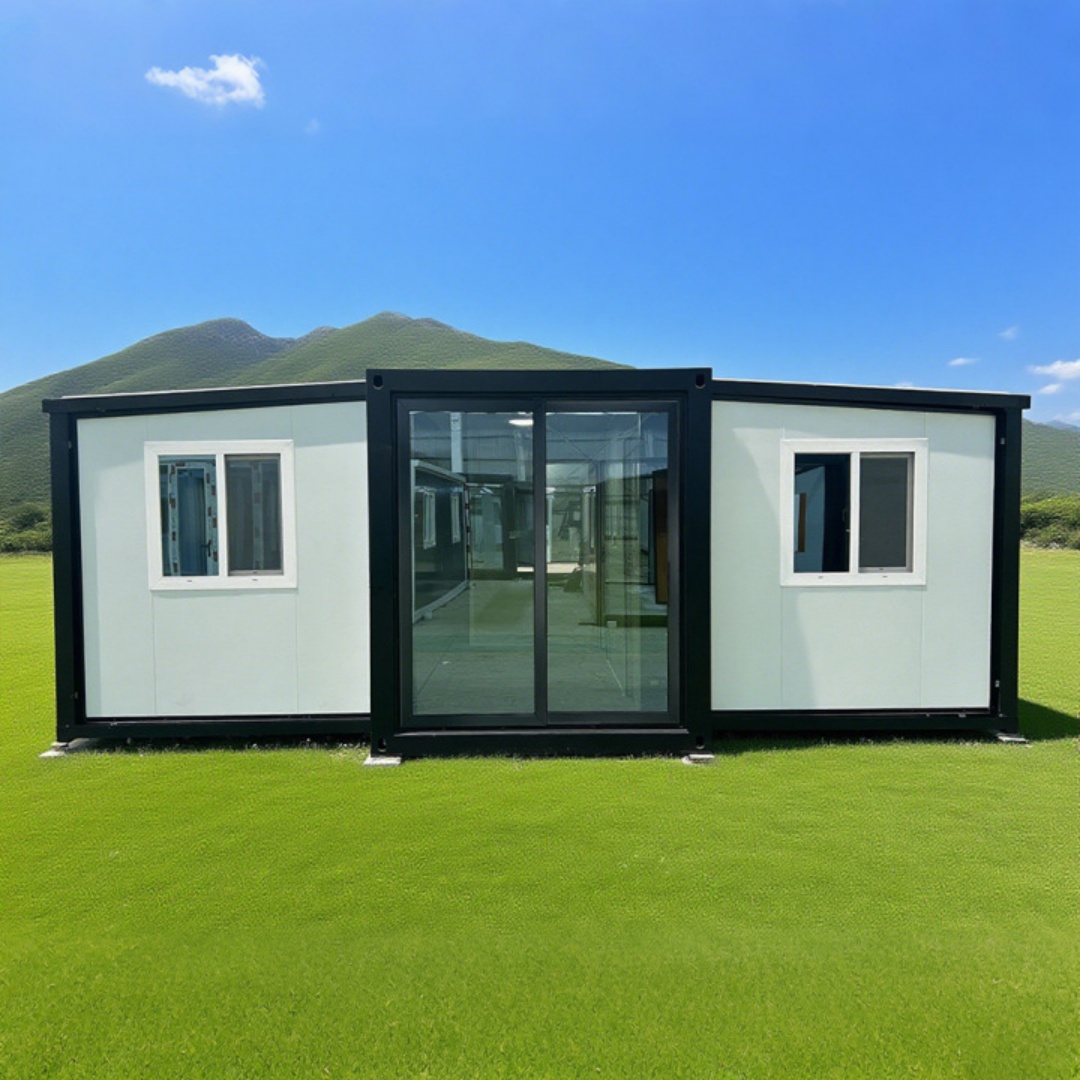
HG Prefab foldable expandable container houses — built to last, delivered worldwide.
Mushrooms are the rare crop that does not need sunlight, soil or much land. What it does need is a small, sealed, washable room where temperature, humidity and carbon dioxide can be held inside narrow bands for weeks on end. That specification describes a folding container house almost exactly, which is why small urban farms, restaurants buying their own supply and rural diversification projects have started buying 20FT, 30FT and 40FT units and fitting them out as fruiting rooms.
This guide is a practical build note rather than a mycology text. It covers why the folded shell suits mushroom growing, which species to start with, how to hold 85–95% relative humidity without drowning the blocks, how to size ventilation against CO2 rather than guesswork, how much shelving actually fits in each unit size, lighting, temperature control, how to separate clean work from dirty work, what the yields and revenue look like, and what power, water and site preparation the install needs. It pairs with our hydroponic container farm guide, our ventilation guide and our insulation guide.
Why a Folding Container Unit Suits Mushroom Growing
An insulated, sealed envelope is the whole game
A fruiting room is a humidity box. You are trying to hold roughly 90% relative humidity at 18–24°C while exchanging enough air to keep CO2 below 1000 ppm — and doing it in a climate that may be 40°C outside or −20°C outside. Every watt of heat lost through the walls is a watt your heater replaces, and every gap that leaks humid air is a gap that also dries the room out and condenses inside the structure.
An HG Prefab folding unit arrives as a fully enclosed sandwich-panel box: insulated wall and roof panels, a sealed floor, factory-fitted door and window openings with gaskets, and no site-built joints to caulk. The steel skin is a perfect substrate for an internal washable lining, and because the shell is a single rigid box rather than a timber frame, it does not move enough to crack seals. Add a continuous vapour barrier on the warm (inner) face and you have an envelope that will hold both the humidity and the heat load.
Fold-out space means one shell, three rooms
The real advantage over a used shipping container is the expansion. A rigid 20FT container gives you about 14 m² of floor in a 2.4 m-wide corridor — awkward for racking and impossible to zone. A folding expandable 20FT unit opens to roughly 36 m², a 30FT to roughly 56 m² and a 40FT to roughly 76 m², all at a width that allows a proper central aisle, racking down both long walls, and a partition for a clean room. The practical consequence: you can separate incubation, fruiting and packing, which is what turns a hobby setup into a farm.
The unit still travels folded at a standard container shipping footprint, so a 40FT fruiting room arrives on one truck and can be sited on a farmyard, a warehouse apron or a peri-urban plot without a building permit for a permanent structure in many jurisdictions. Check locally — our permits guide covers the questions to ask.
Choosing Your Species
Start with the three that forgive mistakes. All three fruit on supplemented hardwood sawdust or straw-based blocks you can buy ready-colonised, which removes the most failure-prone step from your first year.
Oyster (Pleurotus ostreatus and P. pulmonarius)
The beginner's mushroom and still the best commercial volume crop. Oyster colonises fast, fruits in 5–8 days from pinning, tolerates a wide temperature band and produces over two to three flushes. It is also the most forgiving of high CO2, which means a ventilation mistake costs you shape rather than the whole crop. Pink and yellow oysters fruit warmer; pearl and blue oysters fruit cooler and hold better in transit.
Lion's mane (Hericium erinaceus)
Slower but far more valuable per kilo. Lion's mane fruits directly from a cut or hole in the bag rather than across the whole surface, so it needs high humidity right at the fruiting site and very low air movement across the developing spines — moving air browns them. It is unforgiving of dry air and of CO2 above about 1000 ppm, which makes it a good second crop once your controls are proven.
Shiitake (Lentinula edodes)
The long game. Shiitake needs a 60–90 day colonisation and browning period on a sawdust block before it will fruit, then a cold shock — a drop of 5–10°C, often an overnight soak in cold water — to trigger pinning. The reward is a dense, high-value mushroom with strong restaurant demand and a long shelf life. Run shiitake in a separate room or a separate unit, because its temperature and hydration cycle conflicts with oyster.
| Species | Fruiting temp | Relative humidity | CO2 at fruiting | Cycle (inoculation to last flush) | Yield per 5 kg block |
|---|---|---|---|---|---|
| Oyster (pearl / blue) | 16–21°C | 85–95% | <1000 ppm | 6–8 weeks | 3.5–5.0 kg |
| Oyster (pink / yellow) | 21–27°C | 85–95% | <1200 ppm | 5–7 weeks | 3.0–4.5 kg |
| Lion's mane | 18–24°C | 90–95% | <800 ppm | 6–9 weeks | 1.5–2.5 kg |
| Shiitake | 12–20°C | 80–90% | <800 ppm | 12–18 weeks | 1.5–2.5 kg |
Yield per 5 kg block assumes a biological efficiency of roughly 70–100% across all flushes, good substrate and clean air. First-year farms typically land at the lower end of that band and climb.
Humidity and Misting Systems
Humidity is the variable that separates a productive room from a failed one. Mushrooms are about 90% water and they lose it continuously to the air; if the room dries, pins abort and caps crack.
Target and measurement. Hold 85–95% RH for oyster and lion's mane, 80–90% for shiitake, measured at block height rather than at the ceiling — the ceiling always reads wetter. Use at least three sensors distributed along the room, because a single sensor next to the fog line will read 99% while the far corner sits at 70%. Log them; a humidity crash overnight is the most common cause of a lost flush and you will only find it in the data.
Generation. Two technologies do the job. Ultrasonic misting heads in a header tank are cheap, quiet and put out a huge volume of very fine fog, but they need clean water or the piezo discs scale up within weeks. High-pressure fogging lines (40–70 bar) with stainless nozzles are more expensive, more robust and give you the sub-20 micron droplet that evaporates before it lands. Most working farms use ultrasonic for base load and a fog line for peak demand.
Delivery matters more than generation. Fog from a single point humidifies one corner and drenches it. Distribute nozzles evenly along the aisle, mount them above head height pointing down the aisle rather than at the racks, and run them on a humidistat with a 5–10 second on / 3–5 minute off cycle rather than continuously. The goal is a haze that clears in seconds, not a wet film on the blocks: standing water on the substrate surface is how bacterial blotch starts.
Water quality and drainage. Feed the system from a filter at minimum, reverse osmosis if your water is hard, plus a 200–500 L buffer tank so a mains interruption does not dry the room. Expect 20–60 L per day on a 20FT and 60–150 L per day on a 40FT, depending on leakiness and air exchange. All of it ends up somewhere, so the floor needs a sealed, sloped, coved finish with a drain — see our plumbing and electrical guide for the rough-in.
Ventilation and CO2 Control
New growers ventilate by feel and wonder why their oysters come out as long stems with tiny caps. That is a CO2 symptom, and it means the room is under-exchanging.
The rule. During incubation, mushrooms want CO2 high and air still: 2000–5000 ppm is fine and encourages the mycelium to stay in the block rather than pinning early. At fruiting, CO2 drives morphology directly — above roughly 1000 ppm oyster stems elongate and caps stay small, and lion's mane spines go ragged. Hold the fruiting room below about 800–1000 ppm.
The hardware. A variable-speed inline exhaust fan sized for 4–8 air changes per hour, extracting from high on one end wall, with filtered make-up air entering low on the opposite wall through a coarse pre-filter and, ideally, a fine filter. Filtering intake is not optional in a farmyard environment: wild mould spores are your competition. Fit a CO2 sensor with a logger in the fruiting room and run the fan from it, not from a timer.
The conflict, and the fix. Exchanging air dries the room, so ventilation and humidity fight each other. The fix is to run them as one control loop: extract on a short, frequent cycle, and let the misting system replace what the fan removes. In a well-sealed HG Prefab shell with a vapour barrier, a 1–2 kW package of fan, ultrasonic mister and small heater holds a 20FT fruiting room comfortably; the same package scaled to 2–3 kW handles a 40FT.
Shelving Layout for 20FT, 30FT and 40FT
Shelving is where the money is: shelf area, not floor area, determines how many blocks you fruit. The standard layout is four-tier racking 550 mm deep running down both long walls plus a double-sided island row, leaving a 900 mm central aisle for harvesting and a 400 mm gap between the top tier and the ceiling so fog can circulate.
By unit size, using a 5 kg substrate block at roughly seven blocks per square metre of shelf:
- 20FT folding unit. Roughly 36 m² of floor, about 28 m² of growing floor after the clean-in partition and aisle, about 46 m² of shelf area and roughly 320 blocks in fruit at steady state.
- 30FT folding unit. Roughly 56 m² of floor, about 44 m² of growing floor, about 72 m² of shelf area and roughly 500 blocks.
- 40FT folding unit. Roughly 76 m² of floor, about 60 m² of growing floor, about 98 m² of shelf area and roughly 680 blocks. Widening to six rack rows and dropping the aisle to 700 mm pushes this past 130 m² of shelf, but only if your harvest trolley can still pass.
Use open wire or slatted shelves, never solid board: air has to move through every tier or the middle shelves sit in a CO2 pocket. Racking must be galvanised or stainless, because the room is permanently wet. Leave 400 mm clear under the bottom tier for the floor drain and wash-down, and keep every rack off the wall by 50–100 mm so condensation runs down the lining instead of wicking into the blocks.
A word on load
A fully watered 5 kg block weighs closer to 7 kg, and a four-tier rack loaded with 80 blocks carries well over half a tonne. Distribute that across the floor and it is well inside a container floor's rating, but concentrate it and it is not — spread the rack feet, and if you are specifying a 40FT with six rows, tell us at quotation stage so the floor specification and any additional support are built in at the factory rather than added on site.
Lighting
Mushrooms do not photosynthesise, but light is a pinning and orientation signal. Give the fruiting room 500–1000 lux at block height for 10–12 hours a day on a timer, from 5000–6500K LED strips or batten fixtures. Cool-white is fine and cheap; a slightly warmer spectrum improves the colour of pink and yellow oysters for market.
The important detail is evenness rather than intensity. Light the aisle and let it spill onto the racks, or fit a short strip under each shelf — a single bright fixture overhead gives beautiful mushrooms on the top tier and pale, stretched ones everywhere else. LEDs matter here for a second reason: at 10–20 W per square metre they add almost no heat, so they do not fight the cooling load the way fluorescent or incandescent fixtures do. Incubation needs no light at all. See our lighting design guide for fixture spacing.
Temperature Control
Every fruiting block is a small heater. A 20FT room holding 320 colonising blocks generates several kilowatts of metabolic heat, which means your problem in a temperate climate is usually cooling, not heating — even in winter. Plan for both.
Cooling. A small inverter mini-split sized at roughly 1.5–2.5 kW for a 20FT, 2.5–4 kW for a 30FT and 4–6 kW for a 40FT handles the load in most climates. Run it on a 0.5°C deadband rather than on/off, because a wide swing drives condensation cycles on the blocks. Where the unit will run through a hot summer, specify the upgraded insulation package — our extreme climates guide and cold storage guide cover the build-up.
Heating. A 1–2 kW sealed electric heater with a fan, on the same thermostat, covers winter and the overnight setback. Never use an unvented combustion heater in a fruiting room: CO2 and combustion byproducts are exactly what you are trying to extract.
Separate the rooms by temperature. Incubation wants 24–27°C and fruiting wants 16–21°C for oyster. In a 20FT you approximate this with a partition and a small differential; in a 30FT or 40FT you build two genuinely separate zones with independent controls. This is the strongest argument for starting at 30FT if the budget allows.
Clean-In Versus Grow-In Zones
Contamination is the business risk in mushroom farming, and it is managed by airflow and traffic, not by chemicals. The layout principle is a one-way flow: dirty work at one end, clean work at the other, never crossing.
- Receiving and pasteurisation (dirty). Raw substrate, straw or sawdust arrives here and is pasteurised or sterilised. This is the dustiest, most spore-loaded room in the building and it must be at negative pressure relative to everything else.
- Inoculation (clean). A small, positive-pressure room fed through a fine filter, where cooled substrate meets spawn. Bench-height work, a wipe-down table, and a door that is kept shut. On a 20FT this may be no more than a partitioned 4–6 m² corner behind a strip curtain.
- Incubation (clean, dark, warm). Colonising blocks stacked densely, no light, minimal air exchange, 24–27°C. Often the same physical room as fruiting on a small farm, on a staggered schedule.
- Fruiting (clean, humid, bright). The racked room described above.
- Harvest and pack (clean, cool, dry). Immediately inside the exit, with a bench, a scale, a refrigerator and packaging. Keep it dry so the picked mushrooms do not sit in humidity.
On a 20FT unit you get two real zones: clean-in at one end behind a partition, grow-out in the remainder. On a 30FT you can run three. On a 40FT you can run a genuine five-stage flow with a small airlock, which is the layout any farm aiming above about 300 kg per week should be running.
Surface specification matters as much as the plan: weldable vinyl or epoxy flooring with a coved skirting, FRP or PVC wall panels over the steel sandwich panel, silicone-sealed at every joint, and no exposed organic material anywhere — no timber, no plasterboard, no carpet. Our mould prevention guide covers the detailing.
Yields and Revenue Estimate
The numbers below assume oyster on 5 kg blocks at 4 kg average yield per block over three flushes in an eight-week cycle, with all blocks staggered so the room harvests every week.
- 20FT unit. Roughly 320 blocks × 4 kg = about 1280 kg per eight-week cycle, or 150–200 kg per week. At $7/kg wholesale that is $1,050–$1,400 per week gross; at $14/kg through restaurants, farmers markets and a CSA box it is $2,100–$2,800 per week.
- 30FT unit. Roughly 500 blocks × 4 kg = about 2000 kg per cycle, or 240–310 kg per week. $1,700–$2,200 per week wholesale, or $3,400–$4,300 per week direct-marketed.
- 40FT unit. Roughly 680 blocks × 4 kg = about 2720 kg per cycle, or 320–425 kg per week. $2,250–$3,000 per week wholesale, or $4,500–$5,900 per week direct-marketed.
Against that, budget the real costs: substrate blocks at roughly $1.50–$3.00 each delivered, which is $480–$960 per eight-week cycle on a 20FT and $1,000–$2,000 on a 40FT; power at 15–35 kWh per day on a 20FT and 40–90 kWh per day on a 40FT; water; packaging; and labour of roughly 1–1.5 hours per day on a 20FT rising to 3–4 hours on a 40FT for harvest, pack and wash-down.
Against factory prices of 20FT $7,200–$9,800; 30FT $10,500–$14,500; 40FT $12,500–$16,500, plus roughly $3,000–$6,000 of fit-out (lining, racking, misting, extraction, lighting, cooling) and $1,000–$3,000 for the pad and services, a 20FT farm is a $11,200–$18,800 project against a wholesale gross of roughly $55,000–$73,000 a year. Net of substrate, power and packaging but before your own labour, that is a payback measured in months on the wholesale channel and shorter still if you sell direct. Take those figures as a planning model and validate them against your own market before you order — price, not yield, is what decides this business.
Power and Water Hookup
Power. A complete 20FT fit-out draws 1.5–3 kW at peak and 15–35 kWh per day; a 40FT draws 3–6 kW at peak and 40–90 kWh per day. Specify a dedicated circuit, ideally 32 A at 220–240 V, with a residual-current device and separate breakers for the misting system, the extraction fan, the cooling and the lighting, so a single trip does not kill the whole room. Because a humidity failure destroys a crop in hours, connect the CO2 and humidity sensors to a mains-independent alert — a battery-backed SMS or app alarm is cheap insurance. Our electrical load guide covers circuit sizing, and the solar power guide explains what is realistic off-grid.
Water and drainage. You need a filtered cold supply (reverse osmosis if hard), a buffer tank of 200–500 L, and a floor drain connected to a settled or filtered discharge — check with your local authority, because spent mushroom water with high biological load is not always sewer-legal without treatment. Insulate any supply line that could freeze, and remember that the unit ships with plumbing rough-in options; specify the penetrations at order stage.
Delivery, Siting and Scale-Up
Site the unit on a level, compacted pad or slab raised 150–300 mm above grade with positive drainage away from the door, power and water within reach, and enough apron for the delivery truck to stand. Choose a spot with shade if you are in a hot climate — solar gain on a steel roof is the single biggest cooling load — and with vehicle access for a harvest trolley if you are scaling past one unit. Our site prep checklist and foundation comparison cover the preparation.
On delivery day, the sequence is fixed. Yes — a crane or forklift is required to offload the folded unit from the truck. Once it is set in position, four workers can unfold and assemble the main structure in about 2 hours. After the shell is standing, locked and verified against the checklist, the fit-out is a separate one-to-two week package: lining and flooring, racking, misting and extraction, cooling, lighting and controls, then commissioning with a week of empty-room sensor logging before any blocks go in. Our crane offloading guide covers the machine sizing and the site access you need to arrange.
Start with one unit. Learn your own contamination rate, your own harvest rhythm and your own market price on 320 blocks before you multiply it. When you do scale, stack units side by side sharing a single clean-in room, and stagger the flush cycles across units so you harvest every week instead of in gluts — see our multi-unit layout guide.
Planning a container mushroom farm?
HG Prefab, made by Henan Huangang Machinery Equipment Co., Ltd., builds 20FT, 30FT and 40FT folding expandable container houses in roughly 36 m², 56 m² and 76 m², shipped folded worldwide at a standard container shipping footprint. Tell us which species you are growing, your climate and your target weekly output, and we will confirm the insulation package, lining, floor drain and plumbing penetrations, racking layout and power specification for your quote. Email hgmechequip@gmail.com or WhatsApp +86 191 0388 7380. Full range on the products page.
Browse modelsFrequently Asked Questions
Can I really grow mushrooms commercially in a folding container house?
Yes. A folding container house gives you the four things a small mushroom farm needs: a sealed, insulated envelope; a washable interior surface; a compact volume that a 1–2 kW misting and exhaust system can hold at 85–95% relative humidity; and a footprint that can be sited on a farmyard, a warehouse apron or a peri-urban lot. An HG Prefab 20FT unit at roughly 36 m² of floor supports about 320 fruiting blocks and produces 150–200 kg of fresh mushrooms per week once all flush cycles are running. The 30FT at about 56 m² and the 40FT at about 76 m² scale the same layout to roughly 250 kg and 340 kg per week.
What humidity level do mushrooms need inside a growing container?
Keep the fruiting room at 85–95% relative humidity for oyster and lion's mane, and 80–90% for shiitake, measured at block height rather than at the ceiling. Hold it with an ultrasonic misting system on a humidistat plus a high-pressure fogging line for peak demand, fed from a filtered or reverse-osmosis supply so nozzles do not scale up. Avoid soaking the blocks: the target is a fine fog that evaporates within seconds, because standing water on the substrate surface invites bacterial blotch. Condensation on the walls and ceiling is normal, so spec a vapour-sealed, washable interior lining and a floor drain.
How much ventilation does a container mushroom farm need?
Ventilation is driven by carbon dioxide, not by temperature. During incubation mushrooms tolerate 2000–5000 ppm CO2 and need almost no air exchange, but at fruiting oyster and lion's mane must be held below about 800–1000 ppm or they grow long thin stems and small caps. In practice a variable-speed exhaust fan sized for 4–8 air changes per hour, with filtered make-up air entering low and stale air extracted high, holds both the CO2 target and the humidity. Fit a CO2 sensor with a data logger rather than guessing, and run the fan on a cycle so it does not dry the room out.
How many mushroom blocks fit in a 20FT, 30FT or 40FT folding container unit?
Using four-tier racks 550 mm deep with a 900 mm central aisle: a 20FT unit at roughly 36 m² gives about 46 m² of shelf area and roughly 320 blocks of 5 kg substrate; a 30FT at roughly 56 m² gives about 72 m² of shelf area and roughly 500 blocks; a 40FT at roughly 76 m² gives about 98 m² of shelf area and roughly 680 blocks. Aisles, doorways and the clean-in zone are already deducted from those figures. Use open wire or slatted shelves so air moves through every tier, and keep the top tier at least 400 mm below the ceiling.
How is the unit delivered and how long does assembly take?
The unit ships folded at a standard container shipping footprint, so it travels on a normal truck or in a container. Yes — a crane or forklift is required to offload the folded unit from the truck. Once it is set in position, four workers can unfold and assemble the main structure in about 2 hours. Prepare a level, compacted pad with power and water within reach before the truck arrives, and plan the fit-out — lining, racking, misting, extraction and lighting — as a separate one to two week package after the shell is standing.
Talk to HG Prefab
Henan Huangang Machinery Equipment Co., Ltd. (HG Prefab) manufactures folding expandable container houses in 20FT, 30FT and 40FT sizes and ships them folded worldwide. Factory prices are 20FT $7,200–$9,800, 30FT $10,500–$14,500 and 40FT $12,500–$16,500. For a mushroom farm project, send us your species list, your climate, your target weekly output and a note on power and water availability at the site — all four determine the insulation package, lining, drainage and electrical specification.
Email hgmechequip@gmail.com or message us on WhatsApp at +86 191 0388 7380. You can also browse the full range at products.html or request a quotation at contact.html.