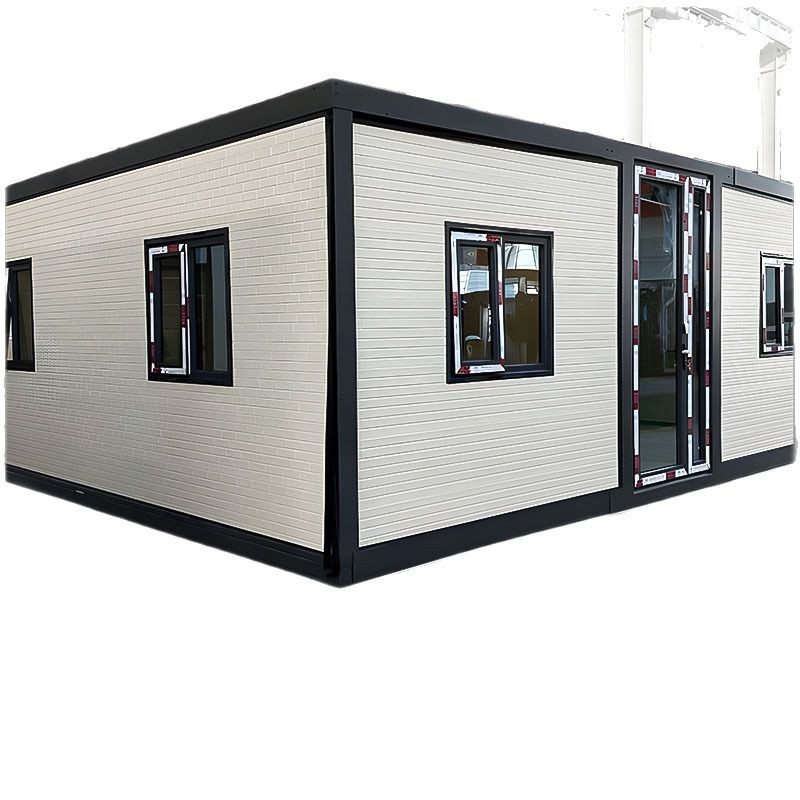
HG Prefab foldable expandable container homes — built to last, delivered worldwide.
Steel does not feed mold. Dust, paper, fabric, paint film and the paper facing on plasterboard do, and all of them need only two things to start growing: a temperature in the range people keep their homes at, and water. In a folding container home the second one is the variable. The unit is small, tightly built, metal-skinned and often sited in exactly the places where humidity is highest: coastal plots, tropical smallholdings, lakeside and forest sites, and cold regions where the inside is warm and the outside is well below freezing for weeks.
That combination is manageable, but it is not forgiving. A 400 m² house has enough thermal mass and air volume to absorb a wet weekend; a 36 m² unit does not. Two people showering, cooking and sleeping in a compact space generate a surprising amount of water every day, and if that water is not removed by air changes or collected by a dehumidifier, it ends up on the coldest surface in the room. Everything below is about intercepting it before it gets there.
This guide sits between three others. Our ventilation guide covers fan and duct layout in detail, our tropical and humid climate guide covers hot-humid siting and envelope design, and our insulation guide compares the insulation systems this advice assumes. Read them together: mold prevention is not one product, it is a chain of decisions, and the chain is only as good as its weakest link.
Why a Steel Unit Still Grows Mold
The folding container home shell is corrosion-protected steel, and steel is inorganic: mold cannot digest it. But steel is also an excellent conductor, which makes it the coldest thing in the room whenever the outside temperature drops. Every steel frame member, every panel fixing that penetrates the insulation layer and every uninsulated reveal is a local cold spot, and cold spots are where condensation begins.
The second factor is volume. A compact unit has a small air volume relative to the number of occupants, so the same daily moisture load produces a much faster rise in vapour pressure. The third is airtightness. Factory-built panels with gasketed joints are excellent for energy performance and terrible at accidental drying, so water that gets into a wall cavity or behind a wardrobe has no easy way out. The answer is not to build loosely; it is to build tightly and then ventilate deliberately.
Where Condensation Actually Forms
Before buying equipment, find out where your water goes. Condensation appears on surfaces that are colder than the dew point of the air next to them, and in a folding unit the usual suspects are consistent:
- Steel frame members and panel joints. Anywhere insulation is interrupted, the interior surface temperature drops. Look for a repeating damp line that follows the frame grid rather than a random patch.
- Window and door reveals. Glazing is typically the coldest element in the envelope, so water collects at the glass edge and runs onto the reveal and the sill below it.
- Floor edges and corners. Outside corners lose heat in two directions at once, so the surface temperature there is lower than on a flat wall. Floor-level corners are the classic first sign.
- Behind furniture and stored items. A wardrobe, a mattress or a stack of boxes pushed against an external wall stops air from warming that patch of wall, and the still air behind it stagnates.
- Cold-water services and tanks. A chilled water pipe or an uninsulated cistern in a humid room sweats continuously, and the drip goes unnoticed under a floor or behind a panel.
The diagnostic is simple: put a cheap infrared thermometer on suspect surfaces and compare them to the room air temperature and humidity. If a surface reads several degrees below the room dew point, you have a thermal problem to insulate. If all surfaces read close to air temperature and you still have damp, you have a ventilation problem to fix with air changes. Our thermal bridge guide covers the first case in depth.
How Much Water a Small Household Makes
Owners routinely underestimate this. One person breathing and perspiring releases roughly 0.5 to 1.5 litres of water per day, and the activities of daily living add much more. In a compact unit, a single unvented drying rack can load the air with more water than the whole building loses in a day through normal air leakage.
| Source | Typical water released | Why it matters in a compact unit | Control |
|---|---|---|---|
| Occupants, breathing and perspiration | 0.5-1.5 L per person per day | Continuous load, day and night, and it rises with activity | Continuous background ventilation, never zero |
| Showering or bathing | 0.3-0.8 L per shower; 0.1 L per bath | A short, intense spike that condenses on the coldest surface within minutes | Local extract on a humidistat or run-on timer |
| Cooking without lids | 0.5-1.5 L per day | Grease-laden moisture also carries particles that feed mold | Recirculating or ducted hood; keep lids on pans |
| Laundry dried indoors | 2.0-5.0 L per load | The single largest avoidable load in a small home | Vented dryer, or dry outdoors or in a sealed service space |
| Dishwashing and cleaning | 0.1-0.5 L per day | Warm water evaporates quickly into a small air volume | Lids closed, extract during and after |
| Unvented combustion heater or cooker | About 1.5 L per kg of propane burned | Adds water and combustion products to a sealed room at once | Vent to outside or avoid; see our propane systems guide |
| New-build moisture in materials | 5-15 L over the first weeks | Wet screeds, board compounds and finishes cure and dry into the air | Heat and ventilate hard before occupation |
Read that table as a design brief. A couple in a 20FT unit can generate 4 to 8 litres of water a day without doing anything unusual, and the entire air volume of the unit holds far less than one litre of vapour at comfortable humidity. Water has to leave continuously, or it condenses. There is no third option.
Ventilation: Rates, Not Guesswork
Continuous background ventilation
Ventilation removes moisture by replacing humid indoor air with drier outdoor air. What matters is the rate, and for a compact unit the useful target is 0.3 to 0.5 air changes per hour of continuous background ventilation, running whether or not anyone is home. That is a low rate by volume but a high rate by effect, because it never stops. Trickle vents, a small continuous-running extract fan, or a balanced mechanical system all deliver it; a fan that only runs when someone remembers to switch it on does not.
Extract where the water is made
Background ventilation handles the steady load. Spikes need local extract, close to the source and ducted to outside, never into a ceiling void or an underfloor space where the water simply condenses somewhere you cannot see. Practical boost rates are 30 to 60 litres per second in the kitchen and 15 to 30 litres per second in the bathroom, on a humidistat or a run-on timer so the fan keeps going after the shower stops. In a small unit, a single well-placed continuous extract serving the wet room plus trickle supply to the living area is often enough; two separate boost points are better where the layout allows it.
Heat recovery ventilators
In cold climates, continuous ventilation costs heat, which is why a heat recovery ventilator is worth the investment on a permanently occupied unit in a heating season. A good unit recovers 70 to 90 percent of the temperature difference while still exchanging the air, so you get the moisture removal without the heating penalty. It also filters incoming air, which helps on dusty or pollen-heavy sites. Size it for about 0.4 to 0.6 air changes per hour, keep the condensate drain primed and drained, and remember that the filters are a maintenance item, not a fit-and-forget component. Our HVAC guide covers equipment selection and our cold climate guide covers winter operation.
Purge ventilation by opening up
Cross-ventilation through opened windows and doors remains the fastest way to dump a moisture spike: five minutes of full cross-draught after a shower does more than an hour of trickle flow. Treat it as a supplement to mechanical ventilation, not a replacement, and use it most aggressively in the first weeks after delivery when the building's own moisture is drying out.
Parameters by Climate
The correct settings depend entirely on where the unit sits. Use this table as a starting specification and then tune it with your own hygrometer readings.
| Climate | Target indoor RH | Background ventilation | Dehumidification | Vapour control layer | Priority detail |
|---|---|---|---|---|---|
| Cold continental (long freezing winters) | 30-45% in winter, 40-55% in summer | 0.4-0.6 ACH continuous, ideally MVHR at 70-90% recovery | Rarely needed; small unit only for the shoulder seasons | Internal vapour control layer, Class I or II, taped and sealed | Continuous insulation over every steel member; warm-side sealing at all penetrations |
| Temperate maritime (mild, damp, rainy) | 40-60% year round | 0.3-0.5 ACH continuous + humidistat boost in wet rooms | 10-20 L/day capacity for winter and autumn | Internal Class II vapour control layer; external sheathing vapour-open | Drained cavity behind cladding; never trap water between two closed layers |
| Hot-humid tropical (warm, RH often 70-90%) | 45-60%, never above 65% | 0.5-0.8 ACH continuous with continuous extract; keep windows shut at midday | Primary control: 20-30 L/day, running most of the day | External vapour resistance; keep the interior assemblies drying to the inside | Shading, raised floor, air conditioning with a dry mode, and no vapour-impermeable finish on the cool side |
| Hot-dry desert (large day-night swing) | 30-50% | 0.3-0.5 ACH, timed for the cooler night hours | Usually unnecessary; evaporative cooling may be desirable | Internal Class II layer; external side kept vapour-open | Night purge ventilation and heavy shading; watch cold desert nights for dew |
| Seasonal mixed (hot humid summer, cold winter) | 40-50% winter, 45-60% summer | 0.4-0.6 ACH with a summer bypass or boost mode | 15-25 L/day for the humid season | Variable-permeance smart membrane that changes with season | Seasonal switch of strategy; inspect in spring and autumn |
Two rules cut across all five rows. First, never sandwich an assembly between two vapour-closed layers in a climate where water can enter it, because whatever gets in has nowhere to dry to. Second, the vapour control layer belongs on the warm-in-winter side in heating climates and on the exterior side in permanently air-conditioned humid climates; putting it in the wrong place is one of the few specification errors that reliably produces interstitial condensation and hidden mold inside a wall.
Sizing a Dehumidifier
Dehumidification is the right tool when ventilation alone cannot hold the line, which is typical in tropical and maritime climates and during shoulder seasons everywhere. Choose by litres of water removed per day at your actual conditions, not by tank size or marketing coverage figures, which are usually quoted at 30 °C and 80 percent relative humidity and rarely reflect a real room.
As a working rule for a folding unit, a 10 to 12 L/day compressor unit suits a temperate bedroom or a small 20FT layout in a mild climate; 20 to 30 L/day is the realistic range for a tropical 30FT or 40FT unit that is occupied full time. Compressor models stop working efficiently below about 15 °C, so a cold-climate unit in winter needs a desiccant model instead. Where the unit is occupied continuously, plumb the condensate to a drain rather than emptying a tank by hand, because a dehumidifier with a full tank removes nothing at all and owners discover this only after the damp returns.
Running cost is modest and worth budgeting: a 20 L/day unit draws roughly 250 to 450 W, so continuous operation is in the range of 6 to 11 kWh per day. Our running costs guide and electrical load guide cover how that sits alongside heating and appliances, and our solar power setup guide covers supplying it off-grid.
Vapour Control: Which Side, Which Class
Heating climates
Where the unit is heated for a meaningful part of the year, vapour drives outward from the warm interior to the cold exterior. Place the vapour control layer on the inside, immediately behind the interior board, and make it continuous: every lap taped, every penetration sealed with a grommet or a compatible tape, and every junction to floor, ceiling, window and door bonded rather than butted. Class II (roughly 0.1 to 1.0 m vapour resistance) is usually sufficient and more forgiving than a Class I foil; a small leak in a Class I layer is more damaging than a mediocre Class II layer, because less moisture escapes through the rest of the surface.
Hot-humid and permanently cooled climates
Where the interior is air-conditioned most of the year, the drive reverses: hot, humid outdoor air tries to move inward and condenses on the cool interior surface or inside the wall. Keep the vapour resistance toward the outside of the assembly and let the interior layers dry inward. Do not apply a foil-faced interior finish in this climate; the classic failure is a vinyl wall covering or a foil-backed board on an air-conditioned wall, which produces condensation behind the finish exactly where nobody looks. Our tropical and humid climate guide and exterior cladding guide go through these build-ups layer by layer.
Materials That Resist Mold
Material choice decides how much damage a moisture mistake does. Inorganic, non-absorbent materials get wet, dry out and carry on. Organic, absorbent materials get wet and stay wet, and once colonised they usually have to be replaced rather than cleaned.
| Layer | Better choice | Avoid or treat | Why |
|---|---|---|---|
| Insulation | Closed-cell spray polyurethane or foil-faced PIR board, joints taped | Unfaced mineral wool against cold steel without a separate vapour layer | Closed cell does not absorb liquid water and adds vapour resistance; open fibre needs a separate, perfectly sealed control layer |
| Interior board | Magnesium oxide board, cement board, or moisture-resistant gypsum in wet rooms | Standard paper-faced gypsum, untreated MDF and chipboard in wet or cold zones | The paper facing is a food source once damp; cementitious boards are not |
| Flooring | Welded sheet vinyl or SPC click vinyl with sealed joints; ceramic tile in wet areas | Carpet and carpet underlay, laminate with a fibre core in wet rooms | Carpet holds moisture against the deck and hides it; laminate cores swell and do not recover |
| Floor build-up | Ventilated void or insulated deck over a drained, free-draining pad | Solid deck laid directly on damp ground with no damp-proof membrane | Ground moisture under a sealed deck has no drying path; see our skirting and underfloor guide |
| Wet room lining | Full-height tile or PVC panel on cement board with sealed penetrations | Paint-on coatings over standard board, tile to half height only | Splash zones stay wet for hours; the substrate has to be inorganic |
| Sealants and coatings | Mould-resistant acrylic or silicone, anti-fungal primer on cold surfaces | Painting over existing growth without treating the cause | Coatings buy time on a dry surface and fail within weeks on a damp one |
| Soft furnishings | Washable covers, breathable storage, clearance from external walls | Fabric wall hangings, mattresses and boxes flat against cold walls | Still air behind objects cools the wall and stagnates; 30 to 50 mm of clearance changes the outcome |
Details That Decide It
Three construction details do more for mold prevention than any product you can buy later:
- Continuous insulation over the frame. The goal is an unbroken thermal layer so the interior surface never dips toward the dew point. Every steel member covered only by interior board becomes a condensation stripe.
- A drained and ventilated cavity behind cladding. Cladding is a rainscreen, not a seal. Water will get behind it; give it a path down and out, and an air gap that lets the back face dry.
- Sealed service penetrations. Every cable, pipe and duct that crosses the vapour control layer is a hole in the strategy. Seal each one with a grommet, a collar or a compatible tape at installation, when it is still accessible.
In wet rooms, add two more: run the extract duct as short and as straight as possible with an insulated section where it passes through cold space, and fall the floor to the drain so standing water does not become standing humidity. Our bathroom design guide covers wet room build-ups, and our flooring guide compares floor finishes in more detail.
Delivery Day and the First Two Weeks
Much of the moisture in a brand-new unit is not occupancy water, it is construction water: board compounds, adhesives, sealants, finishes and any material that was stored in a humid port before loading. Plan to dry it out deliberately. The unit ships folded and weather-sealed, so it arrives dry inside; what you do in the first 48 hours sets the baseline.
On the delivery side, the sequence is fixed. Yes — a crane or forklift is required to offload the folded unit from the truck. Once it is set in position, four workers can unfold and assemble the main structure in about 2 hours. That means the site needs a firm, roughly level standing area for the machine as well as for the unit itself, which matters here for a second reason: a unit set on ground that holds water under it will fight a damp problem for its whole life. Sort the pad drainage before delivery day, not after.
Once the unit is open, run heat and ventilation hard for several days before you move in furniture or textiles, and keep a hygrometer in the room the whole time. Do not close the unit up and leave it sealed while it is still giving off construction moisture. Once occupied, the daily habits matter more than the specification: lids on pans, the bathroom door closed and the fan running during and after showers, no drying racks in the living space, and wardrobes kept off external walls. Our maintenance guide and assembly day timeline cover the surrounding schedule.
Maintenance Routine by Climate
Every unit, every climate, every month: read the hygrometers, and check the four corner zones at floor level plus the window reveals for any sign of damp, staining or musty smell. Beyond that, the routine splits by climate.
- Cold and continental. Inspect the vapour layer penetrations and seals before the heating season; clear MVHR condensate drains and replace filters every three months; keep humidity low enough in winter that window glass does not run; check the skirting and underfloor void after thaw.
- Temperate maritime. Run the dehumidifier through autumn and winter; clear gutters, downpipes and pad drainage quarterly; check cladding cavities and vents are unobstructed; inspect north-facing and shaded walls, which stay damp longest.
- Hot-humid tropical. Empty or plumb dehumidifier condensate daily; clean the air conditioning filters monthly and use dry mode rather than only cool mode; keep windows closed during the hottest, most humid part of the day; inspect shaded walls, the cool side of the building and the underside of the deck every month.
- Hot-dry desert. Purge-ventilate at night, seal during the day; check that any evaporative cooler is not adding humidity to a sealed unit; inspect for dew after rare cold nights.
- Seasonal. Switch strategy twice a year and inspect at both transitions, in particular checking whether summer air conditioning load has left condensation in floor voids before the heating season starts.
Keep a simple log: date, indoor temperature, indoor RH, outdoor RH, and anything you found. Two seasons of that log tells you more about your specific site than any general guide, and it is the fastest way to distinguish a one-off weather event from a real defect. Our winterization guide and rust and corrosion guide cover the two failure modes that follow a long-term damp problem if it is ignored.
Specify It Before the Unit Ships
Almost everything in this guide is cheaper as a specification than as a retrofit. Insulation continuity, thermal breaks, the vapour control layer, sealed penetrations, a condensate-ready dehumidifier position, a plumbed condensate drain, an extract duct route and a humidistat are all decisions made while the unit is still in the factory. Retrofitting a vapour layer means removing interior board, and that is a different project entirely.
HG Prefab, manufactured by Henan Huangang Machinery Equipment Co., Ltd., ships 20FT, 30FT and 40FT folding expandable container houses worldwide. Factory prices are 20FT $7,200–$9,800; 30FT $10,500–$14,500; 40FT $12,500–$16,500, with usable areas of roughly 36 m², 56 m² and 76 m². Tell us your climate, your occupancy and whether the unit is permanent or seasonal, and the ventilation, vapour control and material specification can be matched to it before the build starts rather than after the first damp winter.
Model choice interacts with the moisture load as well. A compact 20FT modern white unit at roughly 36 m² is easy to condition and to dehumidify with a modest appliance, but two occupants generate a high load per cubic metre, so continuous ventilation is non-negotiable. The 30FT white folding house at about 56 m² is the balanced option for a couple or a small family, with room to separate the wet room extract from the living area. Where the budget and the site allow, the 40FT teak retreat at roughly 76 m² gives the lowest moisture load per unit volume and the most layout freedom for ventilation routing. For a wooded or shaded site where drying is slower, a cabin-style finish such as the 20FT mountain cabin pairs well with a ventilated cavity behind the cladding.
Planning a unit for a humid or cold site?
HG Prefab, made by Henan Huangang Machinery Equipment Co., Ltd., builds 20FT, 30FT and 40FT folding expandable container houses that ship folded worldwide at a standard container shipping footprint. Send us your climate, occupancy, site photos and services plan and we will specify the ventilation, vapour control and material package to match before production starts. Email hgmechequip@gmail.com or WhatsApp +86 191 0388 7380. Full range on the products page.
Browse modelsFrequently Asked Questions
Why does condensation form on the walls and ceiling of a folding container home?
Condensation forms wherever a surface is colder than the dew point of the air touching it. In a folding container home that is almost always a steel member or a panel that bridges one to the interior, plus window reveals, floor edges and the backs of wardrobes where air cannot circulate. Warm indoor air carries water vapour, and when it touches a surface below the dew point it gives that water up as liquid. The fix is a combination of warmer surfaces, achieved with continuous insulation and thermal breaks, and drier air, achieved with ventilation and dehumidification. Treating only one of the two usually moves the damp patch rather than removing it.
What indoor humidity level prevents mold in a container home?
Keep relative humidity between 30 and 60 percent, and aim at 40 to 50 percent in winter when cold surfaces are coldest. Below roughly 60 percent at the surface, mold growth is slow to nonexistent; sustained readings above 70 percent make growth likely on dust, paper, fabric and painted board. Use two calibrated hygrometers, one in the living area and one in the coldest corner or bedroom, and log the numbers for a week. If condensation appears in only one spot while the rest of the unit reads dry, you have a cold surface problem rather than a humidity problem, and a bigger dehumidifier will not cure it.
Do I need mechanical ventilation, or is opening windows enough?
Opening windows is a good supplement and a poor primary strategy, because it depends on someone being at home, awake and willing to lose heat. Install continuous mechanical ventilation as the base load: a trickle supply with extract from the kitchen and bathroom, or a heat recovery ventilator in cold climates. Use window opening for fast purge ventilation after cooking, showering or drying clothes. For sizing, a small unit needs roughly 0.3 to 0.5 air changes per hour of continuous background ventilation, with boost rates near 30 to 60 litres per second in the kitchen and 15 to 30 litres per second in the bathroom.
Which materials should I avoid if I am worried about mold?
Avoid anything organic and absorbent on the first condensation line. Standard paper-faced gypsum board, untreated MDF and chipboard, carpet and carpet underlay, fabric wall coverings and unsealed softwood all hold water and feed mold. Choose moisture-resistant board or magnesium oxide board behind tiles and in bathrooms, closed-cell insulation that does not absorb water, a vapour control layer matched to your climate, and a welded or click-lock vinyl floor with sealed joints. Behind any cladding, keep a drainage and drying path so water that gets in can get back out.
How do I remove mold if it has already appeared in the unit?
Fix the moisture source first or the growth returns within weeks. Dry the area below 60 percent relative humidity, then clean non-porous surfaces with a detergent solution or a registered fungicidal cleaner while wearing gloves and a respirator. Porous materials that have been colonised, such as plasterboard paper, chipboard, carpet and soft furnishings, should be cut out and replaced rather than cleaned, because roots penetrate below the surface. Never paint over mold, since a coating hides the symptom and fails quickly. If more than about one square metre is affected, or if an occupant has asthma or an immune condition, use a professional remediation contractor.